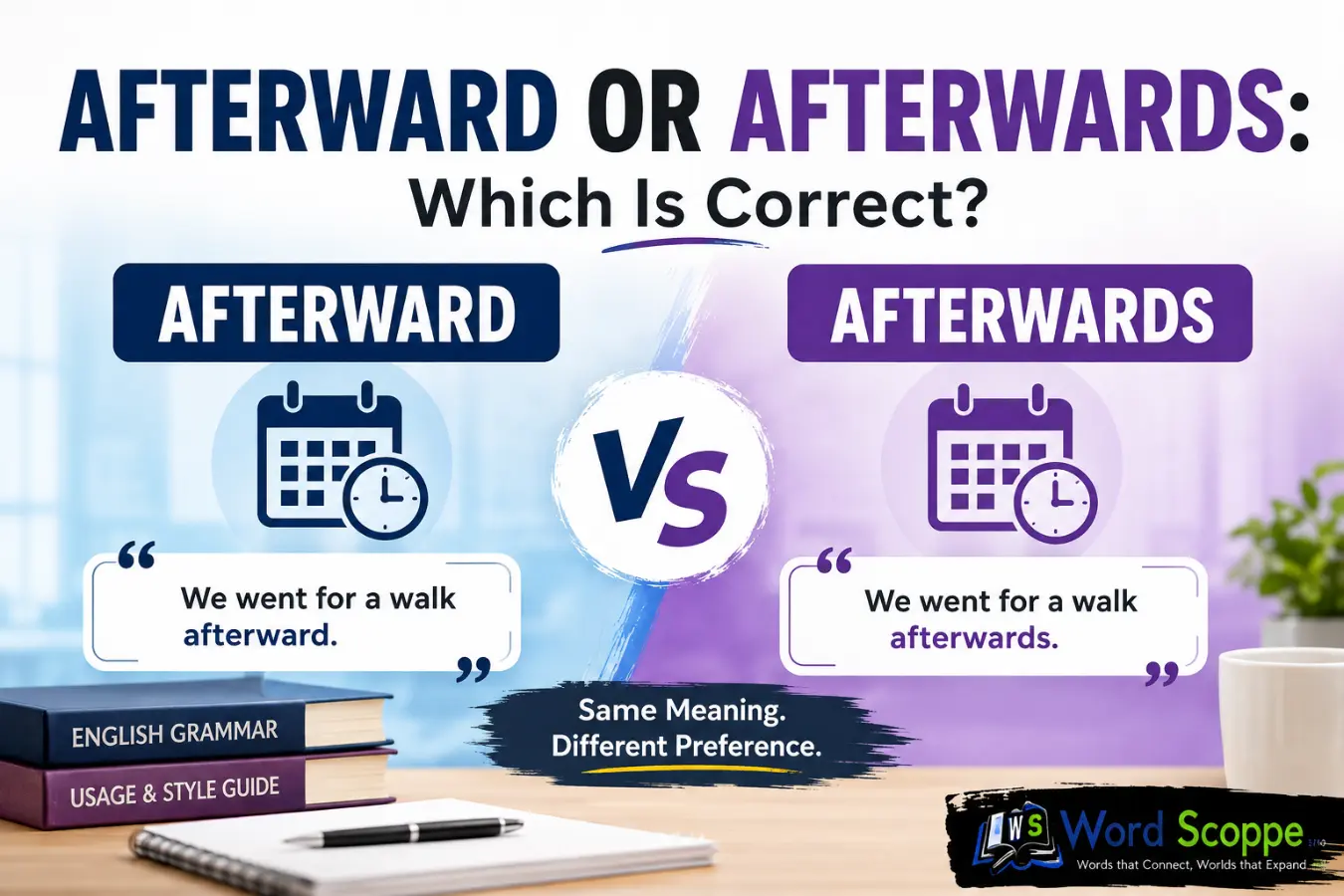
Afterward or afterwards can both mean the same thing in English. They describe something that happens later or after another event. The main difference comes from English variety and style. Afterward is more common in American English. Afterwards is more common in British English and many other varieties. However, both forms are correct and widely understood. You can use either word when the meaning is clear. For example, you might say, “We went home afterward” or “We went home afterwards.” The meaning stays the same. Still, many writers wonder which form sounds more natural. This guide explains the difference in simple terms. You will learn when to use each form, see real-life examples, and avoid common mistakes. By the end, choosing the right form will feel much easier.
Quick Summary
- Both forms mean “later” or “after something happens.”
- Afterward is more common in American English.
- Afterwards is more common in British English.
- Both forms are grammatically correct.
- Neither form changes the basic meaning of a sentence.
- Use the style that fits your audience and writing system.
- Keep your choice consistent throughout formal writing.
What Does Afterward Mean?
Afterward is an adverb that means “at a later time” or “after something.”
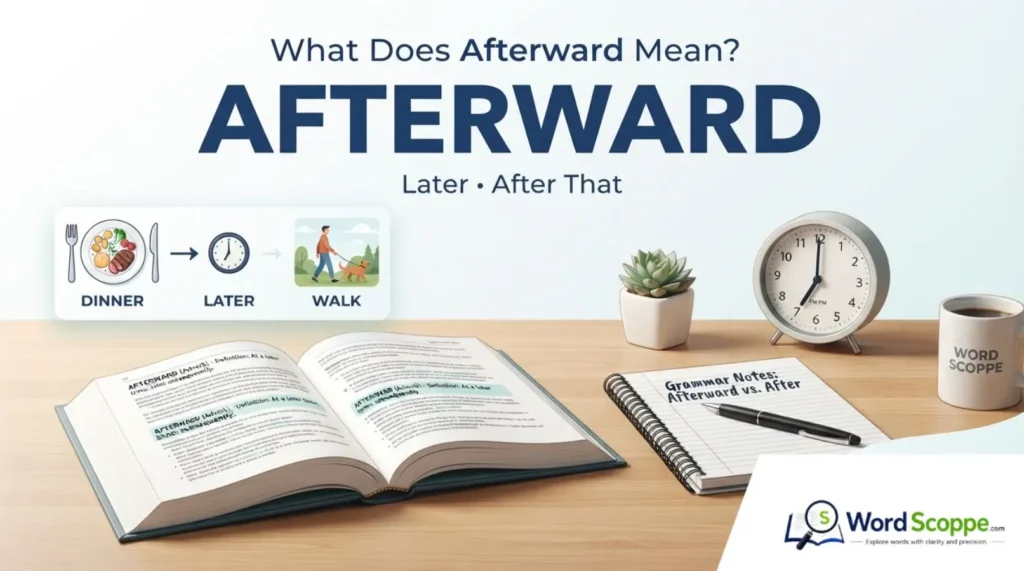
It tells readers that one event happens after another event.
For example:
- We had dinner and went for a walk afterward.
- She finished her exam and called her mother afterward.
- He felt tired afterward.
In each sentence, the word points to a later time.
Afterward often appears at the end of a sentence. However, you can place it elsewhere when the sentence remains clear.
For example:
Afterward, we talked about the problem.
Here, the word appears at the beginning of the sentence.
What Does Afterwards Mean?
Afterwards also works as an adverb. It has the same basic meaning as afterward.
It means “later” or “after that.”
For example:
- We watched a movie and went home afterwards.
- She apologized afterwards.
- Afterwards, they discussed the plan.
The extra s does not create a new meaning. It simply represents another accepted form of the word.
So, you do not need to worry about a major grammar difference.
Afterward or Afterwards: What Is the Difference?
The main difference involves regional preference.
American English usually favors afterward. British English often favors afterwards.
| Feature | Afterward | Afterwards |
| Meaning | Later; after that | Later; after that |
| Grammar | Adverb | Adverb |
| American English | Very common | Less common |
| British English | Common | Very common |
| Formal writing | Correct | Correct |
| Meaning difference | None | None |
Therefore, both words are correct.
The choice usually depends on your audience, location, and preferred style guide.
Which Form Is More Common in American English?
American English generally prefers afterward.
For example:
- We went to the restaurant afterward.
- She spoke with her teacher afterward.
- I realized my mistake afterward.
You may still see afterwards in American writing. It is not grammatically wrong.
However, afterward often sounds more natural to American readers.
If you are writing for a US audience, using afterward can provide a more familiar style.
Which Form Is More Common in British English?
British English often prefers afterwards.
For example:
- We went shopping afterwards.
- He called me afterwards.
- Afterwards, they returned to the hotel.
British writers also use afterward, especially in some formal or international contexts.
Still, afterwards is a very natural choice in British English.
The same pattern appears in several other English-speaking regions.
Real-Life Examples of Both Forms
Seeing both forms in context makes the difference easier to understand.
Everyday conversation
- I will call you afterward.
- I will call you afterwards.
Both sentences mean the same thing.
School or work
- We can discuss the report afterward.
- We can discuss the report afterwards.
Again, the meaning does not change.
Travel
- We visited the museum and had lunch afterward.
- We visited the museum and had lunch afterwards.
Both sentences are correct.
Events
- They went home afterward.
- They went home afterwards.
The only noticeable difference is the preferred form.
Can You Use Afterward at the Beginning of a Sentence?
Yes. You can place afterward at the beginning of a sentence.
For example:
- Afterward, we went back to the office.
- Afterward, she called her friend.
- Afterward, everyone felt relaxed.
A comma usually follows the word when it introduces the sentence.
You can also use it in the middle or at the end.
For example:
- We afterward discussed the results.
- We discussed the results afterward.
The final position often sounds more natural in everyday English.
Common Mistakes to Avoid
Although both forms are easy to use, writers sometimes make simple mistakes.
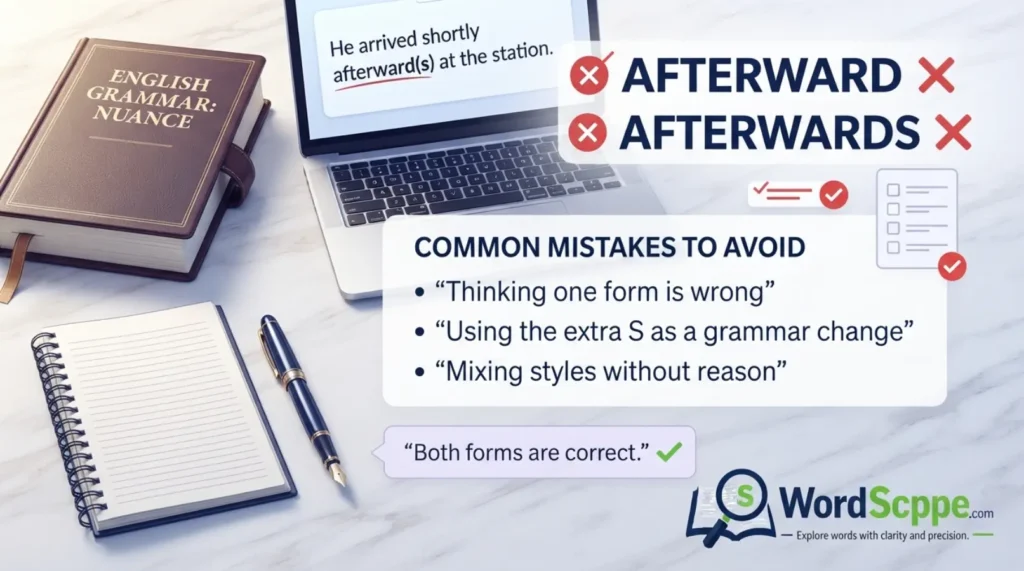
1. Thinking one form is wrong
Neither word is incorrect.
Both are standard English adverbs.
2. Treating the extra “s” as a grammar change
The s in afterwards does not change the tense or meaning.
It only creates a different accepted form.
3. Mixing regional styles without reason
Using both forms in one article can make your writing feel inconsistent.
Choose one style when consistency matters.
4. Using the word when “after” fits better
Afterward refers to a later time.
For example:
- We ate afterward.
However, you need after when introducing a noun or event.
For example:
- We ate after the meeting.
These words perform different grammatical roles.
Afterward vs. After: Are They the Same?
No. Afterward and after are related, but they do different jobs.
After can work as a preposition, conjunction, or adverb.
Examples include:
- We left after dinner.
- Call me after you arrive.
- I arrived soon after.
Afterward works as an adverb.
For example:
- We left afterward.
A useful trick is simple. Use after before a noun or clause. Use afterward when you mean “later.”
Synonyms for Afterward and Afterwards
Several words can express a similar idea.
Common alternatives include:
- later
- later on
- after that
- subsequently
- following that
- from then on
- at a later time
However, these words do not always fit every sentence.
For example, later sounds natural in casual conversation.
I will call you later.
Subsequently sounds more formal.
The company subsequently changed its policy.
Choose the synonym that matches your tone.
How to Choose the Right Form
Choosing between the two forms is simple.
First, think about your audience.
If you mainly write for Americans, afterward may sound more natural.
If your readers mainly use British English, afterwards may fit better.
Next, check your existing writing.
If you already use one form, stay consistent.
Finally, follow your chosen style guide when writing professionally.
For example, a company may have a preferred editorial style. In that case, follow the company rule instead of switching between forms.
Expert Insight: Does Google Care Which Form You Use?
Google does not require one form simply because it is American or British English.
Search engines focus more on useful, clear, relevant content.
Therefore, do not force both forms into your article.
Instead, explain the difference naturally and answer the reader’s question clearly.
For SEO, semantic coverage matters too. Related terms such as “later,” “after that,” “British English,” “American English,” and “grammar” help establish context.
The strongest approach is simple. Write for people first, then optimize naturally.
Frequently Asked Questions
Is afterward or afterwards correct?
Both forms are correct. They have the same basic meaning and grammatical function.
Is afterward American or British?
Afterward is especially common in American English. British English often prefers afterwards.
Is afterwards grammatically correct?
Yes. Afterwards is a standard English adverb and is widely used.
Do afterward and afterwards mean the same thing?
Yes. Both mean “later” or “after that.”
Which is better for formal writing?
Both are suitable for formal writing. Follow your audience and preferred style guide.
Can I use afterward in British English?
Yes. British speakers and writers can use afterward. It is not grammatically incorrect.
Can I use afterwards in American English?
Yes. Afterwards is understood by American readers, although afterward is often more common.
Should I use both forms in the same article?
You can, but consistency usually creates cleaner writing. Pick the form that suits your audience.
Final Takeaway
So, afterward or afterwards is not really a question of right versus wrong. Both forms are correct. Both mean “later” or “after that.” The main difference comes from regional preference. American English often uses afterward, while British English often uses afterwards. Both forms work in casual, academic, and professional writing. Your audience should guide your choice. Also, consistency can make your writing look more polished. If you write mainly for American readers, choose afterward. For British readers, afterwards may sound more natural. Most importantly, remember that the meaning stays the same. When you understand this small difference, you can use either form with confidence.
Dicover More Posts:
Truth or Dare Wheel: Fun Ideas, Rules & Best Game Tips
To Bad or Too Bad? Easy Rule, Meaning, and Examples
Dreamed or Dreamt: Which Is Correct? Easy English Guide

Sophia Hayes is a language researcher and content writer at WordsCoppe.com, specializing in word comparisons, spelling differences, grammar explanations, and vocabulary insights. She is passionate about making English easier to understand through clear, accurate, and practical content. By breaking down complex language topics into simple explanations, Sophia helps readers improve their writing and communication skills. Her goal is to make learning English more accessible, engaging, and confidence-building for learners worldwide.