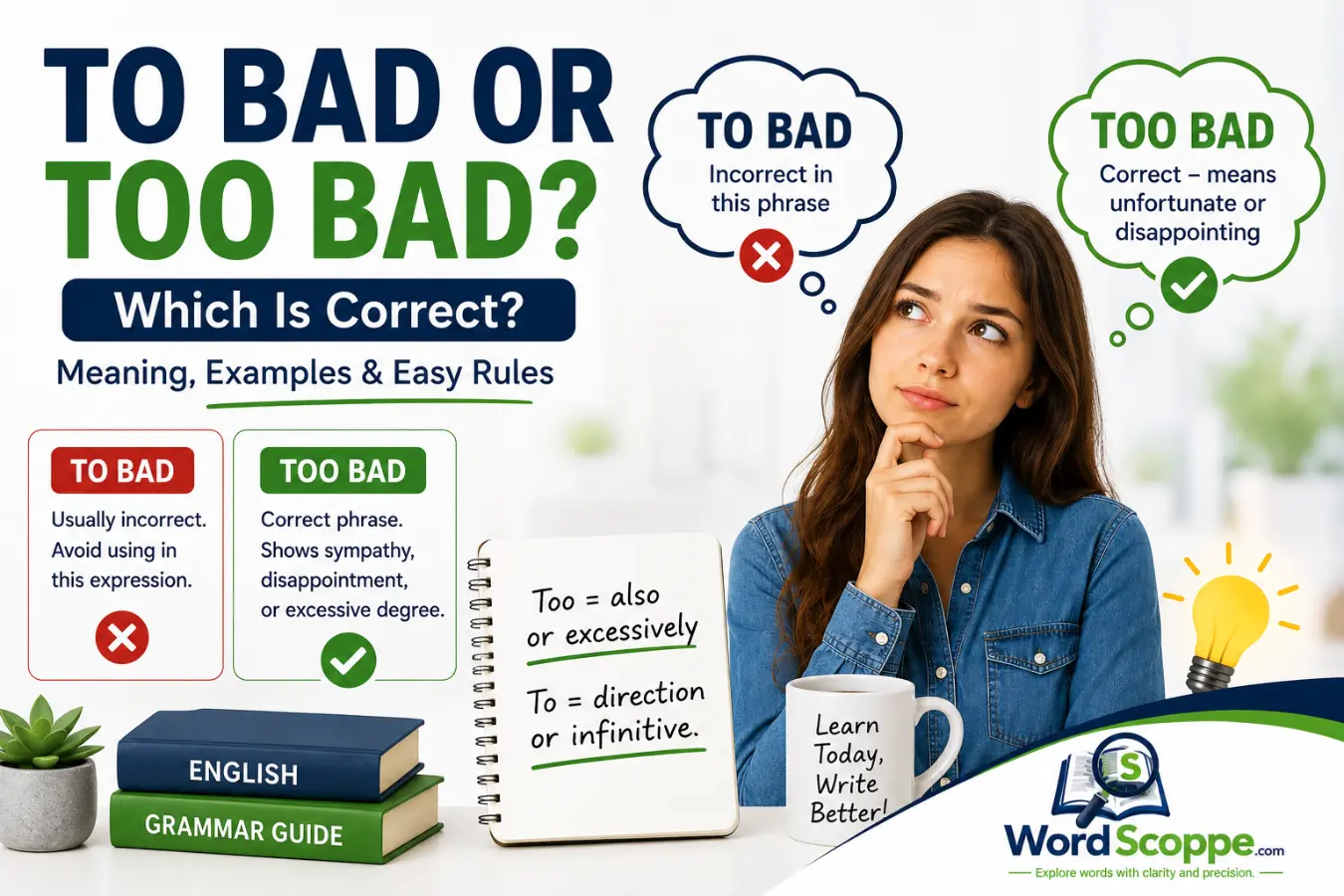
To bad or too bad can be confusing because the two forms sound almost identical. However, only one form works in the common expression. The correct phrase is “too bad.” It can show disappointment, regret, or sympathy. It can also mean that something is excessive or more than needed. The word “too” usually means “more than necessary” or adds emphasis. In contrast, “to” usually works as a preposition or part of an infinitive. Therefore, these words have different jobs in English sentences. This small spelling difference can change your sentence completely. Luckily, the rule is easy to remember. This guide explains the difference with simple examples and useful tips. You will also learn common mistakes and related expressions. By the end, you will know exactly when to use “too bad.”
Quick Summary
- “Too bad” is the correct phrase for disappointment or regret.
- “To bad” is usually incorrect in this expression.
- “Too” can mean “more than needed.”
- “Too” can also express disappointment or sympathy.
- “To” usually shows direction, connection, or an infinitive.
- Use “too bad” in phrases like “That’s too bad.”
- Remember: too = also or excessively, while to = direction or infinitive marker.
What Does “Too Bad” Mean?
“Too bad” has several common meanings in English. The meaning depends on the sentence.
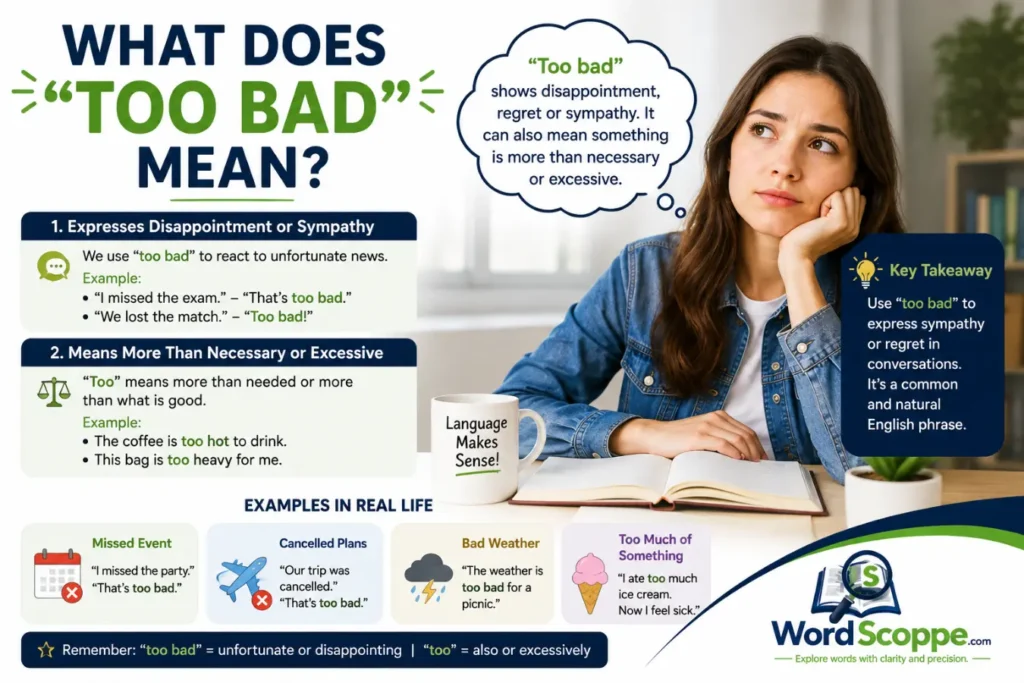
First, it can express disappointment or sympathy.
For example:
That’s too bad.
This often means:
That is unfortunate.
You might say it after hearing disappointing news.
For example:
“I missed the last bus.”
“That’s too bad.”
Here, the speaker shows sympathy.
“Too bad” can also describe something excessive.
For example:
The coffee is too bad to drink.
However, this sentence sounds less natural for quality. A speaker may instead say:
The coffee tastes too bad to drink.
In this case, “too” suggests an extreme degree.
Why Is “To Bad” Usually Incorrect?
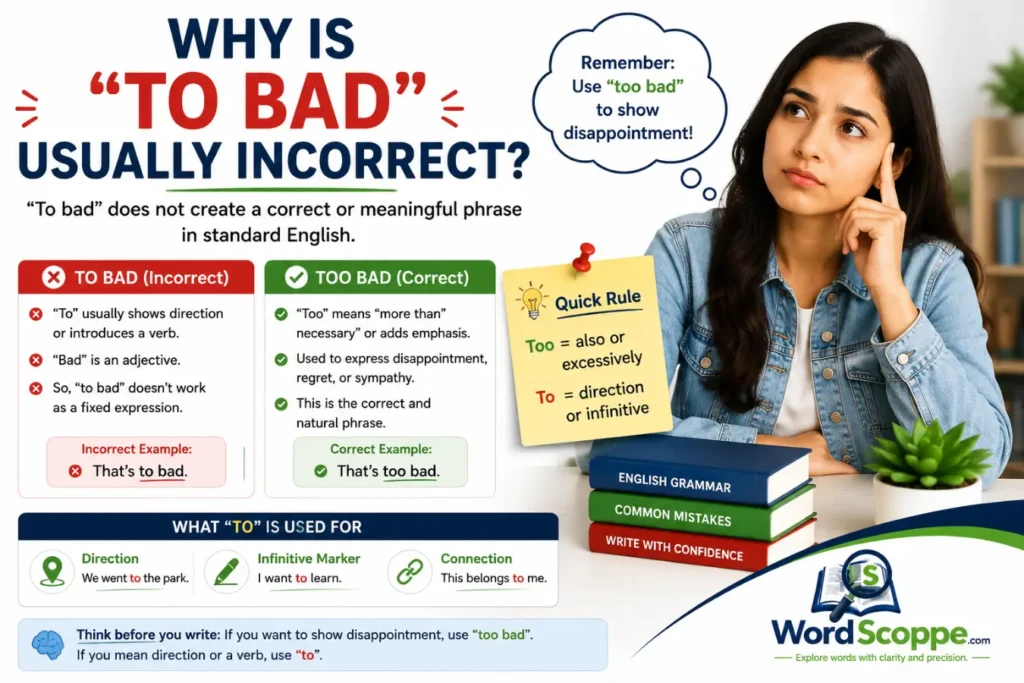
“To bad” does not normally work as a fixed English phrase.
The problem comes from confusing to with too. They sound alike in many accents, but they have different meanings.
“To” often shows direction.
For example:
She went to school.
It can also introduce an infinitive verb.
For example:
I want to sleep.
“Bad” is an adjective. It describes something unpleasant, poor, or harmful.
Therefore, “to bad” does not normally create a meaningful phrase by itself.
If you want to express disappointment, use “too bad.”
What Does “Too” Mean?
“Too” has two main uses.
1. “Too” Means More Than Needed
For example:
The soup is too hot.
The soup has a higher temperature than you want.
Another example is:
This bag is too heavy.
The bag weighs more than you can comfortably carry.
2. “Too” Means Also
For example:
I want to come too.
Here, “too” means “also.”
This meaning is different from “too bad,” but the spelling stays the same.
Understanding these meanings makes the spelling easier to remember.
What Does “To” Mean?
“To” serves several important roles in English.
It often shows movement toward a place or person.
For example:
We drove to the airport.
It can also connect with a verb.
For example:
I need to study.
Other examples include:
- She wants to learn.
- He plans to travel.
- They decided to stay.
- I hope to win.
Therefore, “to” has many useful grammatical functions. It simply does not replace “too” in the expression “too bad.”
Too Bad vs To Bad: Key Difference
The difference becomes clearer when you compare their functions.
| Word or Phrase | Meaning | Example |
| Too bad | Unfortunate or disappointing | That’s too bad. |
| Too | More than needed | The box is too heavy. |
| Too | Also | I want one too. |
| To | Direction | We went to work. |
| To | Infinitive marker | I want to leave. |
| To bad | Usually incorrect | Avoid this form in the common phrase. |
The key point is simple. “Too bad” works as the common expression. “To bad” does not.
Real-Life Examples of “Too Bad”
You can hear “too bad” in many everyday situations.
Example 1: Missed Event
“I missed the concert last night.”
“That’s too bad.”
The response shows sympathy.
Example 2: Cancelled Trip
“Our flight was cancelled.”
“That’s too bad.”
Again, the phrase expresses disappointment.
Example 3: Missed Opportunity
“I forgot to apply before the deadline.”
“Too bad. You can try next year.”
Here, the expression reacts to an unfortunate situation.
Example 4: Casual Conversation
“Too bad you cannot join us.”
This sentence shows that the speaker feels disappointed.
Example 5: Excessive Degree
The weather is too bad for a picnic.
Here, “too” means the weather is unsuitable because of its extreme condition.
How to Use “Too Bad” in Daily Life
“Too bad” appears often in casual English.
You can use it after hearing disappointing news. It can also appear in longer sentences.
Common patterns include:
That’s too bad.
This is one of the most common forms.
It’s too bad that…
For example:
It’s too bad that you missed the meeting.
Too bad you can’t…
For example:
Too bad you can’t stay longer.
It was too bad that…
For example:
It was too bad that the game ended early.
These patterns are useful in conversations, messages, and informal writing.
Is “Too Bad” Formal or Informal?
“Too bad” is common in everyday English. It often sounds conversational and natural.
For formal writing, you may choose a more precise expression.
Instead of:
That’s too bad.
You could write:
That is unfortunate.
Other options include:
- That is disappointing.
- That is unfortunate news.
- Sadly, that did not work out.
- It is unfortunate that this happened.
Still, “too bad” is not grammatically wrong in formal writing. The best choice depends on the tone.
Common Mistakes to Avoid
Several mistakes can happen when writers confuse these words.
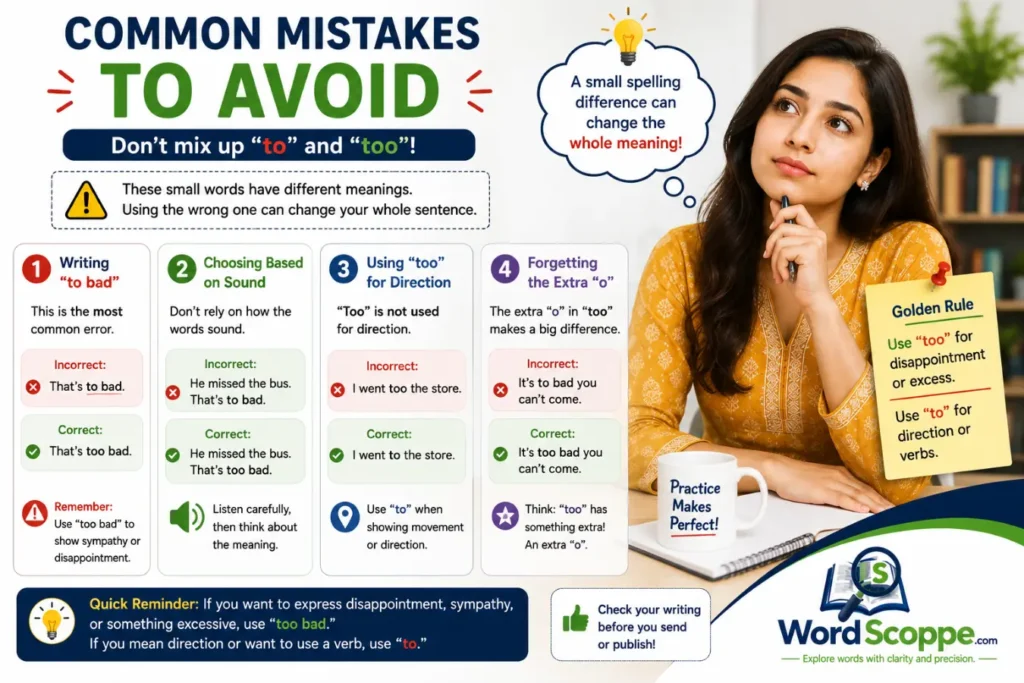
Mistake 1: Writing “to bad”
A common error looks like this:
That’s to bad.
The correct sentence is:
That’s too bad.
Mistake 2: Choosing Based on Sound
“To” and “too” often sound similar. Therefore, listening alone may not help.
Instead, think about the meaning.
If you mean unfortunate, use “too bad.”
Mistake 3: Using “too” for Direction
Do not write:
I went too the store.
The correct sentence is:
I went to the store.
Here, “to” shows movement.
Mistake 4: Forgetting the Second “o”
The extra “o” in “too” can help you remember its meaning.
Think:
too = extra
The extra “o” can remind you of “extra.”
Easy Tricks to Remember the Difference
A simple memory trick can prevent this mistake.
Think of too as having an extra “o.”
The extra letter can remind you of something extra.
For example:
The bag is too heavy.
It has more weight than you want.
Another useful trick involves direction.
If someone or something moves toward a place, use to.
We walked to the park.
If you mean “also,” use too.
I walked there too.
Finally, if you want to express disappointment, use:
That’s too bad.
These three examples cover many everyday situations.
Synonyms for “Too Bad”
Sometimes, you may want a different expression.
For disappointment, you can use:
- unfortunate
- disappointing
- regrettable
- sad
- unfortunate news
- what a shame
For example:
That’s too bad.
You could also say:
That’s unfortunate.
Or:
What a shame.
However, these alternatives can have different tones. “What a shame” often sounds more emotional. “That’s unfortunate” sounds more neutral.
Expert Insight: Why This Small Difference Matters
Small spelling differences can affect clarity in English. “To” and “too” are common homophones. They sound alike but have different meanings and grammatical roles.
Strong writing depends on choosing words based on their function. Therefore, do not rely only on pronunciation.
For SEO content, grammar also affects reader trust. Clear writing makes your content easier to understand. It also helps readers move through your page without confusion.
A simple proofreading step can catch many errors. Search for common homophones before publishing. Pay special attention to to, too, and two.
Frequently Asked Questions
Is “to bad or too bad” the correct phrase?
The correct phrase is “too bad.” Use it to express disappointment, sympathy, or an excessive degree.
Is “to bad” ever correct?
The exact phrase “to bad” is usually incorrect. However, “to” and “bad” can appear next to each other in unusual sentence structures.
What does “too bad” mean?
“Too bad” commonly means something is unfortunate or disappointing. It can also describe something excessive.
Why do people confuse to and too?
People often confuse them because they sound alike. Their meanings and grammatical roles are different.
Is “that’s too bad” grammatically correct?
Yes. “That’s too bad” is a common and natural English expression. It usually shows sympathy or disappointment.
Is “too bad” rude?
It depends on the situation and tone. A friendly tone can show sympathy. A cold tone may sound dismissive.
What is another way to say “too bad”?
You can say “that’s unfortunate,” “that’s disappointing,” or “what a shame.” The best choice depends on the situation.
What is the easiest way to remember “to” and “too”?
Remember that “too” has an extra “o.” Think of that extra letter as something extra or additional.
Conclusion
The difference between to bad or too bad is simple once you understand each word. The correct phrase for disappointment is “too bad.” It can mean something is unfortunate, disappointing, or excessive. Meanwhile, “to” usually shows direction or introduces an infinitive verb. For example, you can go to school, but you can say, “That’s too bad.” The extra “o” in “too” can also help you remember the rule. When you proofread your writing, check these words carefully because they sound alike. With regular practice, the difference becomes natural. So, remember this simple rule: use “too bad” for disappointment, and use “to” for direction or infinitive verbs.

Sophia Hayes is a language researcher and content writer at WordsCoppe.com, specializing in word comparisons, spelling differences, grammar explanations, and vocabulary insights. She is passionate about making English easier to understand through clear, accurate, and practical content. By breaking down complex language topics into simple explanations, Sophia helps readers improve their writing and communication skills. Her goal is to make learning English more accessible, engaging, and confidence-building for learners worldwide.