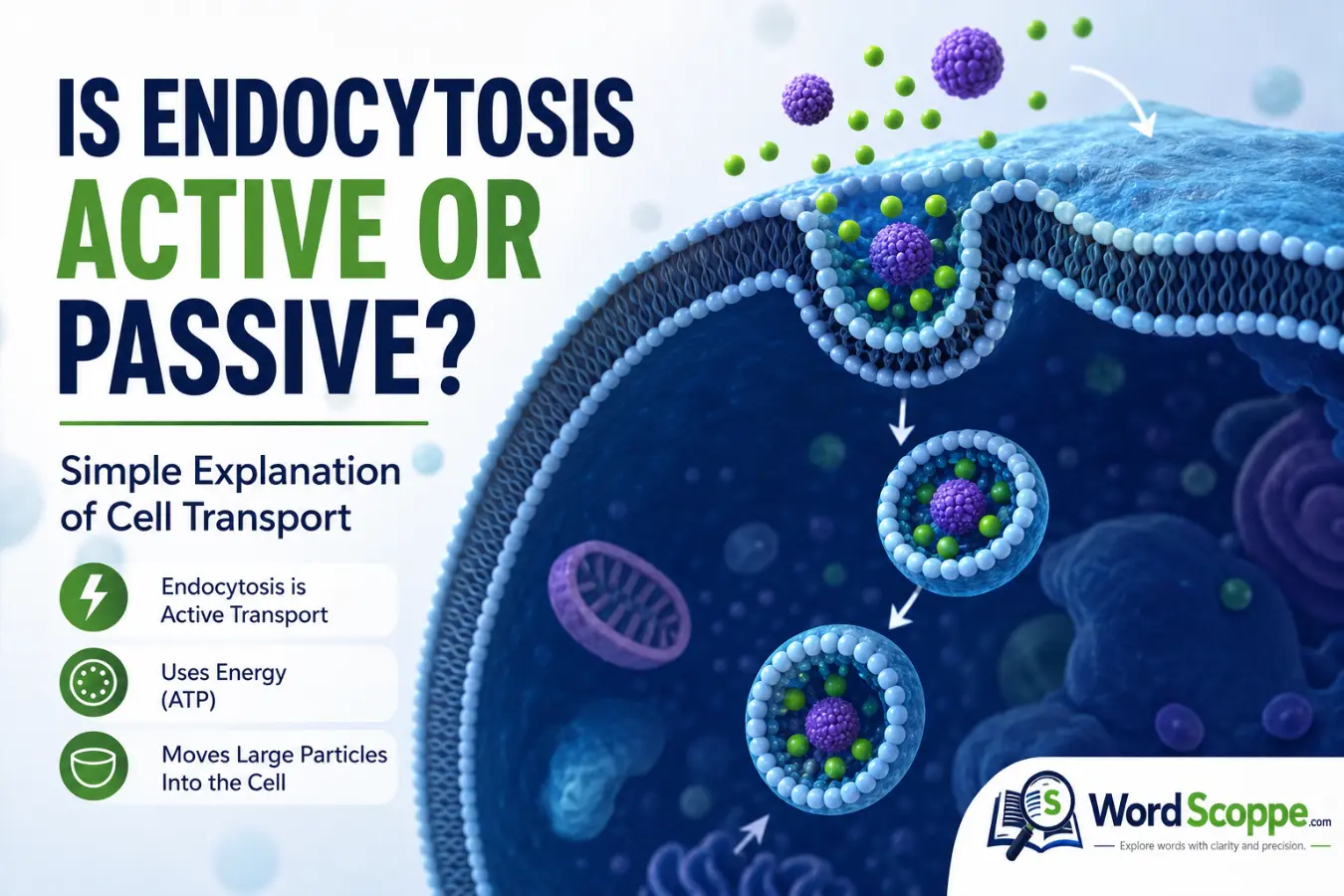
Is endocytosis active or passive is a common biology question. The correct answer is simple: endocytosis is an active transport process. Cells use energy to bring materials inside the cell. The cell membrane folds inward and surrounds the material. Then, it forms a small membrane-bound vesicle inside the cell. This process helps cells take in large particles, fluids, and specific molecules.
Endocytosis plays an important role in cell survival. It helps cells collect nutrients and remove unwanted substances. It also supports communication between cells and their surroundings. Unlike passive transport, endocytosis needs cellular energy. In this guide, you will learn how endocytosis works. You will also see how it differs from passive transport. Simple examples will make the process easier to understand. By the end, you will know why scientists classify endocytosis as active transport.
Quick Summary
- Endocytosis is an active transport process.
- It requires energy from the cell.
- The cell membrane folds inward during the process.
- The membrane forms a vesicle around the material.
- Endocytosis moves large particles and fluids into cells.
- Passive transport does not require cellular energy.
- Phagocytosis, pinocytosis, and receptor-mediated endocytosis are major types.
- Endocytosis helps cells absorb nutrients and other useful materials.
What Is Endocytosis?
Endocytosis is a process that moves materials into a cell.
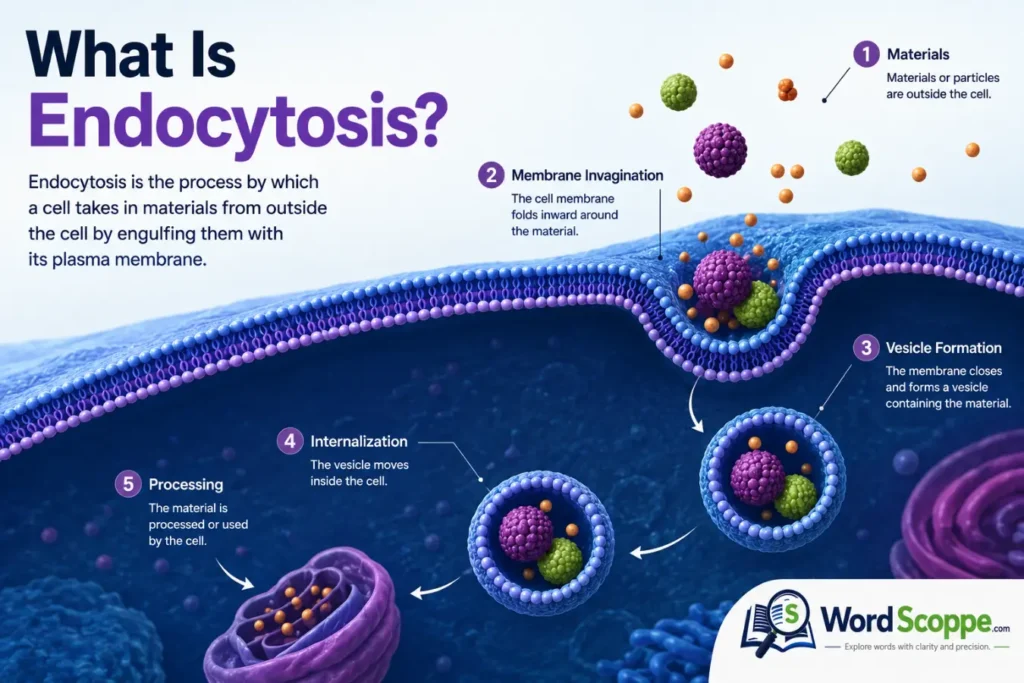
The cell membrane surrounds material outside the cell. Then, the membrane bends inward. Next, it closes around the material and forms a vesicle.
A vesicle is a small membrane-covered structure inside the cell. It carries the captured material to another part of the cell.
Endocytosis can move substances that cannot cross the membrane directly. These substances may include large particles, proteins, fluids, and nutrients.
Therefore, endocytosis gives cells another way to control what enters them.
Is Endocytosis Active or Passive Transport?
So, is endocytosis active or passive?
Endocytosis is active transport because the cell needs energy to perform it. The process requires the cell to change the shape of its membrane.
The cell uses energy mainly from ATP, or adenosine triphosphate. ATP powers many activities inside living cells.
Passive transport works differently. It moves substances across membranes without direct energy use.
For example, oxygen can move across a cell membrane through diffusion. Water can also move through osmosis.
Endocytosis does not work this way. Instead, the cell actively changes its membrane and creates a vesicle.
How Does Endocytosis Work?
Endocytosis follows a simple sequence.
First, material reaches the outside surface of the cell membrane. The membrane then bends inward around that material.
Next, the membrane forms a pocket. The pocket becomes deeper as it surrounds the material.
Finally, the membrane closes and separates from the cell surface. This creates an internal vesicle.
The vesicle can then travel through the cytoplasm. Other cell structures may process the material inside it.
This process allows cells to control the substances they bring inside.
Why Does Endocytosis Need Energy?
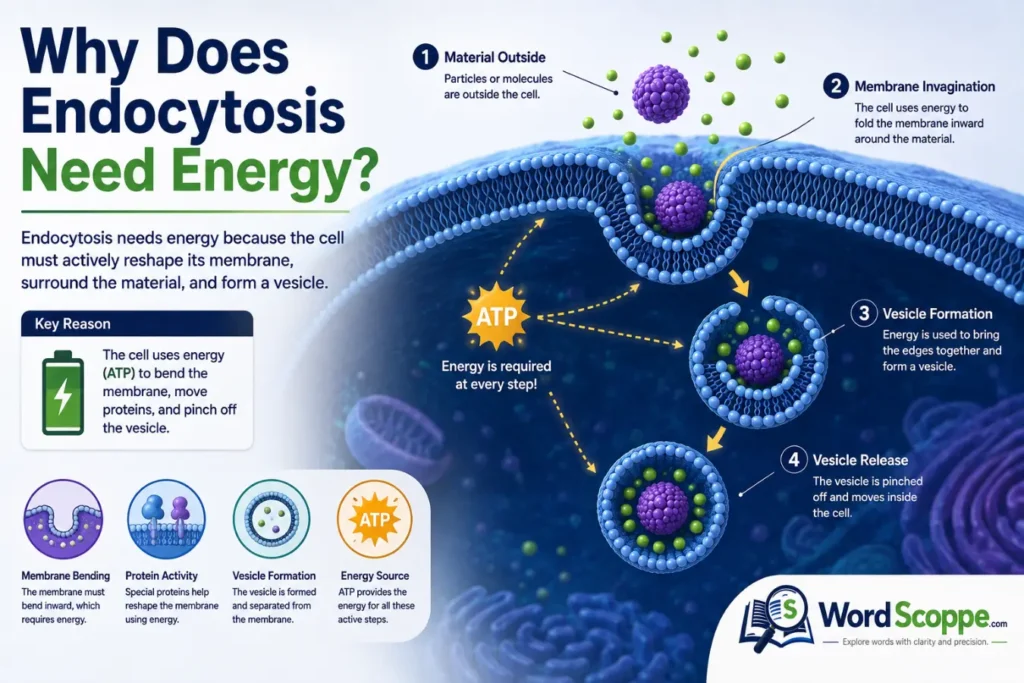
Endocytosis needs energy because the cell must actively reshape its membrane.
The membrane cannot simply allow large materials to pass through. Instead, it must surround and capture them.
The cell uses energy to support membrane movement and vesicle formation. Several proteins also help control this process.
For instance, cells can use proteins that help bend the membrane. Other proteins help pinch off the new vesicle.
Therefore, energy plays a key role from the beginning to the end of endocytosis.
Main Types of Endocytosis
Scientists commonly describe three major types of endocytosis.
1. Phagocytosis
Phagocytosis means cell eating.
The cell surrounds large particles and brings them inside. Immune cells often use this process to capture harmful particles.
For example, some white blood cells engulf bacteria. They then break down the captured material.
2. Pinocytosis
Pinocytosis means cell drinking.
The cell takes in extracellular fluid and dissolved substances. The membrane forms small vesicles that contain the surrounding fluid.
Many cells use pinocytosis regularly to sample their environment.
3. Receptor-Mediated Endocytosis
This process provides a more selective form of cell intake.
Specific molecules attach to receptors on the cell membrane. The membrane then surrounds those molecules and brings them inside.
For example, cells can use receptor-mediated endocytosis to take in certain cholesterol particles.
Endocytosis vs Passive Transport
Endocytosis and passive transport both move substances across the cell boundary. However, they use very different methods.
| Feature | Endocytosis | Passive Transport |
| Transport type | Active | Passive |
| Energy needed | Yes | No direct cellular energy |
| Main direction | Into the cell | Usually down a concentration gradient |
| Vesicles | Yes | No |
| Large particles | Can move them | Usually cannot |
| Examples | Phagocytosis, pinocytosis | Diffusion, osmosis, facilitated diffusion |
The main difference involves energy use. Endocytosis requires energy, while passive transport does not.
Real-Life Examples of Endocytosis
Endocytosis happens in many living organisms.
One example occurs when immune cells capture bacteria. The cell surrounds the bacteria and pulls it inside.
Another example involves cells taking in nutrients. Some nutrients bind to membrane receptors before entering the cell.
Cells can also take in fluids through pinocytosis. This helps them collect dissolved substances from their surroundings.
These examples show why endocytosis matters for normal cell function.
Endocytosis in Daily Life and Human Biology
You may not notice endocytosis, but your body uses it constantly.
Your immune system depends on endocytosis to capture certain harmful particles. Cells also use it to obtain important molecules.
For example, receptor-mediated endocytosis helps cells absorb specific substances from the blood.
Endocytosis also helps cells manage their membrane. The cell can bring membrane proteins and other materials inside.
As a result, this process supports nutrition, defense, communication, and cell regulation.
Common Mistakes About Endocytosis
Students often confuse endocytosis with other forms of membrane transport.
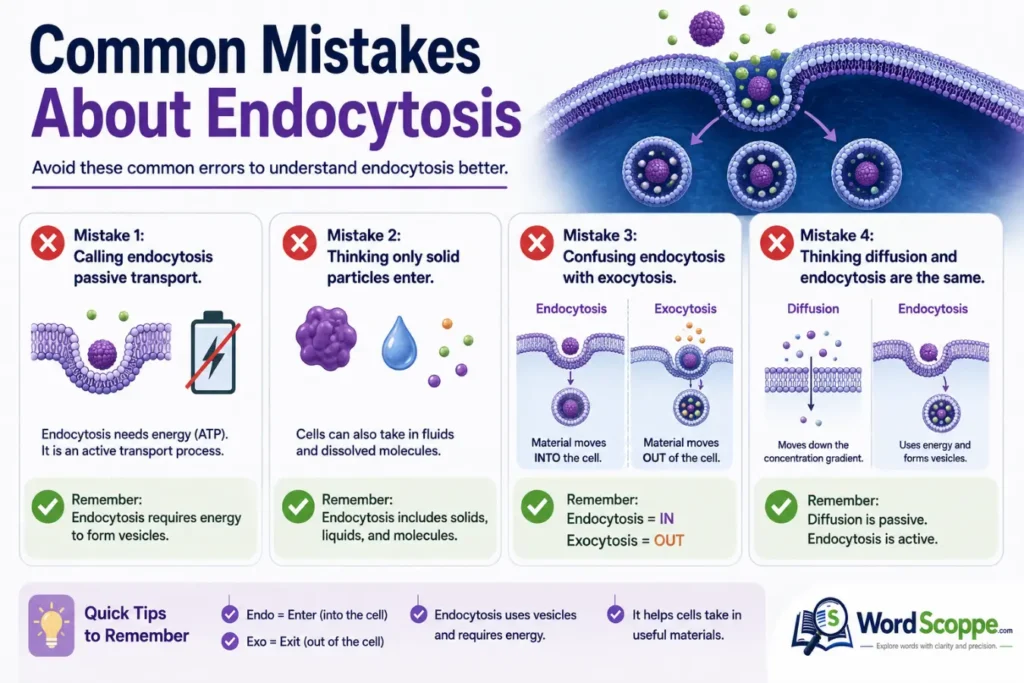
Mistake 1: Calling endocytosis passive transport.
Endocytosis needs cellular energy, so it belongs to active transport.
Mistake 2: Thinking only solid particles enter through endocytosis.
Cells can also take in fluids and dissolved molecules.
Mistake 3: Confusing endocytosis with exocytosis.
Endocytosis moves material into the cell. Exocytosis moves material out of the cell.
Mistake 4: Thinking diffusion and endocytosis work the same way.
Diffusion moves particles down a concentration gradient. Endocytosis uses vesicles and cellular energy.
Easy Tips to Remember Endocytosis
Use these simple memory tricks when studying cell transport.
Endo = Enter
The word “endo” can remind you that material enters the cell.
Exo = Exit
The word “exo” can remind you that material exits the cell.
You can also remember phagocytosis as cell eating. Think of a cell surrounding a large food particle.
For pinocytosis, remember cell drinking. The cell takes in extracellular fluid.
Finally, remember one key rule: vesicles plus energy usually point to active transport.
What Are the Synonyms and Related Terms?
Endocytosis does not have many perfect synonyms. However, several related terms describe parts of the same process.
Common related terms include:
- Cellular uptake
- Membrane transport
- Vesicle formation
- Vesicular transport
- Cell ingestion
- Internalization
- Receptor-mediated uptake
- Phagocytosis
- Pinocytosis
These terms can appear in biology textbooks and exam questions.
Still, they do not all mean exactly the same thing. Phagocytosis and pinocytosis describe specific forms of endocytosis.
Expert Insight: Why Endocytosis Matters
Endocytosis shows how active transport can involve more than simple molecule movement.
Cells need strong control over their internal environment. They cannot allow every substance to enter freely.
Endocytosis gives cells a controlled way to capture larger materials. Receptor-mediated endocytosis adds even more selectivity.
This process also shows the importance of the cell membrane. The membrane does more than separate the cell from its surroundings.
It actively responds to signals and controls material movement. Therefore, endocytosis plays a major role in cell biology.
Frequently Asked Questions
Is endocytosis active or passive?
Endocytosis is active transport. It requires cellular energy to form vesicles and move materials into the cell.
Why is endocytosis considered active transport?
The cell uses energy to reshape its membrane and create a vesicle. This energy requirement makes it active transport.
Does endocytosis require ATP?
Yes. Endocytosis requires cellular energy, and ATP provides energy for many steps involved in the process.
Is phagocytosis active or passive?
Phagocytosis is an active transport process. Cells use energy to surround and engulf large particles.
Is pinocytosis active or passive?
Pinocytosis is active transport. The cell uses energy to form vesicles containing extracellular fluid.
What is the difference between endocytosis and exocytosis?
Endocytosis brings materials into the cell. Exocytosis moves materials out of the cell.
Does passive transport use vesicles?
No. Passive transport usually moves substances directly across the membrane or through membrane proteins.
Conclusion
Endocytosis is an important active transport process in living cells. It allows cells to bring materials inside using membrane-bound vesicles. The process requires cellular energy, so it does not count as passive transport.
There are three major forms: phagocytosis, pinocytosis, and receptor-mediated endocytosis. Each form helps cells collect specific materials from their surroundings.
The easiest way to remember the concept is simple. Endocytosis brings materials into the cell and requires energy.
So, if you see the question is endocytosis active or passive, choose active transport. Remember the role of energy, membrane folding, and vesicle formation. These three ideas will help you understand endocytosis and answer related biology questions with confidence.

Sophia Hayes is a language researcher and content writer at WordsCoppe.com, specializing in word comparisons, spelling differences, grammar explanations, and vocabulary insights. She is passionate about making English easier to understand through clear, accurate, and practical content. By breaking down complex language topics into simple explanations, Sophia helps readers improve their writing and communication skills. Her goal is to make learning English more accessible, engaging, and confidence-building for learners worldwide.