
Timeframe or time frame can look confusing because both forms appear in modern English. You may see one word in emails and two words in reports. So, which spelling should you use?
In most formal writing, time frame remains the safer choice. It means a period during which something happens or should happen. However, timeframe also appears in modern writing and has gained wide acceptance.
The right choice often depends on your style guide, audience, and type of writing. Consistency matters too. If you start with one form, keep that spelling throughout your content.
This guide explains the meaning, spelling, examples, common mistakes, and related words. You will also learn how to use each form naturally. By the end, choosing the right spelling should feel simple.
Quick Summary
- Time frame means a set or expected period of time.
- Timeframe has the same basic meaning.
- Many dictionaries recognize both forms.
- Time frame remains a common choice in formal English.
- Timeframe often appears in business and digital writing.
- Pick one spelling and stay consistent.
- A time frame can describe minutes, days, months, or years.
Meaning and Definition of Time Frame
A time frame is a period in which an event happens or a task gets completed.
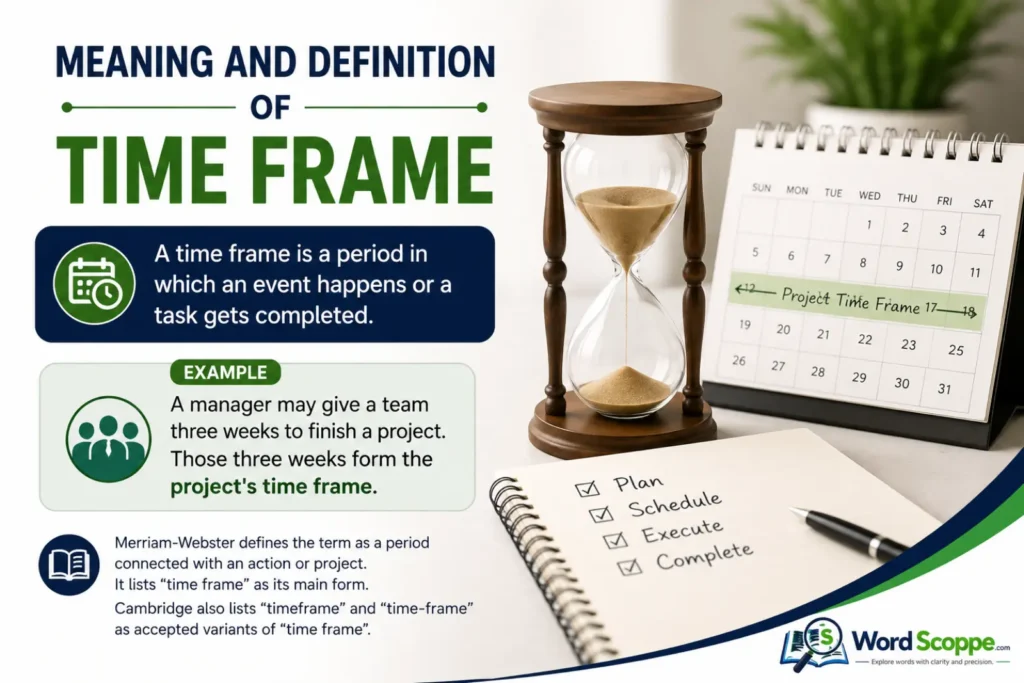
For example, a manager may give a team three weeks to finish a project. Those three weeks form the project’s time frame.
Merriam-Webster defines the term as a period connected with an action or project. It lists time frame as its main form. It also recognizes timeframe as a less common variant.
Cambridge also lists timeframe and time-frame as accepted variants of time frame.
So, both spellings can communicate the same idea.
How to Choose: timeframe or time frame
For polished formal writing, time frame is usually the safest option.
You can use it in essays, business reports, academic content, instructions, and professional emails.
The one-word form, timeframe, also appears often in modern communication. It can work well in websites, workplace messages, and less formal content.
For example:
- The project has a six-month time frame.
- Our development timeframe is about six months.
Both sentences communicate the same idea.
However, your writing should remain consistent. Avoid changing between forms without a reason.
Why Do Both Spellings Exist?
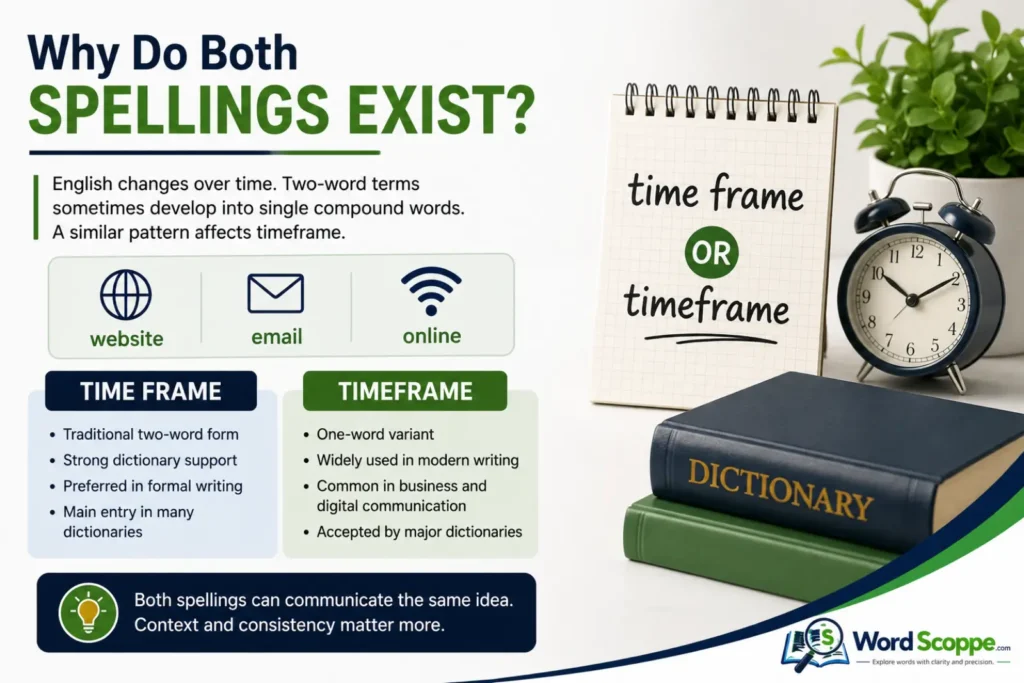
English changes over time. Two-word terms sometimes develop into single compound words.
Think about words such as website, email, and online. Their forms changed as people used them more often.
A similar pattern affects timeframe.
Still, the two-word spelling has strong dictionary support. Cambridge treats time frame as the main entry while recognizing other forms.
As a result, writers may encounter both versions.
This does not mean one form always creates an error. Context and consistency matter more.
How to Use Time Frame in a Sentence
The term usually works as a noun.
Here are simple examples:
- What is the time frame for delivery?
- We need a clear time frame for the project.
- The repair should fit within our planned timeframe.
- She completed the work within the given time frame.
- Our hiring timeframe may last two months.
- Please give us a realistic time frame.
You will often see words such as within, expected, planned, estimated, and realistic near this term.
These words help explain how long something may take.
Real-Life Examples of Time Frames
People use time frames in many daily situations.
At work:
A manager may set a two-week period for a new task.
For deliveries:
A store may give a delivery estimate of three to five days.
During hiring:
A company may plan interviews within a one-month period.
For home repairs:
A builder may estimate four weeks for a kitchen project.
In education:
A student may have ten days to complete an assignment.
For travel:
A traveler may plan a five-day window for a short trip.
In each case, the term describes a defined period.
Time Frame vs Timeline vs Deadline
These words relate to time, but they do not mean exactly the same thing.
| Term | Simple Meaning | Example |
| Time frame | A period available for something | The repair has a two-week time frame. |
| Timeframe | One-word variant with the same meaning | Our timeframe is three months. |
| Timeline | A schedule or sequence of events | The timeline shows each project stage. |
| Deadline | The final time for completion | Friday is the deadline. |
| Time span | The total length of a period | The study covered a ten-year time span. |
| Schedule | A plan showing times or dates | Check the meeting schedule. |
A timeline often shows different stages or dates. Cambridge describes it as a plan showing when stages should finish.
A time frame focuses more on the available period.
Common Mistakes to Avoid
Small spelling and usage mistakes can make writing look less polished.
Mixing both spellings:
Do not switch between time frame and timeframe throughout one article.
Confusing a deadline with a time frame:
A deadline gives an end point. A time frame covers a period.
Using unnecessary words:
Avoid phrases like “period of time frame.” The phrase repeats the same idea.
Making the period unclear:
Give useful details when possible.
Instead of saying, “We have a short time frame,” give the actual period.
For example, write, “We have a three-day time frame.”
Clear details make communication stronger.
Tips for Choosing the Right Spelling
A few simple habits can prevent spelling problems.
First, check your company or publication style guide.
Next, look at the spelling already used on the website or document.
For formal content, time frame gives you a safe and familiar option.
For casual digital writing, timeframe can also feel natural.
Most importantly, stay consistent.
Search engines and readers both benefit from clear, natural writing. Do not repeat one variation only for keyword use.
Instead, write for meaning first.
Using the Term in Daily and Professional Life
You may need this phrase more often than you expect.
Project managers discuss project time frames. Customers ask about delivery periods. Freelancers give estimated completion times.
Doctors may discuss treatment periods. Teachers set assignment periods. Contractors estimate construction schedules.
You may also ask:
- What is the expected completion time?
- How long will the process take?
- What is the estimated time frame?
- Can you provide a delivery window?
- When should I expect completion?
These questions sound natural and direct.
They also help people plan their next steps.
Synonyms and Related Words
You can avoid repetition by using suitable alternatives.
Useful synonyms and related terms include:
- period
- duration
- time span
- timescale
- timeline
- schedule
- interval
- window
- target period
- expected duration
- completion period
- project schedule
- estimated completion time
However, these terms do not always mean exactly the same thing.
For example, duration describes how long something lasts. A deadline marks a final point.
Choose the term that matches your meaning.
Expert Language and SEO Insights
Good writing depends on clarity more than repeated keywords.
For SEO content, use natural variations when they fit the sentence. Related terms can also help explain the topic fully.
Useful semantic phrases include project timeline, estimated duration, completion date, and delivery window.
You can also use expected completion time, schedule, and time period.
This approach gives readers more context. It also prevents awkward keyword repetition.
From an editing view, consistency builds trust. Pick one preferred spelling for your main content style.
Then use other terms only when they improve meaning.
Clear language helps readers find answers faster. It also keeps them engaged with the page.
Frequently Asked Questions
Is time frame one word or two words?
Time frame uses two words and remains a standard dictionary form. Timeframe also works as an accepted variant.
Is timeframe grammatically correct?
Yes. Major dictionaries recognize timeframe as a valid variant. However, some writers still prefer the two-word form.
What does time frame mean?
It means the period during which something happens or should happen.
Should I use time frame in formal writing?
Yes. The two-word form works well in formal, academic, business, and professional writing.
What is the difference between timeframe and timeline?
A timeframe describes a period. A timeline usually shows stages, dates, or events in order.
What is another word for time frame?
Possible alternatives include period, duration, time span, window, timescale, and schedule.
Can a time frame have a deadline?
Yes. A project can have a time frame and a final deadline. The deadline marks the ending point.
Conclusion
Choosing between timeframe or time frame becomes easy once you understand how both forms work. Both versions describe a period linked to an event, task, or activity. However, the two-word spelling remains a strong choice for formal writing. The one-word version also appears widely in modern communication.
More importantly, keep your spelling consistent across the same page or document. Also, choose related terms carefully. A timeline, deadline, schedule, and time span can express different ideas. When you need the safest option, use time frame. Then give readers a clear period whenever possible. Simple and consistent wording makes your message easier to understand. That rule works in business, daily life, and online content.

Sophia Hayes is a language researcher and content writer at WordsCoppe.com, specializing in word comparisons, spelling differences, grammar explanations, and vocabulary insights. She is passionate about making English easier to understand through clear, accurate, and practical content. By breaking down complex language topics into simple explanations, Sophia helps readers improve their writing and communication skills. Her goal is to make learning English more accessible, engaging, and confidence-building for learners worldwide.