
Everytime or every time can look confusing, especially when both forms sound the same. The correct choice depends on standard English usage. Every time is the correct form when you mean “each time” or “whenever something happens.” The word everytime does not usually work as a standard English expression. Many people join the two words because they sound like one word in speech.
However, formal writing requires the two-word form. This guide explains the difference in simple terms. You will learn when to use each form, see clear examples, and discover easy ways to remember the rule. By the end, you should feel confident about choosing the correct spelling in emails, schoolwork, articles, and everyday messages.
Quick Summary
- Every time is the standard and correct form.
- It means “each time” or “whenever.”
- Everytime is generally considered incorrect in standard English.
- Use every time when talking about repeated events.
- The two words can sometimes act as different parts of a sentence.
- A simple replacement test can help you choose correctly.
- Formal writing should use every time.
What Does “Every Time” Mean?
Every time means “each time something happens.”
It describes an event that happens on all occasions. The expression often shows repetition or a repeated result.

For example:
- I smile every time I see that picture.
- She calls me every time she needs help.
- He gets nervous every time he speaks publicly.
- Every time it rains, the streets become wet.
In each example, the action happens on repeated occasions.
The phrase can also mean “whenever” in many sentences.
For instance:
Every time I visit my grandmother, she makes tea.
This means:
Whenever I visit my grandmother, she makes tea.
Therefore, the phrase has a clear meaning and a common grammatical function.
Is “Everytime” a Correct Word?
In standard English, everytime is generally not accepted as the correct spelling.
People often write it because the expression sounds connected when spoken quickly. However, spoken English and written English do not always follow the same patterns.
Standard dictionaries and grammar guides treat every time as the normal form for this meaning.
So, avoid joining the words when you mean “each time.”
Incorrect:
I laugh everytime he tells that story.
Correct:
I laugh every time he tells that story.
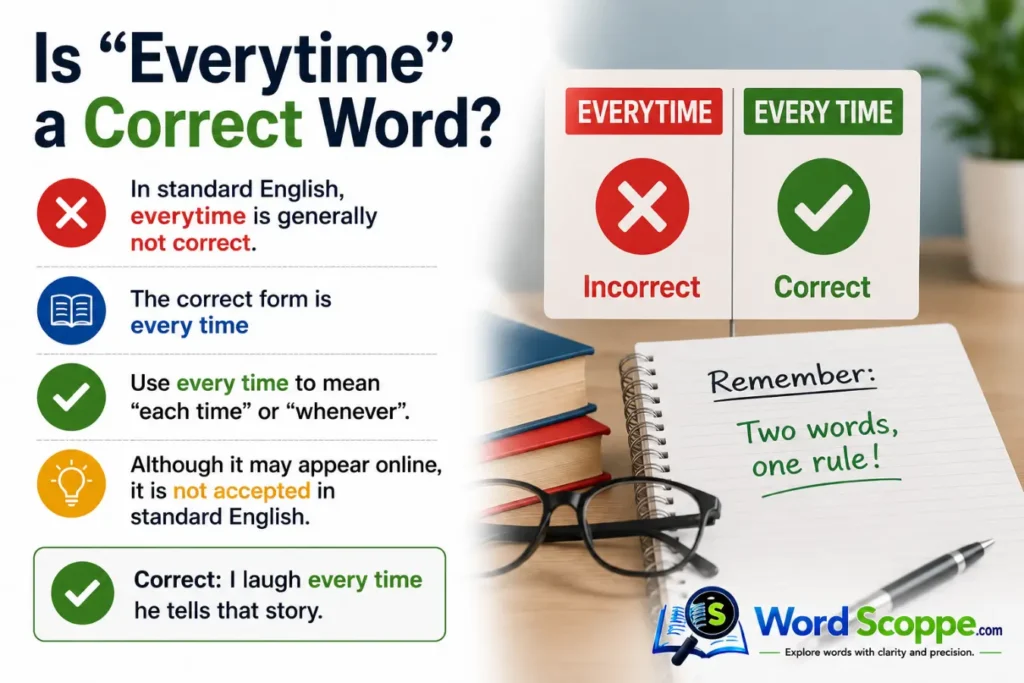
This rule applies to formal and informal writing. It also helps your writing look cleaner and more professional.
Every Time vs. Everytime
The main difference comes down to standard usage.
| Form | Standard English? | Meaning | Example |
| Every time | Yes | Each time | I check my phone every time it rings. |
| Everytime | No, in standard usage | Intended to mean each time | Avoid this spelling. |
The first form contains two separate words.
Every works as a determiner, while time functions as a noun.
Together, they create the expression every time.
Although everytime may appear online, frequent internet usage does not automatically make a spelling standard.
How to Use “Every Time” Correctly
Using the phrase correctly becomes easy once you understand its meaning.
Use it when an action happens on each occasion.
Consider these examples:
Example 1: Repeated Action
I drink water every time I finish exercising.
The action happens after each workout.
Example 2: Repeated Situation
She laughs every time she watches that movie.
The same reaction happens whenever she watches it.
Example 3: Cause and Result
Every time the alarm rings, my dog starts barking.
The first event repeatedly causes the second event.
Example 4: Personal Experience
I learn something new every time I read this book.
The phrase highlights repeated experiences.
These examples show why the two-word form works naturally in everyday English.
Real-Life Examples of “Every Time”
You can find this expression in many common situations.
Here are some natural examples:
- I check the door every time I hear a noise.
- He smiles every time his favorite song plays.
- We order pizza every time we watch a movie.
- She makes notes every time she studies.
- My phone freezes every time I open that app.
- They visit the park every time they come here.
- I remember that trip every time I see this photo.
- The baby laughs every time her father makes a funny face.
Notice the repeated pattern.
The expression connects an action with something that happens again and again.
“Every Time” in Daily English
People use this expression in both speaking and writing.
You might hear it at home, school, work, or while talking with friends.
For example:
“Every time I try to sleep early, something happens.”
You could also see it in a work message:
“Please check the file every time you update the report.”
It works well in casual communication.
It also fits formal writing when the sentence needs to describe repeated events.
However, remember that the expression does not always need to appear next to a verb.
For example:
I made the same mistake every time.
Here, the phrase comes after the main action.
Common Mistakes to Avoid
Many learners make similar mistakes with this expression.
Mistake 1: Joining the Words
Incorrect:
She calls me everytime she visits.
Correct:
She calls me every time she visits.
Keep the words separate.
Mistake 2: Confusing Sound With Spelling
The phrase can sound almost like one word during fast speech.
That does not mean you should combine it in writing.
Mistake 3: Using It as One Word in Formal Work
School assignments, professional emails, websites, and reports need standard spelling.
Therefore, choose the accepted two-word form.
Mistake 4: Assuming Internet Usage Proves Correctness
You may find everytime on social media or informal websites.
However, online usage can include spelling mistakes.
Always follow standard English rules for professional writing.
Easy Ways to Remember the Correct Form
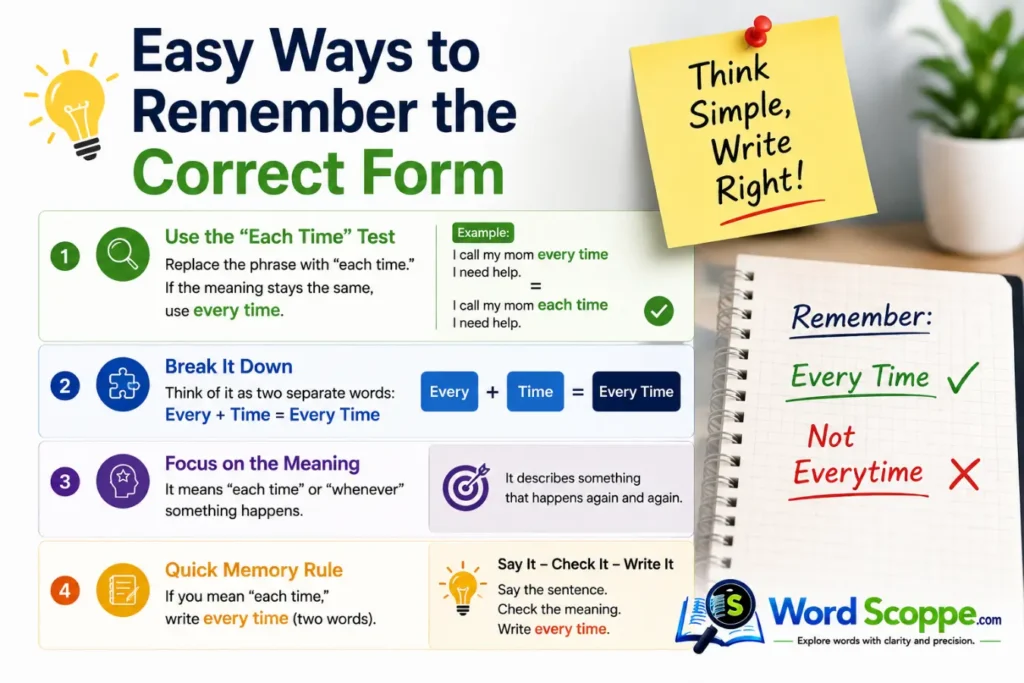
You do not need a complicated grammar rule.
Try these simple methods.
Use the “each time” test.
Replace the phrase with “each time.”
For example:
I smile every time I see him.
Replace it:
I smile each time I see him.
The meaning stays the same.
That tells you the phrase should remain as two words.
You can also remember this simple rule:
Every + time = every time
Think of “every” as describing the noun “time.” That makes the two-word structure easier to remember.
Synonyms and Similar Expressions
Several expressions can replace every time, depending on the sentence.
Each Time
This is the closest direct alternative.
I feel happy each time I visit them.
Whenever
This works well when you mean “at any time that.”
Whenever I visit them, I feel happy.
On Every Occasion
This sounds more formal.
He followed the rules on every occasion.
Without Exception
This emphasizes that something always happens.
She arrives early without exception.
These alternatives can improve variety in your writing. However, choose the expression that best matches your intended meaning.
Why Correct Spelling Matters
Correct spelling helps readers understand your message quickly.
A small spelling mistake can also make professional writing look careless.
This matters especially for:
- School assignments
- Business emails
- Blog posts
- Resumes
- Reports
- Website content
- Social media captions
Using standard English also builds reader trust.
Therefore, learning small grammar differences can improve your overall writing quality.
Expert Insight: Think About Meaning First
A useful writing habit is to focus on meaning before spelling.
Ask yourself what you want to say.
If you mean “each time,” use the standard phrase with two words.
Then check the sentence as a whole.
For example:
Every time I practice, I become better.
The phrase clearly describes repeated occasions.
This approach works better than memorizing isolated spellings. It also helps you understand similar expressions.
When you learn why a phrase works, you are less likely to repeat the same mistake.
Frequently Asked Questions
Is “everytime” one word?
No. In standard English, use every time when you mean “each time.”
Is “every time” grammatically correct?
Yes. Every time is the standard expression for repeated occasions.
Can I use “everytime” in formal writing?
You should avoid it. Use the standard two-word form instead.
What is another word for “every time”?
Depending on context, you can use “each time” or “whenever.”
Is “every time” the same as “each time”?
Usually, yes. Both expressions can describe something that happens on every occasion.
Why do people write “everytime”?
The phrase sounds connected during normal speech. This can cause people to combine the words while writing.
How can I remember the correct spelling?
Replace the phrase with “each time.” If the meaning stays the same, write every time.
Which form should I use in an essay?
Use every time. It follows standard English spelling and grammar conventions.
Conclusion
The difference between everytime or every time becomes simple once you understand the meaning. When you want to say “each time” or “whenever,” use every time as two separate words. The joined form often appears online, but it does not represent standard English usage. You can remember the rule by replacing the phrase with “each time.” If the sentence still makes sense, keep “every” and “time” separate. This small spelling choice can make your writing clearer and more professional. Whether you are writing an email, assignment, article, or casual message, choosing the standard form is always the safer option. When in doubt, remember: every time is the correct choice for standard English.

Sophia Hayes is a language researcher and content writer at WordsCoppe.com, specializing in word comparisons, spelling differences, grammar explanations, and vocabulary insights. She is passionate about making English easier to understand through clear, accurate, and practical content. By breaking down complex language topics into simple explanations, Sophia helps readers improve their writing and communication skills. Her goal is to make learning English more accessible, engaging, and confidence-building for learners worldwide.