
Per say or per se is a common question for English learners and native speakers alike. Many people write per say, but the correct phrase is per se. This expression comes from Latin and means “by itself” or “in itself.” It helps explain that something is true on its own, not because of other factors.
The mistake happens because both phrases sound almost the same. However, only one is correct in English writing. Once you know the meaning, the rule becomes easy to remember. In this guide, you will learn the correct spelling, simple meanings, real-life examples, common mistakes, and expert tips. By the end, you will use per se with confidence in everyday conversations and professional writing.
Quick Summary
Featured Snippet Answer
- Per se is the correct phrase.
- Per say is a spelling mistake.
- Per se means by itself or in itself.
- The phrase comes from Latin.
- Use per se when talking about something alone.
- Example: Money is not bad per se.
What Is the Correct Form: Per Say or Per Se?
The correct expression is per se.
The phrase per say is incorrect because it is simply a misspelling of per se.
English borrowed per se from Latin. Today, it appears in everyday conversations, books, legal writing, academic papers, and business communication.
Correct Examples
- The movie is not bad per se.
- Success is not about money per se.
- The idea is not wrong per se.
- Social media is not harmful per se.
Incorrect Examples
- The movie is not bad per say.
- Success is not about money per say.
- The idea is not wrong per say.
Always write per se, never per say.
What Does “Per Se” Mean?
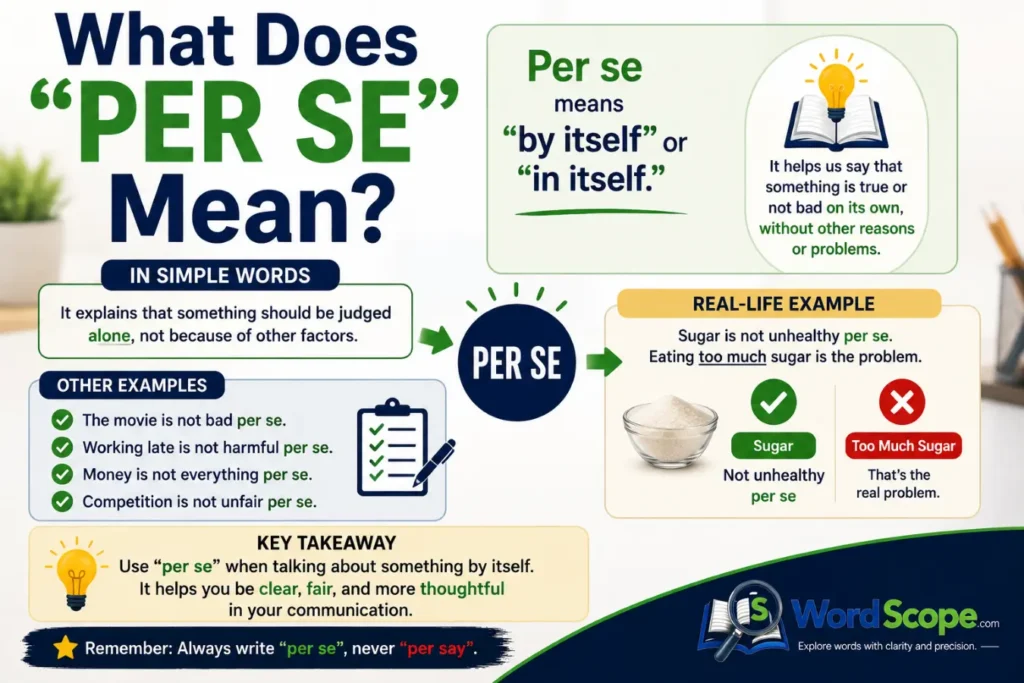
The phrase per se means by itself, in itself, or intrinsically.
It explains that something should be judged alone, without considering other circumstances.
For example:
Sugar is not unhealthy per se. Eating too much sugar is the problem.
In this sentence, sugar itself is not the issue. The amount people consume causes the problem.
This meaning makes per se useful when discussing opinions, facts, or ideas.
Why Do People Write “Per Say”?
Many people hear the phrase before they see it in writing.
Because per se sounds like per say, they assume the spelling matches the pronunciation.
This mistake is common because:
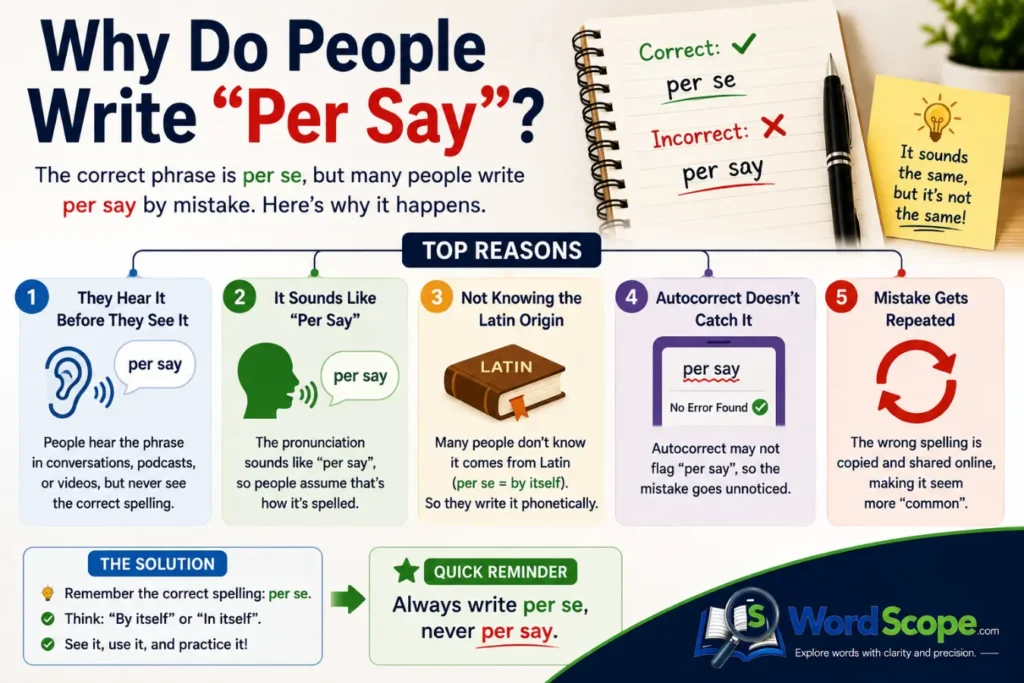
- The words sound almost identical.
- Many people never learn the Latin spelling.
- Autocorrect may not catch the error.
- Informal writing often spreads incorrect spellings.
The pronunciation stays almost the same, but the spelling must remain per se.
The Meaning Behind the Latin Phrase
Per se comes directly from Latin.
It literally means through itself or by itself.
Although English borrowed the phrase centuries ago, it still keeps its original spelling.
Today, writers use it to explain that something should be considered alone.
For example:
- Technology is not dangerous per se.
- Competition is not unfair per se.
- Working late is not harmful per se.
In each sentence, the speaker separates the idea from outside factors.
Per Se vs Per Say: Comparison Table
The table below makes the difference easy to understand.
| Feature | Per Se | Per Say |
| Correct spelling | ✅ Yes | ❌ No |
| Meaning | By itself | No meaning |
| Origin | Latin | Misspelling |
| Accepted in writing | Yes | No |
| Used in formal English | Yes | No |
| Found in dictionaries | Yes | No |
Whenever you write this phrase, always choose per se.
Real-Life Examples of “Per Se”
You may hear per se in many situations.
Examples include:
- Coffee is not unhealthy per se.
- Failure is not a bad thing per se.
- Remote work is not easier per se.
- Experience matters, but degrees are not everything per se.
- Fast food is not harmful per se if eaten occasionally.
- Silence is not rude per se.
These examples show how naturally the phrase fits into everyday English.
Per Se in Everyday English
You can use per se in daily conversations, emails, meetings, and writing. It helps you explain that something is not the issue by itself.
Here are some simple examples:
- The job is not difficult per se.
- Online learning is not better per se.
- The phone is not expensive per se.
- Exercise is not hard per se.
- The rule is not confusing per se.
Using per se correctly makes your English sound clearer and more natural.
Common Mistakes to Avoid
Many writers make the same mistakes. Fortunately, they are easy to fix.
Mistake 1: Writing “Per Say”
This is the most common error.
❌ Per say
✅ Per se
Always remember that per se is the correct spelling.
Mistake 2: Using It Too Often
The phrase sounds formal.
Using it in every paragraph makes your writing feel repetitive.
Instead, use it only when it adds clarity.
Mistake 3: Using It in the Wrong Context
Do not use per se when you simply mean exactly or personally.
Wrong:
❌ I per se like chocolate.
Correct:
✅ I personally like chocolate.
Tips to Remember the Correct Usage
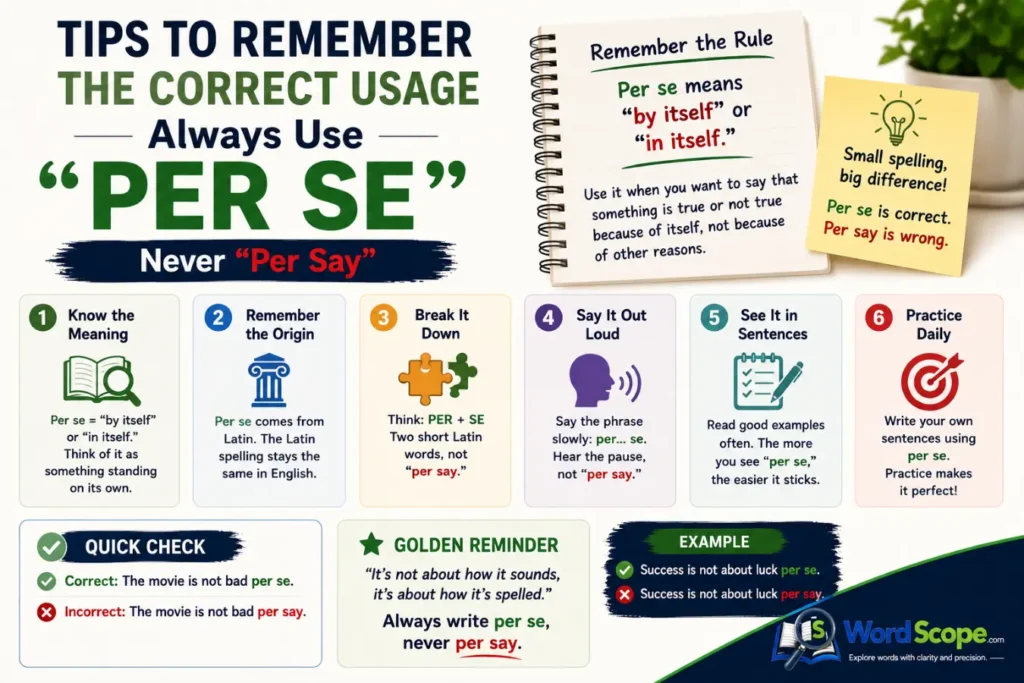
These simple tricks will help you remember the right phrase.
- Remember that per se comes from Latin.
- Never spell it as per say.
- Think of per se as meaning by itself.
- Read the sentence aloud to check if it fits naturally.
- Practice writing the phrase in complete sentences.
The more you use it correctly, the easier it becomes to remember.
Similar Words and Synonyms
Sometimes another phrase works better than per se.
Here are common alternatives:
- by itself
- in itself
- inherently
- intrinsically
- essentially
- fundamentally
- on its own
Choose the alternative that best fits your sentence and tone.
Expert Insight
Professional editors and grammar experts recommend using per se only when it adds meaning.
The phrase is useful because it separates an idea from outside influences. However, it should not replace simpler words when they work just as well.
Understanding this expression also helps you avoid one of the most common spelling mistakes in English. Using per se correctly improves your credibility in academic, business, and professional writing.
Frequently Asked Questions
Is per say ever correct?
No. Per say is always incorrect. The correct phrase is per se.
What does per se mean?
It means by itself, in itself, or on its own.
Why do people spell it as per say?
They spell it that way because the pronunciation sounds similar. However, the correct spelling comes from Latin.
Is per se formal English?
Yes. It appears in both formal and informal English. It is common in academic, legal, and professional writing.
Can I use per se in everyday conversations?
Yes. Native speakers use it in daily speech when discussing ideas or opinions.
Is per se an English word?
Not originally. It comes from Latin, but English has adopted it as a standard expression.
Conclusion
Understanding per say or per se is easier than many people think. The correct phrase is always per se, not per say. It means by itself or in itself, and it helps explain that something should be judged on its own. Because the phrase comes from Latin, its spelling stays the same in modern English.
Keep this simple rule in mind whenever you write. If you hear per say, remember that it is only a pronunciation mistake. With regular practice, you will naturally choose per se in conversations, emails, and professional writing. Small grammar improvements like this make your English clearer, more accurate, and more confident.

Sophia Hayes is a language researcher and content writer at WordsCoppe.com, specializing in word comparisons, spelling differences, grammar explanations, and vocabulary insights. She is passionate about making English easier to understand through clear, accurate, and practical content. By breaking down complex language topics into simple explanations, Sophia helps readers improve their writing and communication skills. Her goal is to make learning English more accessible, engaging, and confidence-building for learners worldwide.