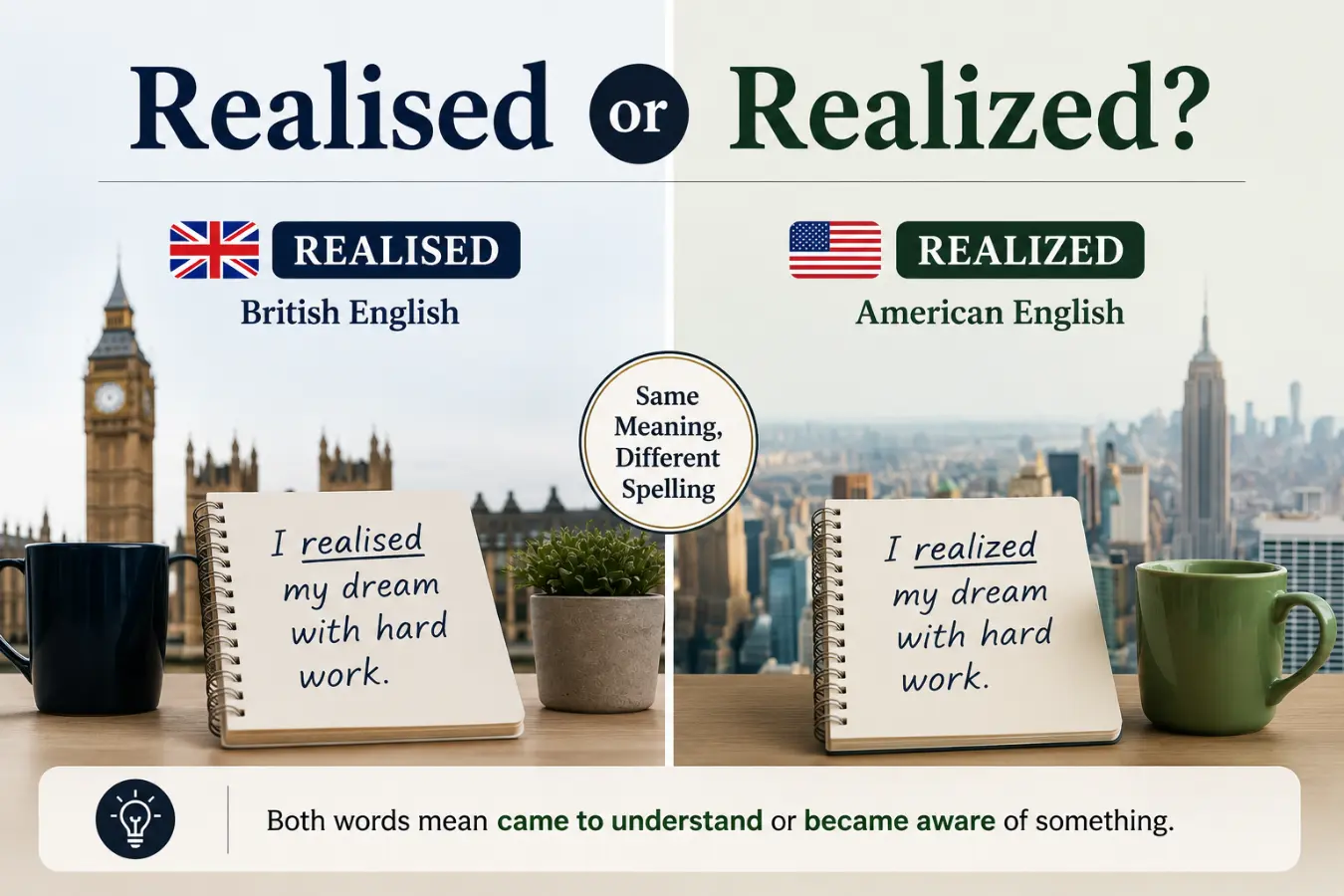
Realised or realized is a common spelling question for English learners and writers. Many people wonder which word is correct. The good news is that both spellings are correct. The right choice depends on the type of English you use. Realised is the preferred spelling in British English, while realized is the standard spelling in American English. Both words have the same meaning and grammar. They simply follow different spelling rules. This guide explains the difference in simple English. You will also see real-life examples, a comparison table, common mistakes, and easy tips. By the end, you will know exactly when to use each spelling with confidence.
Quick Summary
- Both realised and realized are correct.
- Realised is used mainly in British English.
- Realized is the standard spelling in American English.
- Both words mean to become aware of something or to achieve something.
- The meaning does not change because of the spelling.
- Choose one spelling style and stay consistent throughout your writing.
Featured Snippet
Is it realised or realized?
Both “realised” and “realized” are correct. The difference depends on the type of English you are using. Realised is the preferred spelling in British English, while realized is the standard spelling in American English. They have the same pronunciation, meaning, and grammar.
What Do “Realised” and “Realized” Mean?
Both words come from the verb realise/realize.
They have two common meanings.
The first meaning is to suddenly understand something.
Example:
She realized she had left her phone at home.
The second meaning is to make something happen or achieve it.
Example:
He realized his dream of becoming a pilot.
The spelling changes, but the meaning stays exactly the same.
Realised vs Realized: What’s the Difference?
The only real difference is the variety of English.
| Feature | Realised | Realized |
| English Style | British English | American English |
| Correct Spelling | Yes | Yes |
| Meaning | Same | Same |
| Pronunciation | Same | Same |
| Grammar | Same | Same |
| Common Countries | UK, Australia, New Zealand | United States |
If you write for an international audience, follow the style guide your school, company, or publisher uses.
Why Are There Two Spellings?
English has changed over many years.
British English kept many traditional spellings.
American English adopted several spelling changes to make words more consistent.
Many verbs ending in -ise and -ize follow this pattern.
Examples include:
| British English | American English |
| Realised | Realized |
| Organised | Organized |
| Recognised | Recognized |
| Apologised | Apologized |
Both spelling systems are accepted in their own regions.

When Should You Use “Realised”?
Use realised when writing in British English.
It is common in:
- UK newspapers
- British schools
- Government documents in the UK
- Australian publications
- New Zealand writing
Examples
- I realised my mistake after reading the email.
- She realised the answer during the lesson.
- We realised our goal after years of hard work.
- They realised the project needed more planning.
If the rest of your document uses British spelling, realised is the better choice.
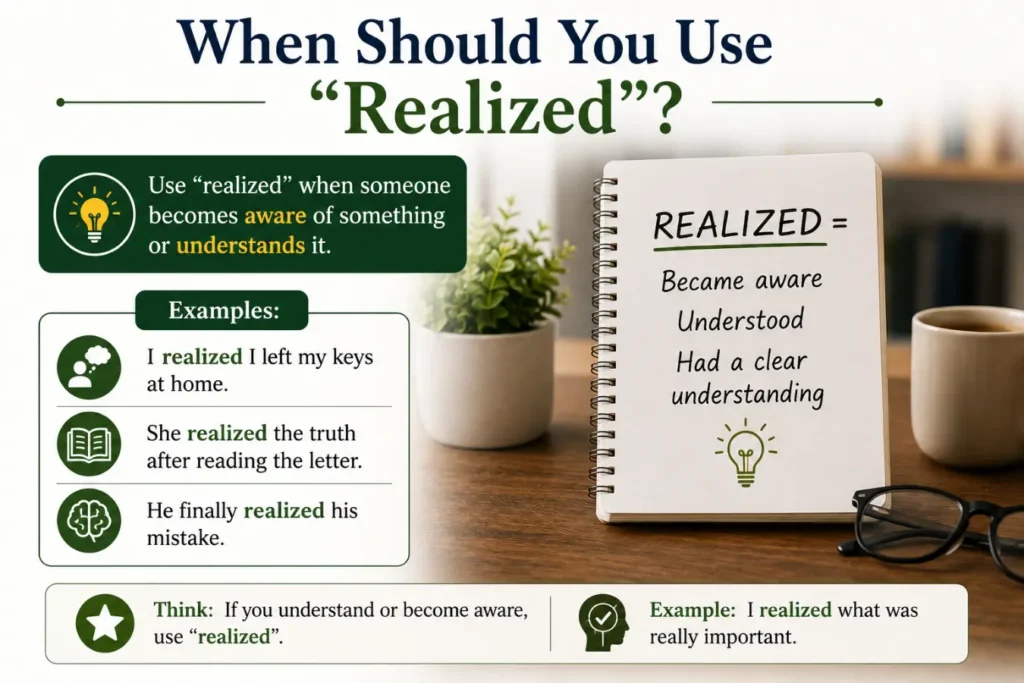
When Should You Use “Realized”?
Use realized when writing in American English.
It appears in:
- American schools
- US universities
- American websites
- Business writing in the United States
- Most US newspapers
Examples
- I realized I forgot my wallet.
- She realized the truth immediately.
- They realized their business plan successfully.
- He realized his lifelong ambition.
If your audience is mainly American, realized is the preferred spelling.
Real-Life Examples of Realised and Realized
Here are some everyday situations.
At School
A student realised the homework was due today.
An American student would write:
A student realized the homework was due today.
At Work
She realised the report contained an error.
In the United States, this becomes:
She realized the report contained an error.
While Traveling
We realised we were on the wrong train.
American English writes:
We realized we were on the wrong train.
During a Conversation
He realised everyone was waiting for him.
American English changes only the spelling:
He realized everyone was waiting for him.
Notice that every sentence keeps the same meaning. Only the regional spelling changes.
Is One Spelling More Correct Than the Other?
No.
Neither spelling is better.
Both appear in respected dictionaries and style guides.
The important rule is consistency.
If you begin writing in British English, continue using British spellings throughout the article.
If you choose American English, stay with American spellings from start to finish.
Mixing both styles in one document can confuse readers and make your writing look less professional.
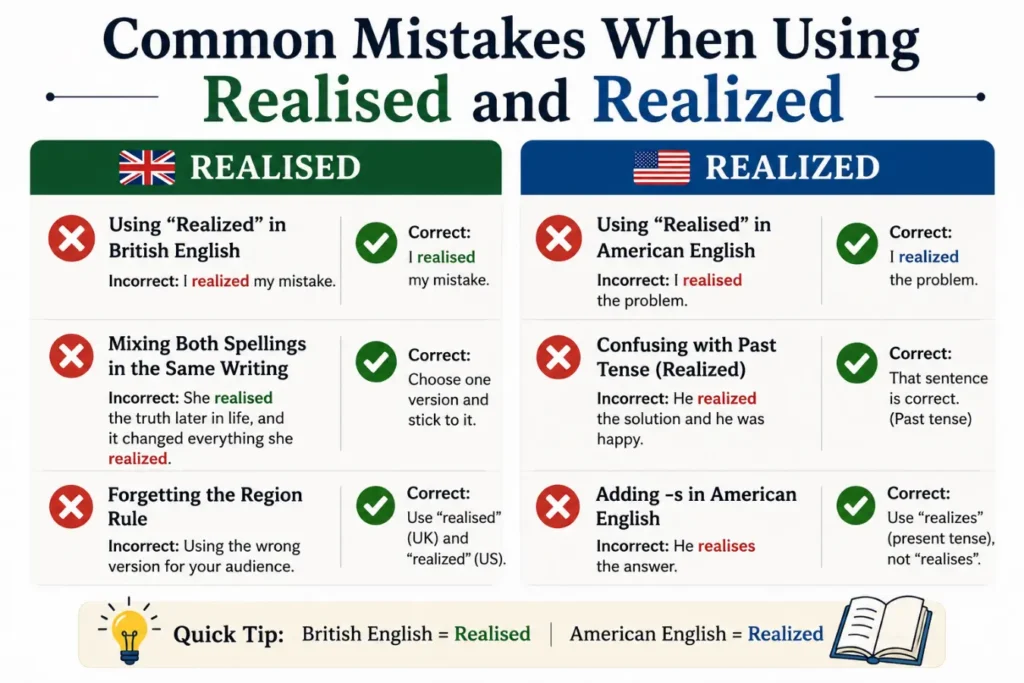
Common Mistakes When Using Realised and Realized
Many writers know both spellings are correct. However, they still make a few common mistakes.
Here are the mistakes to avoid:
- Mixing realised and realized in the same article.
- Using British spelling in American writing.
- Using American spelling in British documents.
- Thinking one spelling is grammatically incorrect.
- Changing the spelling while editing only part of the content.
Keeping one spelling style throughout your writing makes your work look polished and professional.
Easy Tips to Remember the Difference
These simple tricks make the spelling easy to remember.
- Realised belongs to British English.
- Realized belongs to American English.
- If you already use colour, favourite, and organise, choose realised.
- If you write color, favorite, and organize, choose realized.
- Follow the spelling style your school, employer, or publisher requires.
Once you choose a style, use it consistently.
How People Use These Words Every Day
People use these words in many daily situations.
In School
Students often realize they studied the wrong chapter.
British students would write realised instead.
At Work
An employee may realize a meeting starts earlier than expected.
The same sentence in British English uses realised.
In Personal Conversations
Someone might realize they forgot a friend’s birthday.
The message stays the same regardless of the spelling.
In Books and Articles
Writers choose the spelling that matches their target audience.
British publications prefer realised.
American publications prefer realized.
Synonyms
Depending on the sentence, you can replace realised or realized with similar words.
Common synonyms include:
- Understood
- Discovered
- Recognized
- Noticed
- Learned
- Became aware
- Achieved
- Fulfilled
- Accomplished
Choose the synonym that best fits the meaning of your sentence.
Expert Insight
Professional editors agree that both spellings are correct.
The key is consistency.
Most grammar checkers follow the language setting you select. If your document is set to British English, they suggest realised. If it uses American English, they recommend realized.
Before publishing, check your spelling settings and proofread your document. This simple step improves readability and creates a more professional impression.
Frequently Asked Questions
Is realised or realized correct?
Yes. Both spellings are correct. The difference depends on whether you use British or American English.
Is realised British English?
Yes. Realised is the preferred spelling in British English and many other countries that follow British spelling.
Is realized American English?
Yes. Realized is the standard spelling in American English.
Do realised and realized have different meanings?
No. Both words have exactly the same meaning and pronunciation.
Which spelling should I use in academic writing?
Use the spelling style required by your university, teacher, journal, or publisher. Then stay consistent throughout your work.
Can I use both spellings in one article?
It is better not to. Mixing British and American spellings can confuse readers and reduce writing quality.
Which spelling is more common online?
Both are widely used. However, realized appears more often because American English has a larger online audience, while realised remains standard in British English publications.
Conclusion
Choosing between realised or realized is easier than many people think. Both spellings are correct, and both share the same meaning, pronunciation, and grammar. The only difference is the variety of English you use. Realised is the preferred choice in British English, while realized is standard in American English. Neither spelling is more accurate than the other. The most important rule is consistency. Pick one style that matches your audience and use it throughout your writing. Following this simple approach will make your work clearer, more professional, and easier for readers to understand. Whenever you see these two spellings, remember that the language style not the meaning determines the correct choice.

Sophia Hayes is a language researcher and content writer at WordsCoppe.com, specializing in word comparisons, spelling differences, grammar explanations, and vocabulary insights. She is passionate about making English easier to understand through clear, accurate, and practical content. By breaking down complex language topics into simple explanations, Sophia helps readers improve their writing and communication skills. Her goal is to make learning English more accessible, engaging, and confidence-building for learners worldwide.