Walk past or passed is a common grammar question that confuses many English learners and native speakers alike. The two words look similar, but they have different meanings and jobs in a sentence. Using the wrong one can make your writing look incorrect, even if the rest of your sentence is perfect.
The good news is that the rule is simple once you understand it. One word describes movement beyond something, while the other is the past tense of a verb. In this guide, you will learn the difference in clear, simple English. You will also see comparison tables, real-life examples, common mistakes, memory tricks, and expert tips to help you choose the correct word every time.
Quick Summary
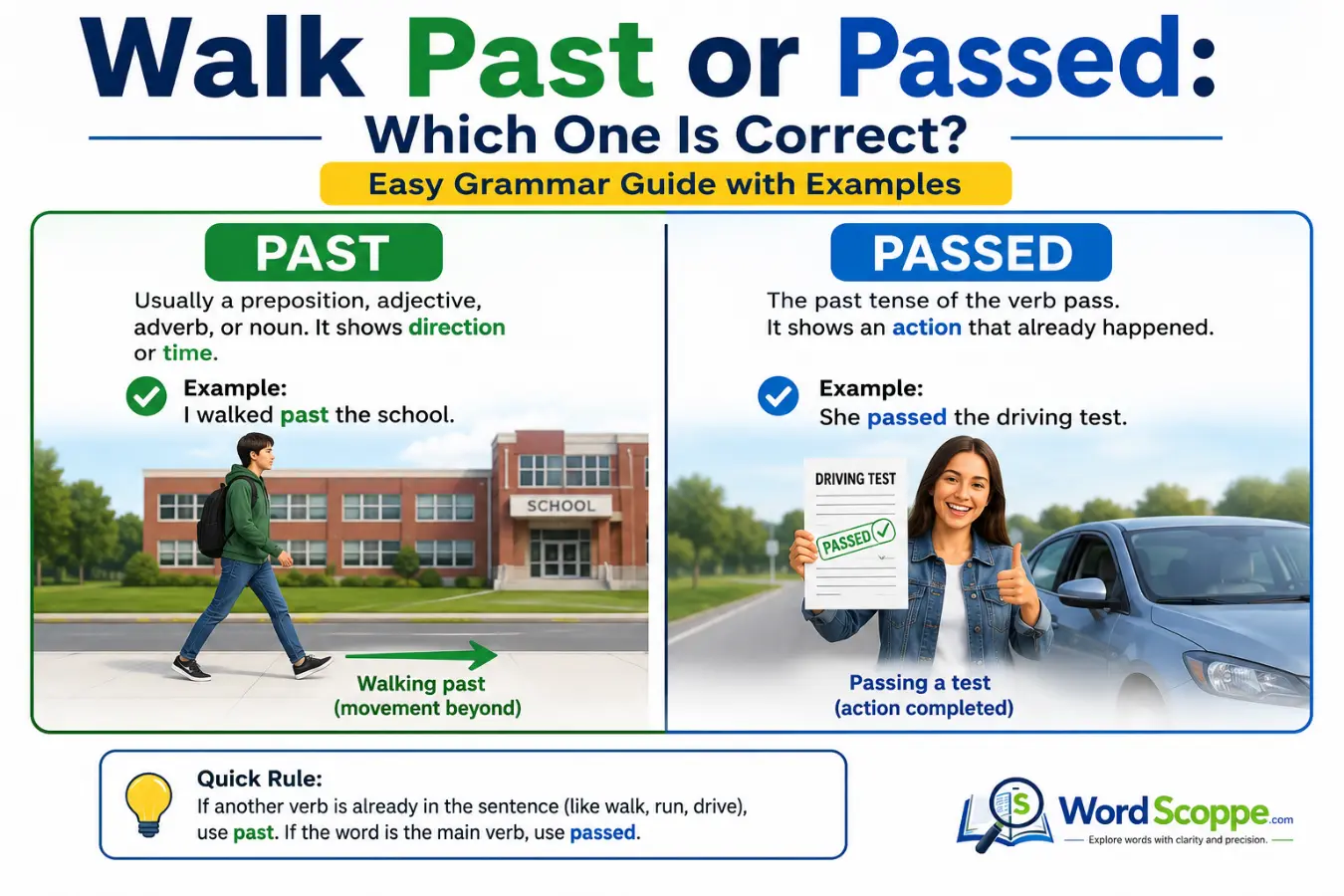
- Past is usually a preposition, adjective, adverb, or noun.
- Passed is the past tense of the verb pass.
- Say walk past the school, not walk passed the school.
- Use passed only when someone performed the action of passing.
- Remember: Passed = Verb. Past = Direction, Time, or Position.
What Does “Past” Mean?
The word past has several meanings in English. Most often, it refers to moving beyond something or to a time that has already happened.
Examples:
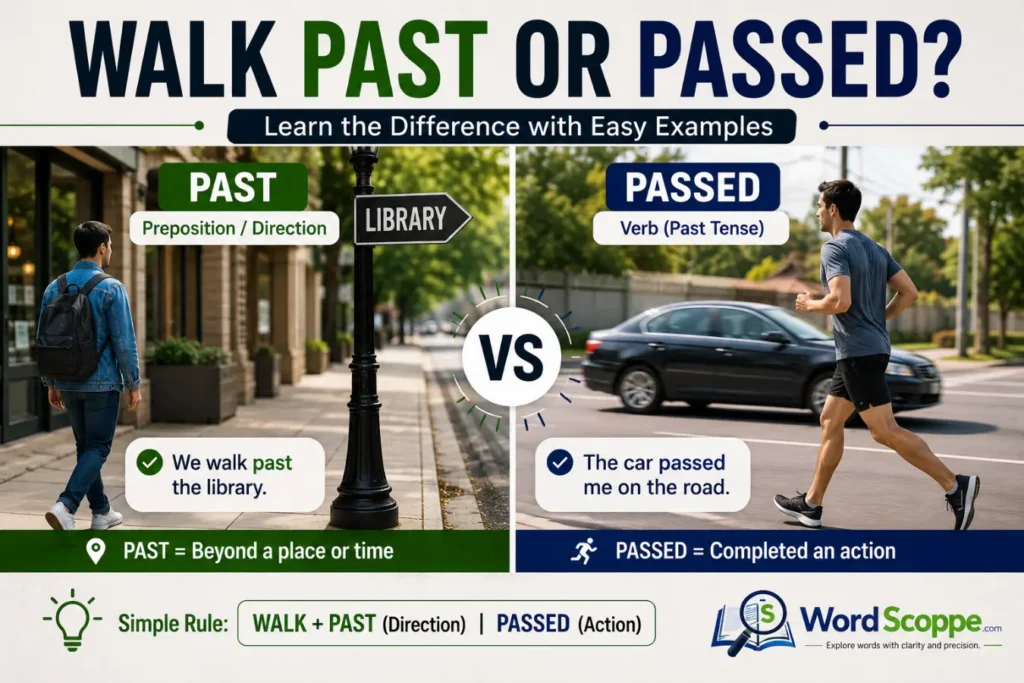
- We walked past the library.
- It is ten minutes past six.
- Leave the past behind.
- The car drove past our house.
In the phrase walk past, past tells us where someone walked. It is not a verb.
What Does “Passed” Mean?
Passed is the past tense and past participle of the verb pass.
It describes an action that already happened.
Examples:
- She passed the driving test.
- The train passed the station.
- He passed me on the road.
- Time passed quickly.
Since passed is a verb, it always shows an action.
Walk Past or Passed: What’s the Difference?
Although the words sound alike, they play different roles in a sentence.
| Word | Part of Speech | Meaning | Example |
| Past | Preposition, adverb, adjective, noun | Beyond a place or time | We walked past the museum. |
| Passed | Verb | Moved beyond or completed an action | She passed the exam. |
The simple rule:
- Walk past ✅ Correct
- Walk passed ❌ Incorrect
In the phrase walk past, the verb is already walk. Therefore, past only describes direction.
Why Is “Walk Past” Correct?
The phrase walk past contains:
- Walk → the action (verb)
- Past → the direction (preposition)
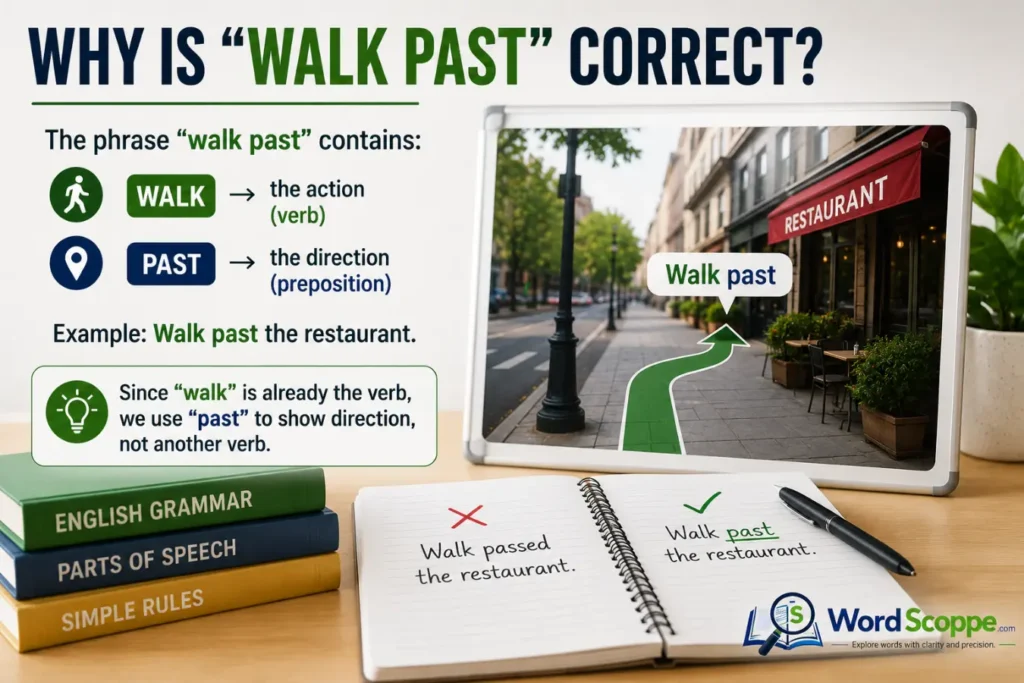
Example:
✅ Walk past the restaurant.
Here, walk is already the verb. You do not need another verb.
Now compare it with:
❌ Walk passed the restaurant.
This sentence contains two verbs (walk and passed), making it grammatically incorrect.
Real-Life Examples of Walk Past and Passed
Understanding real situations makes the rule easier.
Using walk past
- I walk past the park every morning.
- She walked past my office yesterday.
- We walked past the coffee shop.
- Don’t walk past the entrance.
Using passed
- The bus passed our stop.
- He passed the interview.
- She passed the finish line first.
- My grandfather passed away peacefully.
Notice that passed always describes an action.
Common Mistakes People Make
Many writers confuse these words because they sound the same.
Here are frequent mistakes.
❌ I walked passed the bank.
✅ I walked past the bank.
❌ We walk passed his house every day.
✅ We walk past his house every day.
❌ She passed the store without stopping.
✅ Correct.
Here, passed is the action.
❌ The train walk past the station.
✅ The train passed the station.
The train performed the action of passing.
Easy Trick to Remember the Difference
A simple memory trick can help.
Think about the letter -ed.
Words ending in -ed are often verbs.
Examples:
- walked
- jumped
- played
- passed
Since passed ends in -ed, it is usually the verb.
If another verb already appears in the sentence, such as walk, use past instead.
Easy formula:
- Walk + past ✅
- Passed + object ✅
Using Past and Passed in Everyday English
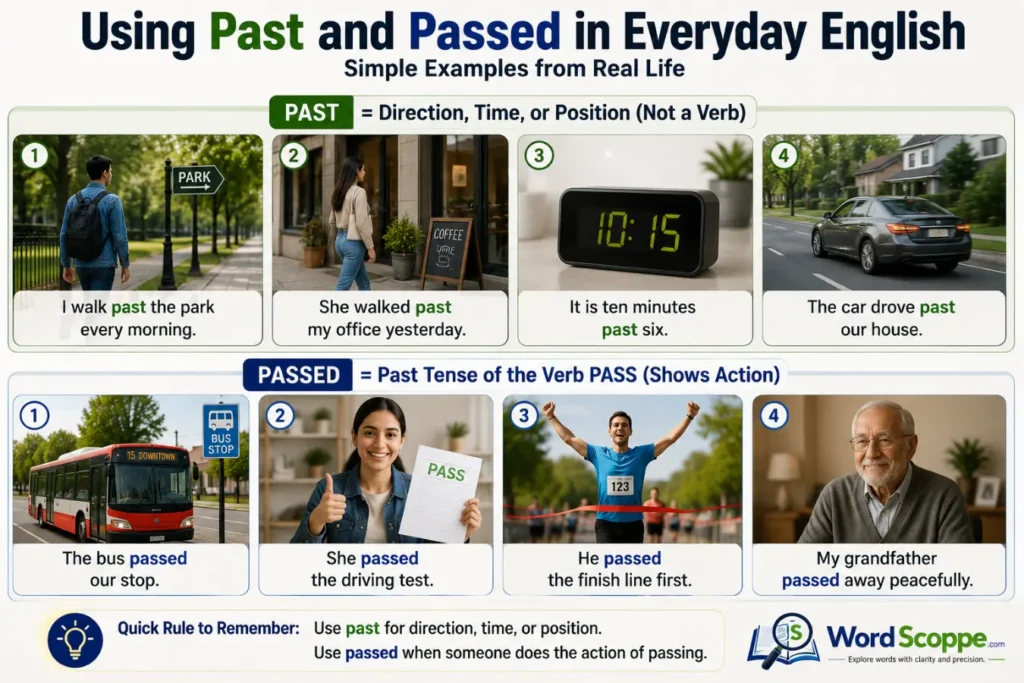
You will hear these words often in daily conversations.
Examples:
- I walked past your house.
- We drove past the airport.
- The teacher passed my homework back.
- He passed me during the race.
- Time has passed quickly.
- They ran past the finish line.
Learning this difference improves both speaking and writing.
Synonyms and Related Words
Depending on the sentence, these words have similar meanings.
Synonyms for past
- beyond
- alongside
- by
- after
- over
Synonyms for passed
- moved beyond
- crossed
- overtook
- completed
- succeeded
Choose synonyms carefully because the meaning may change slightly.
Expert Insights
Grammar experts recommend focusing on the function of the word rather than its spelling. First, identify the verb in the sentence. If walk, run, drive, or another action word is already present, the correct choice is usually past because it describes direction. Use passed only when it acts as the main verb. This simple habit prevents one of the most common grammar mistakes in English and improves your writing accuracy.
Frequently Asked Questions
Is it walk past or walk passed?
Walk past is correct because walk is the verb and past shows direction.
Why is “walk passed” incorrect?
It uses two verbs together. The sentence only needs one verb.
Is “passed” ever correct after “walk”?
No. After walk, use past when talking about movement.
What is the difference between past and passed?
Past usually refers to time or direction. Passed is the past tense of pass.
Can “past” be a noun?
Yes. Example: We cannot change the past.
Is “passed away” correct?
Yes. Here, passed is the verb in the phrase passed away.
Why do people confuse these words?
They sound exactly the same, making them easy to mix up in writing.
Conclusion
Knowing the difference between walk past or passed is easier than many people think. Past refers to direction, position, or time, while passed is the past tense of the verb pass. When you say someone walked past a building, walk is already the action, so past is the correct choice. Use passed only when it describes the action itself, such as passing a person, a test, or a location. By remembering this simple rule and practicing with everyday examples, you can avoid a common grammar mistake and write with greater confidence and accuracy.

Sophia Hayes is a language researcher and content writer at WordsCoppe.com, specializing in word comparisons, spelling differences, grammar explanations, and vocabulary insights. She is passionate about making English easier to understand through clear, accurate, and practical content. By breaking down complex language topics into simple explanations, Sophia helps readers improve their writing and communication skills. Her goal is to make learning English more accessible, engaging, and confidence-building for learners worldwide.