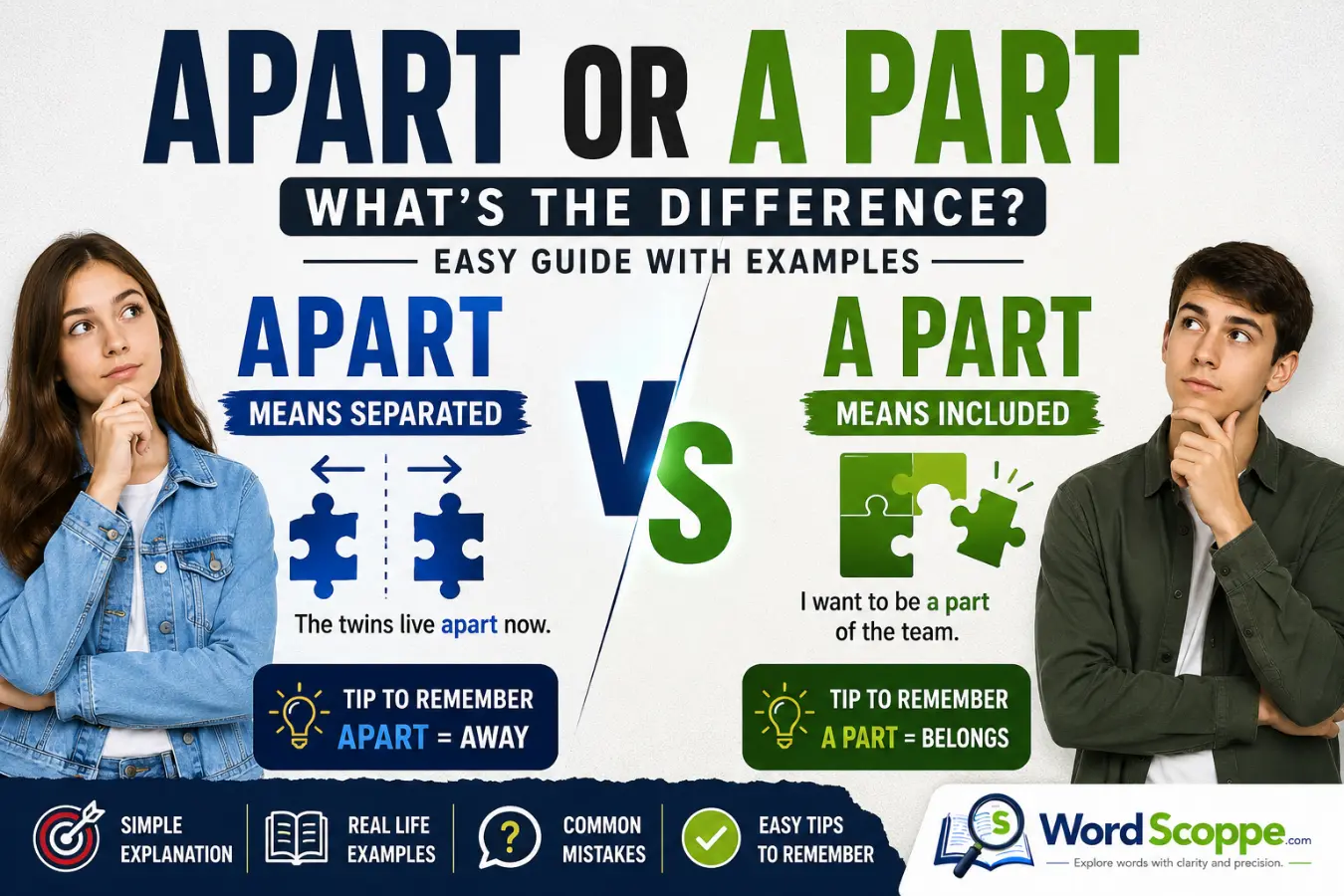
Apart or a part may look almost identical, but they have completely different meanings. Many English learners and even native speakers confuse these two expressions because they differ by only one space. However, choosing the wrong one can completely change the meaning of a sentence.
The good news is that the rule is easy to understand. Once you know what each expression means, you can use them with confidence in everyday writing and speaking. This guide explains the difference in simple English with clear examples, comparison tables, and practical tips. By the end, you’ll know exactly when to use apart and when a part is the correct choice.
Quick Summary
- Apart means separated or away from something.
- A part means a piece, section, or member of something.
- Apart is one word.
- A part is two separate words.
- They cannot replace each other.
- Use simple memory tricks to avoid mistakes.
What Does “Apart” Mean?
Apart is an adverb. It describes something that is separated, divided, or at a distance from something else.

It often shows that two people or things are no longer together.
Examples
- The twins live apart now.
- Keep the magnets apart.
- Their opinions grew apart over time.
- The old bridge fell apart after the storm.
- Please stand six feet apart.
In each example, apart shows separation.
What Does “A Part” Mean?
A part is a noun phrase. It means one piece of a whole or someone who belongs to a group.
It always refers to something included within a larger thing.
Examples
- I want to be a part of the team.
- This chapter is a part of the book.
- She became a part of our family.
- Every wheel is a part of the bicycle.
- Education is a part of personal growth.
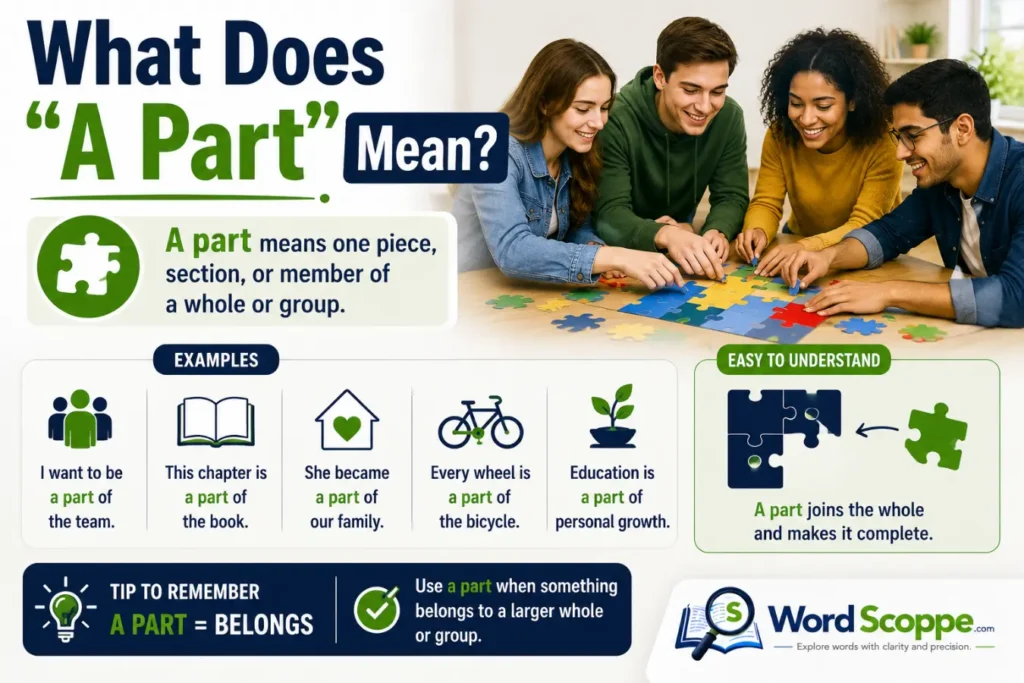
Here, a part means one section or one member of a larger whole.
Apart vs A Part: Key Differences
Although the words look similar, their meanings are opposite in many situations.
| Feature | Apart | A Part |
| Word Type | Adverb | Noun Phrase |
| Meaning | Separated | One piece of a whole |
| Number of Words | One | Two |
| Shows Distance | Yes | No |
| Shows Inclusion | No | Yes |
| Example | We sat apart. | I am a part of the club. |
The easiest way to remember the difference is this:
- Apart = separated
- A part = included
Apart or A Part in Simple Words
Think about a puzzle.
If one puzzle piece belongs inside the puzzle, it is a part of the puzzle.
If you remove that piece and place it on the table, it is apart from the puzzle.
This simple idea explains the difference clearly.
- A part joins something.
- Apart separates something.
Real-Life Examples of Apart and A Part
Using these words in everyday situations makes the difference easier to remember.
At School
✅ I am a part of the science club.
✅ The desks are placed apart for more space.
At Work
✅ She became a part of the marketing team.
✅ Our offices are miles apart.
Home
✅ Every family member plays a part in cleaning.
✅ Keep the cleaning products apart from food.
During Sports
✅ He is a part of the football squad.
✅ The players stood apart before the match started.
These examples show that a part always means belonging, while apart means separated.
Common Mistakes People Make
Many writers confuse these expressions because they sound alike.
Here are the most common mistakes.
Mistake 1: Using “Apart” for Membership
❌ I am apart of the group.
✅ I am a part of the group.
Why?
Because the speaker belongs to the group.
Mistake 2: Using “A Part” for Separation
❌ Please keep the chairs a part.
✅ Please keep the chairs apart.
Why?
The chairs should remain separated.
Mistake 3: Forgetting the Space
Changing one space changes the meaning completely.
Compare these sentences.
- We grew apart after college.
- We became a part of the same company.
The meanings are completely different.
Easy Tips to Remember the Difference
Learning one small trick can help you choose the correct expression every time.
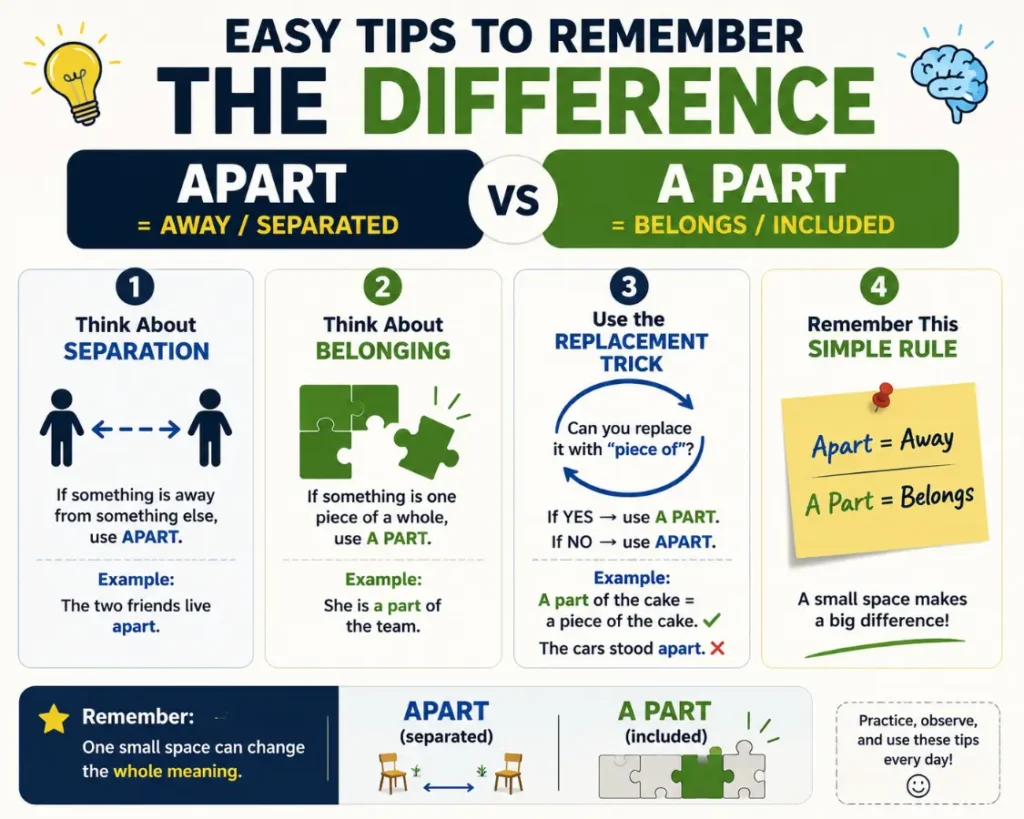
Tip 1: Think About “Together”
If something belongs together, use a part.
Example
- She is a part of our team.
Tip 2: Think About “Separate”
If something moves away or stays separate, use apart.
Example
- The children stood apart during the activity.
Tip 3: Replace the Words
Ask yourself this question.
Can you replace it with piece of?
If yes, use a part.
Example
- A part of the cake = A piece of the cake.
If not, use apart.
Example
- The buildings stand apart.
Tip 4: Remember This Simple Rule
Apart = Away
A Part = Belongs
This short memory trick helps many English learners avoid mistakes.
Using Apart and A Part in Everyday Life
Understanding apart or a part becomes much easier when you see these expressions in daily situations. Although they look similar, each one fits a different purpose.
In Conversations
- We live apart because of our jobs.
- I am proud to be a part of this community.
At School
- The students sat apart during the exam.
- Emma became a part of the debate club.
Work
- Our offices are located miles apart.
- He is a part of the sales department.
Home
- Keep sharp tools apart from children.
- Every family member is a part of the celebration.
When you connect the meaning to real situations, choosing the correct expression becomes much easier.
Synonyms and Related Words
Using related words can improve your vocabulary and make your writing more natural.
Synonyms for Apart
- Separate
- Away
- Divided
- Detached
- Isolated
- Split
- Distant
Example
The two houses stand apart.
The two houses stand separate.
Synonyms for A Part
- Piece
- Portion
- Section
- Member
- Element
- Component
- Fraction
Example
She is a part of the committee.
She is a member of the committee.
Expert Insight: Why This Difference Matters
Professional writers, teachers, and editors pay close attention to small word choices because they affect meaning. The difference between apart and a part is a perfect example.
Using the wrong expression can confuse readers and change the message of your sentence. For example, saying “I am apart of the team” suggests separation, not membership. The correct phrase is “I am a part of the team.”
A helpful habit is to pause before writing. Ask yourself whether you mean separated or included. This simple check prevents one of the most common grammar mistakes in English.
Frequently Asked Questions
Is it “apart of” or “a part of”?
A part of is correct when someone or something belongs to a group or whole. Apart of is incorrect in standard English.
What does “apart” mean?
Apart means separated, away from, or not together.
What does “a part” mean?
A part means one piece, section, or member of a larger whole.
Can “apart” and “a part” be used interchangeably?
No. They have different meanings and cannot replace each other.
Why do people confuse apart and a part?
They sound almost the same when spoken, but the space changes the meaning completely.
How can I remember the difference?
Remember this simple rule:
- Apart = Away
- A Part = Belongs
This memory trick works in most situations.
Which expression is more common?
Both are common, but they appear in different contexts. Apart usually describes separation, while a part describes inclusion.
Is “a part” always written as two words?
Yes. When it means a piece or member of something, a part is always written as two separate words.
Conclusion
Choosing between apart or a part is easy once you understand their meanings. Apart describes separation or distance, while a part refers to something included within a larger whole. Although they differ by only one space, they cannot replace each other because their meanings are completely different. Reading real-life examples and using the simple memory trick—apart means away, a part means belongs—can help you avoid mistakes. With regular practice, you’ll use both expressions correctly in conversations, emails, schoolwork, and professional writing. The next time you pause over apart or a part, remember the meaning first, and the correct choice will become clear.

Sophia Hayes is a language researcher and content writer at WordsCoppe.com, specializing in word comparisons, spelling differences, grammar explanations, and vocabulary insights. She is passionate about making English easier to understand through clear, accurate, and practical content. By breaking down complex language topics into simple explanations, Sophia helps readers improve their writing and communication skills. Her goal is to make learning English more accessible, engaging, and confidence-building for learners worldwide.