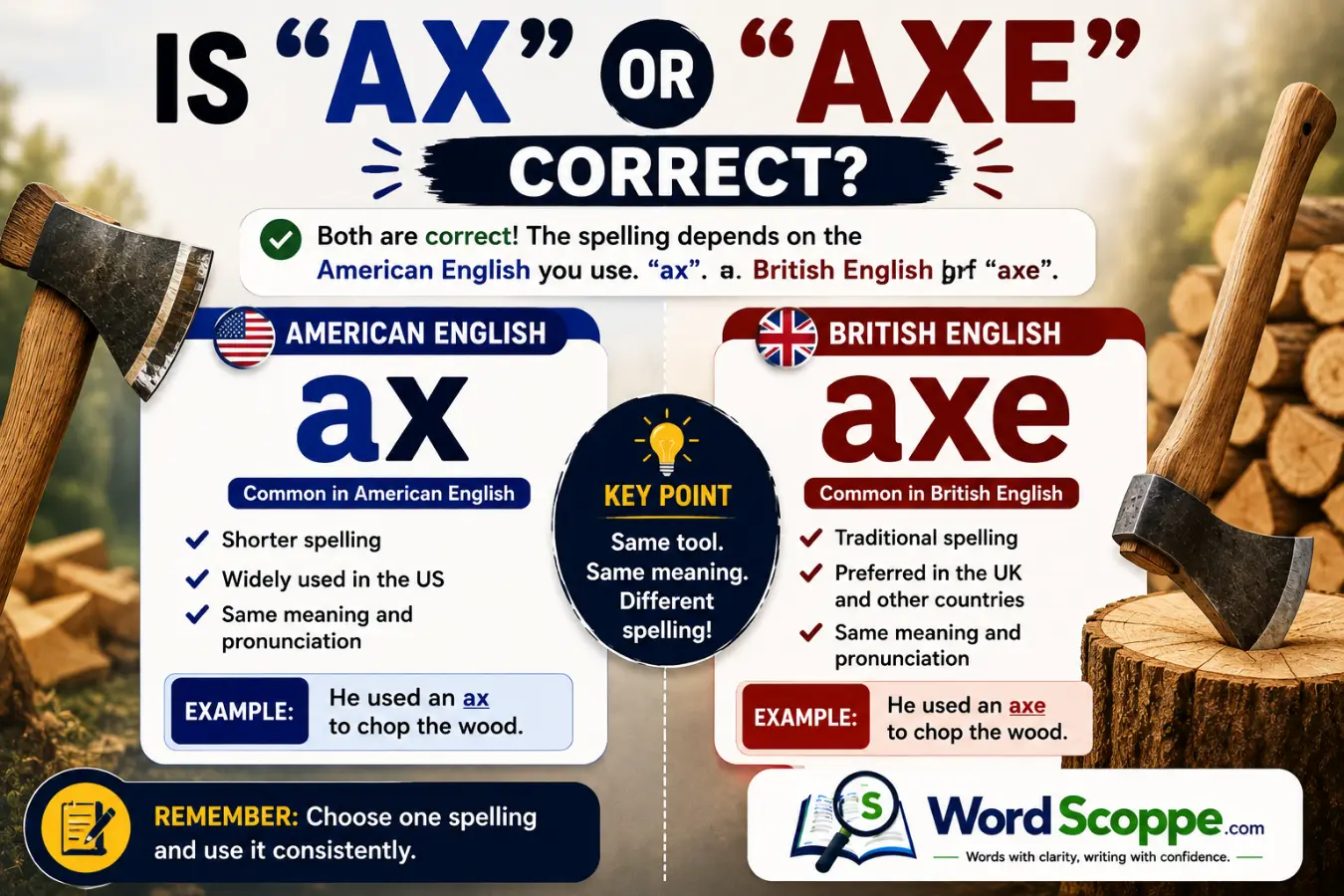
Ax or axe is a common spelling question in English. Both forms are correct, but usage depends on the type of English you follow. Axe is more common in British English and many other English varieties. Ax is widely accepted in American English. Both words refer to the same tool. They can also work as verbs when someone cuts or removes something with an ax or axe. The spelling difference does not change the meaning or pronunciation. However, choosing one form consistently makes your writing clearer. This guide explains the difference between ax and axe in simple terms. You will also learn which spelling works in American and British English. Plus, you will see everyday examples, common mistakes, and easy tips for remembering the correct form.
Quick Summary
- Ax and axe are both correct spellings.
- Ax is especially common in American English.
- Axe is especially common in British English.
- Both forms describe the same cutting tool.
- Both spellings can also function as verbs.
- The pronunciation stays the same.
- Neither spelling is universally wrong.
- Choose one form based on your audience and style guide.
What Does “Ax” or “Axe” Mean?
An ax or axe is a tool used for cutting wood and other materials.
It usually has a sharp metal blade.
The blade attaches to a handle.
People have used axes for thousands of years.
Today, axes can serve several purposes.
For example, people may use them for cutting firewood, chopping branches, or outdoor work.
The word can also describe an action.
For example:
He axed the branch from the tree.
In this sentence, axed means cut with an ax or axe.
The spelling changes slightly between English varieties.
However, the basic meaning remains the same.
Is “Ax” or “Axe” Correct?
The short answer is both are correct.
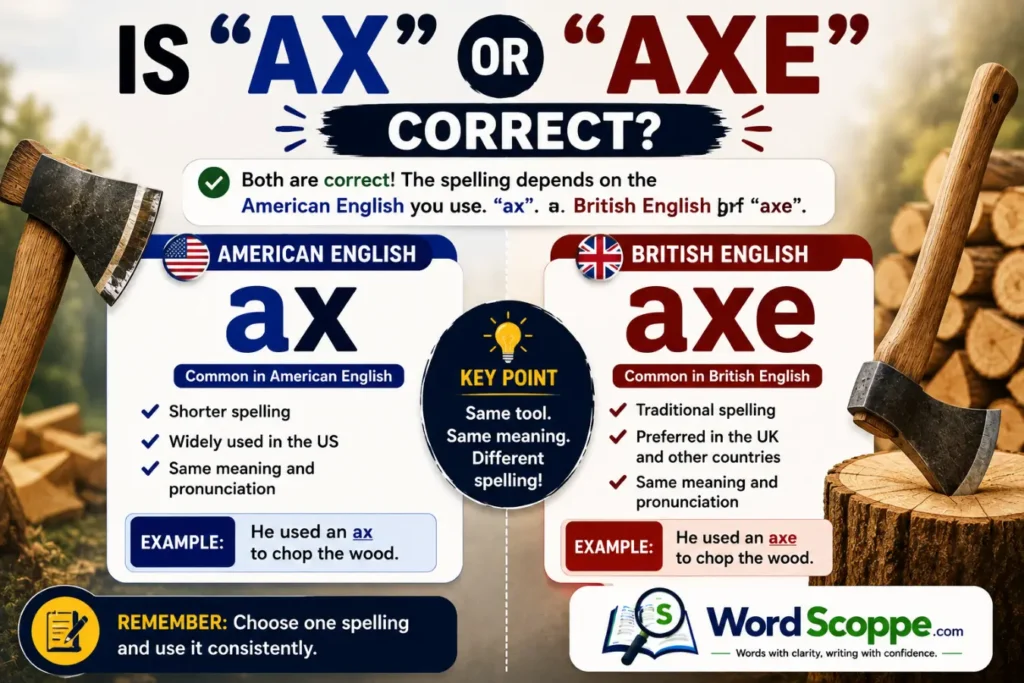
Ax is a standard spelling, especially in American English.
Axe is also standard and remains more common in British English.
Therefore, you do not need to worry that one form is simply a spelling mistake.
Consider these examples:
He used an ax to cut the wood.
He used an axe to cut the wood.
Both sentences are correct.
The main difference involves regional spelling preferences.
Ax vs Axe: What Is the Difference?
The biggest difference is the extra e.
| Word | Common Usage | Meaning | Example |
| ax | American English | Cutting tool | He picked up an ax. |
| axe | British English | Cutting tool | He picked up an axe. |
| axed | Both | Cut with an ax or axe | He axed the branch. |
| axing | American English | Cutting or removing | They are axing the old plan. |
| axing/axeing | Varies | Cutting or removing | Usage depends on the style. |
In most cases, the difference is only spelling.
The pronunciation stays essentially the same.
So, the choice depends mainly on your preferred English variety.
Why Does British English Prefer “Axe”?
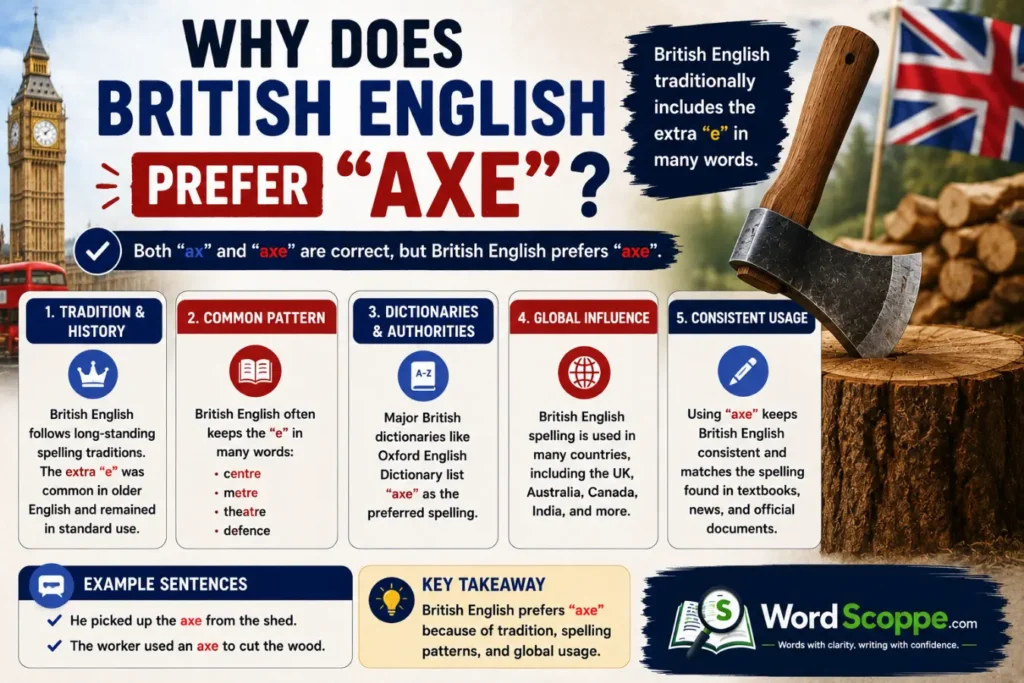
British English traditionally uses the longer spelling axe.
The extra e appears in many dictionaries and British publications.
For example:
The worker lifted the axe.
He sharpened his axe before cutting the wood.
The old axe had a wooden handle.
British English also uses axe in figurative expressions.
For example:
The company decided to axe several positions.
Here, axe means to remove or cancel something.
Therefore, the word does not always describe a physical tool.
Why Does American English Use “Ax”?
American English commonly uses the shorter spelling ax.
For example:
The lumberjack carried an ax.
He used an ax to split the logs.
The ax had a sharp blade.
American dictionaries generally recognize ax as a standard spelling.
The shorter form also appears in American writing when the word acts as a verb.
For example:
The company plans to ax the project.
Here, ax means to remove or cancel something.
Therefore, American writers can use the shorter form in both literal and figurative contexts.
Ax or Axe as a Noun
The most common use describes a physical tool.
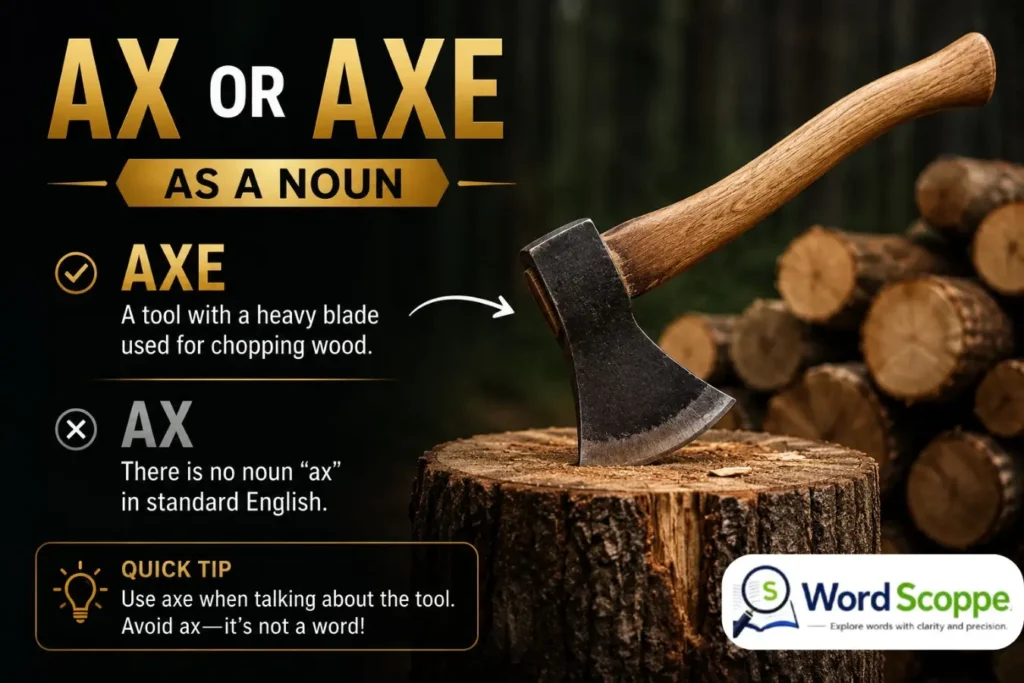
For example:
The axe is hanging in the shed.
He bought a new ax for cutting firewood.
The ax has a strong wooden handle.
The noun can refer to different types of cutting tools.
These include:
- hatchets
- splitting axes
- felling axes
- camping axes
- carpenter’s axes
Each tool can have a different shape and purpose.
Still, the general word remains ax or axe.
Ax or Axe as a Verb
The word can also work as a verb.
As a verb, it can mean to cut with an ax or axe.
For example:
The worker axed the thick branch.
It can also have a figurative meaning.
In business or entertainment, ax or axe can mean to remove, cancel, or dismiss something.
For example:
The network axed the show after one season.
Or:
The company axed the expensive project.
This meaning often appears in news reports and informal writing.
Therefore, context can change the meaning.
Real-Life Examples of Ax and Axe
Seeing both forms in sentences makes the difference easier.
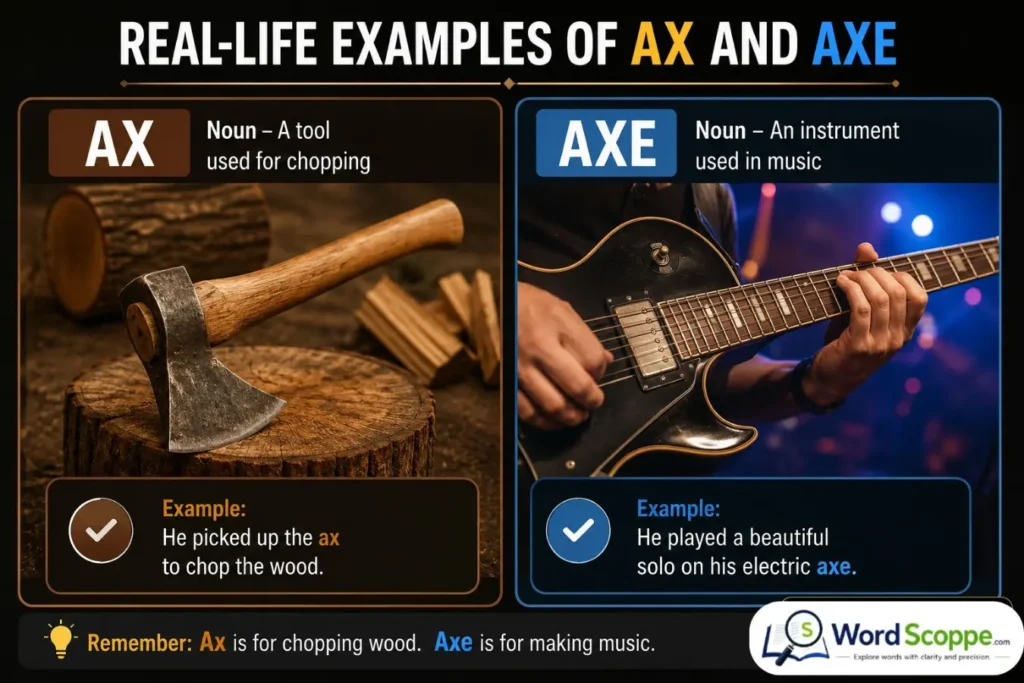
Physical tool
Dad kept an axe in the garage.
The camper carried an ax into the forest.
Cutting wood
She used an axe to split the logs.
He used an ax to cut the branch.
Business
The company axed several unnecessary expenses.
The company axed the project last year.
Entertainment
The network axed the television series.
The producer decided to axe the program.
In every example, the meaning remains clear.
Only the spelling varies by style.
Common Mistakes With Ax and Axe
Writers often make a few mistakes with these words.
Mistake 1: Thinking “Ax” Is Always Wrong
Some writers believe axe is the only correct spelling.
That is not true.
Ax is a standard spelling, especially in American English.
Mistake 2: Thinking “Axe” Is Wrong in American English
American English also recognizes axe.
However, ax is often the preferred American form.
Therefore, seeing axe does not automatically mean the writer made an error.
Mistake 3: Mixing Styles
A writer may use ax in one section and axe in another.
That can make the article look inconsistent.
Choose one style and follow it throughout your content.
Mistake 4: Confusing “Axe” With “Ask”
In some accents, people may pronounce words differently.
However, axe as a tool has a completely different meaning from ask.
Context helps readers understand the intended word.
How to Choose Between Ax and Axe
Choosing the correct form is simple.
First, identify your target audience.
If you are writing primarily for American readers, ax is a natural choice.
If you are writing for British readers, axe is usually the better choice.
Next, check your style guide.
Some organizations have strict spelling preferences.
Finally, stay consistent.
For example, if your article uses American English, you might write:
The ax was sharp.
Then keep using ax throughout the article.
Do not switch to axe without a reason.
Tips to Remember the Correct Spelling
Here are some easy ways to remember the difference.
Tip 1: American English = Shorter Form
Think:
American → ax
The shorter spelling can help you remember the common American form.
Tip 2: British English = Extra E
Think:
British → axe
The extra e can remind you of the British spelling.
Tip 3: Remember That Both Are Correct
This is the most important tip.
You do not need to memorize one spelling as “right” and the other as “wrong.”
Both belong to standard English.
Tip 4: Follow Your Audience
When writing online, think about your readers.
Your audience can help you choose the best spelling.
Ax or Axe in Daily Life
You can encounter this word in many everyday situations.
Outdoor guides may discuss axes for camping.
Hardware stores may list different types of axes.
Woodworkers may use axes for specific tasks.
News articles may also use the word as a verb.
For example:
The company axed the plan.
You may also see axe in British news writing:
The company axed the plan.
Both sentences communicate the same basic idea.
The spelling simply reflects the writer’s preferred English variety.
Related Words and Synonyms
The best synonym depends on the context.
For the physical tool, related words include:
- hatchet
- cutting tool
- chopping tool
- hand tool
- splitting tool
However, these words are not always exact synonyms.
A hatchet, for example, usually refers to a smaller type of ax.
For the verb meaning “remove,” related words include:
- cancel
- remove
- eliminate
- dismiss
- cut
- drop
Again, context matters.
For example, cancel may work for a project.
It may not describe physically cutting a tree.
Ax or Axe in American and British English
The difference becomes clearer when you compare the two varieties.
| Feature | American English | British English |
| Common spelling | ax | axe |
| Tool meaning | Yes | Yes |
| Verb meaning “cut” | Yes | Yes |
| Verb meaning “remove” | Yes | Yes |
| Pronunciation | Same | Same |
| Extra letter | None | e |
This comparison shows that the difference is mainly regional.
Neither variety has a monopoly on the word.
Expert Insight: Why Spelling Variation Matters
English contains many regional spelling differences.
The same pattern appears in words such as color/colour, center/centre, and organize/organise.
These differences do not make one variety inferior.
Instead, they reflect the development of different English standards.
The best writing follows a clear style.
Therefore, professional writers should identify their audience before choosing regional spellings.
They should also follow a client’s or publisher’s style guide when one exists.
For SEO content, consistency is especially useful.
Readers should not become distracted by unnecessary spelling changes.
FAQs About Ax or Axe
Is ax or axe correct?
Both are correct. Ax is common in American English, while axe is common in British English.
Is “axe” British or American?
Axe is especially common in British English.
Is “ax” American spelling?
Yes. Ax is a standard and common American English spelling.
Do ax and axe mean the same thing?
Yes. Both spellings refer to the same tool and can also work as verbs.
Is “axe” wrong in American English?
No. American English recognizes axe, although ax is often preferred.
Is “ax” wrong in British English?
No. Ax is understood and accepted, but axe is more traditional in British English.
What is the plural of ax?
The plural is usually axes.
For example:
The store sells several axes.
What does “axe” mean as a verb?
It can mean to cut with an axe. It can also mean to remove, cancel, or dismiss something.
Conclusion
When choosing between ax or axe, remember that both spellings are correct. The main difference comes from regional English preferences. Ax is especially common in American English, while axe remains especially common in British English. Both words describe the same cutting tool. They can also work as verbs with meanings such as cutting, removing, or canceling. Therefore, you should not treat one spelling as universally correct. Instead, consider your audience and follow the English style they expect. Most importantly, keep your spelling consistent throughout your writing. If you are using American English, ax is usually the natural choice. If you are following British English, axe is usually preferred. The simple takeaway is clear: ax and axe are both correct; your English variety determines the preferred form.

Sophia Hayes is a language researcher and content writer at WordsCoppe.com, specializing in word comparisons, spelling differences, grammar explanations, and vocabulary insights. She is passionate about making English easier to understand through clear, accurate, and practical content. By breaking down complex language topics into simple explanations, Sophia helps readers improve their writing and communication skills. Her goal is to make learning English more accessible, engaging, and confidence-building for learners worldwide.