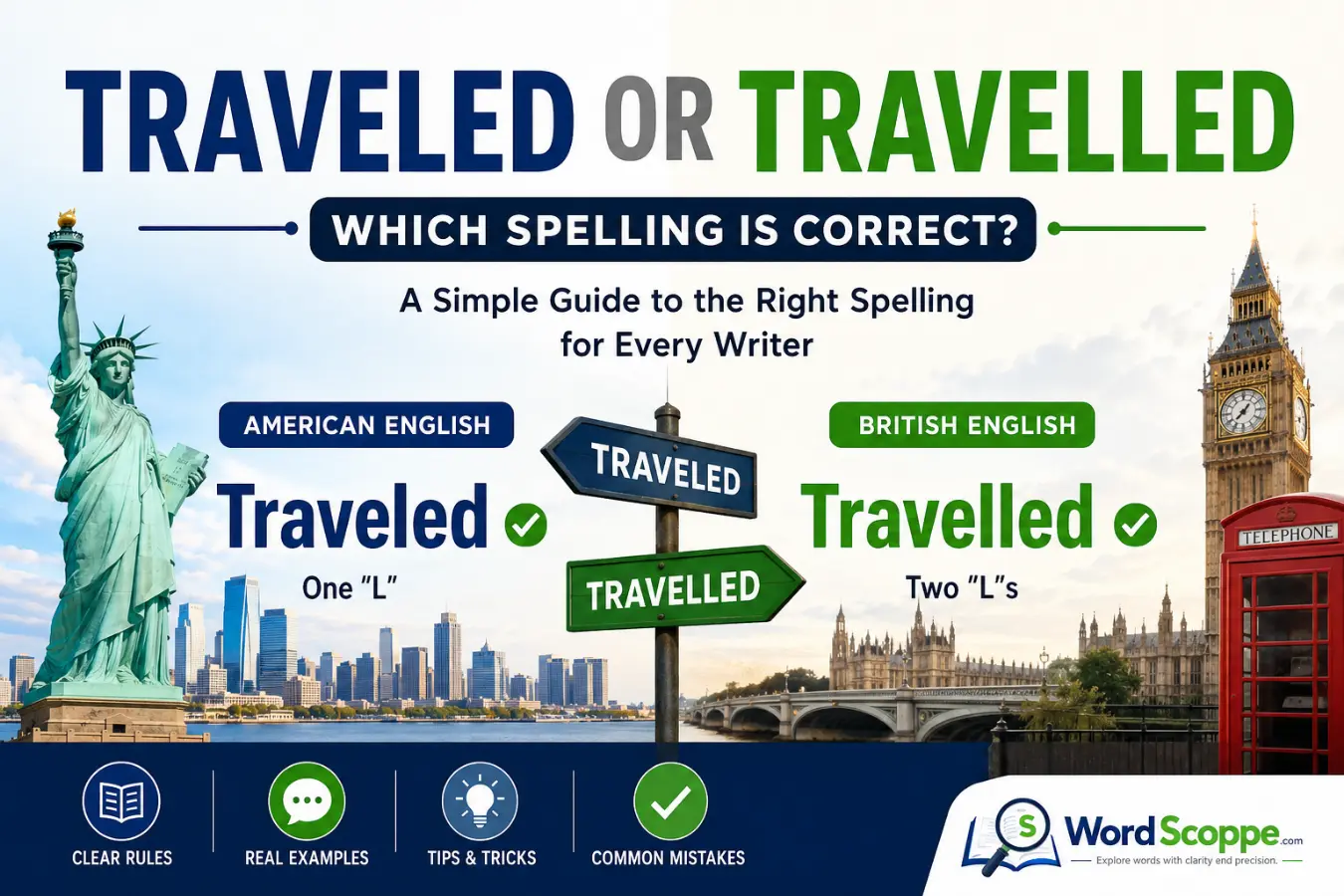
Traveled or travelled can both be correct, depending on the English variety you use. The main difference comes from American and British spelling rules. American English usually uses traveled with one “l.” British English often uses travelled with two “l’s.” Both forms describe the same action. For example, both mean that someone went from one place to another. This spelling difference also appears in words like traveling and travelling. So, which form should you choose? The answer depends on your audience, location, and writing style. Once you know the rule, the choice becomes easy. This guide explains the difference in simple terms. You will also see examples, common mistakes, and useful writing tips.
Quick Summary
- Traveled is the standard American English spelling.
- Travelled is the standard British English spelling.
- Both words have the same meaning.
- Canadian, Australian, and British writing often uses travelled.
- American websites and publications usually use traveled.
- Choose one spelling and use it consistently.
- The same rule affects traveling and travelling.
What Does Traveled or Travelled Mean?
Both spellings are the past tense and past participle of travel.
The word means to move from one place to another. It can describe short trips or long journeys.
For example:
- She traveled to Lahore last month.
- She travelled to Lahore last month.
- We traveled across the country by train.
- They travelled through several European cities.
The meaning stays the same in every example. Only the spelling changes.
Why Are There Two Spellings?
English has different spelling traditions in different countries.
American English often removes an extra letter in some words. British English often keeps that letter.
This difference developed through changes in English spelling over time. American dictionaries also helped establish shorter spellings.
For this reason, you may see:
- traveled / travelled
- traveling / travelling
- canceled / cancelled
- labeled / labelled
- modeled / modelled
These differences do not change the meaning. They mainly show which English variety the writer follows.
Traveled: The American English Spelling

Traveled is the common spelling in American English.
American writers usually use one “l” before the -ed ending. The same pattern applies to the present participle.
Examples include:
- I traveled to New York last summer.
- He traveled alone for the first time.
- We are traveling across America.
- She has traveled to many states.
Therefore, choose traveled when your content targets American readers.
This choice often works well for US websites, blogs, school papers, and business content.
Travelled: The British English Spelling
Travelled is the common spelling in British English.
British English usually doubles the final “l” before -ed and -ing.
Examples include:
- I travelled to London last summer.
- He travelled across England by train.
- We are travelling around Scotland.
- She has travelled widely.
This spelling also appears in many forms of English used outside the United States.
For example, British spelling is common in the United Kingdom and Australia. It also appears in many Commonwealth writing contexts.
Traveled vs Travelled: A Simple Comparison
| Feature | Traveled | Travelled |
| English variety | American English | British English |
| Number of “l” letters | One | Two |
| Meaning | Same | Same |
| Past tense | Traveled | Travelled |
| Present participle | Traveling | Travelling |
| Common US usage | Yes | No |
| Common UK usage | No | Yes |
The key point is simple: neither spelling is wrong.
The correct choice depends on the English style you follow.
Real-Life Examples of Both Spellings
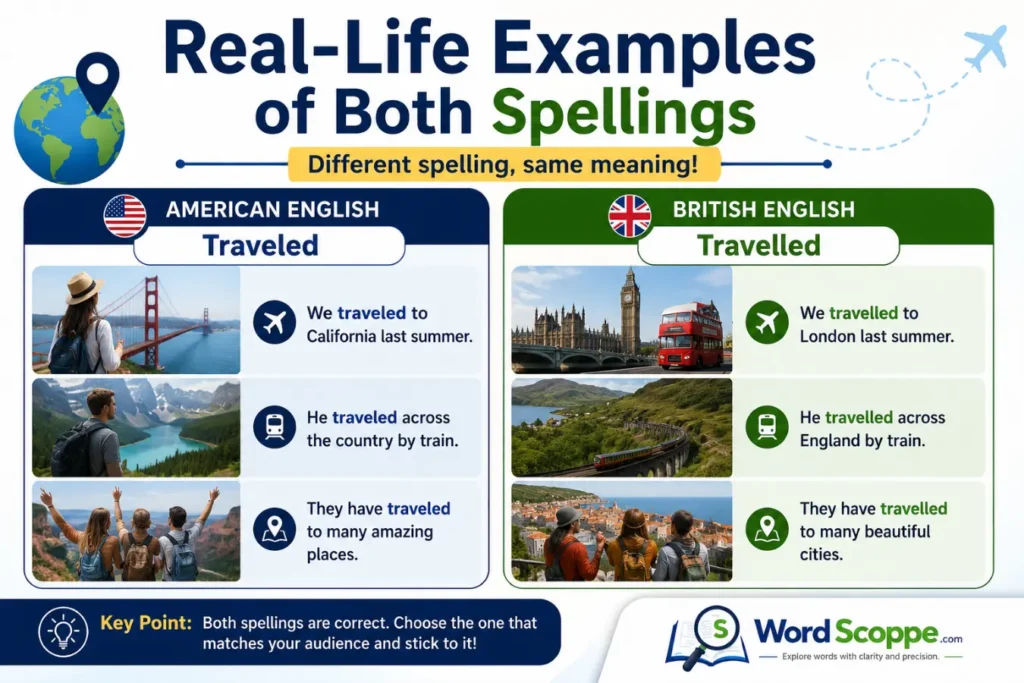
Imagine an American travel blogger writing about a vacation.
We traveled to California during the summer.
An English travel writer may write:
We travelled to California during the summer.
Both sentences communicate exactly the same idea.
The difference also appears in formal writing.
American style:
The team traveled to several cities for the project.
British style:
The team travelled to several cities for the project.
So, always consider your target audience before choosing a spelling.
When Should You Use Each Spelling?
Your audience should guide your choice.
Use traveled when your content follows American English. This choice suits US readers and American publications.
Use travelled when your content follows British English. This style suits UK readers and many international publications.
However, consistency matters most.
Do not write traveled in one paragraph and travelled in the next. That creates an inconsistent style.
Instead, select one English variety before you begin. Then follow its spelling rules throughout the article.
Common Mistakes to Avoid
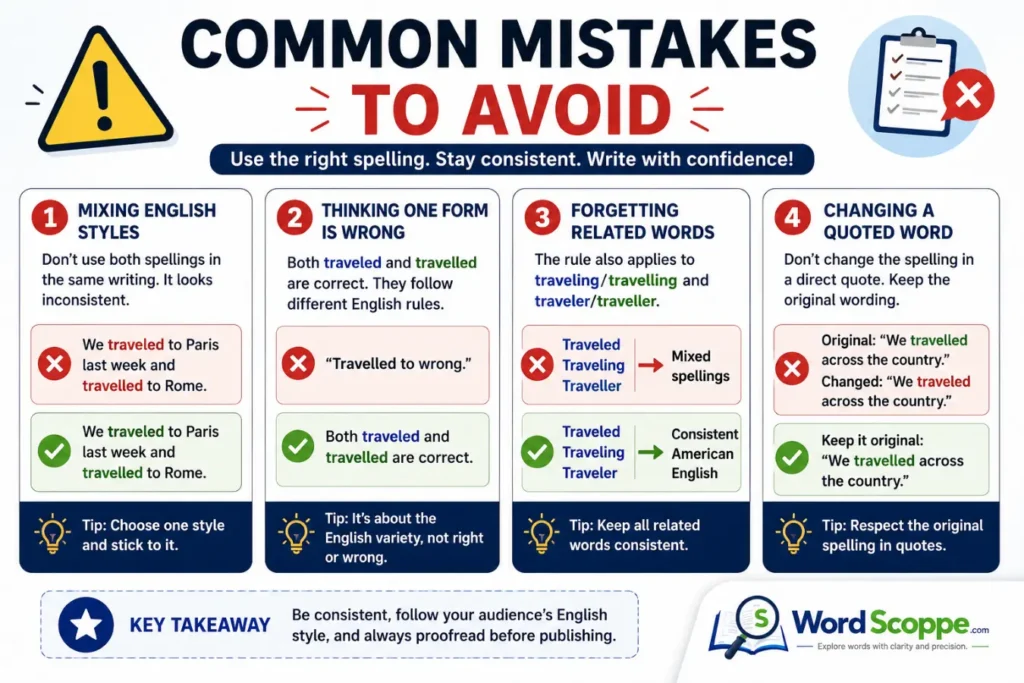
Many writers understand the difference but still mix the forms.
Here are some common mistakes to watch for.
Mixing English Styles
Using traveled and travelled in the same article can look careless.
Choose one style and keep it consistent.
Assuming One Form Is Wrong
Neither spelling is incorrect. Each belongs to a different English spelling system.
Forgetting Related Words
The difference does not stop with the past tense.
American English uses:
- traveled
- traveling
- traveler
British English uses:
- travelled
- travelling
- traveller
Changing a Quoted Word
If a source uses travelled, do not change it to traveled inside a direct quote.
Keep the original wording when accuracy matters.
Easy Tips for Choosing the Right Spelling
You can remember the rule with a simple method.
First, identify your target audience. Are you writing mainly for US readers or British readers?
Next, check your existing content. Look at words such as color/colour or favorite/favourite.
If your content uses American spellings, choose traveled.
If it uses British spellings, choose travelled.
Finally, check your article before publishing. Search for both versions.
This quick check can prevent unwanted spelling changes.
Synonyms and Related Travel Words
Sometimes writers want alternatives to avoid repetition. Several related words can help.
Useful alternatives include:
- journeyed
- went
- toured
- explored
- visited
- journeyed abroad
- went on a trip
- moved from place to place
- took a journey
However, these words do not always have exactly the same meaning.
For example, visited focuses on reaching a place. Explored suggests discovering or examining a place.
Therefore, choose a synonym based on the exact meaning you want.
Why This Spelling Difference Matters for SEO
Spelling consistency can improve the quality of your content.
Search engines understand many spelling variations and related terms. However, readers still expect content to match their language style.
For example, a UK audience may naturally search for travelled. A US audience may expect traveled.
Your main goal should not be keyword stuffing. Instead, write naturally for the people you want to reach.
Use related terms such as:
- American English spelling
- British English spelling
- past tense of travel
- travel spelling
- traveling vs travelling
- traveler vs traveller
- English spelling differences
These terms give search engines useful context.
Expert Insight: Which Form Should You Choose?
The best spelling is the one that matches your content’s English variety.
For a US-focused website, traveled usually makes the most sense. For a UK-focused website, travelled usually fits better.
Global websites, consistency still matters. Pick a clear editorial style and apply it across your pages.
Also, create a simple style guide for your website. Include rules for common spelling differences.
This approach helps writers, editors, and content teams stay consistent.
It also creates a more professional reading experience.
Frequently Asked Questions
Is traveled or travelled correct?
Both are correct. Traveled follows American English, while travelled follows British English.
Is traveled American or British English?
Traveled is the standard American English spelling.
Is travelled British English?
Yes. Travelled is the standard British English spelling.
Which spelling should I use for a US website?
Use traveled if your website follows American English.
Which spelling should I use for a UK website?
Use travelled if your website follows British English.
Are traveling and travelling different?
They follow the same spelling rule. American English uses traveling, while British English uses travelling.
Is traveler or traveller correct?
Both are correct. Traveler is common in American English, while traveller is common in British English.
Does the spelling change the meaning?
No. Both forms have the same meaning. The difference only reflects English spelling conventions.
Conclusion
The choice between traveled or travelled depends on the English variety you follow. American English normally uses traveled, while British English normally uses travelled. Both forms have the same meaning and describe movement from one place to another. The same difference appears in related words, such as traveling and travelling. Therefore, your target audience should guide your choice. Most importantly, stay consistent throughout your content. Do not switch between American and British spellings without a clear reason. If you write for US readers, choose the American form. If you write for UK readers, choose the British form. Once you know this simple rule, choosing the right spelling becomes easy.

Sophia Hayes is a language researcher and content writer at WordsCoppe.com, specializing in word comparisons, spelling differences, grammar explanations, and vocabulary insights. She is passionate about making English easier to understand through clear, accurate, and practical content. By breaking down complex language topics into simple explanations, Sophia helps readers improve their writing and communication skills. Her goal is to make learning English more accessible, engaging, and confidence-building for learners worldwide.