Began or begun is a common grammar question that confuses many English learners and native speakers. Both words come from the verb begin, but they are not interchangeable. Using the wrong one can make your writing sound incorrect. The good news is that the difference is simple once you know one grammar rule. In this guide, you will learn when to use began and when to use begun with easy explanations and real-life examples. You will also see a comparison table, common mistakes, helpful tips, and answers to frequently asked questions. By the end of this article, you will know exactly which word fits your sentence with confidence.
Quick Summary
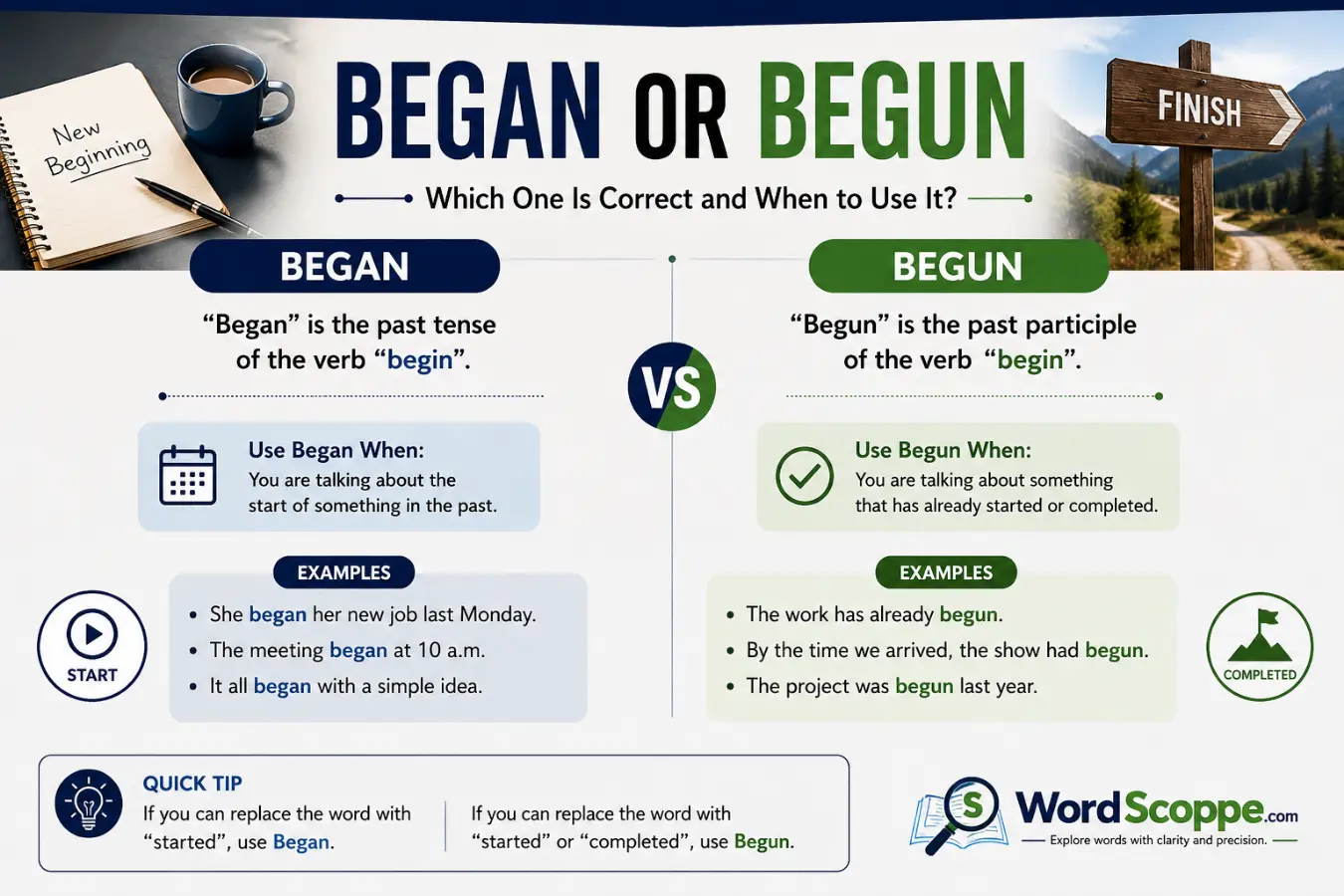
- Began is the simple past tense of begin.
- Begun is the past participle of begin.
- Use began without a helping verb.
- Use begun with has, have, or had.
- “I began my homework.” ✅
- “I have begun my homework.” ✅
- “I have began my homework.” ❌
Quick Rule:
Use began for a completed action in the past. Use begun after a helping verb.
What Do “Began” and “Begun” Mean?
Both began and begun come from the verb begin, which means to start something.
Although they share the same meaning, they have different grammar roles.
- Begin = Base form
- Began = Simple past tense
- Begun = Past participle
Choosing the correct form depends on the sentence structure, not the meaning.
Began vs Begun: The Key Difference
The easiest way to remember the difference is to look for a helping verb.
| Word | Grammar Form | Helping Verb Needed? | Example |
| Began | Simple Past | No | She began reading yesterday. |
| Begun | Past Participle | Yes | She has begun reading the book. |
Simple Rule
- If there is no helping verb, use began.
- If the sentence has has, have, or had, use begun.
This simple trick works in almost every situation.
When Should You Use “Began”?
Use began when talking about something that started and happened in the past.
It does not need a helping verb.
Examples
- I began learning English last year.
- They began the meeting at 9 a.m.
- The rain began suddenly.
- She began writing her novel in college.
- We began our journey before sunrise.
In each example, the action happened in the past and stands alone.
When Should You Use “Begun”?
Use begun only with a helping verb such as has, have, or had.
It cannot stand alone as the main verb.
Examples
- I have begun a new project.
- She has begun preparing dinner.
- They had begun the game before we arrived.
- The company has begun hiring new employees.
- We have begun decorating the house.
Notice that every sentence includes a helping verb before begun.
Real-Life Examples of Began and Begun
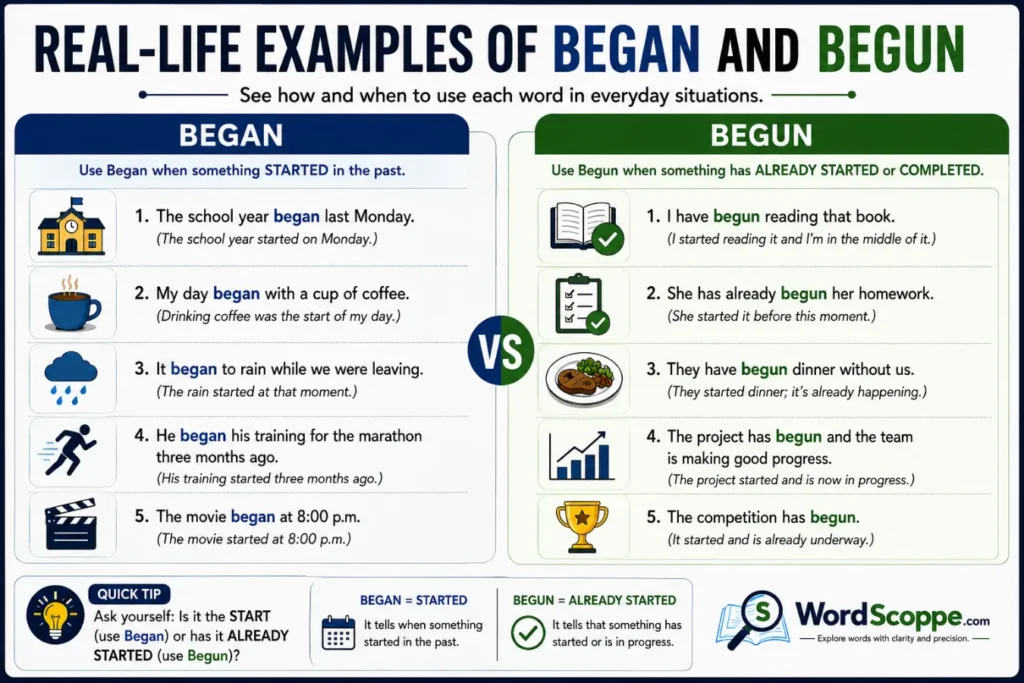
These examples show how both words appear in everyday English.
| Situation | Correct Sentence |
| School | The class began at eight o’clock. |
| Work | We have begun the new marketing campaign. |
| Travel | Our trip began on Monday morning. |
| Home | She has begun cleaning the kitchen. |
| Sports | The match began after the rain stopped. |
| Business | The company had begun expanding overseas. |
Reading real examples makes the grammar easier to remember.
Why Do People Confuse “Began” and “Begun”?
Many learners mix these words because both describe something that started.
However, the real difference is grammar.
Here are the most common reasons for confusion:
- Both come from the verb begin.
- Both refer to past actions.
- Many irregular verbs have similar forms.
- Learners forget to check for helping verbs.
- Spoken English sometimes makes the difference harder to notice.
The easiest solution is to ask yourself one question:
Does the sentence have has, have, or had?
- Yes → Use begun.
- No → Use began.
Common Verb Forms of “Begin”
Learning all three forms helps you avoid mistakes.
| Verb Form | Word | Example |
| Base Form | Begin | Let’s begin now. |
| Simple Past | Began | We began early. |
| Past Participle | Begun | We have begun already. |
Remember this pattern:
Begin → Began → Begun
It is one of the most common irregular verbs in English.
Common Mistakes When Using Began or Begun
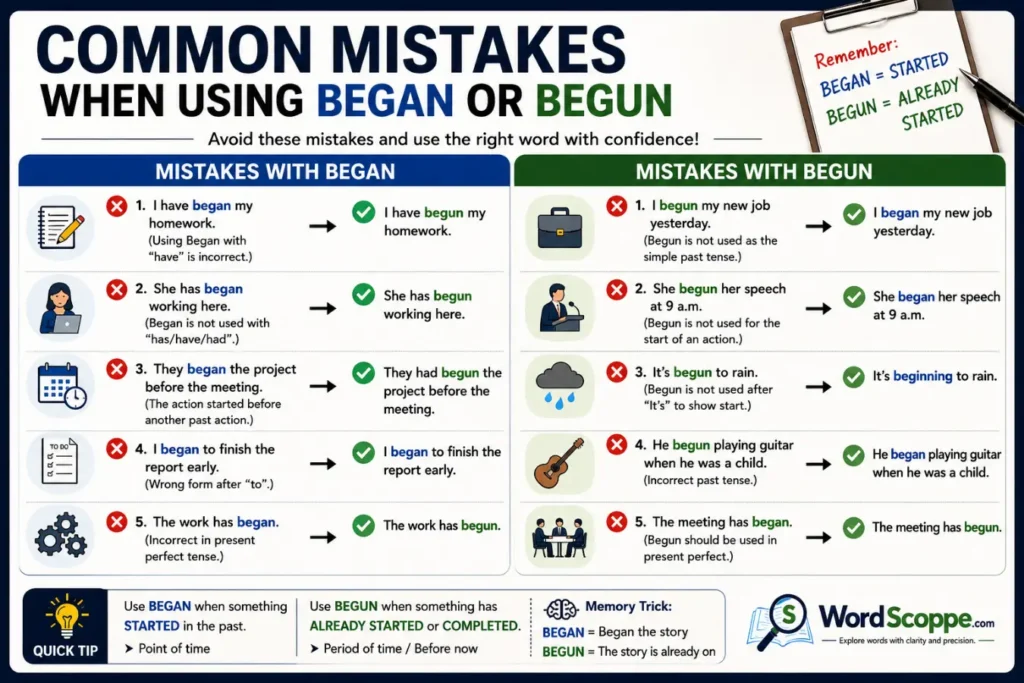
Even advanced English learners sometimes confuse these two verb forms. Here are the mistakes you should avoid.
1. Using Begun Without a Helping Verb ❌
Incorrect:
- I begun my homework yesterday.
Correct:
- I began my homework yesterday.
Why?
The sentence has no helping verb, so began is the correct choice.
2. Using Began After Has, Have, or Had ❌
Incorrect:
- She has began her presentation.
Correct:
- She has begun her presentation.
Why?
After has, have, or had, always use the past participle begun.
3. Forgetting That Begin Is an Irregular Verb
Some learners try to say “begined,” but this word is incorrect.
Correct verb forms are:
- Begin
- Began
- Begun
4. Mixing Tenses in the Same Sentence
Incorrect:
- They had began before we arrived.
Correct:
- They had begun before we arrived.
Always match the correct verb form with the sentence tense.
Tips to Remember the Difference Between Began and Begun
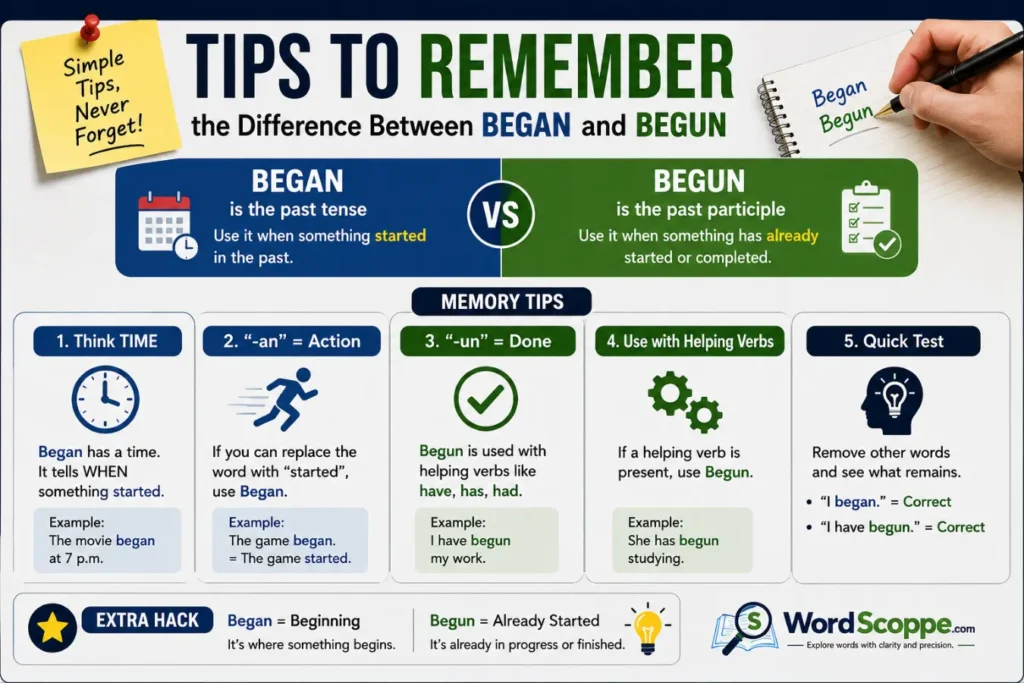
These simple tricks make the grammar easy to remember.
- No helping verb? Use began.
- Has, have, or had? Use begun.
- Remember the pattern: Begin → Began → Begun.
- Read the sentence aloud. If it sounds awkward after has or have, check the verb form.
- Practice with short sentences every day.
Memory Trick
Think of this simple formula:
Has/Have/Had + Begun ✅
Yesterday/Last week + Began ✅
Using Began and Begun in Daily Life
These words appear in everyday conversations, emails, books, and work.
At School
- The lesson began at 9 a.m.
- The teacher has begun the next chapter.
Work
- We began the meeting on time.
- Our team has begun testing the new software.
At Home
- She began cooking dinner.
- They have begun painting the living room.
While Traveling
- The journey began before sunrise.
- Our vacation has begun at last.
Using these examples helps you remember the correct grammar naturally.
Synonyms of Begin
If you want to avoid repeating begin, you can use these synonyms.
| Word | Best Used For |
| Start | Everyday conversations |
| Commence | Formal writing |
| Launch | Projects or businesses |
| Initiate | Professional or technical writing |
| Open | Events or meetings |
| Kick off | Informal speech |
| Get underway | Processes or activities |
Choose the synonym that best matches your audience and writing style.
Expert Insight
The confusion between began and begun comes from English irregular verbs, not from difficult grammar. Once you understand the difference between the simple past tense and the past participle, choosing the correct word becomes much easier.
Professional writers and editors often look for helping verbs before checking verb forms. You can use the same strategy. Before you write began or begun, quickly check whether the sentence includes has, have, or had. This simple habit will improve your grammar and make your writing sound more natural and accurate.
Frequently Asked Questions
Is it began or begun?
It depends on the sentence. Use began for the simple past tense and begun after has, have, or had.
Can I say “I have began”?
No. The correct sentence is “I have begun.”
Which is correct: “The meeting began” or “The meeting begun”?
“The meeting began” is correct because there is no helping verb.
Is begun a past tense?
No. Begun is the past participle of begin.
Why do people confuse began and begun?
Both words come from begin and describe past actions, but they serve different grammar functions.
What are the three forms of begin?
The three forms are:
- Begin
- Began
- Begun
How can I remember the difference easily?
Remember this rule:
- Began = Past tense
- Begun = After has, have, or had
Conclusion
Understanding began or begun is easier than it first appears. Both words come from the verb begin, but they have different grammar roles. Began is the simple past tense and works without a helping verb. Begun is the past participle and always follows has, have, or had. Learning this one rule will help you avoid one of the most common English grammar mistakes.
Whenever you feel unsure, check the sentence for a helping verb before choosing the correct form. With regular practice and real-life examples, using began and begun will soon become natural. Mastering this difference will also make your speaking and writing clearer, more accurate, and more professional.

Sophia Hayes is a language researcher and content writer at WordsCoppe.com, specializing in word comparisons, spelling differences, grammar explanations, and vocabulary insights. She is passionate about making English easier to understand through clear, accurate, and practical content. By breaking down complex language topics into simple explanations, Sophia helps readers improve their writing and communication skills. Her goal is to make learning English more accessible, engaging, and confidence-building for learners worldwide.