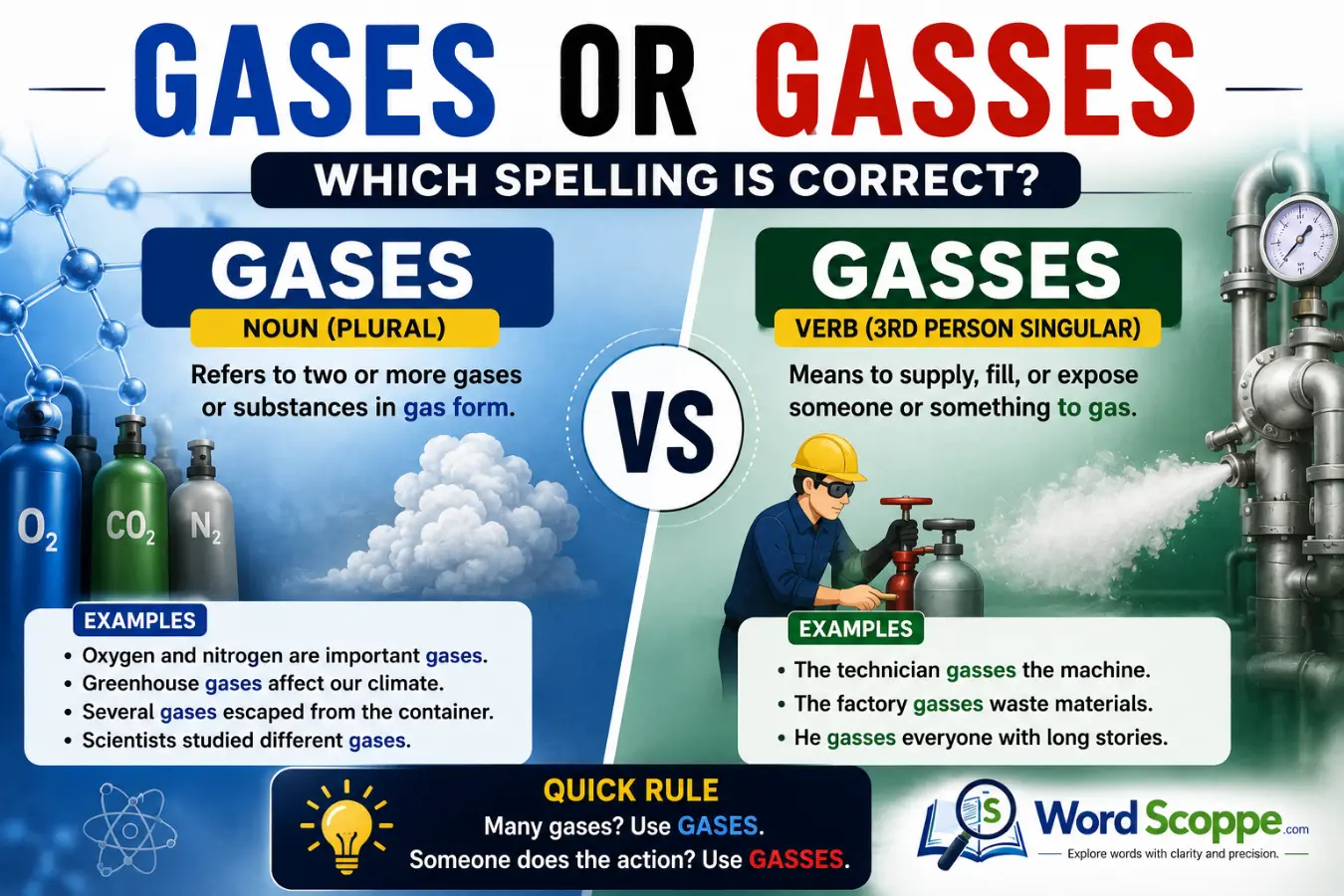
Gases or gasses is a spelling question that often confuses English writers. The two words look almost identical, yet they are not used in the same way. One is the standard plural form of gas, while the other is a verb with a completely different meaning. Because both spellings appear in English, many people accidentally choose the wrong one.
Fortunately, the rule is straightforward. Once you know how each word functions, you can avoid a common writing mistake. Whether you are writing about science, chemistry, cooking, or everyday conversation, choosing the correct spelling improves clarity and professionalism.
This guide explains the difference in simple English. You will also find comparison tables, practical examples, common mistakes, memory tricks, FAQs, and expert advice to help you use the right word every time.
Quick Summary
- Gases is the correct plural of gas.
- Gasses is the third-person singular form of the verb gas.
- Use gases when talking about more than one gas.
- Use gasses only when someone or something gasses another.
- Remember: Plural = gases. Verb = gasses.
What Does “Gases” Mean?
Gases is the plural form of the noun gas.
It refers to two or more gases or substances in the gas state.
Examples include:
- Oxygen and nitrogen are important gases.
- Greenhouse gases affect Earth’s climate.
- Several gases escaped from the container.
- Scientists studied different gases in the laboratory.
Whenever you mean more than one gas, gases is the correct spelling.
What Does “Gasses” Mean?
Gasses is a verb.
It is the third-person singular form of gas, meaning to expose someone to gas, supply gas, or sometimes to talk excessively in informal English.
Examples:
- The factory gasses waste materials safely.
- The mechanic gasses the vehicle before testing it.
- He gasses everyone with long stories. (informal)
Although gasses is a correct English word, it is much less common than gases.
Gases or Gasses: What’s the Difference?
The easiest way to choose the correct spelling is to identify whether you need a noun or a verb.
| Word | Part of Speech | Meaning | Example |
| Gases | Noun (Plural) | More than one gas | Several gases filled the chamber. |
| Gasses | Verb | Supplies or exposes to gas | The technician gasses the system. |
Simple rule:
- More than one gas → gases ✅
- Someone performs the action → gasses ✅
Why Is “Gases” Usually Correct?
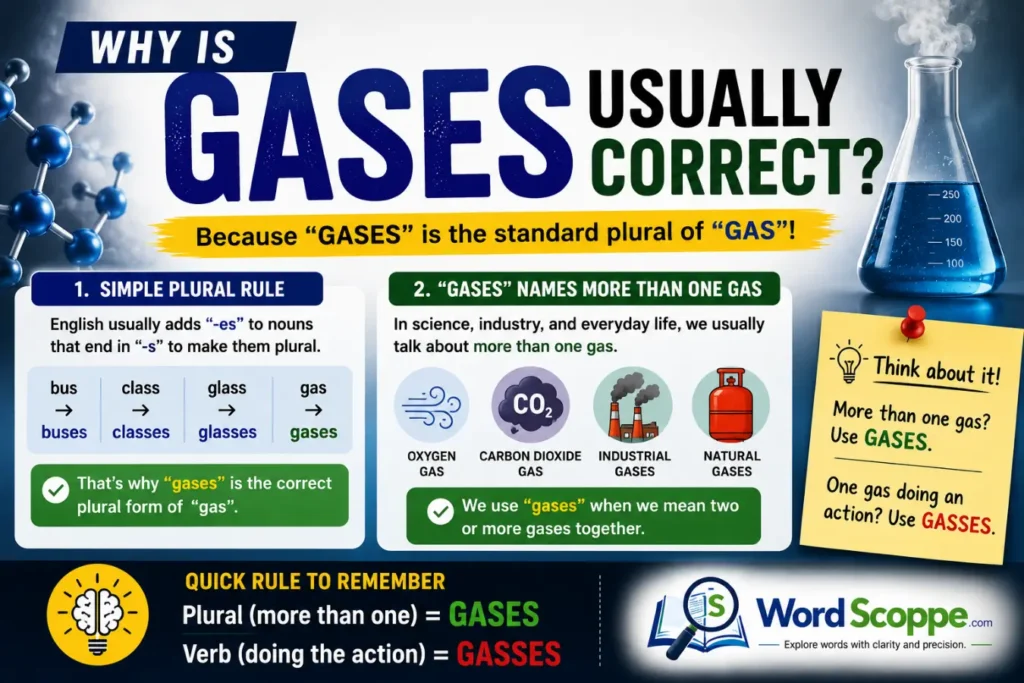
Most people search for gases or gasses because they need the plural form of gas.
English usually forms plurals by adding -es after nouns ending in -s.
Examples:
- bus → buses
- class → classes
- gas → gases
That is why gases is the correct spelling in nearly every science article, textbook, or news report.
Real-Life Examples of Gases and Gasses
Looking at everyday examples makes the difference clearer.
Using gases
- Hot gases rise into the atmosphere.
- Natural gases occur underground.
- Scientists tested several gases.
- Harmful gases can pollute the air.
Using gasses
- The engineer gasses the equipment before inspection.
- The company gasses storage tanks carefully.
- He gasses his friends with endless jokes. (informal)
Notice that gasses always describes an action.
Common Mistakes Writers Make
Many people mix these words because they focus only on spelling.
Here are some common errors.
❌ Scientists studied different gasses.
✅ Scientists studied different gases.
❌ Harmful gasses damage the environment.
✅ Harmful gases damage the environment.
❌ The technician gases the machine.
✅ The technician gasses the machine.
Always decide whether you need a noun or a verb before choosing the spelling.
Easy Trick to Remember the Difference
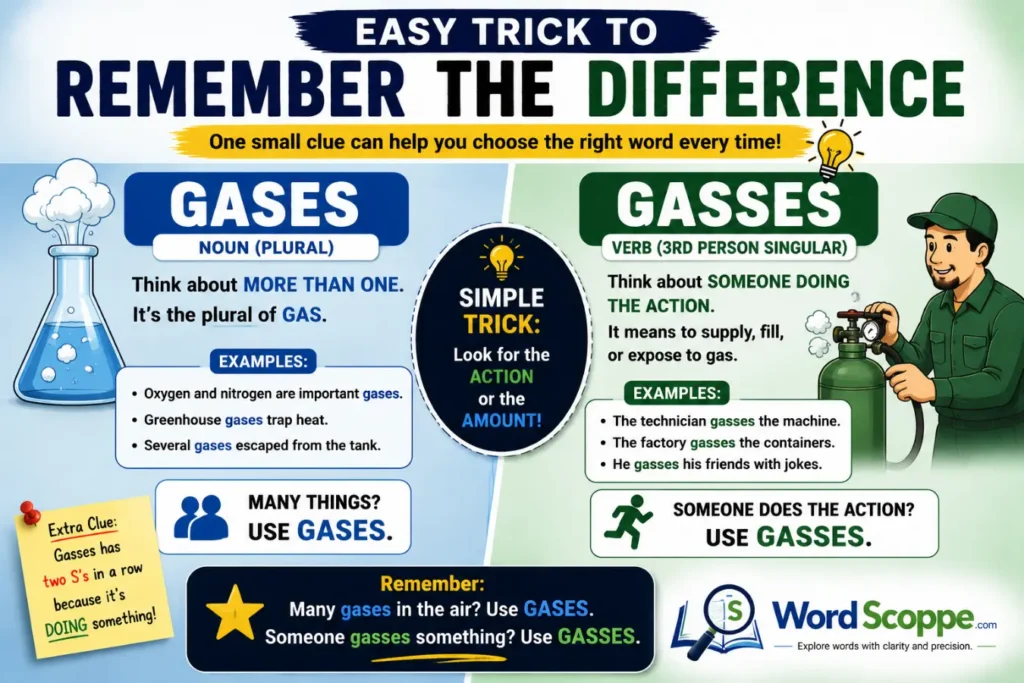
A simple memory trick makes the choice easy.
Think about the double s.
The extra s in gasses reminds you that it is doing something.
It is an action.
Examples:
- fixes
- misses
- passes
- gasses
Meanwhile, gases simply names more than one gas.
Easy formula:
- Many gases ✅
- Someone gasses ✅
How These Words Are Used in Everyday English
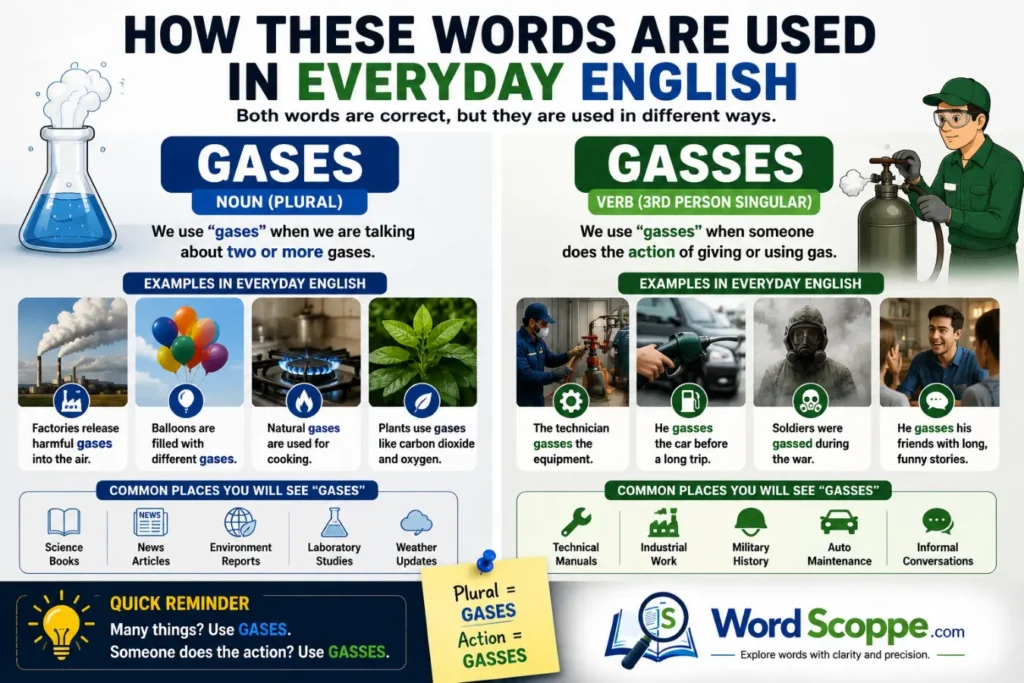
Although gases appears much more often, both words have real uses.
You may read gases in:
- Science books
- Chemistry lessons
- Environmental reports
- Medical articles
- Weather discussions
You may see gasses in:
- Technical manuals
- Industrial writing
- Military history
- Informal conversations
Knowing the difference helps you write accurately in every situation.
Related Words and Synonyms
Depending on the context, these related words may appear with gases or gasses.
Related words for gases
- vapors
- fumes
- emissions
- air
- atmosphere
Related words for gasses
- fuels
- supplies
- fills
- exposes
- releases
Choose synonyms carefully because their meanings are not always identical.
Expert Insights
Language experts recommend identifying the role of the word before checking its spelling. If the word names substances such as oxygen, hydrogen, or carbon dioxide, use gases because it is the plural noun. If the word describes someone performing the action of applying or releasing gas, use gasses because it is the verb. This simple habit prevents one of the most common spelling mistakes in scientific and technical writing.
Frequently Asked Questions
Is it gases or gasses?
Both are correct, but they have different meanings. Gases is the plural noun, while gasses is a verb.
Which spelling is more common?
Gases is much more common because it is the standard plural form of gas.
Is “gasses” a real word?
Yes. It is the third-person singular form of the verb gas.
Why do people confuse gases and gasses?
The words look similar and sound almost the same, making them easy to mix up.
How do I remember the difference?
Remember: gases = plural noun, gasses = action verb.
Is “greenhouse gases” correct?
Yes. Greenhouse gases is the correct scientific term.
Can I use “gasses” for more than one gas?
No. The correct plural is gases.
Conclusion
Understanding the difference between gases or gasses is easier once you know each word’s job in a sentence. Gases is the standard plural form of gas and is the correct choice when talking about more than one gas. Gasses, on the other hand, is a verb that describes the action of supplying or exposing something to gas. In everyday writing, scientific articles, and school assignments, you will use gases far more often than gasses. Remember this simple rule, and you will avoid a common spelling mistake while writing with greater confidence and accuracy.

Sophia Hayes is a language researcher and content writer at WordsCoppe.com, specializing in word comparisons, spelling differences, grammar explanations, and vocabulary insights. She is passionate about making English easier to understand through clear, accurate, and practical content. By breaking down complex language topics into simple explanations, Sophia helps readers improve their writing and communication skills. Her goal is to make learning English more accessible, engaging, and confidence-building for learners worldwide.