Have you ever wondered whether here here or hear hear is the correct phrase? Many people type “here here” when they want to show agreement. However, the correct expression is “hear hear.” This small spelling difference changes the meaning completely. Knowing the right form helps you write clearly and avoid common mistakes. In this guide, you will learn what each phrase means, where it came from, and how to use it with confidence. By the end, you will never confuse these words again.
Quick Summary
- “Hear hear” is the correct expression.
- It means “I agree” or “Well said.”
- “Here here” is usually a spelling mistake.
- The phrase started in the British Parliament.
- Use “hear hear” in speeches, meetings, debates, and formal discussions.
- Remember: hear = listen, which matches the phrase’s meaning.
What Does “Hear Hear” Mean?

“Hear hear” is an expression people use to show strong agreement with someone’s words. It is similar to saying:
- I agree.
- Well said!
- Exactly!
- That’s right!
Instead of clapping or interrupting, listeners can simply say “hear hear” to support the speaker.
The phrase encourages others to listen carefully because the speaker has said something important.
What Does “Here Here” Mean?
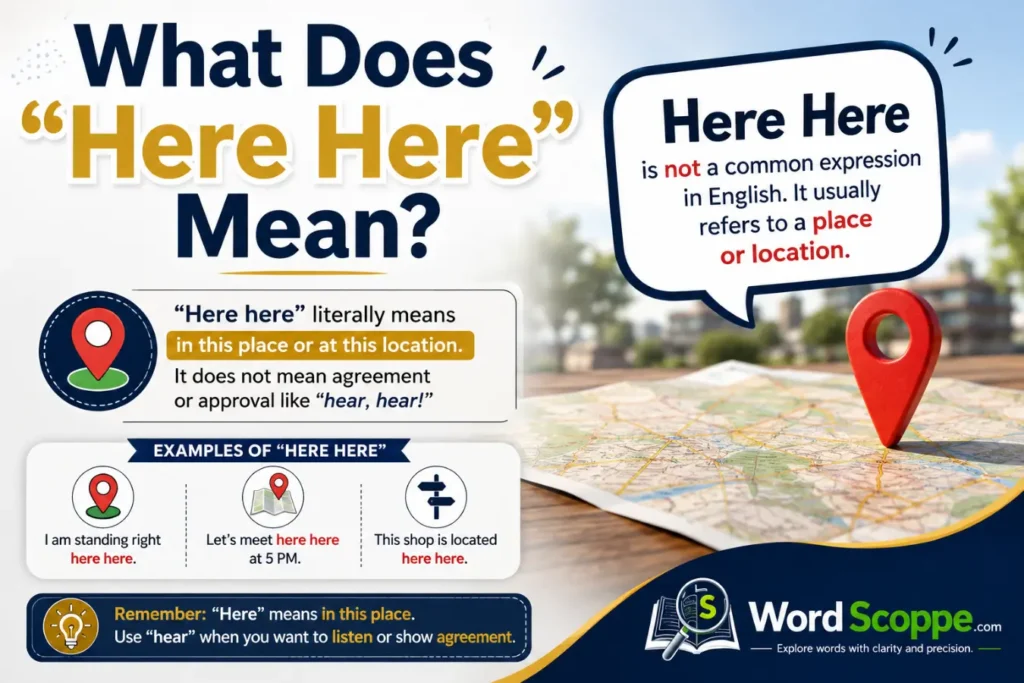
The words “here here” have no special meaning as an English expression.
Taken literally:
- Here means in this place.
- Saying “here here” simply repeats the location word.
People often write “here here” because it sounds exactly like “hear hear.” Since both phrases have the same pronunciation, this mistake is very common.
In modern English, “here here” is almost always considered incorrect when you want to express agreement.
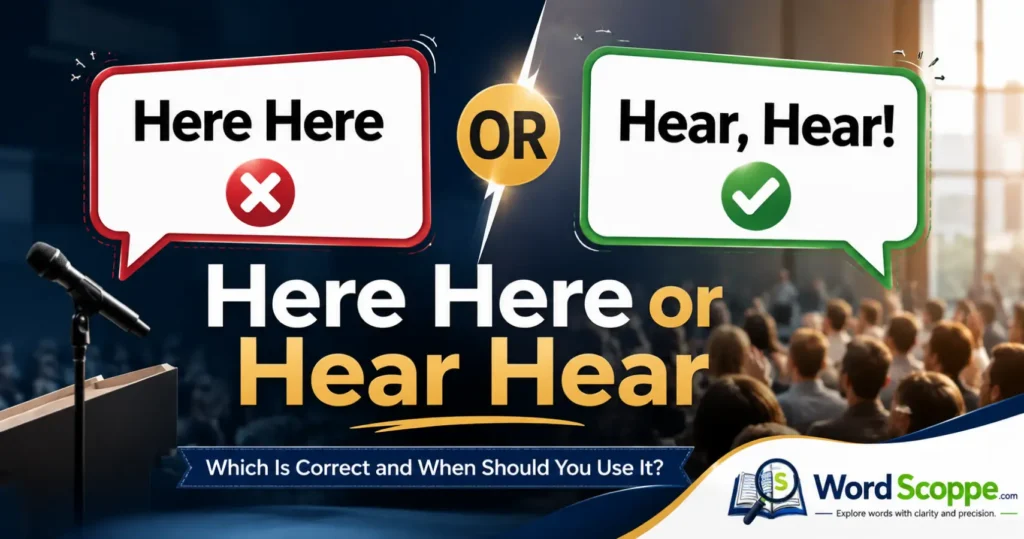
Here Here or Hear Hear: Which One Is Correct?
The answer is simple.
| Phrase | Correct? | Meaning |
| Hear hear | ✅ Yes | Shows agreement or approval |
| Here here | ❌ No | Usually a spelling mistake |
If someone makes a great point during a meeting, you should write or say:
✅ Hear, hear!
Not:
❌ Here, here!
The confusion happens because both phrases sound the same.
Why Do People Confuse These Two Phrases?
English contains many words that sound alike but have different meanings.
These are called homophones.
For example:
- Hear → to listen
- Here → in this place
- Their → belonging to them
- There → location
- They’re → they are
Because hear and here sound identical, many writers choose the wrong spelling without realizing it.
Autocorrect may also miss the mistake because here is a correctly spelled English word.
Where Did “Hear Hear” Come From?
The expression has an interesting history.
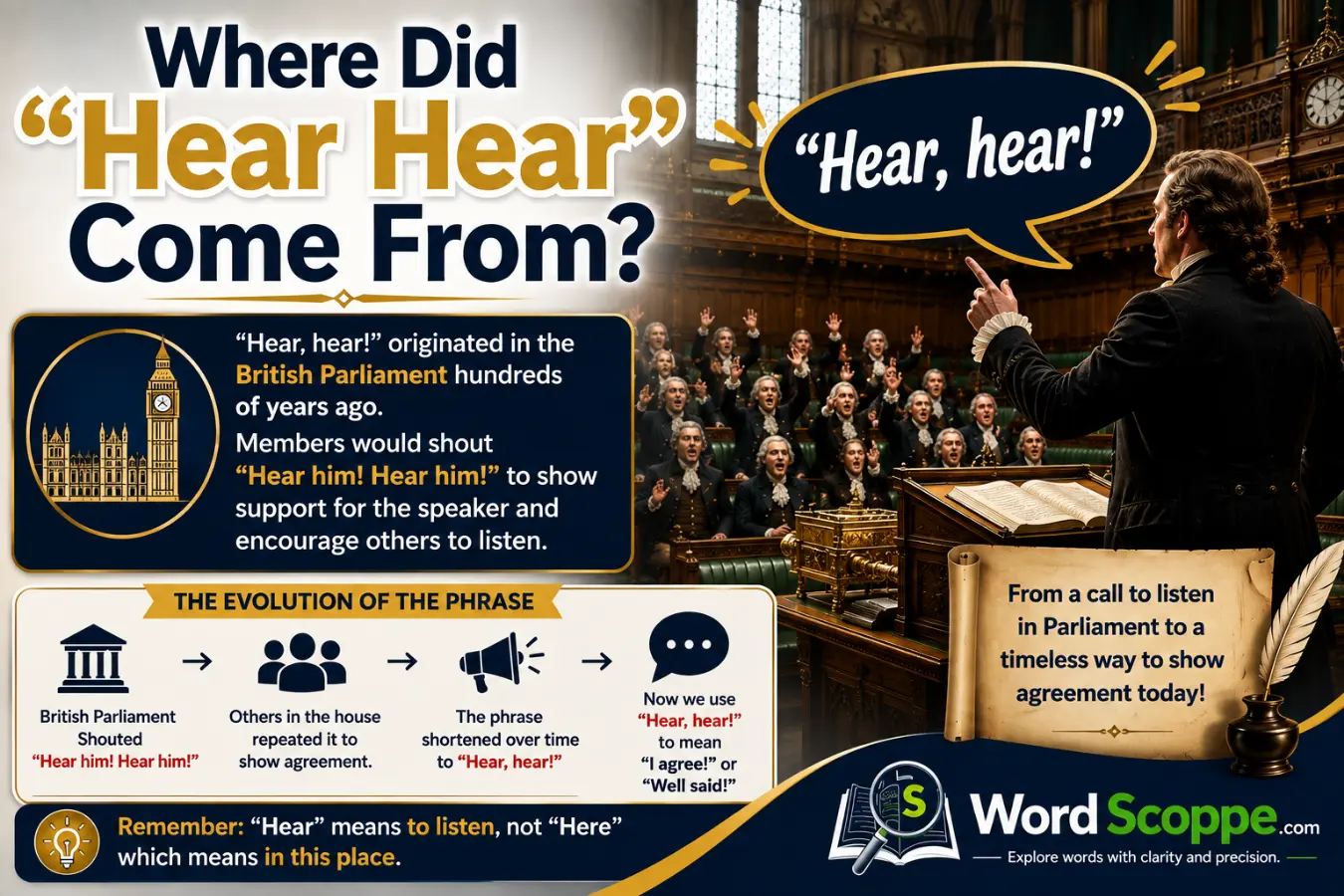
Hundreds of years ago, members of the British Parliament often shouted:
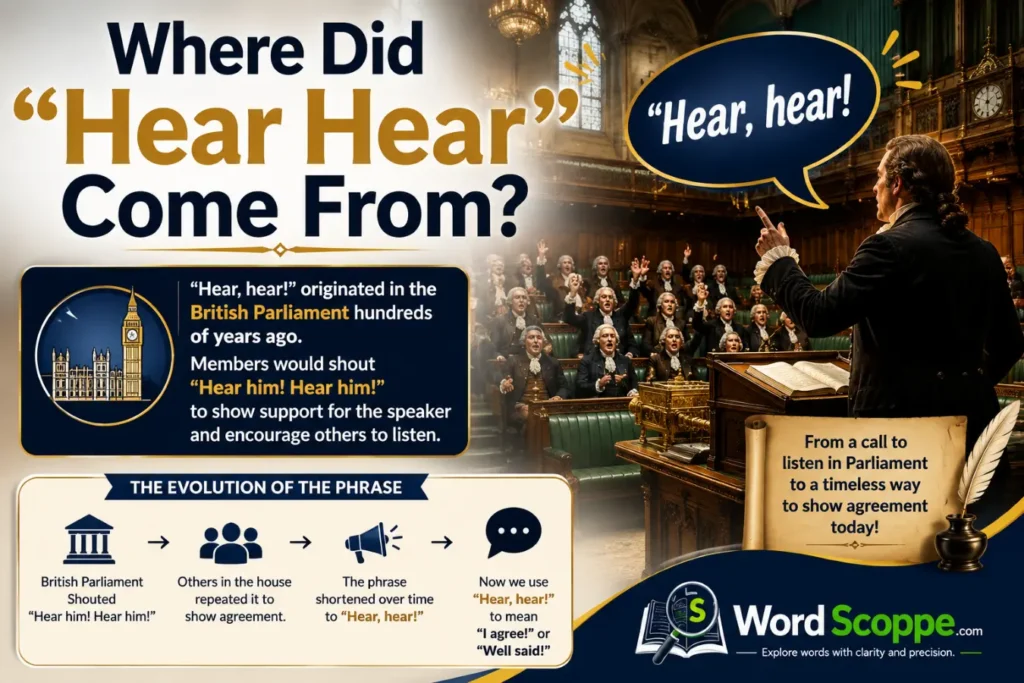
“Hear him! Hear him!”
They wanted others to listen carefully to the speaker.
Over time, people shortened the phrase to:
“Hear, hear!”
Today, it remains a traditional way to show support during speeches, debates, ceremonies, and formal meetings.
Even outside politics, people still use it to express agreement.
Simple Examples of “Hear Hear”
These everyday examples make the meaning easy to understand.
At School
Teacher:
Reading every day improves your vocabulary.
Students:
Hear, hear!
During a Meeting
Manager:
Teamwork always creates better results.
Employee:
Hear, hear!
At a Family Dinner
Parent:
We should spend more time together.
Everyone:
Hear, hear!
During a Speech
Speaker:
Kindness costs nothing but means everything.
Audience:
Hear, hear!
Each example shows support for the speaker’s opinion.
Real-Life Examples: Correct vs Incorrect Usage
Correct:
- Hear, hear! That was an excellent idea.
- Everyone shouted, “Hear, hear!” after the speech.
- I completely agree—hear, hear!
- The audience responded with a loud “Hear, hear!”
Incorrect:
- Here, here! That was an excellent idea.
- Everyone shouted, “Here, here!” after the speech.
- Here here, I agree with you.
Although many people write these incorrect examples online, professional writing prefers “hear, hear.”
Why “Hear Hear” Makes More Sense
Think about the meaning.
The phrase asks listeners to hear what someone has said.
It does not tell people to come here.
This simple idea makes remembering the correct spelling much easier.
A quick memory trick is:
If people should listen, use “hear.”
Common Situations Where You Can Use “Hear Hear”
You may hear this phrase in many settings.
It works well in:
- Public speeches
- Classroom discussions
- Business meetings
- Political debates
- Award ceremonies
- Formal presentations
- Club meetings
- Community events
It is less common in casual text messages, but people still use it online to show agreement.
Common Mistakes People Make
Many writers confuse here here or hear hear because both phrases sound exactly alike. However, only one is correct in standard English.
Here are the most common mistakes to avoid.
1. Writing “Here Here” Instead of “Hear Hear”
This is the mistake people make most often.
❌ Here, here! That’s a great point.
✅ Hear, hear! That’s a great point.
2. Thinking the Phrase Means “Come Here”
Some people believe here here calls attention to a place.
It does not.
The expression is about listening, not location.
3. Using It in Every Conversation
Although hear, hear is correct, it fits best after someone makes a statement worth supporting.
It sounds natural in speeches, meetings, debates, and formal discussions.
4. Forgetting the Comma
The traditional form is:
Hear, hear!
Many people also write:
Hear hear!
Both are widely understood, but the comma is the more traditional style.
Easy Tips to Remember the Correct Spelling
You can remember the right phrase with these simple tricks.
Think About Listening
The word hear means to listen.
If you agree with someone’s words, you want others to hear them.
Link the Meaning
Ask yourself:
Am I talking about listening or about a place?
- Listening → Hear
- Location → Here
The answer becomes obvious.
Remember This Sentence
Good ideas should be heard, not placed here.
This memory trick helps many learners avoid the mistake.
Using “Hear Hear” in Everyday Life
Although the phrase began in formal debates, people still use it today.
Here are some everyday situations.
During a Team Meeting
Manager:
Customer service should always come first.
You can respond:
Hear, hear!
At a Graduation Ceremony
Speaker:
Never stop learning.
Audience:
Hear, hear!
Online Discussions
Someone writes:
We should spend less time on our phones.
You might reply:
Hear, hear!
Family Conversations
Parent:
Eating dinner together is important.
Family member:
Hear, hear!
The phrase always shows agreement with the speaker.
Synonyms and Similar Expressions
If you want to express agreement in different ways, try these alternatives.
| Expression | Meaning |
| Well said! | I agree completely. |
| Exactly! | That’s correct. |
| Absolutely! | Strong agreement. |
| I couldn’t agree more. | Complete agreement. |
| That’s right. | Confirmation. |
| Good point. | Approval of an idea. |
| You’re absolutely right. | Strong support. |
| I agree. | Simple agreement. |
These expressions work well in everyday conversations.
Expert Insight: Why This Phrase Still Matters
Understanding here here or hear hear improves both your writing and communication.
Small spelling mistakes can affect credibility, especially in emails, articles, academic work, and professional messages.
Because hear hear is an established English expression, using it correctly shows attention to detail and a good understanding of idioms.
Writers, students, teachers, and professionals all benefit from learning the correct form.
Remember that English contains many homophones. Always focus on the meaning before choosing the spelling.
Frequently Asked Questions
Is “hear hear” grammatically correct?
Yes. this is the correct expression for showing agreement with a speaker.
Is “here here” ever correct?
Only if you literally mean a location by repeating the word here. It is not correct as an expression of agreement.
Why do people write “here here”?
Because hear and here sound the same. They are homophones, which often causes spelling mistakes.
Can I use “hear hear” in emails?
Yes. It works well in professional or formal emails when you want to support someone’s opinion.
Is “hear hear” still used today?
Yes. Although it is more common in formal settings, people still use it in meetings, speeches, discussions, and online conversations.
Where did “hear hear” originate?
It comes from the British Parliament, where members once shouted “Hear him! Hear him!” to encourage others to listen.
Is “hear hear” an idiom?
Yes. It is a fixed English expression used to show approval or agreement.
Conclusion
Understanding this is easier once you know the meaning behind each word. Although many people accidentally write “here here,” the correct expression is “hear, hear!” because it encourages others to listen to an important statement. The phrase has a long history and remains useful in speeches, meetings, debates, and everyday conversations. Remember that hear relates to listening, while here refers to a place. Keeping that simple difference in mind will help you choose the correct spelling every time. With regular practice, you can avoid this common mistake and write with greater confidence and accuracy.

Sophia Hayes is a language researcher and content writer at WordsCoppe.com, specializing in word comparisons, spelling differences, grammar explanations, and vocabulary insights. She is passionate about making English easier to understand through clear, accurate, and practical content. By breaking down complex language topics into simple explanations, Sophia helps readers improve their writing and communication skills. Her goal is to make learning English more accessible, engaging, and confidence-building for learners worldwide.