
There or their is a common grammar question that confuses many English learners and even native speakers. These two words sound the same, but they have different meanings and uses. That is why people often mix them up while writing.
The good news is that learning the difference is easy. Once you know what each word means, you can choose the correct one with confidence.
In this guide, you will learn the meaning of each word in simple English. You will also see easy examples, common mistakes, and helpful tips. By the end, you will know exactly when to use there and when to use their in everyday writing and speaking.
Quick Summary
- There shows a place or introduces a sentence.
- Their shows that something belongs to people.
- Both words sound the same but have different meanings.
- They are examples of homophones.
- Using the correct word makes your writing clear and professional.
- A simple memory trick can help you avoid mistakes.
What Does “There” Mean?
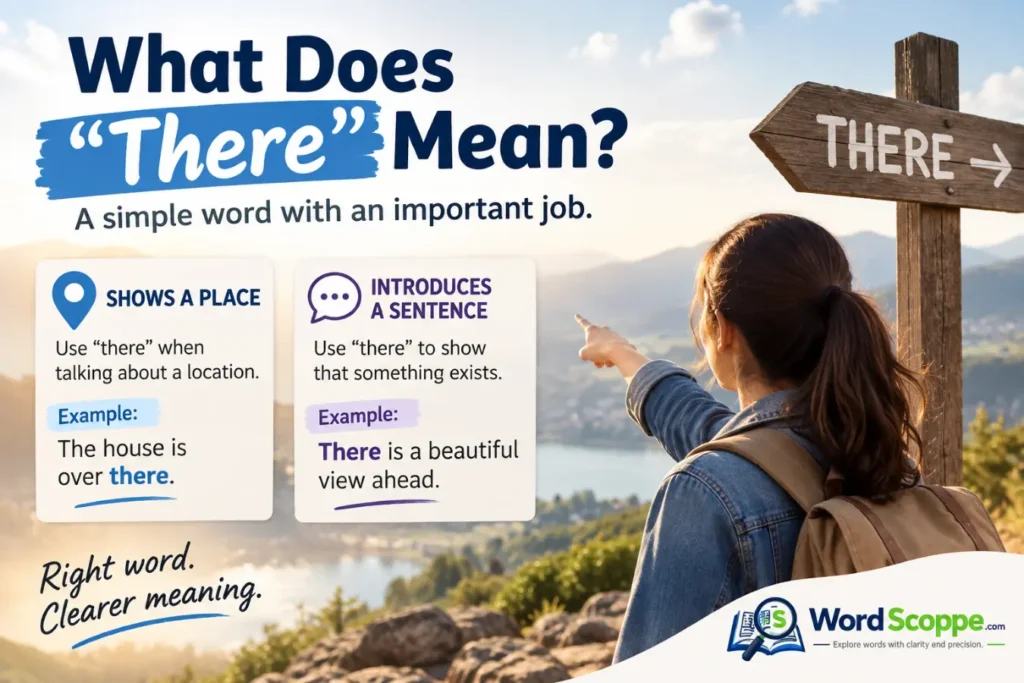
The word there has more than one job in English. Most often, it points to a place. It can also begin a sentence to show that something exists.
There as a Place
Use there when talking about a location.
Examples:
- The books are over there.
- We parked our car there.
- She stood there and smiled.
- My school is there, across the road.
There to Introduce Something
Sometimes there starts a sentence before the real subject.
Examples:
- There is a cat on the roof.
- There are many students in the classroom.
- There was a loud noise outside.
- There will be a meeting tomorrow.
In these examples, there does not show a place. Instead, it introduces the sentence.
What Does “Their” Mean?
The word their is a possessive adjective. It tells us that something belongs to two or more people. It can also refer to one person when the person’s gender is unknown or not specified.
Their Shows Ownership
Use their before a noun to show possession.
Examples:
- The children forgot their bags.
- My friends love their new house.
- The players celebrated their victory.
- The teachers prepared their lessons.
Their for Singular “They”
Modern English often uses their with singular they.
Examples:
- Every student should bring their notebook.
- Someone left their umbrella here.
- Each customer received their receipt.

This use is common in everyday English because it sounds natural and inclusive.
There or Their: What’s the Difference?
Although there and their sound exactly the same, they serve different purposes.
| Feature | There | Their |
| Part of Speech | Adverb, pronoun, or introductory word | Possessive adjective |
| Main Meaning | Refers to a place or introduces a sentence | Shows ownership |
| Answers Which Question? | Where? or What exists? | Whose? |
| Example | There is a bird outside. | Their bird is outside. |
The Main Difference
- Choose there when talking about a place or introducing a sentence.
- Choose their when talking about something people own or have.
Understanding this simple rule helps you avoid one of the most common English grammar mistakes.
There or Their in Simple Words
Think about these easy questions before choosing the correct word.
Use there if you can ask:
- Where is it?
- Is something being introduced?
Use their if you can ask:
- Who owns it?
- Who does it belong to?
Here are two easy examples.
- The kids left their toys in the garden.
- The toys are still there.
The first sentence shows ownership. The second sentence shows a location.
Real-Life Examples of There and Their
You will see these words every day. Here are some simple examples from daily life.
School
- Their teacher explained the lesson.
- There is a test on Friday.
At Home
- Their dinner is ready.
- Put the dishes over there.
At Work
- Their manager praised the team.
- There are five meetings today.
While Traveling
- Their flight leaves at noon.
- We arrived there before sunset.
These examples show how both words appear naturally in everyday conversations.
There or Their in Everyday Writing
Correct word choice improves emails, homework, social media posts, and business writing.
Example 1
❌ Their is a new restaurant downtown.
✅ There is a new restaurant downtown.
Example 2
❌ There car is parked outside.
✅ Their car is parked outside.
Example 3
❌ The students forgot there books.
✅ The students forgot their books.
Checking your sentence for location or ownership helps you choose the right spelling.
Why Do People Confuse There and Their?
Many writers make this mistake because the two words are homophones. That means they have the same pronunciation but different meanings and spellings.
Here are the main reasons for the confusion:
- They sound exactly alike.
- Fast typing leads to spelling errors.
- Spell check may not catch the mistake.
- Many learners focus on pronunciation instead of meaning.
- People forget to check the role of the word in the sentence.
Fortunately, a quick review before publishing or sending a message can prevent these mistakes.
Common Mistakes People Make
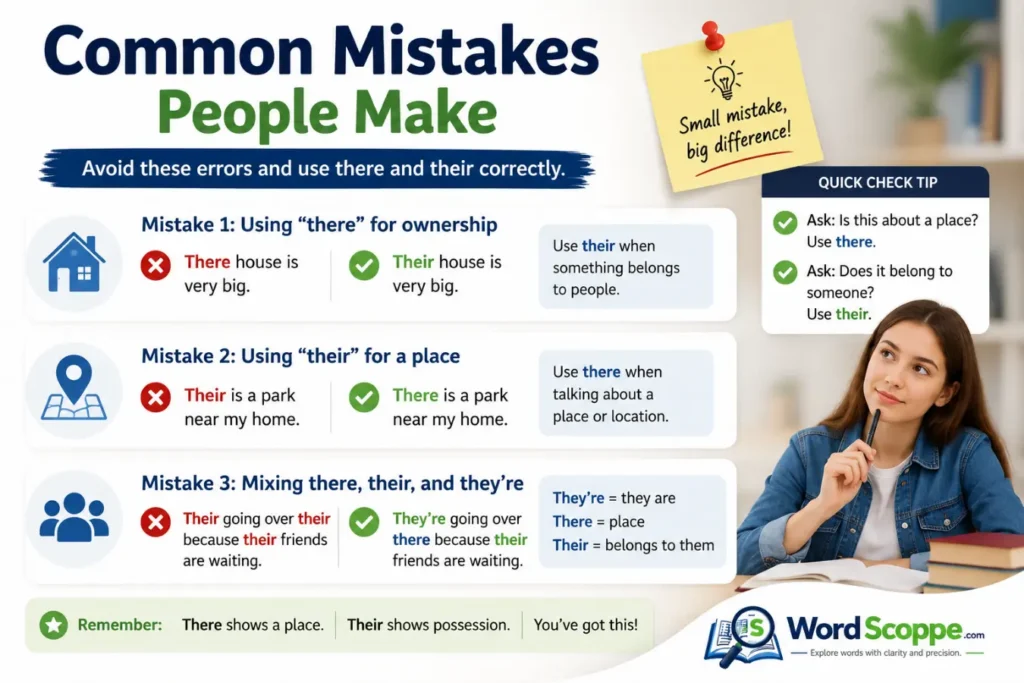
Here are mistakes that often appear in writing.
Mistake 1: Using “there” for ownership
❌ There house is beautiful.
✅ Their house is beautiful.
Mistake 2: Using “their” for a place
❌ Their is my favorite café.
✅ There is my favorite café.
Mistake 3: Mixing both words in the same sentence
❌ Their going over their because their friends are waiting.
✅ They’re going over there because their friends are waiting.
Notice that they’re means they are, which is different from both there and their.
Easy Tips to Remember the Correct Spelling
Learning a simple memory trick can help you choose the right word every time.
Remember “There” Has Here
The word there contains here, and both words relate to a place.
Example:
- Put your bag over there.
- Come here after class.
If your sentence talks about a location, there is usually the correct choice.
Remember “Their” Has Heir
An heir receives something that belongs to a family. This can remind you that their is about ownership.
Example:
- Their books are on the desk.
- Their dog loves to play.
Ask Yourself One Question
Before writing, ask:
- Is this about a place? → Use there.
- Does something belong to someone? → Use their.
This quick check prevents many grammar mistakes.
Using There and Their in Daily Life
You use these words in many situations every day.
In Text Messages
- I’ll meet you there.
- Did you see their new car?
In Emails
- There is an update on the project.
- Their report looks excellent.
At School
- There are three questions on the board.
- Their homework is complete.
At Work
- There will be a meeting this afternoon.
- Their presentation impressed everyone.
Using the correct word makes your writing clear and professional.
Synonyms and Related Words
Although there and their have different meanings, these related words may help you understand them better.
Words Related to “There”
- Here
- Nearby
- Away
- Somewhere
- Anywhere
- Everywhere
Words Related to “Their”
- Belonging to them
- Owned by them
- Shared
- Personal
- Possessed
Remember that these words are not always direct replacements. Their meaning depends on the sentence.
There, Their, and They’re: Know the Difference
Many people also confuse they’re with there and their.
| Word | Meaning | Example |
| There | A place or introduces a sentence | There is a book on the table. |
| Their | Shows ownership | Their book is on the table. |
| They’re | Short for they are | They’re reading a book. |
A quick way to test they’re is to replace it with they are. If the sentence still makes sense, they’re is correct.
Expert Insights
Grammar experts recommend focusing on the meaning of a sentence instead of how a word sounds.
Because there and their are homophones, your ears cannot tell the difference. Your understanding of the sentence must guide your choice.
Professional writers also proofread carefully before publishing. Even experienced writers make homophone mistakes during fast typing.
Reading your work aloud and checking for location or ownership can greatly reduce errors.
Small grammar improvements like this make your writing more accurate, trustworthy, and easier to understand.
Frequently Asked Questions
Is there or their correct?
Both words are correct. There refers to a place or introduces a sentence. Their shows ownership.
When should I use there?
Use there when talking about a location or introducing that something exists.
When should I use their?
Use their when something belongs to people or to someone using singular they.
Why do people confuse there and their?
They are homophones. They sound the same but have different meanings and spellings.
Is “their” a possessive word?
Yes. Their is a possessive adjective that shows ownership.
Is “there” an adverb?
Often, yes. It can function as an adverb of place. It can also introduce a sentence, such as “There is a problem.”
What is the easiest way to remember there and their?
Think of here inside there for places. Think of ownership when using their.
Can spell check find this mistake?
Not always. Both words are spelled correctly, so many spell checkers will not detect the wrong choice.
Featured Snippet Box
What is the difference between there and their?
- There refers to a place or introduces a sentence.
- Their is a possessive adjective that shows ownership.
- Although both words sound the same, they have different meanings and uses.
- Remember: there = place, their = belongs to them.
Conclusion
Understanding there or their becomes much easier once you know what each word does. There points to a place or introduces a sentence, while their shows that something belongs to someone. Although they sound the same, they have different meanings and should never be used interchangeably.
A simple memory trick and a quick check before writing can help you avoid mistakes. With regular practice, choosing the correct word will become natural. Whether you are writing school assignments, emails, social media posts, or business documents, using there and their correctly will make your writing clearer, more professional, and easier for readers to understand.

Sophia Hayes is a language researcher and content writer at WordsCoppe.com, specializing in word comparisons, spelling differences, grammar explanations, and vocabulary insights. She is passionate about making English easier to understand through clear, accurate, and practical content. By breaking down complex language topics into simple explanations, Sophia helps readers improve their writing and communication skills. Her goal is to make learning English more accessible, engaging, and confidence-building for learners worldwide.