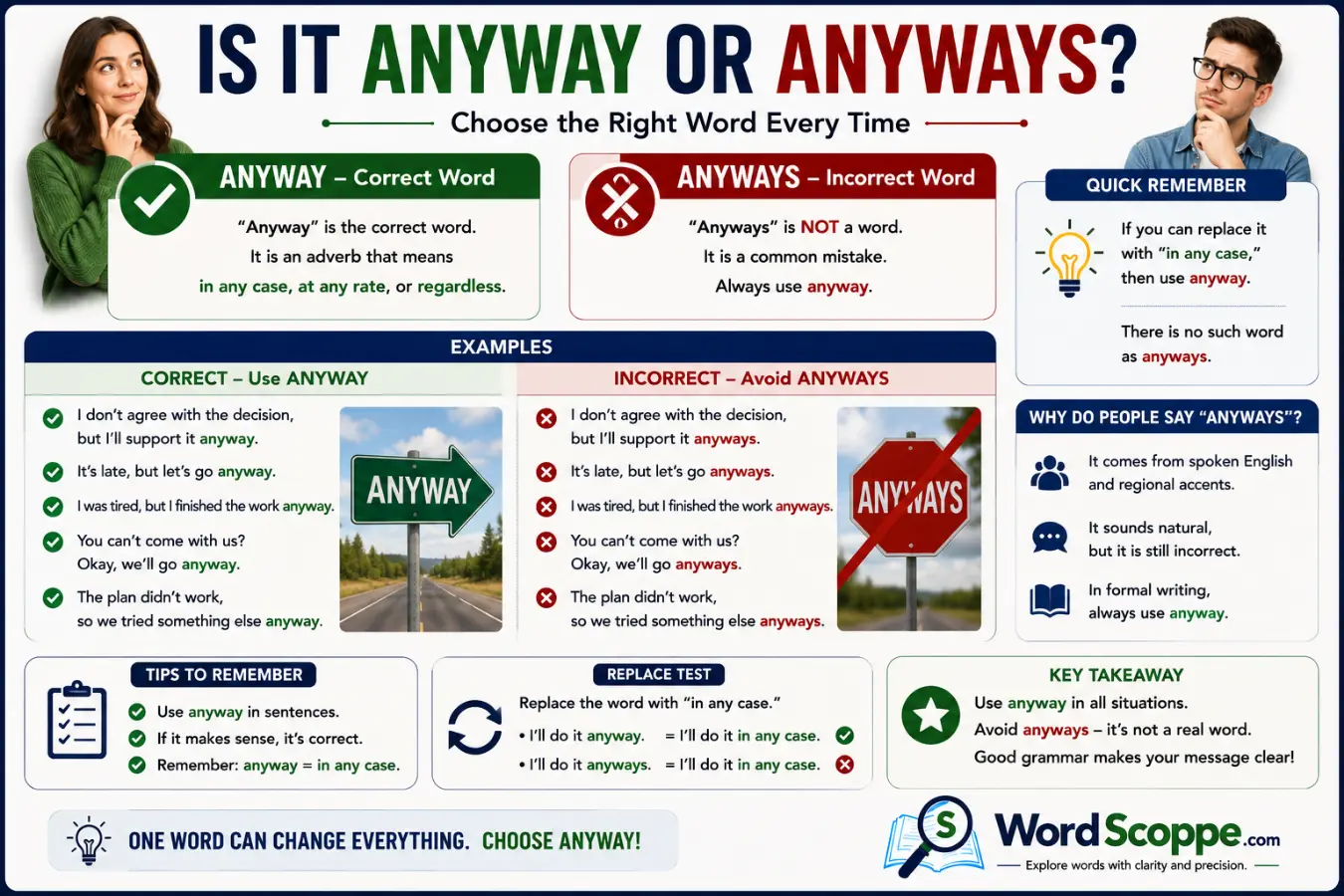
Is it anyway or anyways? Many English learners ask this question because both words appear in conversations, books, and online posts. At first, they seem to mean the same thing. However, they are not always used in the same situations. Anyway is the standard word in formal and everyday English. Anyways is an informal variation that people often use in casual speech. Knowing the difference helps you choose the right word for school, work, emails, and daily conversations. In this guide, you will learn when to use anyway or anyways, see simple examples, compare both words side by side, and discover easy tips to avoid common grammar mistakes.
Quick Summary
- Anyway is the standard and preferred word.
- Anyways is an informal variation.
- Use anyway in formal writing, school, and business.
- Use anyways only in casual conversations if appropriate.
- Both words usually mean “regardless” or “moving on.”
- When unsure, choose anyway.
Quick Answer:
Anyway is correct for almost all writing. Anyways is acceptable in informal speech but is not recommended in formal English.
What Do “Anyway” and “Anyways” Mean?
Both anyway and anyways help move a conversation or sentence forward.
They often mean:
- Regardless
- In any case
- Moving on
- Returning to the main topic
Although they share the same meaning, they differ in tone.
- Anyway = Standard English
- Anyways = Informal English
That is why anyway appears much more often in books, newspapers, and professional writing.
Anyway vs Anyways: What’s the Difference?
The biggest difference is the level of formality.
| Word | Grammar Status | Best Used In | Example |
| Anyway | Standard English | Formal and informal writing | Anyway, let’s continue the meeting. |
| Anyways | Informal variation | Casual conversations | Anyways, I’ll see you tomorrow. |
Simple Rule
- Choose anyway for essays, emails, articles, and business writing.
- Use anyways only in relaxed conversations when the tone is informal.
If you are unsure, anyway is always the safer choice.
When Should You Use “Anyway”?
Use anyway whenever you want your English to sound correct, natural, and professional.
It works in both spoken and written English.
Examples
- Anyway, let’s finish the project.
- I enjoyed the movie anyway.
- She decided to go anyway, despite the rain.
- Anyway, where were we?
- He thanked everyone anyway.
These examples show why anyway is the preferred option.
When Should You Use “Anyways”?
Anyways appears mostly in informal speech.
People often use it while chatting with friends or family.
Some speakers also use it to change the topic or end a conversation.
Examples
- Anyways, I’ll call you later.
- Anyways, that’s all I wanted to say.
- It was fun. Anyways, I should go now.
Although native speakers sometimes say anyways, many editors replace it with anyway in published writing.
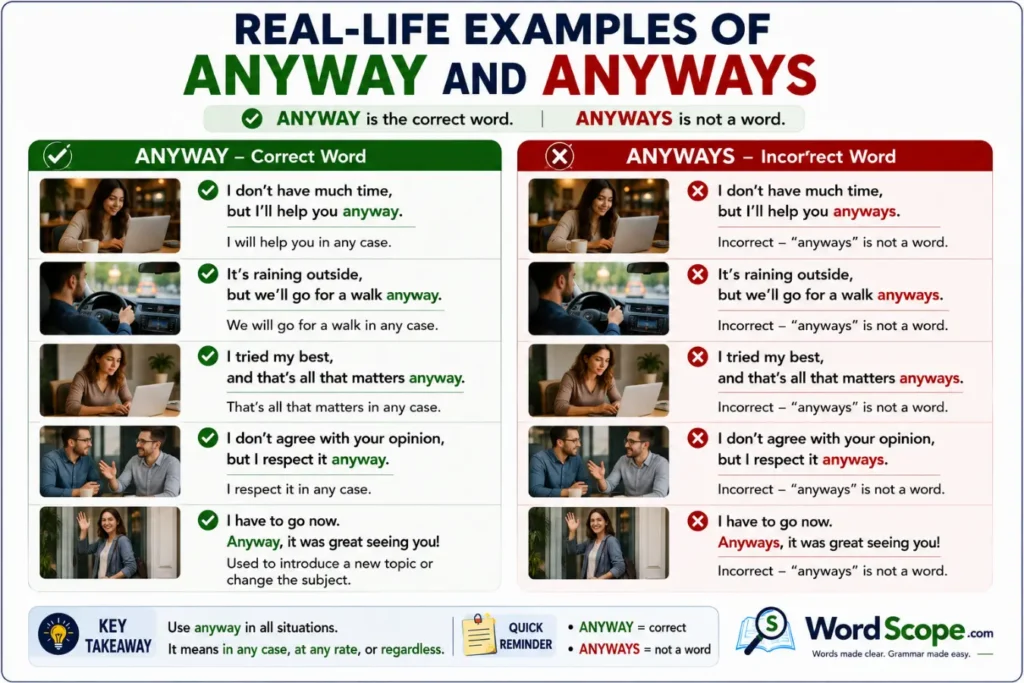
Real-Life Examples of Anyway and Anyways
These examples show how both words appear in different situations.
| Situation | Correct Sentence |
| Business Email | Anyway, I have attached the report. |
| Classroom | Anyway, let’s continue today’s lesson. |
| Conversation | Anyways, what are your weekend plans? |
| Storytelling | It was getting late. Anyway, we kept walking. |
| Phone Call | Anyways, I’ll talk to you tomorrow. |
| Blog Article | Anyway, here are the final results. |
Notice that professional writing almost always prefers anyway.
Why Do People Confuse “Anyway” and “Anyways”?
The confusion happens because both words sound similar and often have the same meaning.
However, they differ in style rather than grammar.
Here are the main reasons people mix them up:
- Both words mean nearly the same thing.
- Native speakers use anyways in casual speech.
- Social media and text messages often include anyways.
- Learners assume adding -s makes the word more correct.
- Informal conversations do not always follow formal grammar rules.
The easiest way to choose is to think about your audience.
If you are writing for school, work, or a website, use anyway.
Common Meanings of “Anyway”
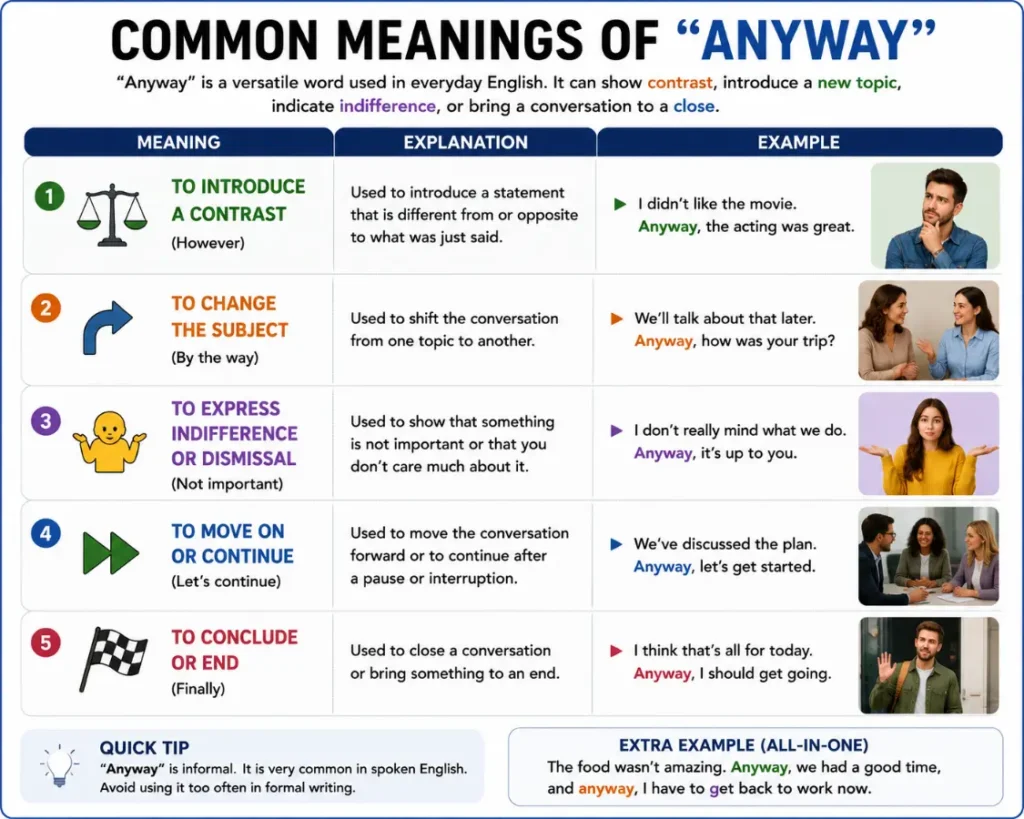
Learning the different meanings helps you use the word naturally.
| Meaning | Example |
| Regardless | I’ll help you anyway. |
| In any case | Anyway, we should leave now. |
| Returning to a topic | Anyway, as I was saying… |
| Changing the subject | Anyway, let’s discuss something else. |
| Concluding a conversation | Anyway, it was nice talking to you. |
Understanding these meanings makes it easier to recognize anyway in books, articles, movies, and everyday conversations.
Common Mistakes When Using Anyway or Anyways
Many people use these words interchangeably. Although both appear in English, they are not always the best choice. Here are the most common mistakes.
1. Using Anyways in Formal Writing
Incorrect (less suitable):
- Anyways, I have attached the report.
Correct:
- Anyway, I have attached the report.
Why?
Professional emails, essays, reports, and articles should use anyway because it is the standard form.
2. Thinking Anyways Is Incorrect
Many learners believe anyways is always wrong.
That is not true.
Anyways is an accepted informal word. However, it is much less common in formal English.
3. Using Anyway as a Filler Too Often
Repeating anyway in every paragraph can make your writing sound repetitive.
Instead, use other transition words when possible.
Examples include:
- However
- Still
- In any case
- Nevertheless
- Even so
4. Choosing the Wrong Tone
The biggest mistake is ignoring your audience.
- Formal audience → Anyway
- Casual conversation → Anyway or Anyways
Choosing the right tone makes your writing sound more natural.
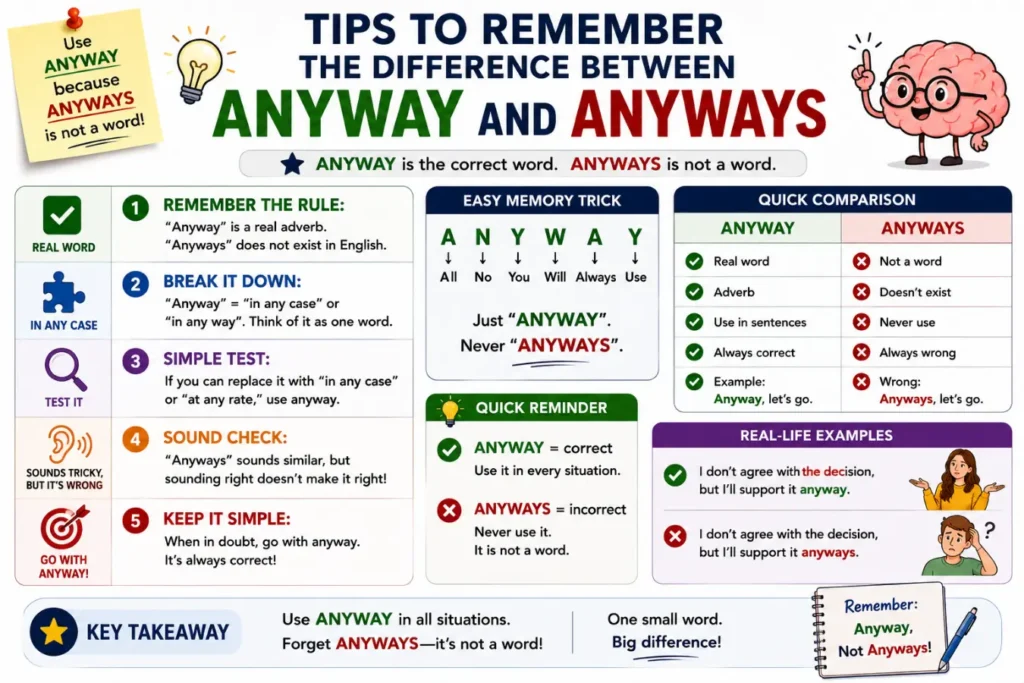
Tips to Remember the Difference Between Anyway and Anyways
These simple tips make the choice easy.
- Use anyway for school, work, blogs, and professional writing.
- Use anyways only in relaxed conversations.
- If you are unsure, always choose anyway.
- Think about your audience before writing.
Memory Trick
Remember this simple rule:
Formal = Anyway ✅
Casual Chat = Anyways (sometimes) ✅
This trick works in almost every situation.
Using Anyway and Anyways in Daily Life
You will hear these words in many everyday situations.
At Work
- Anyway, let’s begin today’s meeting.
- Anyway, I have finished the report.
At School
- Anyway, let’s review yesterday’s lesson.
- The teacher said, “Anyway, let’s move to the next topic.”
Talking with Friends
- Anyways, what are your plans tonight?
- Anyways, I’ll see you later.
Online Messages
People often write anyways in texts or social media because the tone is informal. However, most websites and professional blogs still use anyway.
Synonyms of Anyway
Using different transition words can improve your writing.
| Word | Best Used For |
| Regardless | Showing something happens despite a situation |
| In any case | Formal writing |
| Nevertheless | Academic and professional writing |
| Still | Everyday conversation |
| Even so | Showing contrast |
| However | Formal transitions |
| Moving on | Changing the topic |
These alternatives help you avoid repeating the same word.
Expert Insight
The difference between anyway and anyways is mainly about style, not meaning. Modern dictionaries recognize both forms. However, grammar experts, editors, and professional writers strongly prefer anyway in formal communication.
If you write articles, emails, assignments, or business documents, choosing anyway improves clarity and professionalism. Reserve anyways for casual conversations where a relaxed tone feels natural. Following this simple guideline will make your English sound more polished and appropriate for any audience.
Frequently Asked Questions
Is it anyway or anyways?
Both words exist, but anyway is the standard and preferred choice.
Is anyways grammatically correct?
Yes. It is an accepted informal variation, but it is not recommended in formal writing.
Which word should I use in an email?
Use anyway because it is more professional.
Do native English speakers say anyways?
Yes. Many native speakers use anyways in casual conversations, especially in North America.
Is anyways wrong in conversation?
No. It sounds informal, but many people use it naturally while speaking.
Why is anyway more common?
Schools, publishers, businesses, and style guides recommend anyway, so it appears more often in written English.
How can I remember the difference?
Use this easy rule:
- Formal writing → Anyway
- Casual speech → Anyways (optional)
Conclusion
Understanding is it anyway or anyways is simple once you know the difference in style. Both words share the same basic meaning, but they do not fit every situation. Anyway is the standard choice and works well in formal writing, professional emails, academic work, and everyday communication. Anyways is an informal variation that many native speakers use in casual conversations.

Sophia Hayes is a language researcher and content writer at WordsCoppe.com, specializing in word comparisons, spelling differences, grammar explanations, and vocabulary insights. She is passionate about making English easier to understand through clear, accurate, and practical content. By breaking down complex language topics into simple explanations, Sophia helps readers improve their writing and communication skills. Her goal is to make learning English more accessible, engaging, and confidence-building for learners worldwide.