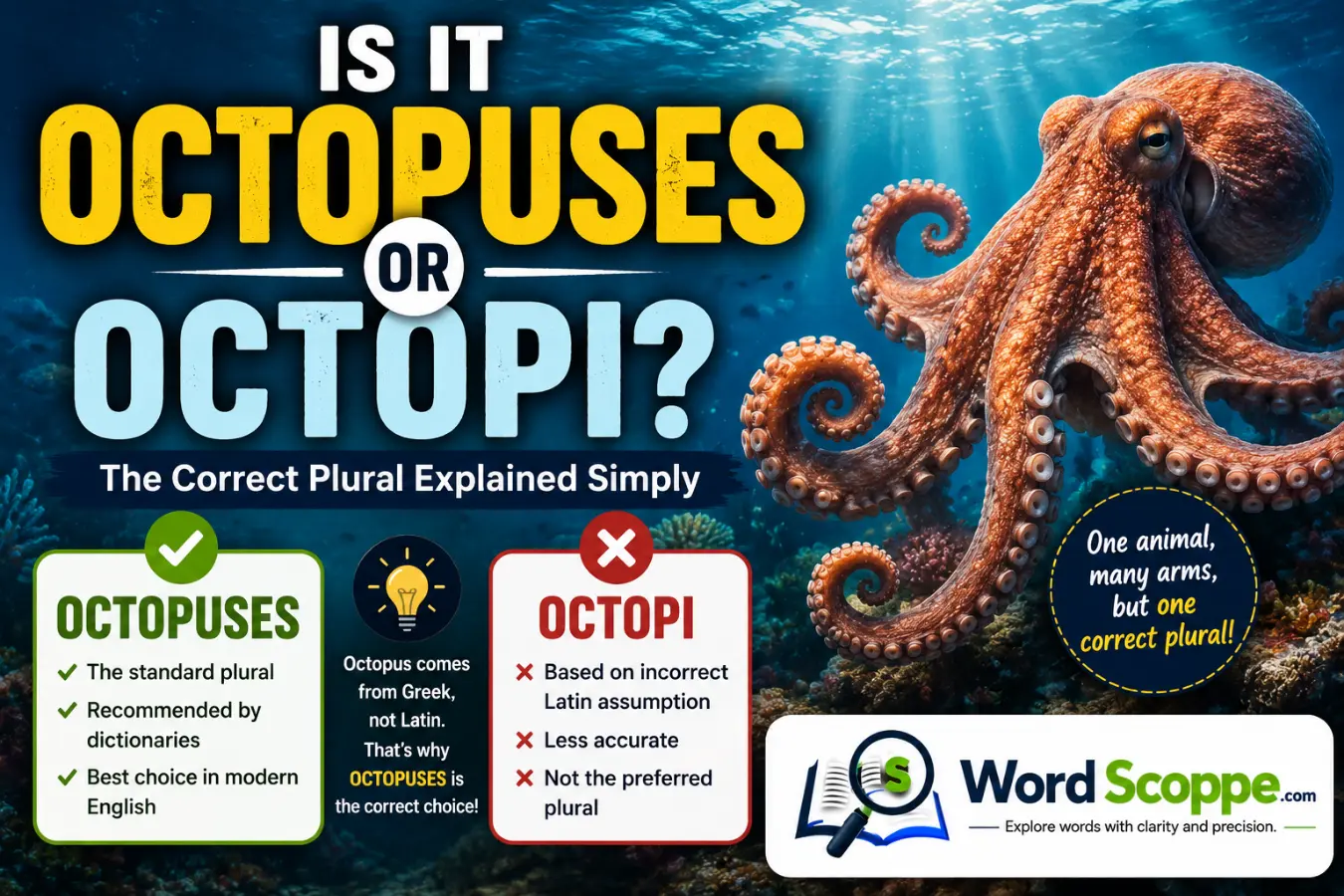
Is it octopuses or octopi? This question confuses many English learners and even native speakers. You may see both words in books, websites, and everyday conversations. However, only one is the preferred plural in modern English. Understanding the correct form can improve your grammar and make your writing more accurate. It also helps you avoid a common language mistake. In this guide, you will learn the meaning of each word, why the confusion exists, and when to use the correct plural. We will also compare octopuses, octopi, and another less common form, octopodes, using simple examples that are easy to understand.
Quick Summary
- Octopuses is the standard plural in modern English.
- Octopi is common but not grammatically accurate.
- Octopodes is technically correct in Greek but very rare.
- Most dictionaries recommend octopuses.
- Use octopuses in school, business, and everyday writing.
- Octopi is still widely understood but less preferred.
- The confusion comes from the word’s origin.
Featured Snippet
Is it octopuses or octopi?
The correct plural in modern English is octopuses. Although octopi is widely used, it assumes the word octopus comes from Latin. In fact, octopus comes from Greek, making octopuses the standard English plural. The form octopodes follows Greek grammar but is rarely used in everyday English.
What Does “Octopus” Mean?
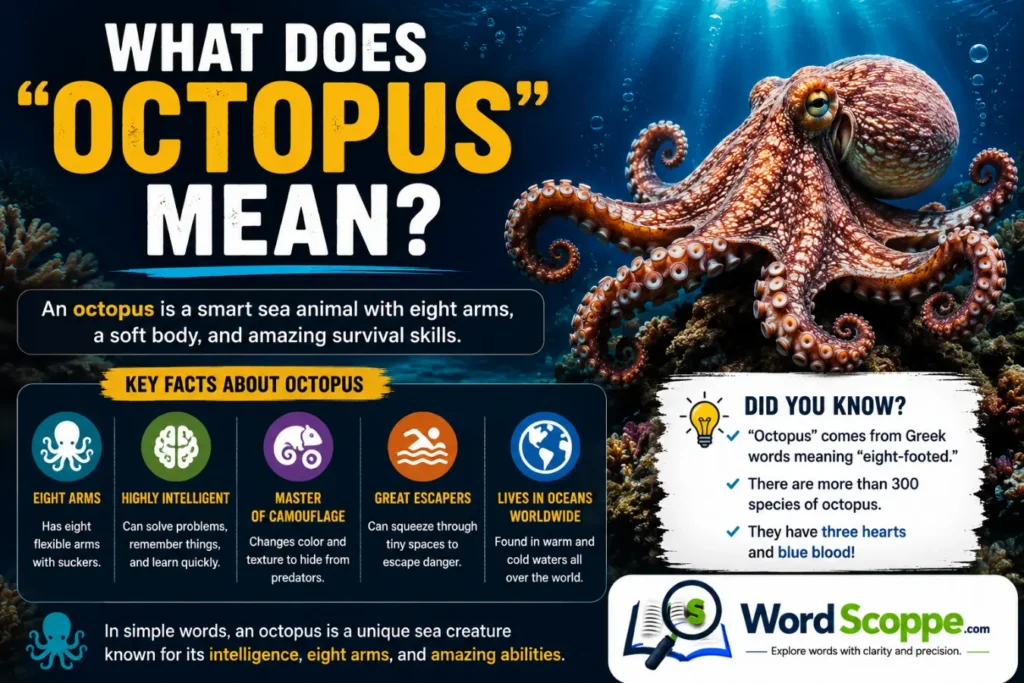
An octopus is a sea animal with eight arms, a soft body, and a high level of intelligence. It belongs to the group of animals called cephalopods.
Octopuses live in oceans around the world. They are famous for:
- Eight flexible arms
- Excellent camouflage
- Problem-solving skills
- Escaping from predators
- Changing color quickly
Because they are so unique, people often talk about more than one octopus. That is where the grammar question begins.
Is It Octopuses or Octopi?
The simple answer is octopuses.
Modern English grammar accepts octopuses as the standard plural. It follows normal English plural rules by adding -es to the end of the noun.
Although many people say octopi, language experts and major dictionaries recommend octopuses for formal and everyday writing.
You may also hear octopodes, but it is extremely rare outside language discussions.
Octopuses vs Octopi Comparison
| Feature | Octopuses | Octopi |
| Modern English | ✅ Preferred | Sometimes used |
| Grammar | Correct English plural | Based on incorrect Latin assumption |
| Dictionary Recommendation | Yes | Usually listed as an alternative |
| Formal Writing | Best choice | Less recommended |
| Everyday Conversation | Very common | Still understood |
| Academic Writing | Preferred | Usually avoided |
Why Do People Say “Octopi”?
Many people think every word ending in -us follows Latin grammar.
For example:
- Cactus → Cacti
- Fungus → Fungi
- Radius → Radii
Because of these examples, people naturally assume:
Octopus → Octopi
However, this rule does not apply here.
The word octopus did not come from Latin. It came from the Greek word oktōpous, meaning “eight-footed.”
Since the word entered English through Greek, the Latin ending -i is not the correct grammatical choice.
Even so, octopi became popular over time because it sounds familiar to English speakers.
Where Did the Word “Octopus” Come From?
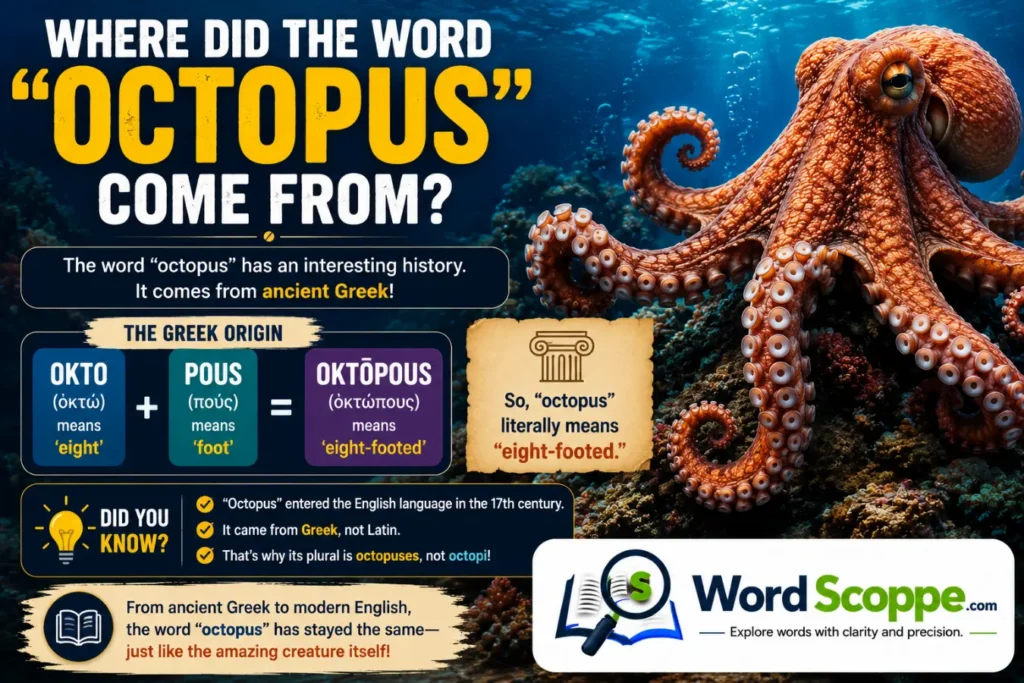
The history of the word explains the confusion.
The word comes from two Greek words:
- Okto = eight
- Pous = foot
Together, they mean eight-footed.
Because the word has Greek roots, its original Greek plural would be octopodes.
However, English usually creates plurals using English grammar instead of Greek grammar. That is why octopuses became the accepted standard.
Is “Octopodes” Correct?
Yes, but almost nobody uses it.
Octopodes follows ancient Greek grammar. It is technically accurate if you follow the original language.
However, it sounds unusual to most English speakers.
You might see octopodes in:
- Language studies
- Linguistics books
- Greek grammar discussions
You will rarely hear it in everyday conversation.
For nearly all situations, octopuses is the better choice.
What Do Dictionaries Recommend?
Most trusted dictionaries recommend octopuses as the primary plural.
They often list octopi as an accepted alternative because many people use it.
However, octopuses remains the preferred choice for:
- School assignments
- Professional writing
- News articles
- Books
- Websites
- Business communication
Using the standard form helps your writing stay clear and grammatically accurate.
When Should You Use “Octopuses”?
Choose octopuses whenever you write in modern English.
Examples include:
- School essays
- Science reports
- Blog posts
- Social media captions
- Emails
- Articles
- Everyday conversations
Readers immediately recognize octopuses, and it matches current dictionary recommendations.
Real-Life Examples of Using “Octopuses” and “Octopi”
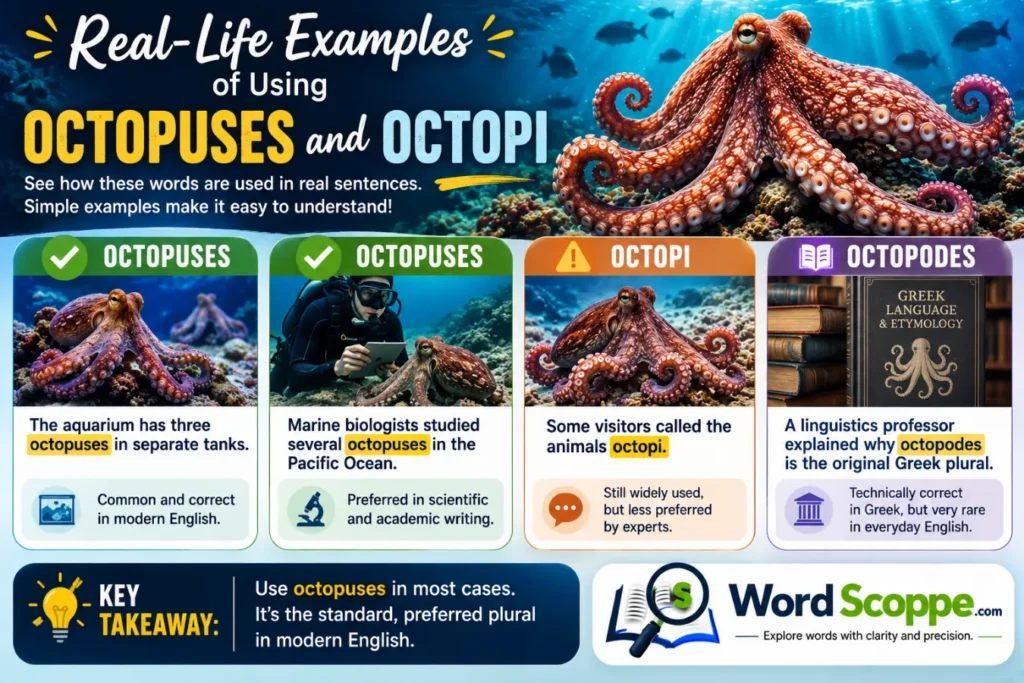
Seeing the words in real sentences makes the difference easier to remember.
Example 1
✅ The aquarium has three octopuses in separate tanks.
This is the preferred sentence in modern English.
Example 2
✅ Marine biologists studied several octopuses in the Pacific Ocean.
This is the best choice for scientific and educational writing.
Example 3
⚠️ Some visitors called the animals octopi.
Many people use this form, but language experts generally prefer octopuses.
Example 4
📚 A linguistics professor explained why octopodes is the original Greek plural.
This form is correct in Greek but very uncommon in everyday English.
These examples show that octopuses fits almost every writing situation.
Common Mistakes People Make
Many writers make the same mistakes because they assume all words ending in -us follow the same rule.
Here are the most common errors.
Assuming Every “-us” Word Becomes “-i”
This is the biggest mistake.
Words like cactus and fungus have Latin roots, so their Latin plurals became popular.
However, octopus comes from Greek, not Latin.
Thinking “Octopi” Is the Only Correct Form
Many people believe octopi is the proper plural.
In fact, modern dictionaries recommend octopuses as the standard English plural.
Using “Octopodes” in Everyday Writing
Although octopodes follows Greek grammar, it sounds unfamiliar to most readers.
Using it in normal conversation may confuse your audience.
Avoiding the Word Completely
Some writers rewrite sentences because they are unsure which plural is correct.
Instead, confidently use octopuses.
Easy Trick to Remember the Correct Plural
Remember this simple rule:
If you’re writing in English, think in English.
English usually adds -es to nouns ending in -s.
So:
- Bus → Buses
- Class → Classes
- Glass → Glasses
- Octopus → Octopuses
This simple pattern helps you choose the correct word every time.
How to Use “Octopuses” in Daily Life
You may need this word in many situations.
Examples include:
- Talking about sea animals
- Visiting an aquarium
- Watching wildlife documentaries
- Writing school assignments
- Reading science books
- Posting on social media
- Playing educational games
In each case, octopuses is the safest and most natural choice.
Synonyms and Related Sea Animals
There is no true synonym for octopus, but these sea creatures are closely related.
| Word | Meaning |
| Squid | A fast-swimming cephalopod with ten limbs |
| Cuttlefish | A marine animal known for changing color |
| Nautilus | A shelled cephalopod |
| Cephalopod | The animal group that includes octopuses, squid, and cuttlefish |
| Marine animal | A general term for animals that live in the ocean |
These related terms often appear in articles about ocean life and marine biology.
Expert Insights
Language experts agree that octopuses is the best plural for modern English.
The confusion comes from the word’s Greek origin and the popularity of Latin-style plurals. Even though octopi appears in conversation and some publications, major dictionaries and grammar guides recommend octopuses for clear and accurate writing.
Choosing the standard English form improves your grammar, avoids confusion, and helps your writing look more professional.
Frequently Asked Questions
Is it octopuses or octopi?
Octopuses is the preferred plural in modern English. Although octopi is widely understood, it is less accurate.
Why do people say octopi?
People assume octopus follows Latin grammar because it ends in -us. However, the word actually comes from Greek.
Is octopodes correct?
Yes. Octopodes follows ancient Greek grammar, but it is very rare in modern English.
Which plural do dictionaries recommend?
Most major dictionaries list octopuses as the primary and preferred plural.
Can I still use octopi?
Yes. People will understand it, but octopuses is the better choice for formal and everyday writing.
Is octopuses grammatically correct?
Yes. It follows normal English plural rules and is accepted by modern grammar guides.
Why isn’t octopi the standard plural?
Because octopus has Greek origins, not Latin ones. The Latin plural ending -i does not naturally apply.
Which plural should students use?
Students should use octopuses in essays, exams, reports, and other academic writing.
Conclusion
Is it octopuses or octopi? The answer is simple once you know the history. Octopuses is the preferred plural in modern English and the form recommended by major dictionaries and grammar experts. Although octopi remains popular, it comes from an incorrect assumption that octopus is a Latin word. The rare form octopodes follows Greek grammar but is almost never used in everyday writing. If you want your English to sound natural, clear, and correct, choose octopuses. Remember this easy rule: when writing in English, use the standard English plural. That simple habit will improve your grammar and help you communicate with confidence.

Sophia Hayes is a language researcher and content writer at WordsCoppe.com, specializing in word comparisons, spelling differences, grammar explanations, and vocabulary insights. She is passionate about making English easier to understand through clear, accurate, and practical content. By breaking down complex language topics into simple explanations, Sophia helps readers improve their writing and communication skills. Her goal is to make learning English more accessible, engaging, and confidence-building for learners worldwide.