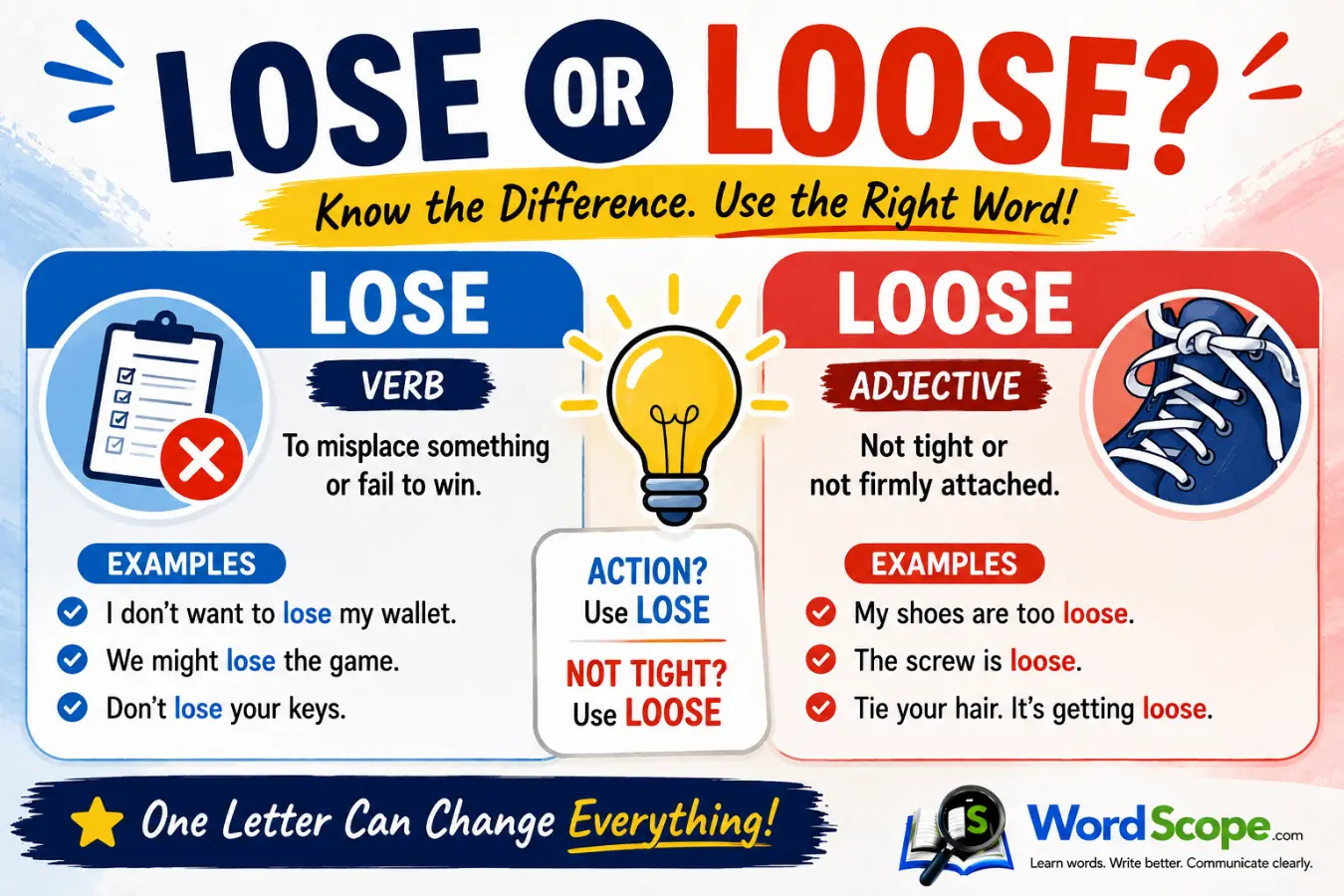
Lose or loose is one of the most common grammar questions in English. These two words look almost the same, but they have different meanings and uses. Many people mix them up when writing emails, school assignments, social media posts, or business messages.
The good news is that learning the difference is simple. Once you understand what each word means, you will avoid this mistake with confidence. In this guide, you will discover clear definitions, simple explanations, comparison tables, and real-life examples. You will also learn easy memory tricks that help you remember the correct spelling every time. Whether you are a student, writer, or English learner, this guide will help you choose the right word without second-guessing yourself.
Quick Summary
Featured Snippet Answer
- Lose is a verb that means to misplace something or fail to win.
- Loose is an adjective that means not tight or firmly attached.
- Lose describes an action.
- Loose describes a condition or state.
- Remember: Lose has one “o.” Loose has two “o’s.”
- Choosing the correct word makes your writing clearer and more professional.
What Is the Difference Between Lose and Loose?
The biggest difference is their job in a sentence.
Lose is a verb. It describes an action.
Loose is an adjective. It describes something that is not tight.
Examples of Lose
- Do not lose your wallet.
- Our team may lose the game.
- I never want to lose this photo.
Examples of Loose
- My jacket feels loose.
- The wheel is loose.
- These shoes are too loose.
Although the spellings are similar, their meanings are completely different.
What Does “Lose” Mean?
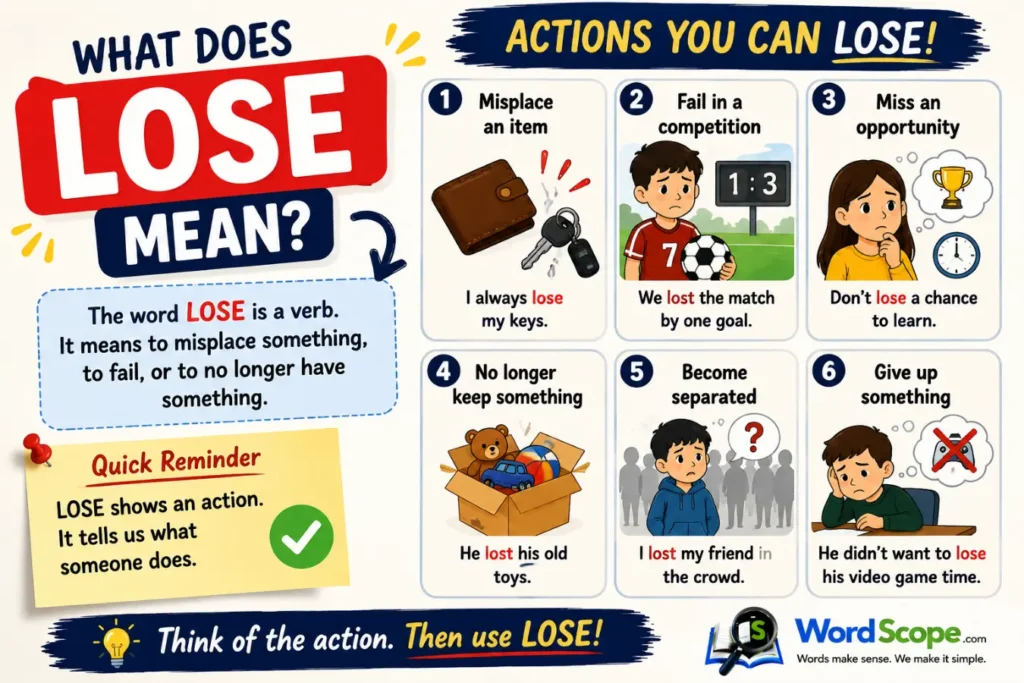
The word lose means to no longer have something or to fail to succeed.
It can describe many situations.
Common meanings include:
- Misplacing an item
- Failing a competition
- Missing an opportunity
- No longer keeping something
- Becoming separated from someone
Everyday Examples
- I always lose my keys.
- They did not want to lose the championship.
- Please do not lose your homework.
- She hopes not to lose her phone again.
In every example, lose shows an action.
What Does “Loose” Mean?
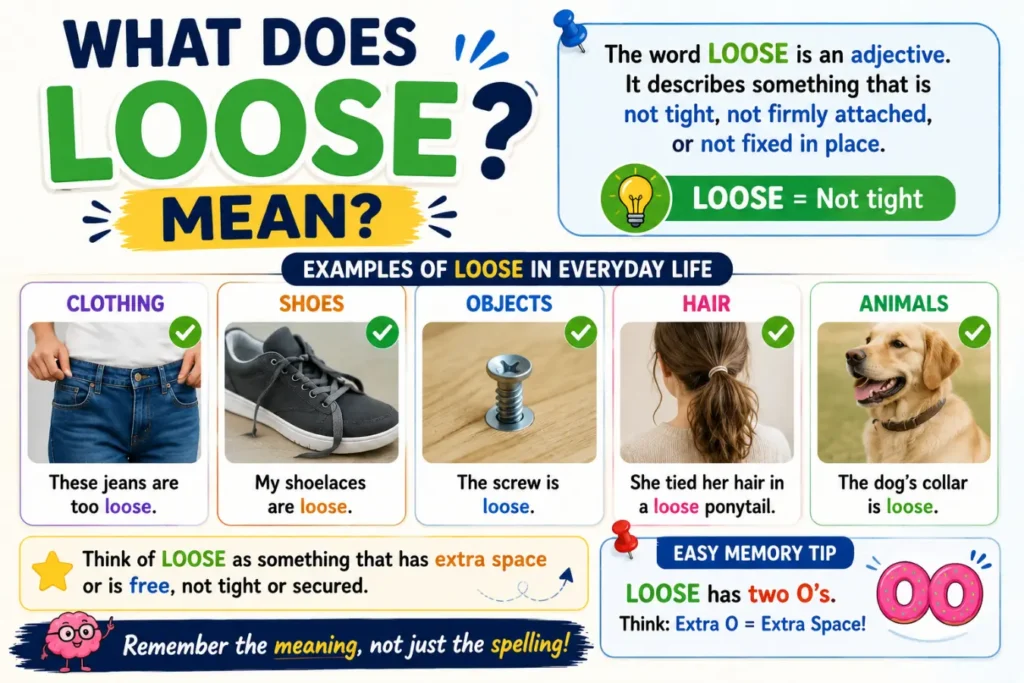
The word loose describes something that is not tight, secure, or fixed.
It tells us about the condition of an object.
You can use loose when talking about:
- Clothing
- Shoes
- Screws
- Rope
- Hair
- Animals
- Objects
Everyday Examples
- My belt is too loose.
- The dog escaped because its collar was loose.
- One button on my shirt is loose.
- The bicycle chain feels loose.
Here, loose describes how something looks or feels.
Why Do People Confuse Lose and Loose?
Many English learners confuse these words because they look almost identical.
Their pronunciation also adds to the confusion.
Common reasons include:
- The spellings differ by only one letter.
- Both words appear often in daily writing.
- Autocorrect may not catch the mistake.
- Fast typing increases spelling errors.
- Many people focus on pronunciation instead of meaning.
Learning the grammar role of each word makes the difference much easier to remember.
Lose vs Loose: Comparison Table
The table below highlights the key differences.
| Feature | Lose | Loose |
| Part of speech | Verb | Adjective |
| Meaning | Misplace or fail | Not tight |
| Describes | An action | A condition |
| Example | Lose your phone | Loose shoelaces |
| Used in competitions | ✅ Yes | ❌ No |
| Used for clothing | ❌ No | ✅ Yes |
A simple rule can help:
Action = Lose
Not Tight = Loose
Real-Life Examples of Lose and Loose
These examples show how each word works in everyday conversations.
Examples Using Lose
- Do not lose your passport before your trip.
- We might lose the match if we stop practicing.
- She does not want to lose her favorite necklace.
- Try not to lose your patience.
Examples Using Loose
- My backpack strap feels loose.
- The kitchen cabinet has a loose handle.
- His tie became loose after work.
- Check for any loose wires before using the machine.
Reading real-life examples helps you remember the correct word more naturally.
Common Mistakes When Using Lose and Loose
Even experienced writers sometimes confuse these words. Here are the mistakes you should avoid.
Mistake 1: Using Loose Instead of Lose
This is the most common error.
❌ I don’t want to loose my phone.
✅ I don’t want to lose my phone.
Remember, lose is the verb.
Mistake 2: Using Lose to Describe Something Not Tight
When something is not tight, use loose.
❌ These shoes are too lose.
✅ These shoes are too loose.
Mistake 3: Focusing Only on Spelling
Many people remember the spelling but forget the meaning.
Instead, ask yourself:
- Is it an action? → Use lose.
- Does it describe something? → Use loose.
Mistake 4: Trusting Autocorrect
Both words are spelled correctly.
Because of this, spell check often misses the mistake.
Always read your sentence before publishing it.
Easy Tips to Remember the Correct Usage
These memory tricks make the difference easy to remember.
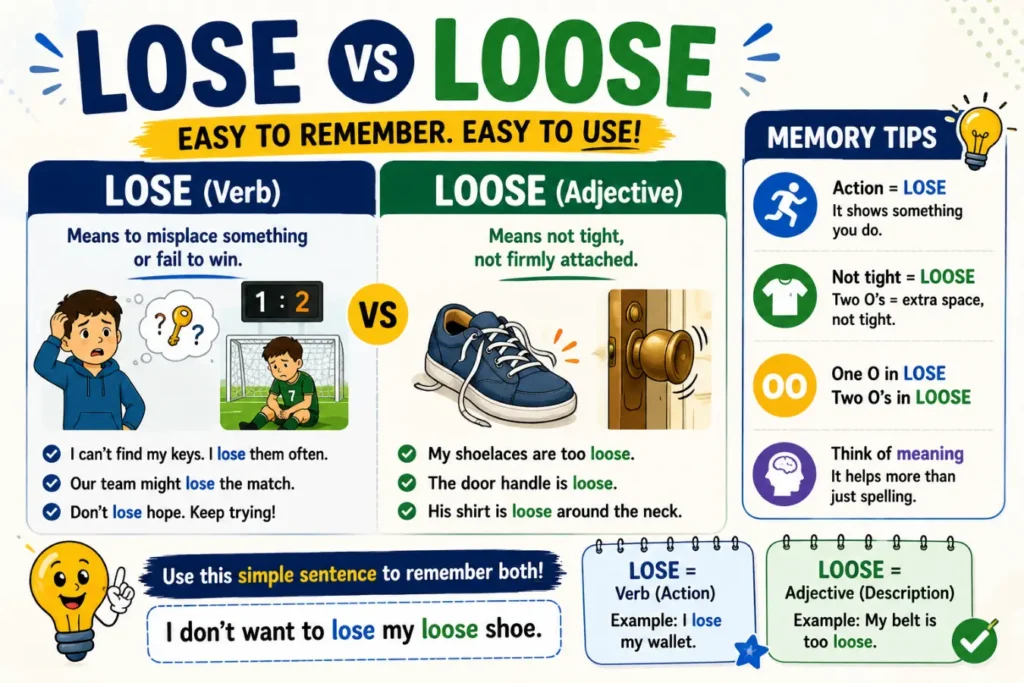
Tip 1: Think About the Number of “O”s
- Lose has one O.
- Loose has two Os.
The extra O reminds you that something has extra space, so it is loose.
Tip 2: Remember the Grammar Rule
- Lose = Verb = Action
- Loose = Adjective = Description
Tip 3: Use This Simple Sentence
If you lose your loose shoe, you have both words in one sentence.
This trick helps many learners remember the difference.
Tip 4: Read Your Sentence Aloud
Ask yourself:
- Am I describing an action?
- Or am I describing how something feels?
The answer usually tells you which word to choose.
Using Lose and Loose in Everyday Life
You will see these words in many daily situations.
At School
- Do not lose your notebook.
- My backpack strap is loose.
At Work
- We cannot lose this client.
- The office chair feels loose.
During Sports
- Nobody wants to lose the final match.
- My shoelaces became loose while running.
At Home
- Please do not lose the TV remote.
- Tighten the loose door handle.
These examples show how naturally both words appear in everyday English.
Synonyms and Related Words
Using related words can improve your vocabulary.
Synonyms for Lose
- misplace
- drop
- miss
- fail
- surrender
- forfeit
- waste
- give up
Synonyms for Loose
- untied
- slack
- free
- unsecured
- detached
- relaxed
- unfastened
- hanging
Choose the synonym that best matches your sentence.
Expert Insight
Grammar experts recommend learning the meaning before memorizing the spelling.
Many spelling mistakes happen because writers rely on how words sound instead of how they work in a sentence. Since lose is always an action and loose always describes something, focusing on grammar makes the correct choice much easier.
Reading English regularly also helps you recognize the correct spelling naturally. Over time, using the right word becomes a habit instead of a rule you have to remember.
Frequently Asked Questions
Which is correct, lose or loose?
Both are correct. Lose means to misplace something or fail. Loose means not tight.
What is the difference between lose and loose?
Lose is a verb that shows an action. Loose is an adjective that describes something.
Is “I will loose my keys” correct?
No. The correct sentence is “I will lose my keys.”
How do I remember lose and loose?
Remember this rule:
Action = Lose
Not Tight = Loose
Why do people confuse lose and loose?
They look almost the same and sound similar, so many writers accidentally switch them.
Can loose be used as a verb?
Yes, but it is uncommon. In everyday English, loose is almost always used as an adjective.
Conclusion
Understanding lose or loose becomes simple once you know how each word works. Lose is a verb that means to misplace something or fail to win. Loose is an adjective that describes something that is not tight or securely attached. Although the spellings are very similar, their meanings are completely different.
Before you write, think about your sentence. If you describe an action, choose lose. If you describe the condition of an object, choose loose. With a little practice and the memory tips in this guide, you will avoid this common grammar mistake and write with greater confidence.

Sophia Hayes is a language researcher and content writer at WordsCoppe.com, specializing in word comparisons, spelling differences, grammar explanations, and vocabulary insights. She is passionate about making English easier to understand through clear, accurate, and practical content. By breaking down complex language topics into simple explanations, Sophia helps readers improve their writing and communication skills. Her goal is to make learning English more accessible, engaging, and confidence-building for learners worldwide.