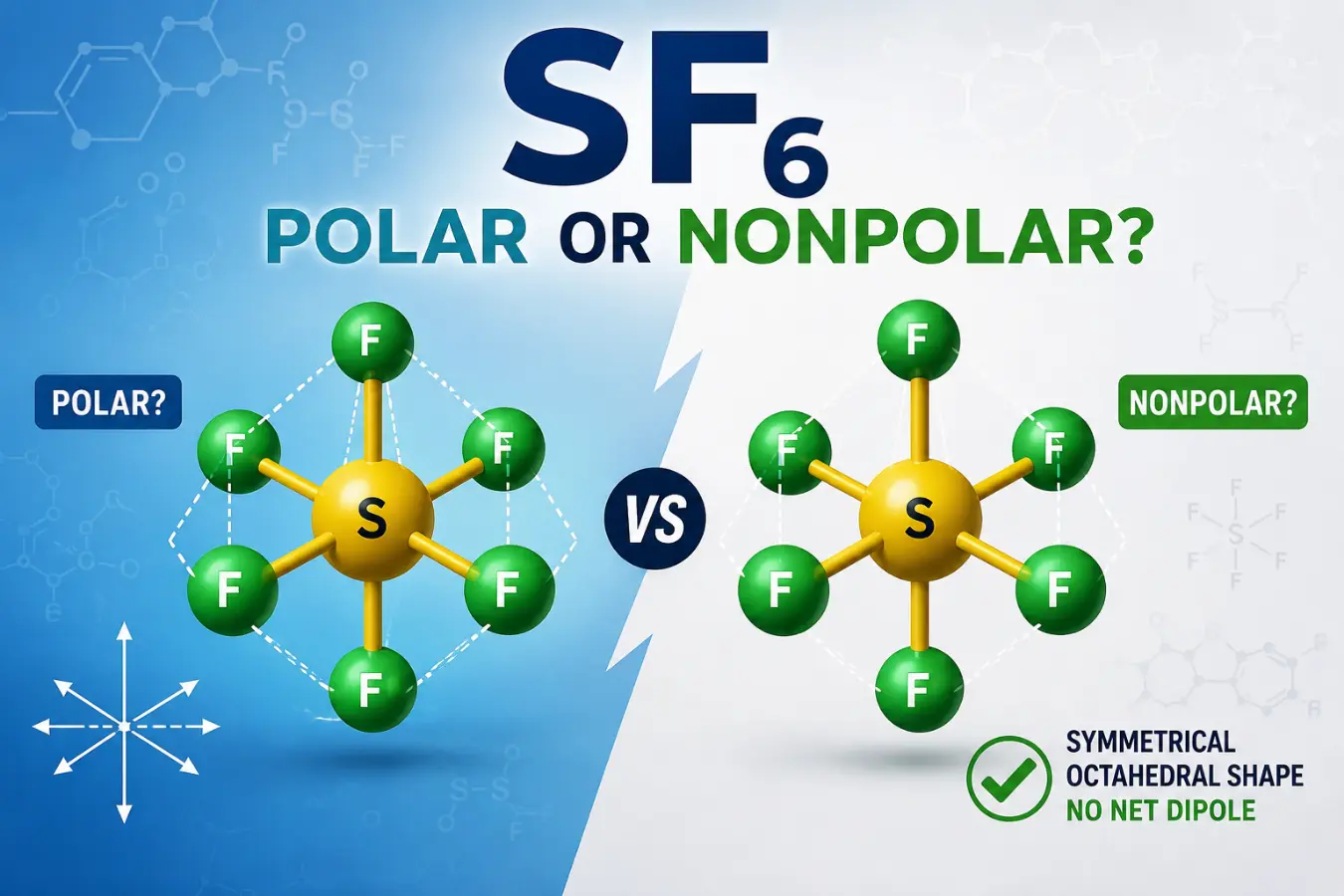
SF6 polar or nonpolar is a common chemistry question for students and science learners. At first, sulfur hexafluoride (SF6) may seem polar because each sulfur-fluorine bond is polar. However, the complete molecule behaves differently. Its unique shape causes the bond dipoles to cancel each other. As a result, SF6 becomes a nonpolar molecule. Understanding this concept is important for chemistry exams and helps you learn molecular geometry, bond polarity, and dipole moments. In this guide, you will discover why SF6 is nonpolar, how its structure affects polarity, and how to identify similar molecules. You will also see easy examples, a comparison table, and practical tips to remember the answer.
Quick Summary
- SF6 is a nonpolar molecule.
- Sulfur hexafluoride has six polar S–F bonds.
- The molecule has an octahedral shape.
- The bond dipoles cancel each other.
- The net dipole moment equals zero.
- Molecular geometry decides the final polarity.
Featured Snippet: Is SF6 Polar or Nonpolar?
SF6 is nonpolar. Although each sulfur-fluorine bond is polar because fluorine is highly electronegative, SF6 has a symmetrical octahedral molecular shape. The bond dipoles point in opposite directions and cancel each other. Therefore, the molecule has no overall dipole moment.
What Is SF6?
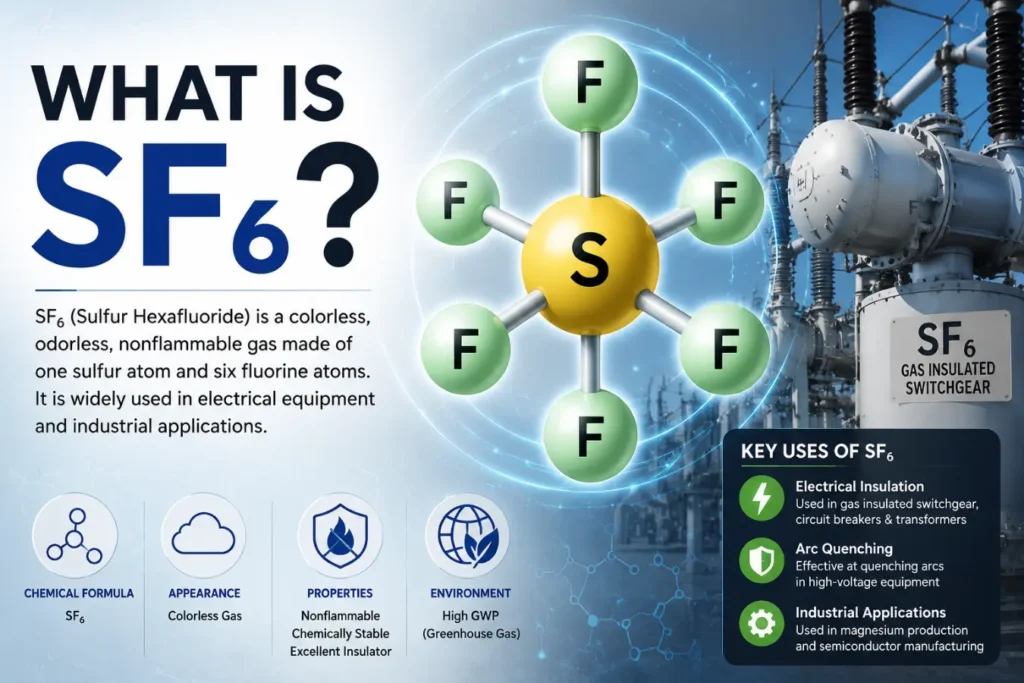
SF6 stands for sulfur hexafluoride. It contains:
- One sulfur (S) atom
- Six fluorine (F) atoms
Sulfur sits at the center of the molecule. Six fluorine atoms surround it evenly.
Because fluorine attracts electrons strongly, every sulfur-fluorine bond is polar. However, bond polarity alone does not determine whether the whole molecule is polar.
Is SF6 Polar or Nonpolar?
The answer is simple.
SF6 is nonpolar.
Even though each S–F bond is polar, the molecule has perfect symmetry. Every bond dipole balances another bond dipole.
Since all dipoles cancel, the molecule has:
- Zero net dipole moment
- Uniform charge distribution
- Nonpolar behavior
This is why chemistry textbooks classify sulfur hexafluoride as a nonpolar molecule.
Why Is SF6 Nonpolar?
To understand this, look at three important factors.
1. Polar Bonds
Each sulfur-fluorine bond is polar because fluorine attracts electrons more strongly than sulfur.
Therefore, every bond has a dipole.
2. Octahedral Molecular Shape
According to VSEPR theory, SF6 forms an octahedral geometry.
The six fluorine atoms sit evenly around the sulfur atom.
This arrangement creates perfect symmetry.
3. Dipole Moments Cancel
Every bond dipole points outward.
Another bond directly opposes it.
As a result, the dipoles cancel completely.
The overall dipole moment becomes zero.
Therefore, SF6 is nonpolar.
SF6 Polar vs. Nonpolar: Comparison Table
| Property | SF6 |
| Chemical name | Sulfur hexafluoride |
| Molecular formula | SF6 |
| Bond polarity | Polar S–F bonds |
| Molecular geometry | Octahedral |
| Molecular symmetry | Perfectly symmetrical |
| Lone pairs on sulfur | None |
| Net dipole moment | Zero |
| Final polarity | Nonpolar |
How Molecular Geometry Affects Polarity
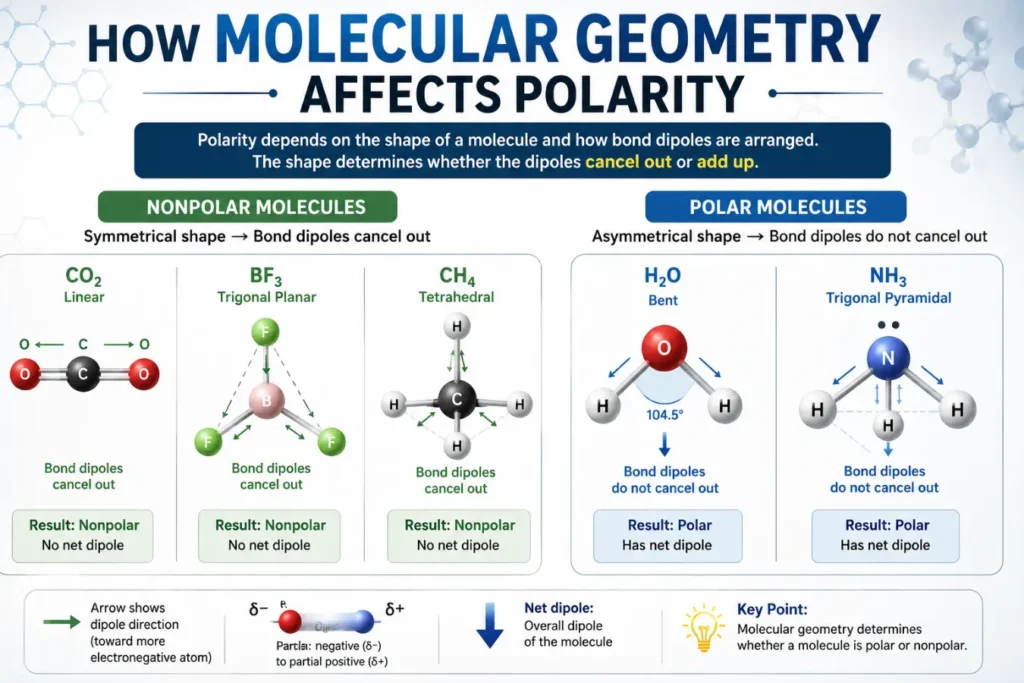
Molecular shape plays a major role in polarity.
Imagine six people pulling a rope from six equal directions.
Each person pulls with equal force.
No one side wins.
The rope stays in the center.
SF6 behaves in the same way.
Each fluorine atom pulls electrons toward itself.
Because the atoms sit evenly around sulfur, every pull balances another pull.
The molecule stays electrically balanced.
Bond Polarity vs. Molecular Polarity
Many students confuse these two ideas.
Here is the difference.
| Bond Polarity | Molecular Polarity |
| Looks at one chemical bond | Looks at the whole molecule |
| Depends on electronegativity difference | Depends on both bond polarity and molecular shape |
| SF bond is polar | SF6 molecule is nonpolar |
Remember this simple rule:
Polar bonds do not always create a polar molecule.
The molecular shape decides the final answer.
Lewis Structure of SF6
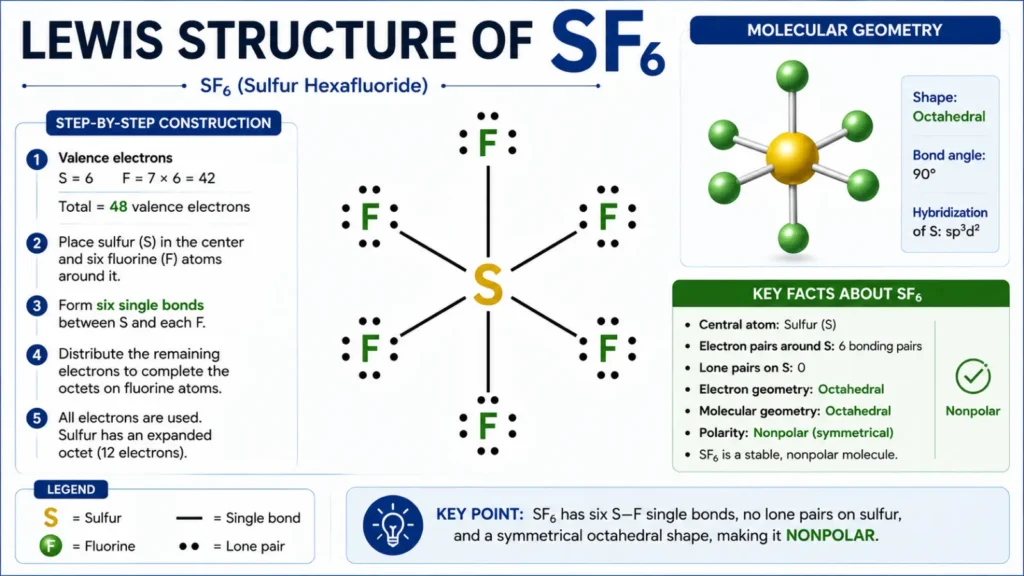
The Lewis structure also explains why SF6 is nonpolar.
- Sulfur is the central atom.
- Six fluorine atoms form six single bonds.
- Sulfur has no lone pairs.
- Every fluorine has three lone pairs.
- The molecule remains perfectly symmetrical.
Since no lone pairs push the bonds unevenly, the octahedral shape stays balanced.
Real-Life Examples to Understand SF6 Polarity
Example 1: Equal Tug of War
Imagine six teams pulling a rope from opposite directions.
Every team has equal strength.
The rope does not move.
SF6 works the same way because every bond dipole balances another one.
Example 2: Balanced Ceiling Fan
Think about a ceiling fan with six identical blades.
Each blade has equal weight.
The fan spins smoothly because it stays balanced.
SF6 has the same balanced arrangement around the sulfur atom.
Example 3: Symmetrical Umbrella
Picture an open umbrella with ribs spread evenly around the center.
Each rib supports the umbrella equally.
Likewise, each fluorine atom surrounds sulfur evenly, making SF6 nonpolar.
Common Mistakes When Identifying SF6 Polarity
Many students answer this question incorrectly. Most mistakes happen because they focus only on bond polarity.
Mistake 1: Assuming Polar Bonds Mean a Polar Molecule
❌ SF6 has polar bonds, so it must be polar.
✅ SF6 has polar bonds, but its symmetrical shape cancels the dipoles.
Mistake 2: Ignoring Molecular Geometry
Some students only compare electronegativity values.
However, molecular geometry is just as important.
Always check the molecule’s shape before deciding its polarity.
Mistake 3: Forgetting the Net Dipole Moment
A molecule is polar only if it has a net dipole moment.
SF6 has a net dipole moment of zero.
Therefore, it is nonpolar.
Mistake 4: Confusing SF6 with Similar Molecules
Some learners think SF6 behaves like molecules with lone pairs.
Unlike those molecules, SF6 has no lone pairs on the central sulfur atom.
Its symmetry stays complete.
Tips to Remember Why SF6 Is Nonpolar
Use these simple tricks during exams.
- Count the surrounding atoms. SF6 has six identical fluorine atoms.
- Check the shape. Octahedral geometry is highly symmetrical.
- Look for lone pairs. Sulfur has none in SF6.
- Remember the dipoles. Equal bond dipoles cancel each other.
- Use the rule: Symmetrical molecule + identical outer atoms = usually nonpolar.
These tips make polarity questions much easier.
Where Is SF6 Used in Real Life?
Although students mostly study SF6 in chemistry, it also has practical uses.
Electrical Equipment
SF6 acts as an excellent insulating gas in high-voltage electrical systems.
Scientific Research
Researchers use sulfur hexafluoride in laboratory experiments because it is chemically stable.
Leak Detection
Engineers sometimes use SF6 to detect leaks in sealed systems.
Medical Applications
In certain medical procedures, SF6 helps improve imaging and diagnostic tests.
These uses depend on its unique chemical properties, including its stability and nonpolar nature.
Synonyms
When learning about SF6 polar or nonpolar, you may also encounter these related chemistry terms:
- Sulfur hexafluoride
- Molecular polarity
- Polar molecule
- Nonpolar molecule
- Bond polarity
- Dipole moment
- Molecular geometry
- Octahedral structure
- Lewis structure
- VSEPR theory
- Electronegativity
- Symmetrical molecule
- Covalent bond
These terms often appear in textbooks, exams, and online chemistry resources.
Expert Insight
Chemistry experts recommend solving polarity questions in a fixed order. First, draw the Lewis structure. Next, identify the molecular geometry using VSEPR theory. Then check for lone pairs on the central atom. Finally, decide whether the bond dipoles cancel. This method works for SF6 and many other molecules. It also reduces mistakes during exams and strengthens your understanding of chemical bonding.
Frequently Asked Questions
Is SF6 polar or nonpolar?
SF6 is nonpolar because its octahedral shape makes all bond dipoles cancel.
Why is SF6 nonpolar if the S–F bonds are polar?
Each sulfur-fluorine bond is polar, but the molecule is perfectly symmetrical. Therefore, the dipoles cancel.
What is the molecular geometry of SF6?
SF6 has an octahedral molecular geometry.
Does SF6 have a dipole moment?
No. SF6 has a net dipole moment of zero.
Does sulfur have lone pairs in SF6?
No. The central sulfur atom has no lone pairs in SF6.
Is SF6 a covalent compound?
Yes. SF6 is a covalent compound made of sulfur and fluorine atoms.
Why do students confuse SF6 polarity?
Many students look only at bond polarity and forget that molecular shape determines the overall polarity.
Conclusion
Understanding SF6 polar or nonpolar becomes simple once you consider both bond polarity and molecular geometry. Although every sulfur-fluorine bond is polar, the molecule forms a perfectly symmetrical octahedral shape. Because of this arrangement, all bond dipoles cancel each other, leaving no overall dipole moment. As a result, SF6 is a nonpolar molecule. Remember that molecular shape is just as important as electronegativity when determining polarity. By following the step-by-step method of checking the Lewis structure, geometry, and dipole moments, you can confidently solve similar chemistry questions in class, exams, and everyday learning.

Sophia Hayes is a language researcher and content writer at WordsCoppe.com, specializing in word comparisons, spelling differences, grammar explanations, and vocabulary insights. She is passionate about making English easier to understand through clear, accurate, and practical content. By breaking down complex language topics into simple explanations, Sophia helps readers improve their writing and communication skills. Her goal is to make learning English more accessible, engaging, and confidence-building for learners worldwide.