
Catchup or catch up is a common grammar question. Many people wonder which form is correct when writing emails, messages, or school assignments. The answer depends on how you use the words. In most cases, catch up is the correct choice because it works as a verb. However, catchup also exists, but it usually refers to another spelling of ketchup or appears as a noun in limited contexts.
Understanding this difference helps you write more clearly and avoid common mistakes. It also makes your English sound more natural. In this guide, you will learn the meaning of each form, when to use them, and how to remember the correct spelling. You will also see simple examples and practical tips you can use every day.
Quick Summary
- Catch up is the correct form in most situations.
- Catch up is a verb phrase that means to reach the same level or meet after some time.
- Catchup is uncommon in modern English.
- Some dictionaries list catchup as a noun.
- Many people also use catchup as another spelling of ketchup.
- When talking about actions, choose catch up.
Featured Snippet: Catchup or Catch Up
The correct choice is usually catch up. It is a phrasal verb that means to reach the same point as someone else, complete missed work, or meet after a long time. Catchup is much less common and is mainly used as a noun in a few cases or as a variant spelling of ketchup.
What Does Catch Up Mean?
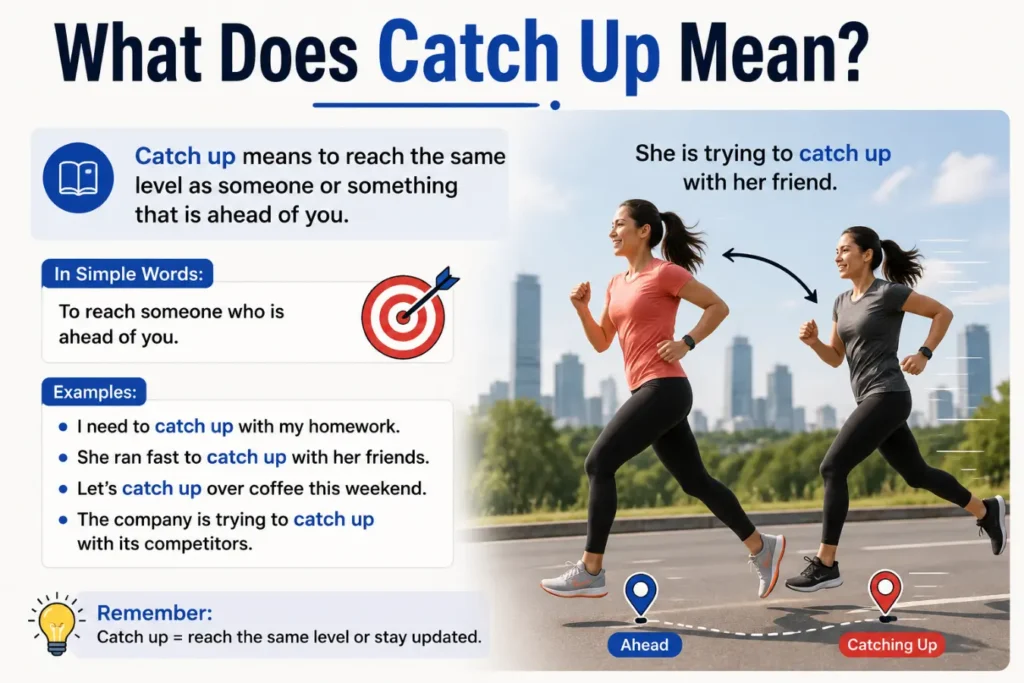
Catch up is a phrasal verb. It combines the verb catch with the adverb up.
It has several meanings.
- Reach someone who is ahead.
- Finish work you missed.
- Learn information you missed.
- Meet someone after a long time.
- Return to the same level as others.
Because it describes an action, the two words stay separate.
Examples
- I need to catch up on my homework.
- We should catch up over coffee.
- She ran faster to catch up with her friends.
- He stayed late to catch up on work.
What Does Catchup Mean?
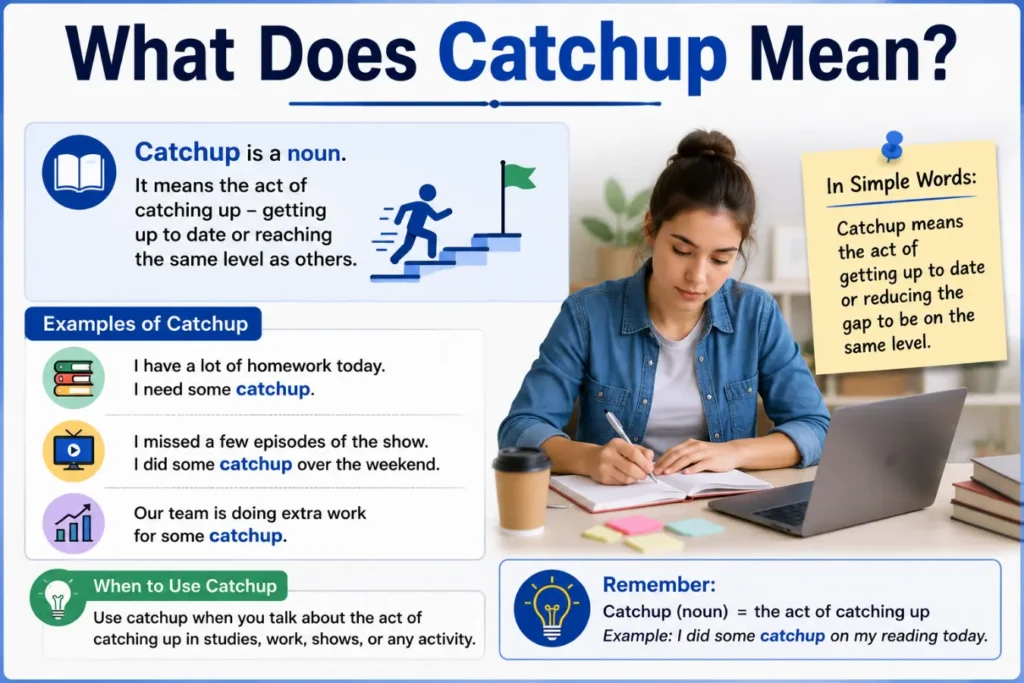
Catchup is much less common.
Some dictionaries recognize it as a noun that means a meeting to share updates or the act of catching up. However, many writers avoid this form because catch-up or catch up is clearer.
In addition, catchup has long appeared as an alternative spelling of ketchup, although ketchup is now the standard spelling for the tomato sauce.
Examples
- We had a quick catchup before the meeting. (less common)
- Please pass the catchup. (older spelling of ketchup)
In modern writing, many style guides recommend using catch-up as the noun instead.
Catchup vs. Catch Up: Key Differences
| Feature | Catch Up | Catchup |
| Word type | Phrasal verb | Noun (rare) |
| Common today | Yes | Rare |
| Main meaning | Reach the same level, meet, or finish missed work | Informal meeting or old spelling of ketchup |
| Used in formal writing | Yes | Rarely |
| Best choice for most situations | ✅ Yes | ❌ Usually no |
Simple Rule
- Use catch up when talking about an action.
- Use catch-up if you need the noun.
- Avoid catchup unless you mean the older spelling of ketchup or follow a specific style guide.
Is “Catch Up” Always the Correct Choice?
For most everyday writing, yes.
You should write catch up when describing an action.
For example:
- Let’s catch up this weekend.
- I must catch up on my reading.
- She worked hard to catch up with the class.
Readers expect this spelling because it follows standard English grammar.
When Can You Use “Catchup”?
Although uncommon, catchup still appears in some places.
You may see it in:
- Older books
- Brand names
- Informal writing
- Internal company notes
- Older dictionary entries
Even so, professional writers usually choose catch-up or catch up instead.
Why Do People Get Confused?
The confusion happens because English often combines words over time.
For example:
- Log in → Login
- Set up → Setup
- Work out → Workout
However, catch up has mostly remained two words when used as a verb.
Another reason is that people see catchup meeting in workplaces. Some companies write it as one word, while others use catch-up meeting. The hyphenated form is generally preferred when it acts as an adjective.
Real-Life Examples of Catch Up and Catchup
Example 1: Meeting a Friend
✅ Let’s catch up after work.
❌ Let’s catchup after work.
Example 2: School Assignment
✅ I need to catch up on my math lessons.
❌ I need to catchup on my math lessons.
Example 3: Office Conversation
✅ We had a short catch-up meeting this morning.
Less common: We had a quick catchup this morning.
Example 4: Sports
The runner sped up to catch up with the group.
Example 5: Reading the News
After my vacation, I spent an hour trying to catch up on the latest news.
Common Situations Where You Should Use “Catch Up”
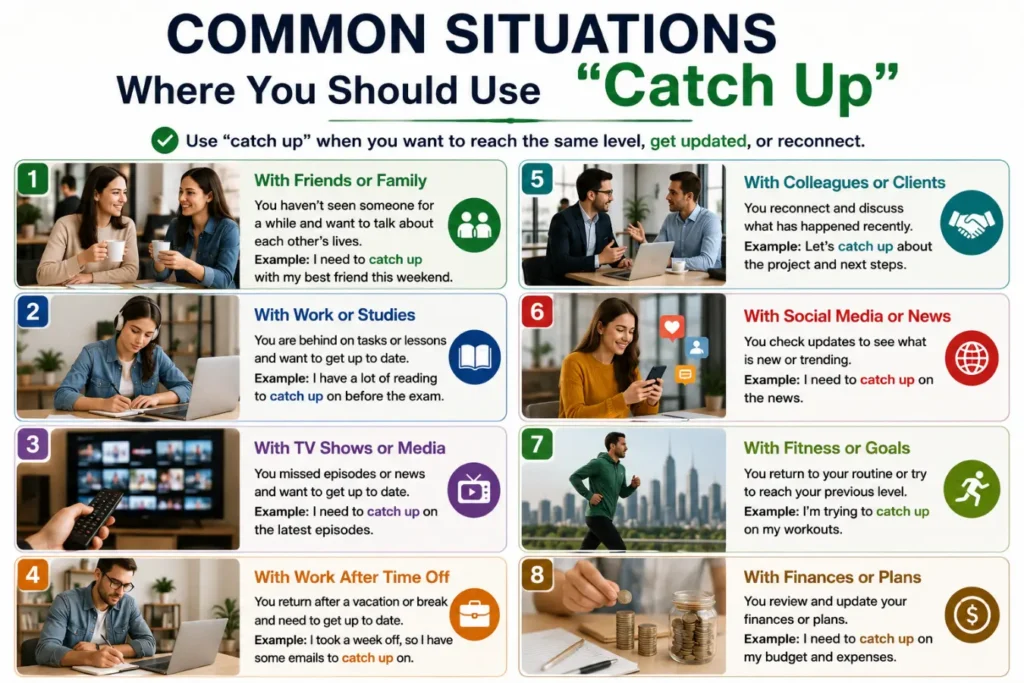
You should choose catch up in these everyday situations:
- Finishing missed homework
- Completing office tasks
- Reading missed emails
- Watching missed TV episodes
- Meeting friends after a long time
- Reaching someone while walking or running
- Learning information you missed
These are the most common uses in modern English.
Common Mistakes When Using Catchup or Catch Up
Many writers confuse these forms because they sound the same. However, using the correct one makes your writing clearer.
Writing catchup as a verb
❌ I need to catchup on my emails.
✅ I need to catch up on my emails.
Using catch up as a noun
❌ We had a team catch up yesterday.
✅ We had a team catch-up yesterday.
Forgetting the Hyphen
When the phrase works as an adjective before a noun, use a hyphen.
✅ We scheduled a catch-up meeting.
✅ She attended a catch-up call.
Copying Informal Workplace Usage
Some companies write catchup meeting in calendars or chat apps. That does not make it the preferred standard English spelling.
Tips to Remember the Difference
These simple tricks can help you choose the right form every time.
- Think action = two words. If someone is doing something, write catch up.
- Think describing a noun = hyphen. Write catch-up meeting or catch-up session.
- Avoid one word. Unless you mean the old spelling of ketchup or follow a specific company style, do not use catchup.
- Read your sentence aloud. If it sounds like an action, use the two-word form.
How People Use “Catch Up” in Everyday Life
You will hear catch up in many daily conversations.
At School
Students catch up on lessons after missing class.
At Work
Employees catch up on emails after returning from vacation.
With Friends
People meet to catch up over coffee or lunch.
In Sports
A player tries to catch up with the leader.
At Home
Parents catch up on housework during the weekend.
Because the phrase fits many situations, it is one of the most useful phrasal verbs in English.

Synonyms
Depending on the meaning, you can also use these words and phrases:
Completing Missed Work
- Finish
- Complete
- Make up
- Get up to date
For Meeting Someone
- Reconnect
- Meet
- Get together
- Visit
For Reaching Someone
- Overtake
- Reach
- Close the gap
These alternatives can improve your writing and reduce repetition.
Expert Insight
Professional editors and grammar experts recommend using catch up as the verb because it follows standard English usage. If you need a noun before another noun, catch-up is the clearer choice. Most modern style guides avoid catchup because readers may confuse it with the older spelling of ketchup. Choosing the correct form improves clarity and helps your writing look more polished.
Frequently Asked Questions
Is it catchup or catch up?
Catch up is correct in most situations. Use it when talking about an action.
Is catchup one word?
Yes, but it is uncommon. It appears as a rare noun and as an older spelling of ketchup.
How do you write catch-up meeting?
Write catch-up meeting with a hyphen because catch-up describes the noun meeting.
Can I write “Let’s catchup”?
No. The correct sentence is Let’s catch up.
Is catch up a phrasal verb?
Yes. Catch up is a common English phrasal verb with several meanings.
Why is catchup considered incorrect?
It is not always incorrect, but it is uncommon. Modern English usually prefers catch up or catch-up.
Is catch-up formal?
Yes. Catch-up is acceptable as a noun or adjective in both formal and informal writing.
Conclusion
Choosing between catchup or catch up becomes easy once you know the grammar rule. In most situations, catch up is the correct form because it is a phrasal verb that describes an action. If you use the phrase as a noun or adjective, catch-up is usually the better choice. The one-word form catchup is rare in modern English and often reminds readers of the older spelling of ketchup. By using the correct form, you make your writing clearer and more professional. Whether you are writing an email, completing schoolwork, or chatting with friends, following this simple rule will help you use the phrase with confidence.

Sophia Hayes is a language researcher and content writer at WordsCoppe.com, specializing in word comparisons, spelling differences, grammar explanations, and vocabulary insights. She is passionate about making English easier to understand through clear, accurate, and practical content. By breaking down complex language topics into simple explanations, Sophia helps readers improve their writing and communication skills. Her goal is to make learning English more accessible, engaging, and confidence-building for learners worldwide.