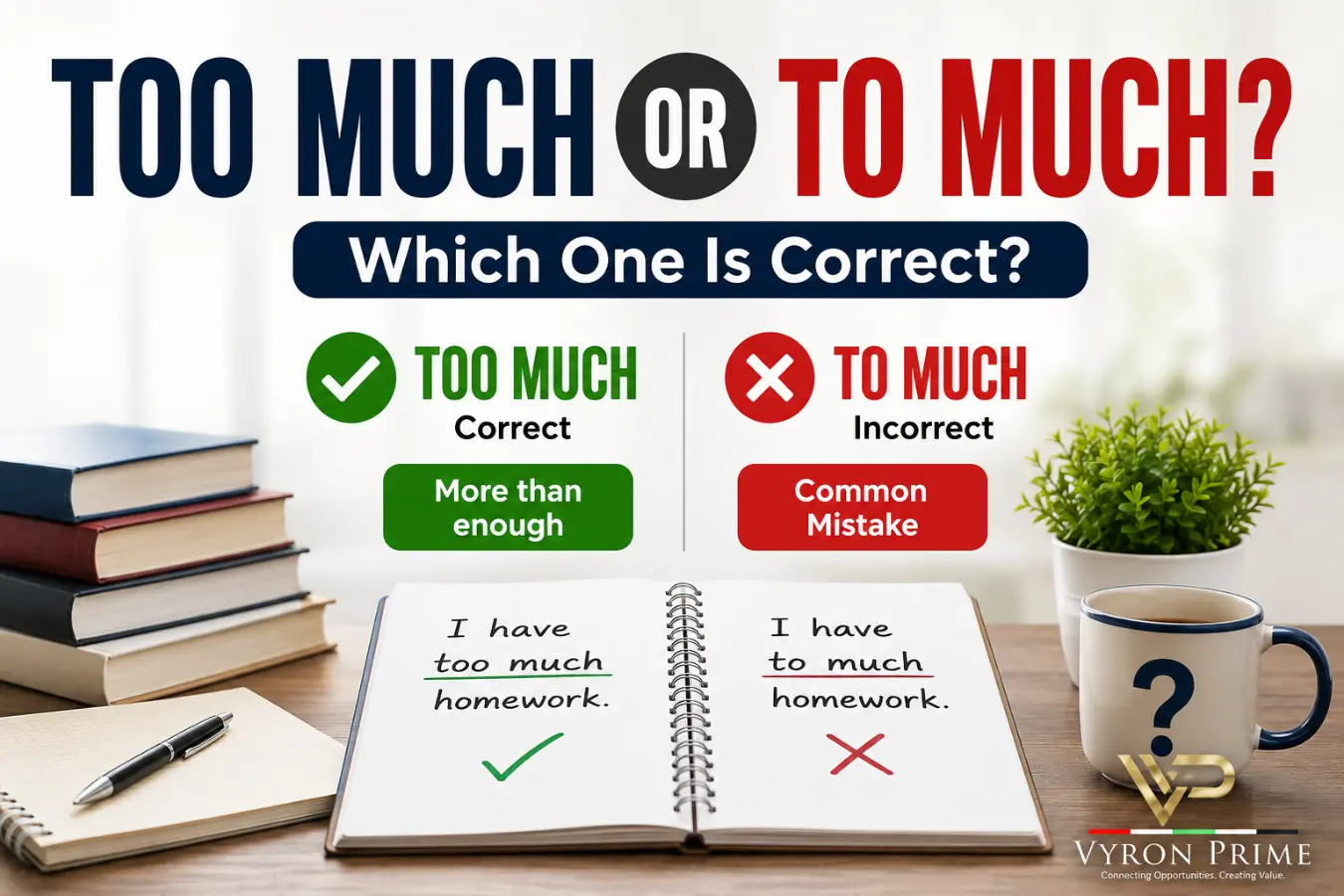
Too much or to much is a common grammar question, especially for English learners. Many people type to much by mistake because both to and too sound the same. However, only one form is correct in standard English.
The good news is that this rule is easy to learn. Once you understand the difference, you will avoid this mistake in emails, schoolwork, social media posts, and professional writing. In this guide, you will learn the meaning of too much, why to much is incorrect, real-life examples, common mistakes, and simple tricks to remember the correct spelling. By the end, you will use this expression with confidence every time.
Quick Summary Box
- Too much is the correct phrase.
- To much is grammatically incorrect.
- Too means more than needed or also.
- To is mainly used as a preposition or before a verb.
- Remember: If you mean “more than enough,” always write too much.
What Does “Too Much” Mean?
Too much means more than is needed, wanted, or acceptable.
It describes an excessive amount of something.
Examples
- I ate too much pizza.
- She spends too much time online.
- There is too much noise outside.
- We added too much sugar to the cake.
In every example, the amount is greater than necessary.
Is “To Much” Ever Correct?
No.
To much is not correct English.
The word to cannot replace too when talking about an excessive amount.
Incorrect
❌ I drank to much coffee.
Correct
✅ I drank too much coffee.
If your sentence means “more than enough,” always choose too much.
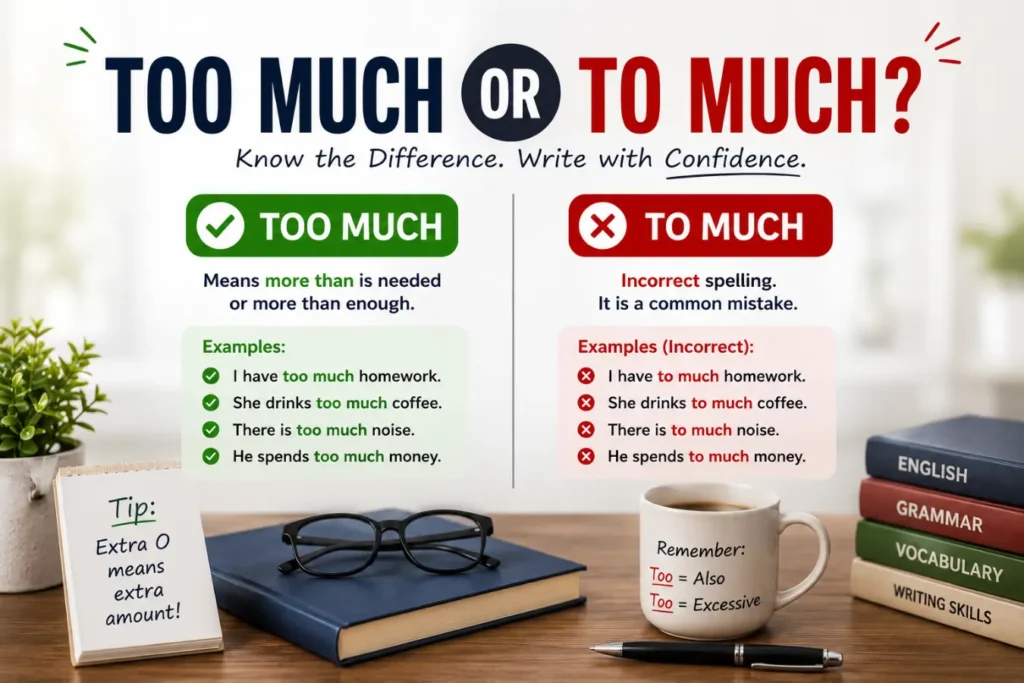
Too Much or To Much: Comparison Table
| Feature | Too Much | To Much |
| Correct spelling | ✅ Yes | ❌ No |
| Standard English | ✅ Yes | ❌ No |
| Means excessive amount | ✅ Yes | ❌ No |
| Used in formal writing | ✅ Yes | ❌ Never |
| Common typing mistake | ❌ No | ✅ Yes |
The table makes the choice simple. Too much is always the correct option.
Why Do People Write “To Much”?
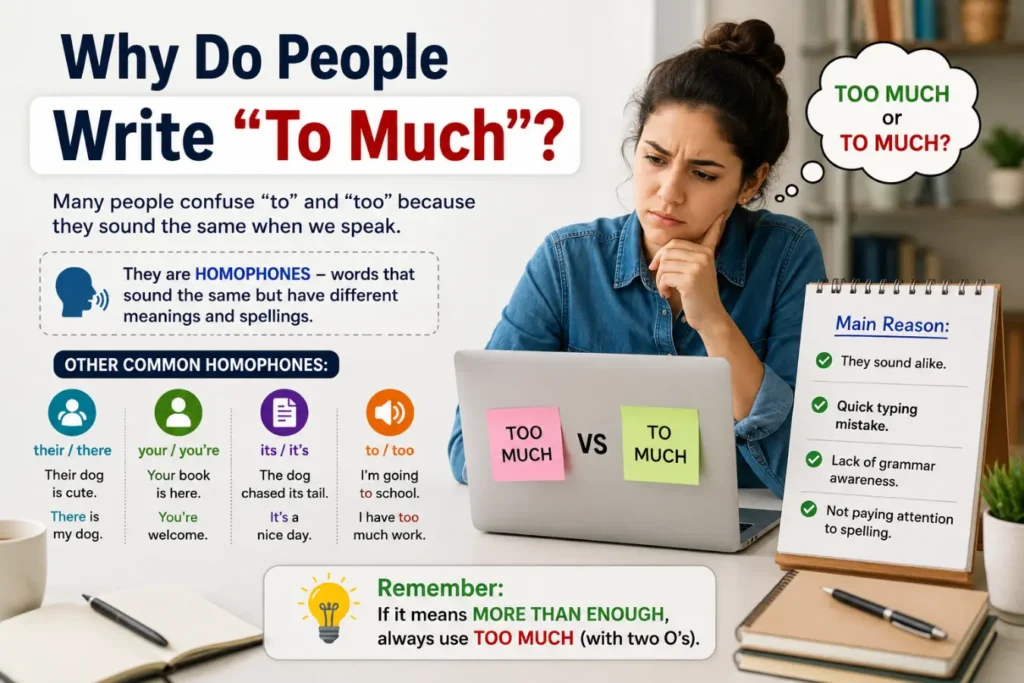
Many people confuse these words because to and too sound exactly alike.
This happens because English has many homophones, or words that share the same pronunciation but have different meanings.
Some common examples include:
- their / there
- your / you’re
- its / it’s
- too / to
As a result, people often type to much without noticing the mistake.
Real-Life Examples of “Too Much”
Here are examples you may hear every day.
Home
- There is too much laundry today.
- We bought too much food.
School
- I have too much homework tonight.
- The teacher gave us too much reading.
Work
- She has too much work this week.
- We received too much information during the meeting.
Online
- I spend too much time on my phone.
- Watching too much TV can reduce productivity.
These examples show how naturally the phrase fits into everyday conversations.
Common Mistakes When Using Too Much
Avoid these frequent errors.
Mistake 1
❌ To much homework
✅ Too much homework
Mistake 2
❌ I eat to much candy.
✅ I eat too much candy.
Mistake 3
❌ To much stress is unhealthy.
✅ Too much stress is unhealthy.
Mistake 4
❌ There are too much books.
✅ There are too many books.
Remember:
- Too much = uncountable nouns
- Too many = countable nouns
Examples:
- too much water ✅
- too much money ✅
- too many cars ✅
- too many students ✅
Easy Trick to Remember the Difference
A simple memory trick can help.
The extra “o” in too reminds you of extra.
Since too much means more than enough, it also has an extra letter.
Think like this:
Extra amount → Extra “O” → Too much
This trick works every time.
Using “Too Much” in Daily Life
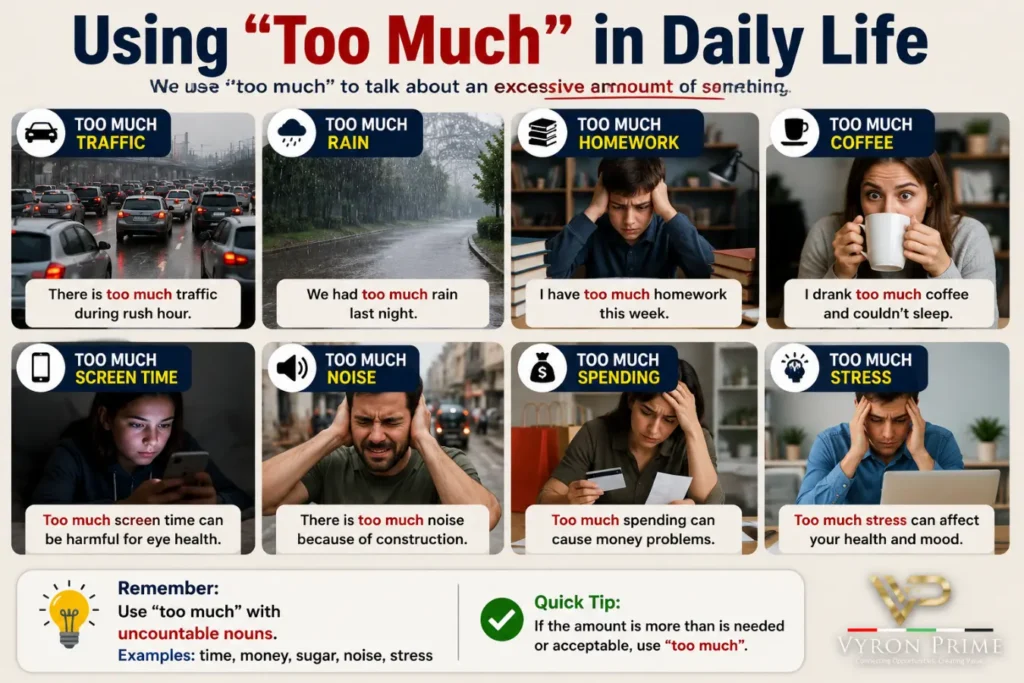
You will often use this phrase in normal conversations.
Examples include:
- Too much traffic
- Too much rain
- Too much homework
- Too much coffee
- Too much screen time
- Too much noise
- Too much spending
- Too much stress
Because the phrase is common, learning it improves both speaking and writing.
Synonyms and Similar Expressions
Depending on the sentence, you can use similar words.
Synonyms
- Excessive
- Overly
- More than enough
- An excessive amount
- An overload
- Overabundance
Similar Expressions
- Too many
- More than necessary
- Far too much
- Excessively
Choose the expression that sounds most natural for your sentence.
Expert Insight
Professional editors and English teachers agree on one important rule:
“Too much” is the only correct spelling when talking about an excessive amount.
Writing to much creates a grammar mistake that can reduce your credibility. Whether you write emails, blog posts, school assignments, or business documents, using the correct phrase helps your writing look polished and professional.
Learning this small rule also improves your overall grammar because it teaches the difference between to and too, one of the most common English spelling challenges.
Frequently Asked Questions
Is “to much” ever correct?
No. It is a spelling mistake. Use too much instead.
Why is “too much” correct?
Because too means more than enough or excessively.
Is “too much” one word?
No. It is written as two separate words.
What is the difference between “too much” and “too many”?
Too much is used with uncountable nouns, while too many is used with countable nouns.
Can I use “too much” in formal writing?
Yes. It is correct in both formal and informal English.
Why do people confuse “to” and “too”?
They are homophones. They sound the same but have different meanings and spellings.
How can I remember the correct spelling?
Remember that too has an extra O, just like it means an extra amount.
Conclusion
Choosing between too much or to much is simple once you know the rule. Too much is the only correct spelling when you mean more than is needed or acceptable. To much is a common spelling mistake and should not appear in correct English writing. Remember that too has an extra O, which can remind you of an extra amount. With this easy trick and the examples above, you can avoid the mistake in everyday conversations, school assignments, emails, and professional writing. The next time you wonder which phrase to use, choose too much with confidence.

Sophia Hayes is a language researcher and content writer at WordsCoppe.com, specializing in word comparisons, spelling differences, grammar explanations, and vocabulary insights. She is passionate about making English easier to understand through clear, accurate, and practical content. By breaking down complex language topics into simple explanations, Sophia helps readers improve their writing and communication skills. Her goal is to make learning English more accessible, engaging, and confidence-building for learners worldwide.