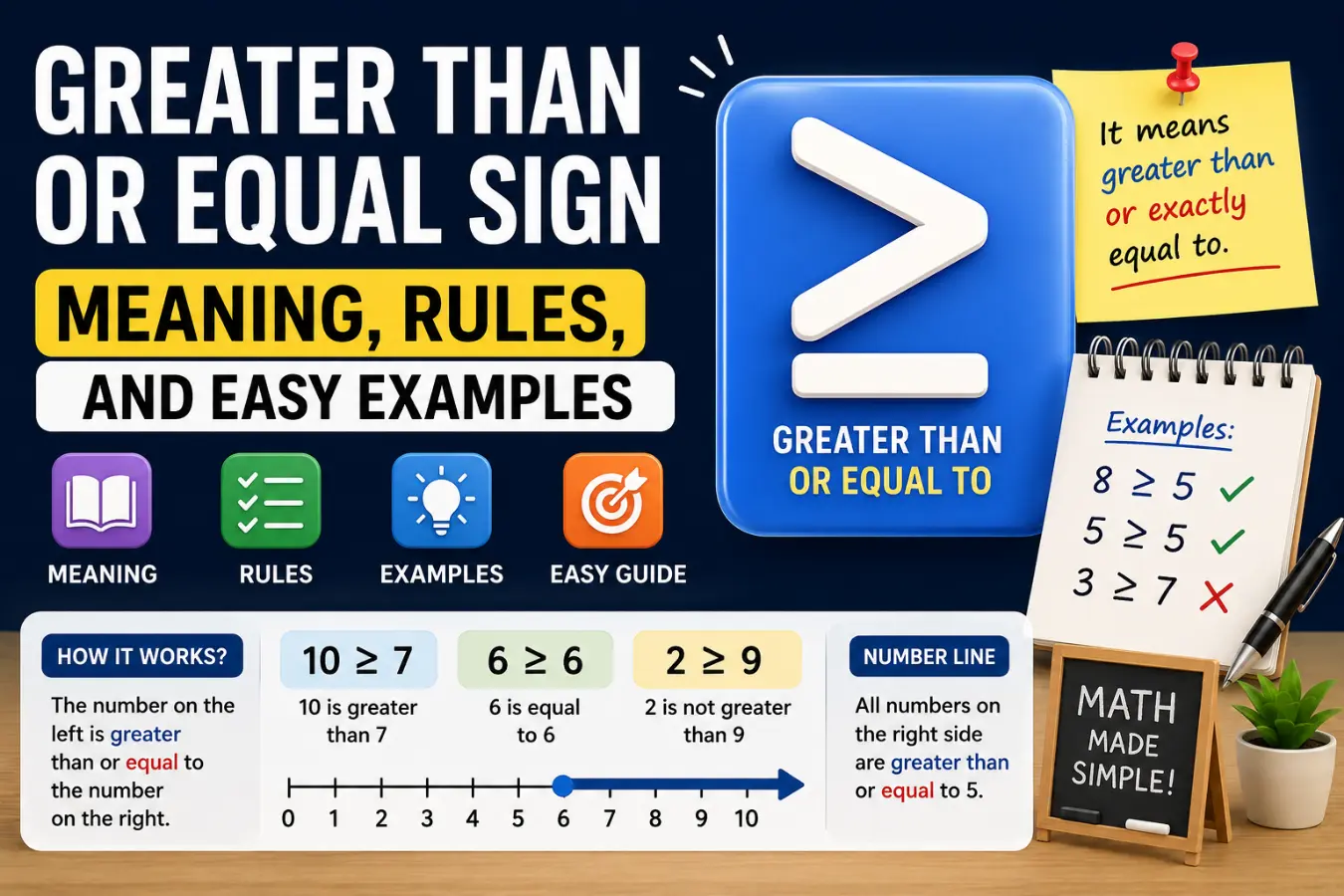
The greater than or equal sign is one of the most useful math symbols you will ever learn. You will see it in school, exams, graphs, computer programming, and real-life calculations. Although the symbol looks simple, many students confuse it with the greater than sign or the less than or equal sign. Learning the difference makes math easier and helps you solve inequalities correctly.
In this guide, you will discover what the greater than or equal sign means, how to use it, and where it appears in everyday life. You will also find simple examples, a comparison table, common mistakes, helpful memory tricks, expert tips, and answers to frequently asked questions. By the end, you will know exactly when and how to use this important mathematical symbol.
Quick Summary Box
- The greater than or equal sign is ≥.
- It means a value is greater than or exactly equal to another value.
- The symbol combines greater than (>) and equal (=).
- It is commonly used in math, algebra, graphs, and programming.
- Numbers on the left must be larger than or equal to numbers on the right.
- Example: 8 ≥ 5 and 5 ≥ 5 are both true.
What Is the Greater Than or Equal Sign?
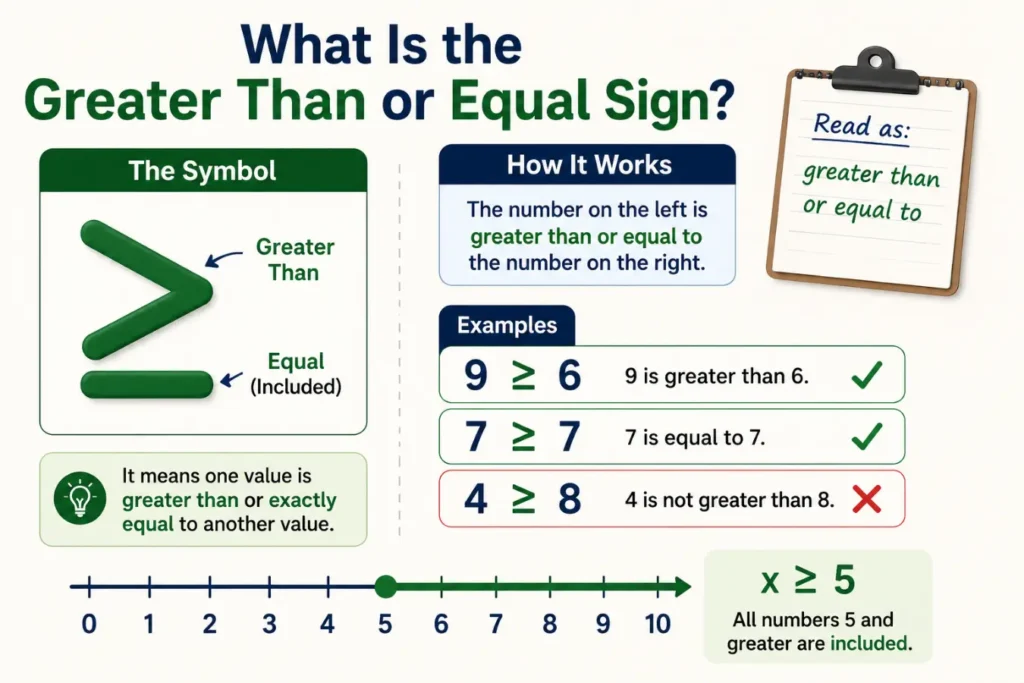
The greater than or equal sign (≥) is a mathematical symbol.
It tells us that one number is either:
- Greater than another number, or
- Exactly equal to it.
For example:
- 9 ≥ 6 ✔
- 7 ≥ 7 ✔
- 4 ≥ 8 ✘
The symbol gives two possible answers instead of one.
What Does the Greater Than or Equal Sign Mean in Simple Words?
Think of the symbol as saying:
“More than or the same as.”
This means the first number cannot be smaller.
For example:
- 15 ≥ 10 means 15 is greater than 10.
- 20 ≥ 20 means both numbers are equal.
- 12 ≥ 18 is false because 12 is smaller.
This simple idea makes inequalities much easier to understand.
How to Read the Greater Than or Equal Symbol
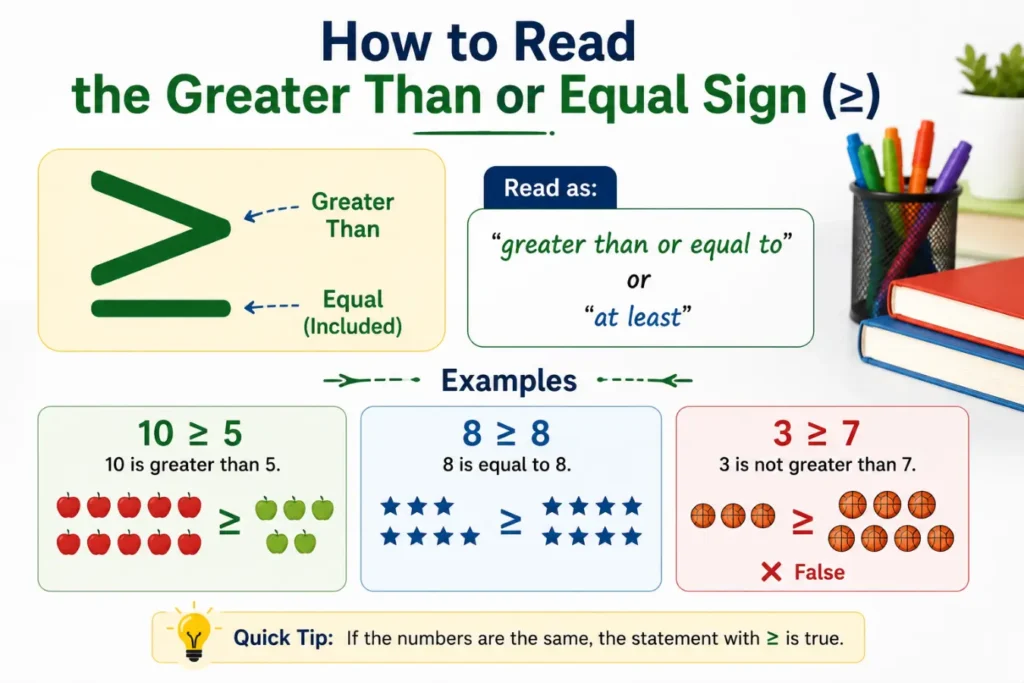
You can read ≥ in several correct ways.
Common ways include:
- Greater than or equal to
- At least
- No less than
- Equal to or greater than
Example:
Age ≥ 18
This means a person must be 18 years old or older.
Greater Than or Equal Sign vs Other Comparison Symbols
Many learners confuse comparison symbols.
The table below shows the difference.
| Symbol | Meaning | Example | True or False |
| > | Greater than | 9 > 4 | ✅ True |
| ≥ | Greater than or equal to | 9 ≥ 9 | ✅ True |
| < | Less than | 2 < 5 | ✅ True |
| ≤ | Less than or equal to | 5 ≤ 5 | ✅ True |
| = | Equal to | 8 = 8 | ✅ True |
Remember that ≥ includes equality, while > does not.
When Should You Use the Greater Than or Equal Sign?
Use this symbol when a value can be larger or exactly the same.
Examples include:
- Age must be 18 or older.
- Score must be 70 or higher.
- Temperature should be 30°C or above.
- Salary must be $2,000 or more.
These situations all allow equality.
Real-Life Examples of the Greater Than or Equal Sign
You may notice this symbol in many places.
At school
Score ≥ 50 to pass.
Driving rules
Age ≥ 18 for a driver’s license.
Shopping offers
Spend $100 ≥ to receive free shipping.
Sports
Teams need 10 points or more to qualify.
Computer programming
Developers use ≥ when creating conditions in software.
This symbol appears far beyond the classroom.
Common Mistakes Students Make
Many learners make the same errors.
Mistake 1: Mixing up > and ≥
Remember that ≥ includes equal numbers.
Mistake 2: Facing the symbol the wrong way
The open side always points toward the larger number.
Mistake 3: Forgetting equality
Many students ignore the small line underneath.
That line changes the meaning completely.
Mistake 4: Reading it too quickly
Always check whether the symbol includes equality.
A quick glance can lead to the wrong answer.
Easy Tricks to Remember the Symbol
These simple tips help you remember it.
- The extra line means equal is allowed.
- Think of ≥ as saying “at least.”
- The open side faces the larger number.
- If the numbers match, ≥ can still be true.
- Practice with simple inequalities every day.
These tricks make learning easier.
Where You Will Use This Symbol in Everyday Life
The greater than or equal sign appears in many everyday situations.
You may see it in:
- School math lessons
- Algebra homework
- Science formulas
- Business reports
- Computer programming
- Data analysis
- Engineering calculations
- Financial planning
Understanding this symbol makes many subjects easier.
Related Math Symbols and Similar Terms
These symbols often appear with ≥.
- Greater than (>)
- Less than (<)
- Less than or equal to (≤)
- Equal sign (=)
- Inequality symbols
- Comparison operators
- Mathematical expressions
Learning them together builds stronger math skills.
Expert Insight: Why Learning Comparison Symbols Matters
Comparison symbols are the foundation of mathematics.
They help students solve equations, compare values, read graphs, and understand formulas. Professionals also use these symbols in engineering, economics, programming, finance, and science.
Mastering the greater than or equal sign early makes advanced math much easier. It also reduces mistakes during exams and improves problem-solving confidence.
Frequently Asked Questions
What is the greater than or equal sign?
It is the symbol ≥, meaning greater than or equal to.
What does ≥ mean?
It means one value is larger than or exactly equal to another value.
Is 5 ≥ 5 true?
Yes. Both numbers are equal, so the statement is true.
What is the difference between > and ≥?
The symbol > does not include equality. The symbol ≥ does.
Where is the greater than or equal sign used?
It appears in mathematics, science, programming, engineering, and everyday comparisons.
How do I type the greater than or equal sign?
Most devices let you insert ≥ through the symbol menu, character map, or keyboard shortcuts.
Is ≥ an inequality symbol?
Yes. It belongs to the family of inequality symbols.
Conclusion
The greater than or equal sign is an important mathematical symbol that shows one number is larger than or exactly equal to another. Although it looks similar to the greater than sign, the extra line changes its meaning by allowing equality. You will see this symbol in school, science, business, computer programming, and everyday calculations. Once you understand how it works, solving inequalities becomes much easier. Remember that the open side faces the larger number, while the line underneath means equal values are accepted. With regular practice, using the greater than or equal sign will soon become simple and natural

Sophia Hayes is a language researcher and content writer at WordsCoppe.com, specializing in word comparisons, spelling differences, grammar explanations, and vocabulary insights. She is passionate about making English easier to understand through clear, accurate, and practical content. By breaking down complex language topics into simple explanations, Sophia helps readers improve their writing and communication skills. Her goal is to make learning English more accessible, engaging, and confidence-building for learners worldwide.