
Working hard or hardly working is a common English phrase that many people hear at work, in school, and even in casual conversations. However, many learners feel confused about its real meaning. Some people also think both expressions mean the same thing, but they do not. Understanding the difference helps you speak and write English more naturally. It also prevents common grammar mistakes. In addition, this phrase often appears in jokes, office chats, and social media posts. Therefore, learning how to use it correctly is useful in daily life. This guide explains the meaning in simple words. It also shares examples, comparisons, common mistakes, and practical tips. By the end, you will know exactly when to use each expression with confidence.
Quick Summary
Featured Snippet Box
- Working hard means putting in a lot of effort.
- Hardly working means doing very little or no work.
- Although the words look similar, their meanings are opposite.
- “Hardly” means almost not, not “with effort.”
- The phrase “Working hard or hardly working?” is often used as a playful joke.
- Knowing the difference helps improve English speaking and writing.
What Does “Working Hard or Hardly Working” Mean?
The phrase working hard or hardly working is a playful question people ask someone who appears busy.
It creates humor because the two parts have opposite meanings.
- Working hard = putting in serious effort.
- Hardly working = doing almost no work.
The joke makes the listener smile because both expressions sound similar. However, they communicate completely different ideas.
Simple definition
| Expression | Meaning |
| Working hard | Putting in a lot of effort |
| Hardly working | Doing little or almost no work |

Working Hard vs. Hardly Working Explained in Simple Words
Many English learners think hard and hardly have similar meanings. That is not true.
Let’s look at them separately.
Working hard
The word hard describes strong effort.
Examples:
- She is working hard for her exams.
- They worked hard to finish the project.
- He studies hard every evening.
In each sentence, the person gives their best effort.
Hardly working
The word hardly means almost not.
Examples:
- He is hardly working today.
- They are hardly paying attention.
- She hardly speaks during meetings.
Here, the action happens very little.
Easy trick
- Hard = a lot of effort
- Hardly = almost not
Remember this rule because it prevents many grammar mistakes.
Why Do People Say “Working Hard or Hardly Working?”
This question is usually a joke.
People ask it when they see someone sitting at a desk, looking busy, or taking a short break.
Sometimes the person is truly working hard.
Other times, they may only look busy.
Because of this, the phrase creates friendly humor.
Example conversation
Manager: Working hard or hardly working?
Employee: Definitely working hard today!
Another reply could be:
Employee: A little of both.
This playful response often makes everyone laugh.
Working Hard vs. Hardly Working: Comparison Table
| Feature | Working Hard | Hardly Working |
| Meaning | Putting in strong effort | Doing very little work |
| Tone | Positive | Humorous or negative |
| Shows productivity | Yes | Usually no |
| Common use | Work, school, sports | Jokes, casual conversations |
| Example | She is working hard. | He is hardly working. |
Real-Life Examples of Working Hard and Hardly Working
Real situations make the difference easier to understand.
At work
Maria finishes every task before the deadline.
She is working hard.
Tom spends most of the day scrolling through social media.
He is hardly working.
At school
Emma studies every night before exams.
She is working hard.
Jake talks with friends during class.
He is hardly working on his assignments.
At home
Your parents clean the house all morning.
They are working hard.
Your brother watches TV all afternoon.
He is hardly working on his chores.
During sports practice
The team trains every day.
They are working hard.
One player skips most drills.
He is hardly working compared with the others.
Grammar Rule Behind Hard and Hardly
Understanding the grammar makes everything easier.
Hard
“Hard” can be an adjective or an adverb.
As an adverb, it means with great effort.
Examples:
- Work hard.
- Practice hard.
- Train hard.
Hardly
“Hardly” is an adverb.
It means almost not.
It does not mean “with effort.”
Examples:
- I hardly know him.
- She hardly eats sweets.
- We hardly see each other.
This small difference changes the meaning completely.
Common Mistakes People Make
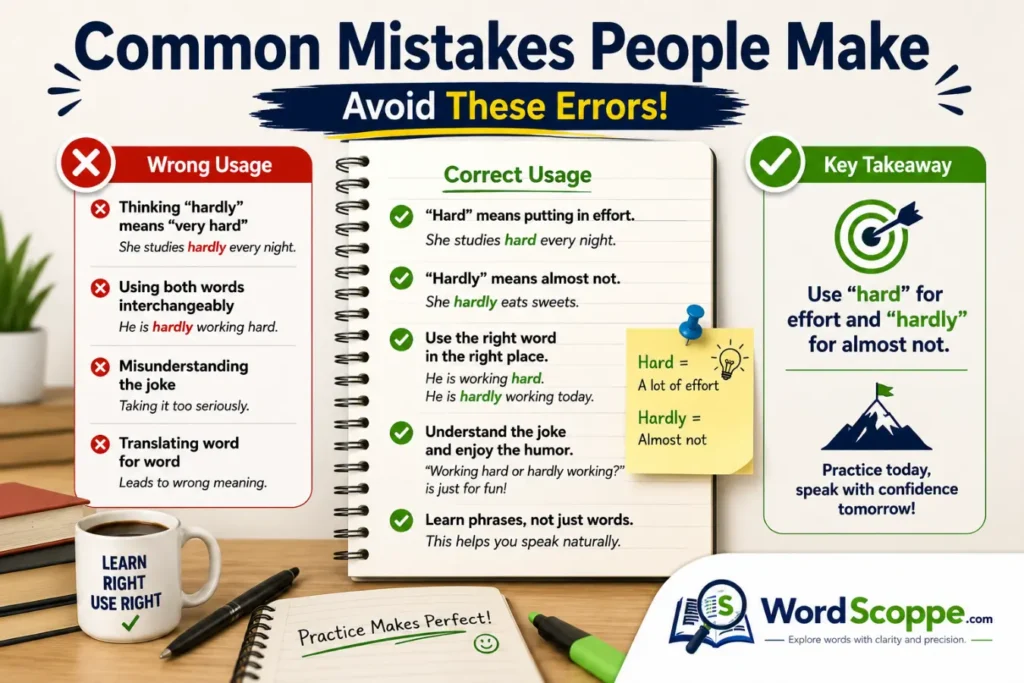
Many English learners repeat the same errors.
Avoid these mistakes.
Mistake 1: Thinking “hardly” means “very hard”
❌ She studies hardly every night.
✅ She studies hard every night.
Mistake 2: Using both interchangeably
These words are not synonyms.
Always remember:
- Hard = strong effort
- Hardly = almost not
Mistake 3: Misunderstanding the joke
Some learners believe the question asks whether someone works hard.
Actually, it is a humorous expression.
The speaker often expects a funny reply.
Mistake 4: Translating word for word
Direct translation from another language can change the meaning.
Instead, learn the expression as a complete phrase.
Tips to Remember the Correct Usage
These simple tricks help you remember the difference.

- Think of hard as maximum effort.
- Think of hardly as almost zero.
- Practice with daily conversations.
- Read English articles and books regularly.
- Watch workplace comedy shows.
- Learn common English idioms naturally.
- Repeat example sentences aloud.
- Notice how native speakers use the phrase.
These habits improve both speaking and writing naturally.
Using “Working Hard” and “Hardly Working” in Daily Life
You can hear these expressions in many everyday situations. Knowing the correct meaning helps you understand conversations and respond naturally.
In the workplace
People often use the phrase to lighten the mood.
Example
Manager: Working hard or hardly working?
Employee: Working hard. The deadline is today.
At school
Teachers may praise students who put in effort.
Example
The students are working hard before the final exams.
At home
Parents often encourage children to stay focused.
Example
My sister is working hard on her science project.
With friends
Friends usually say the phrase as a joke.
Example
I walked into the café and asked my friend, “Working hard or hardly working?”
On social media
Many people use this expression as a funny caption.
Example
Working hard… or hardly working? ☕
Synonyms and Similar Expressions
These words and phrases have related meanings. However, they do not always replace each other.
Synonyms for working hard
- Putting in effort
- Working diligently
- Giving your best
- Staying productive
- Working tirelessly
- Being dedicated
- Putting your heart into something
- Making a strong effort
Similar expressions for hardly working
- Doing very little
- Slacking off
- Taking it easy
- Not being productive
- Wasting time
- Avoiding work
- Doing almost nothing
Tip: Choose the expression that matches the situation and tone.
When Should You Use “Working Hard” or “Hardly Working”?
Use working hard when someone gives full effort.
Examples
- She is working hard to earn a promotion.
- They worked hard to complete the building.
- We are working hard to improve our English.
Use hardly working when someone is doing very little work or when you want to make a light-hearted joke.
Examples
- He is hardly working today.
- They are hardly paying attention.
- My friend laughed and asked, “Working hard or hardly working?”
Understanding the context helps you choose the correct phrase every time.
Expert Insights
English learners often confuse hard and hardly because the words look almost the same. However, they have different meanings.
Language experts recommend learning common phrases instead of memorizing single words. This method improves speaking confidence and reduces grammar mistakes.
It also helps you understand workplace humor, movies, TV shows, and casual conversations more easily.
A simple rule works well:
- Hard = a lot of effort
- Hardly = almost not
Practice this rule often, and it will soon become natural.
Frequently Asked Questions
Is “working hard or hardly working” a joke?
Yes. It is a playful expression that people often use in friendly conversations.
What does “hardly working” really mean?
It means doing very little work or almost no work.
Does “hardly” mean “working very hard”?
No. Hardly means almost not. It does not describe strong effort.
Is the phrase polite?
Yes. It is usually friendly and humorous. However, use it only when the situation feels relaxed.
Can I use this phrase at work?
Yes. Many coworkers use it casually. Still, avoid it during serious meetings or formal discussions.
Why do English learners confuse these words?
The words hard and hardly look similar, but their meanings are completely different.
How can I remember the difference?
Remember this simple trick:
- Hard = lots of effort
- Hardly = almost none
Conclusion
The phrase working hard or hardly working may sound simple, but it often confuses English learners. The key difference is easy to remember once you understand the meaning of each word. Working hard describes someone who puts in strong effort. Hardly working means someone is doing very little work or almost none at all. Although the words look alike, they are not interchangeable. Learning this common expression also helps you understand workplace jokes, everyday conversations, and social media captions. Practice the examples in this guide and use the phrase naturally in real situations. The more you hear and use it, the more confident your English will become.

Sophia Hayes is a language researcher and content writer at WordsCoppe.com, specializing in word comparisons, spelling differences, grammar explanations, and vocabulary insights. She is passionate about making English easier to understand through clear, accurate, and practical content. By breaking down complex language topics into simple explanations, Sophia helps readers improve their writing and communication skills. Her goal is to make learning English more accessible, engaging, and confidence-building for learners worldwide.