Yay or nay is a popular English phrase that people use when asking for a simple opinion or decision. You may hear it in conversations, online polls, social media posts, or even business meetings. Although the phrase sounds casual, it has a clear meaning and fits many everyday situations. Therefore, learning how to use it correctly can improve your English speaking and writing. It also helps you understand native speakers more easily.
In addition, many learners confuse this phrase with similar expressions like yes or no. However, there are small differences in tone and usage. This guide explains everything in simple words. You will also find examples, comparisons, common mistakes, and practical tips. By the end, you will know exactly when to say yay or nay with confidence.
Quick Summary
Featured Snippet Box
- Yay or nay means asking someone to choose yes or no.
- Yay means approval, agreement, or support.
- Nay means rejection, disagreement, or refusal.
- The phrase is common in casual conversations and online polls.
- It sounds more fun and friendly than simply saying yes or no.
- Use it when asking for a quick opinion or decision.
What Does “Yay or Nay” Mean?
The phrase yay or nay asks someone to make a simple choice.
It means:
Do you agree or disagree?
or
Yes or no?
People often use it when they want a quick answer.
Simple definition
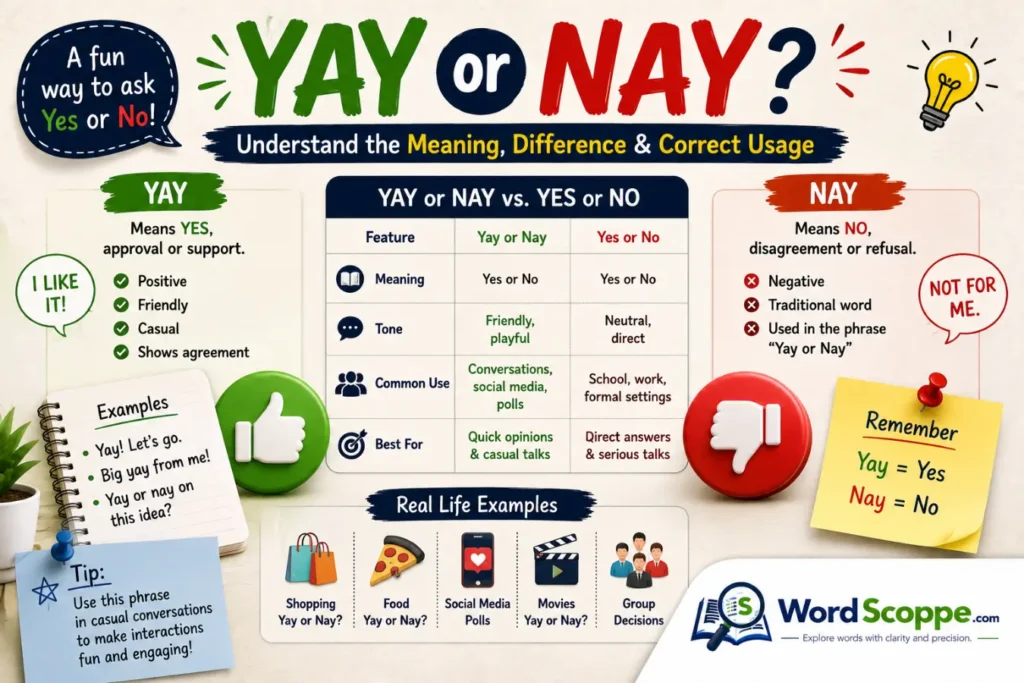
- Yay = Yes, I agree.
- Nay = No, I disagree.
The phrase makes conversations sound more relaxed and friendly.
Yay or Nay Explained in Simple Words
Understanding this expression is very easy.
Imagine you show your friend a new jacket.
You ask,
“Yay or nay?”
Your friend only needs to decide whether they like it.
If they like it, they answer:
Yay!
If they do not like it, they answer:
Nay.
The phrase is often playful. Therefore, people commonly use it in casual settings rather than formal situations.
Where Did “Yay” and “Nay” Come From?
The two words have different histories.
Yay
Yay is a cheerful word.
People use it to show happiness, excitement, or approval.
Over time, it also became another way to say yes in casual English.
Nay
Nay is an old English word.
It simply means no.
Today, people rarely use it in everyday speech by itself.

However, it remains popular in the phrase yay or nay.
Because of this, the expression combines a modern word with a traditional one.
Yay or Nay vs. Yes or No
Many learners wonder if these phrases mean the same thing.
The answer is almost.
Both ask for a choice.
However, the tone is different.
| Expression | Meaning | Tone | Common Use |
| Yay or Nay | Yes or No | Friendly and playful | Social media, conversations, polls |
| Yes or No | Direct answer | Neutral | Everyday speech, school, business |
Example
Friend: Pizza tonight? Yay or nay?
Teacher: Answer yes or no.
Both questions ask for a decision.
However, the first sounds much more casual.
Real-Life Examples of Yay or Nay
Real examples make the meaning easier to remember.

On social media
Someone posts a new hairstyle.
Caption:
Yay or nay?
Followers vote in the comments.
Shopping
You try on new shoes.
You ask your friend,
Yay or nay?
They smile and say,
Yay! They look great.
Food
You create a new recipe.
Before serving it, you ask your family,
Yay or nay?
Everyone shares their opinion.
At work
Your team discusses a new logo.
Someone asks,
Yay or nay before we choose the final design?
Everyone gives quick feedback.
During a group chat
A friend suggests going to the beach.
Another friend replies,
Big yay from me!
The group quickly reaches a decision.
When Should You Use “Yay or Nay”?
This phrase works best in informal situations.
You can use it when asking for opinions, feedback, or approval.
Good situations
- Choosing clothes
- Voting in a group
- Social media polls
- Deciding on food
- Picking a movie
- Selecting a logo
- Choosing a gift
- Planning a weekend activity
Less suitable situations
Avoid this phrase during formal interviews, legal discussions, academic writing, or official business documents.
In these situations, yes or no sounds more professional.
Common Mistakes People Make
Many English learners make small mistakes with this expression.
Here are the most common ones.
Mistake 1: Thinking “yay” means excitement only
While yay can express happiness, it also means approval in this phrase.
❌ Yay! means only celebration.
✅ Yay can also mean yes.
Mistake 2: Using “nay” in every conversation
Some learners start replacing every no with nay.
That sounds unnatural.
Today, people mainly use nay inside the phrase yay or nay.
Mistake 3: Using the phrase in formal writing
Avoid writing:
The manager requested a yay or nay response.
Instead write:
The manager requested a yes or no response.
Mistake 4: Confusing it with voting terms
Although yea and nay appear in official voting, yay is different.
Yay expresses approval in casual English.
Yea appears mainly in formal voting or legislative contexts.
Learning this difference improves both writing and speaking.
Tips to Remember the Correct Usage
These simple tricks make the phrase easy to remember.
- Think of yay as a happy yes.
- Think of nay as another word for no.
- Use the phrase in friendly conversations.
- Listen for it in YouTube videos and podcasts.
- Notice how people use it in online polls.
- Practice with everyday questions.
- Read comments on social media for real examples.
- Repeat simple sentences aloud until they feel natural.
These habits help you remember the expression and use it with confidence.
Using “Yay or Nay” in Daily Life
You can use yay or nay in many everyday situations. It works best when you want a quick opinion or simple decision.
With friends
Friends often use this phrase when choosing something together.
Example
Yay or nay for pizza tonight?
While shopping
Ask for honest feedback before buying something.
Example
Yay or nay on this blue jacket?
On social media
Many creators ask followers to vote.
Example
New profile picture. Yay or nay?
During family discussions
Families often use the phrase when making plans.
Example
Camping this weekend—yay or nay?
In team brainstorming
Small groups sometimes use it before making a final choice.
Example
Yay or nay for this new logo design?
Remember, the phrase creates a friendly tone. Therefore, it fits informal conversations much better than formal ones.
Synonyms and Similar Expressions
These expressions have similar meanings. However, each one suits a different situation.
Synonyms for yay
- Yes
- Absolutely
- Definitely
- I agree
- Sounds good
- Count me in
- I’m in
- Approved
Synonyms for nay
- No
- Not really
- I disagree
- No thanks
- I don’t think so
- Negative
- Not for me
- I pass
Similar expressions
- Yes or no
- Thumbs up or thumbs down
- Agree or disagree
- For or against
- Approve or reject
- Good idea or bad idea
Choose the expression that matches the situation and the level of formality.
Yay, Nay, and Yea: What’s the Difference?
Many English learners mix up these three words because they look alike.
| Word | Meaning | Where It Is Common |
| Yay | Yes, approval, excitement | Everyday conversations and social media |
| Nay | No, refusal, disagreement | Fixed phrases and traditional language |
| Yea | Formal yes vote | Government, legal, and parliamentary voting |
Examples
- Yay! We won the game.
- Yay or nay?
- The proposal passed with 45 yeas and 10 nays.
This small difference helps you choose the correct word every time.
Expert Insights
Simple expressions often make English sound more natural. Yay or nay is a good example.
Language experts encourage learners to study common phrases instead of single words. This approach improves speaking confidence and listening skills.
The phrase also appears in online polls, videos, product reviews, and everyday conversations. Therefore, understanding it helps you communicate more naturally.
One easy rule can help you remember it forever:
- Yay = Yes
- Nay = No
Practice this expression often, and it will soon become part of your everyday English.
Frequently Asked Questions
What does “yay or nay” mean?
It means asking someone for a simple yes or no opinion or decision.
Is “yay or nay” formal?
No. It is mainly an informal expression used in friendly conversations.
What is the difference between “yay” and “yea”?
Yay means approval or excitement in everyday English. Yea is a formal voting word.
Can I use “yay or nay” at work?
Yes, but only in casual workplace conversations or creative meetings. Use yes or no in formal communication.
Is “nay” still used today?
Yes, but mostly in the phrase yay or nay or in formal voting language.
Why is “yay or nay” so popular online?
It encourages quick responses. Therefore, many people use it in polls, captions, and comment sections.
Is “yay or nay” the same as “thumbs up or thumbs down”?
Almost. Both ask for approval or rejection, but yay or nay uses words instead of symbols.
Conclusion
The phrase yay or nay is a simple and useful expression that makes conversations more engaging. It gives people an easy way to share their opinion without using long answers. Although it means almost the same as yes or no, it sounds more friendly, playful, and conversational. Learning the difference between yay, nay, and yea also helps you avoid common English mistakes.
Whether you are asking friends about a movie, posting a social media poll, or choosing a new outfit, this phrase fits many everyday situations. Keep practicing it with real-life examples, and you will soon use it naturally and confidently in your daily English conversations.

Sophia Hayes is a language researcher and content writer at WordsCoppe.com, specializing in word comparisons, spelling differences, grammar explanations, and vocabulary insights. She is passionate about making English easier to understand through clear, accurate, and practical content. By breaking down complex language topics into simple explanations, Sophia helps readers improve their writing and communication skills. Her goal is to make learning English more accessible, engaging, and confidence-building for learners worldwide.