
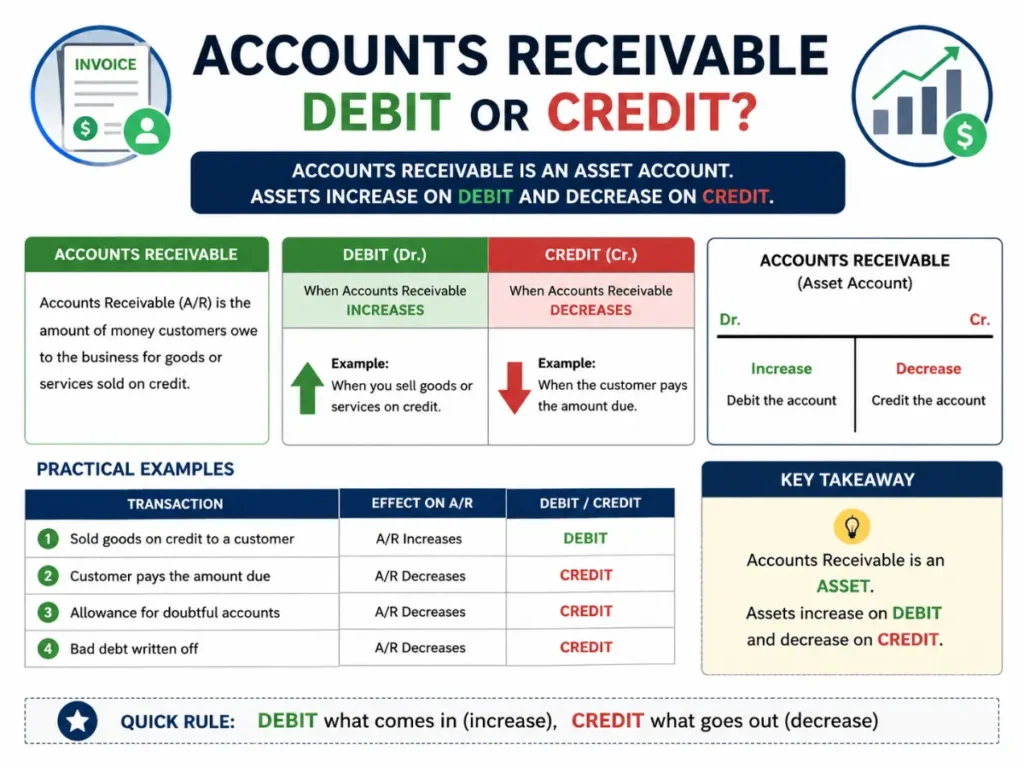
Accounts Receivable Debit or Credit is one of the first questions new accounting students ask. The answer is simple once you understand the basic rule. Accounts receivable is an asset account. Assets increase with a debit and decrease with a credit. This means you debit accounts receivable when a customer owes your business money. You credit it when the customer pays the amount due.
Many people confuse accounts receivable with revenue or cash. However, each account has a different purpose. Learning this rule helps you record transactions correctly. It also helps you avoid common bookkeeping mistakes. In this guide, you will learn the meaning of accounts receivable, why it is a debit or credit, and how it works in daily business. You will also see easy examples, expert tips, and answers to common questions.
Quick Summary
- Accounts receivable is an asset account.
- Assets increase with a debit.
- Assets decrease with a credit.
- Debit accounts receivable when selling goods or services on credit.
- Credit accounts receivable when customers pay their invoices.
- Accounts receivable represents money customers owe your business.

What Is Accounts Receivable?
Accounts receivable (A/R) is the money customers owe a business after buying goods or services on credit. Instead of paying immediately, customers promise to pay later.
For example, a company sells office furniture worth $2,000 on credit. The customer will pay in 30 days. Until payment arrives, the business records $2,000 as accounts receivable.
Simply put, accounts receivable is money your business expects to collect.
Is Accounts Receivable Debit or Credit?
The answer is straightforward.
Accounts receivable is normally a debit balance because it is an asset.
Here is the rule:
- Debit → Accounts receivable increases.
- Credit → Accounts receivable decreases.
Whenever your business makes a credit sale, accounts receivable increases. When customers pay, the balance decreases.
This is one of the most important accounting rules to remember.
Why Is Accounts Receivable an Asset?
Assets are resources a business owns or controls.
Accounts receivable qualifies as an asset because:
- It has future economic value.
- Customers are expected to pay.
- The payment will increase company cash.
Even though cash has not arrived yet, the business still owns the legal right to receive payment.
That is why accounts receivable appears under Current Assets on the balance sheet.
How Debits and Credits Affect Accounts Receivable
Understanding the effect of debits and credits becomes easier with this table.
| Transaction | Debit | Credit |
|---|---|---|
| Sell goods on credit | Accounts Receivable | Sales Revenue |
| Customer pays invoice | Cash | Accounts Receivable |
| Write off bad debt | Bad Debt Expense | Accounts Receivable |
| Customer returns goods | Sales Returns | Accounts Receivable |
Remember this simple rule:
Debit increases Accounts Receivable. Credit decreases Accounts Receivable.
Real-Life Examples of Accounts Receivable
Here are simple examples anyone can understand.
Example 1: Credit Sale
A furniture store sells products worth $1,000 on credit.
Journal Entry
Debit: Accounts Receivable $1,000
Credit: Sales Revenue $1,000
The customer now owes the business money.
Example 2: Customer Payment
The customer pays the $1,000 invoice.
Journal Entry
Debit: Cash $1,000
Credit: Accounts Receivable $1,000
The amount owed becomes zero.
Example 3: Partial Payment
A customer owes $800 but pays $300.
Debit: Cash $300
Credit: Accounts Receivable $300
The remaining balance is $500.
Accounts Receivable vs Accounts Payable
Many beginners confuse these two accounts.
| Feature | Accounts Receivable | Accounts Payable |
|---|---|---|
| Meaning | Money customers owe you | Money you owe suppliers |
| Account Type | Asset | Liability |
| Normal Balance | Debit | Credit |
| Increases With | Debit | Credit |
| Decreases With | Credit | Debit |
A simple trick is:
- Receivable = Receive money
- Payable = Pay money

Common Mistakes When Recording Accounts Receivable
Avoid these common errors.
Recording cash sales as accounts receivable
Cash sales should increase cash, not accounts receivable.
Crediting accounts receivable during a credit sale
This is incorrect because receivables increase after a credit sale.
Forgetting customer payments
Always reduce accounts receivable after receiving payment.
Mixing receivables with accounts payable
Remember that receivables are assets, while payables are liabilities.
Ignoring bad debts
Businesses should remove receivables that cannot be collected.
Tips to Remember Debit and Credit Rules
Learning accounting becomes easier with memory tricks.
- Assets increase with debit.
- Liabilities increase with credit.
- Equity usually increases with credit.
- Revenue increases with credit.
- Expenses increase with debit.
Easy shortcut:
DEALER
- Dividends
- Expenses
- Assets
Increase with Debit
- Liabilities
- Equity
- Revenue
Increase with Credit
This popular accounting mnemonic helps many students remember the rules.

How Accounts Receivable Is Used in Daily Business
Almost every business uses accounts receivable.
Common examples include:
- Construction companies
- Marketing agencies
- Hospitals
- Law firms
- Wholesalers
- Manufacturing businesses
- Software companies
- Retail stores that offer credit
Businesses track receivables to improve cash flow and reduce unpaid invoices.
Good receivable management also helps companies stay profitable.
Synonyms
You may see different terms that relate to accounts receivable.
Synonyms
- Trade receivables
- Customer receivables
- Outstanding invoices
- Money owed by customers
Expert Insights
Professional accountants follow one simple rule.
Always identify the account type first before deciding on debit or credit.
Since accounts receivable is an asset, the debit and credit rules become easy.
Modern accounting software records entries automatically. However, understanding the logic helps you detect errors and prepare accurate financial statements.
Strong accounting knowledge also improves financial decision-making and business performance.
Frequently Asked Questions
Is accounts receivable a debit or credit?
Accounts receivable normally has a debit balance because it is an asset account.
Why does accounts receivable increase with a debit?
Assets increase with debits under the basic accounting equation.
Why is accounts receivable credited?
It is credited when customers pay their invoices or when receivables are written off.
Is accounts receivable shown on the balance sheet?
Yes. It appears under current assets.
Does every business use accounts receivable?
No. Only businesses that sell goods or services on credit use it.
What happens if a customer never pays?
The business records a bad debt expense and removes the receivable.
Can accounts receivable have a credit balance?
Normally no. However, a temporary credit balance can happen because of overpayments or accounting adjustments.
Conclusion
Understanding Accounts Receivable Debit or Credit becomes much easier once you know one basic accounting rule. Accounts receivable is an asset account, so it increases with a debit and decreases with a credit. Every credit sale creates a debit entry in accounts receivable, while every customer payment creates a credit entry. This simple principle helps you record transactions correctly and prepare accurate financial statements. Whether you are a student, bookkeeper, or business owner, mastering this concept builds a strong accounting foundation. Keep practicing journal entries with real examples, and soon debit and credit rules will become second nature.

Sophia Hayes is a language researcher and content writer at WordsCoppe.com, specializing in word comparisons, spelling differences, grammar explanations, and vocabulary insights. She is passionate about making English easier to understand through clear, accurate, and practical content. By breaking down complex language topics into simple explanations, Sophia helps readers improve their writing and communication skills. Her goal is to make learning English more accessible, engaging, and confidence-building for learners worldwide.