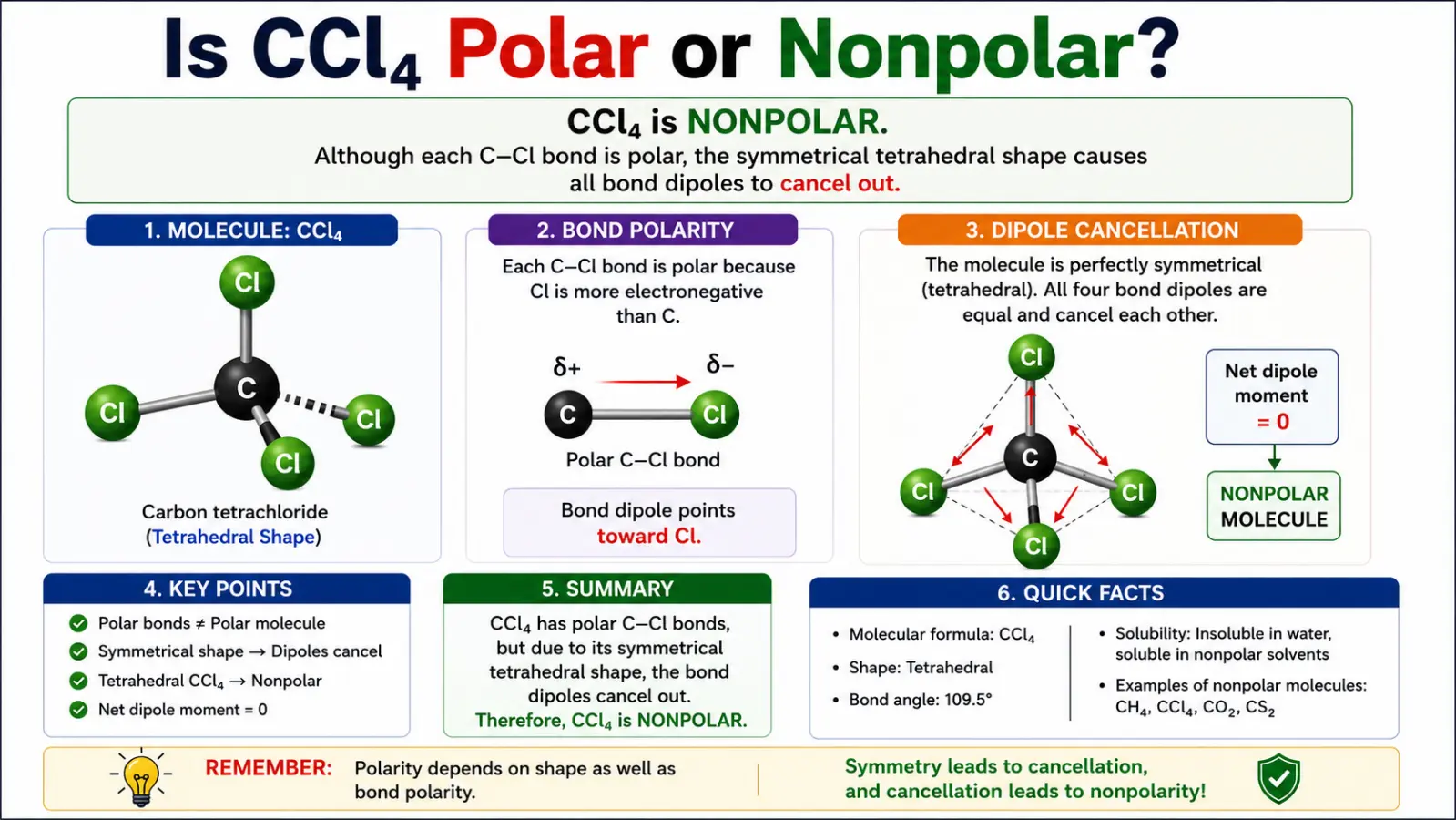
Is CCl4 Polar or Nonpolar? This is one of the most common chemistry questions students ask. The answer depends on the molecule’s shape and how its electrons are shared. At first, CCl4 may look polar because each carbon-chlorine bond is polar. However, the whole molecule behaves differently.
Understanding molecular polarity helps you learn chemical bonding, solubility, and molecular interactions. It also explains why some substances mix while others do not. In this guide, you will learn the answer in simple English. You will also discover why CCl4 is nonpolar, how its shape affects polarity, and where this concept appears in real life. By the end, you will easily identify whether CCl4 is polar or nonpolar and understand the science behind it.
Quick Summary
- CCl4 is a nonpolar molecule.
- Carbon tetrachloride has four polar C–Cl bonds.
- The molecule has a symmetrical tetrahedral shape.
- Bond dipoles cancel each other completely.
- The net dipole moment is zero.
- CCl4 does not have a positive or negative end.
- Molecular geometry determines its overall polarity.
What Is CCl4?
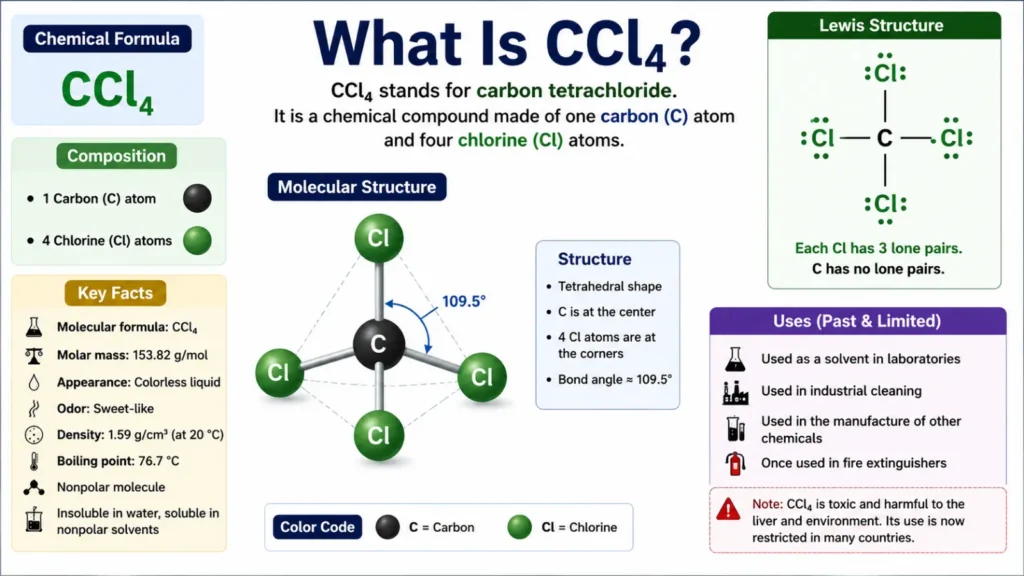
CCl4 is the chemical formula for carbon tetrachloride.
It contains:
- One carbon (C) atom
- Four chlorine (Cl) atoms
The carbon atom sits in the center. Four chlorine atoms surround it equally. This arrangement creates a tetrahedral structure.
Is CCl4 Polar or Nonpolar?
CCl4 is nonpolar.
Although every carbon-chlorine bond is polar, the molecule has perfect symmetry. Each bond pulls electrons toward chlorine. However, all four pulls are equal.
As a result:
- The bond dipoles cancel each other.
- The molecule has no overall dipole.
- The net dipole moment equals zero.
This makes carbon tetrachloride a nonpolar molecule.
Why Is CCl4 Nonpolar?
The main reason is its tetrahedral molecular geometry.
Carbon forms four identical single bonds with chlorine atoms. These bonds point toward the corners of a tetrahedron.
Because the arrangement is perfectly balanced:
- Every chlorine atom pulls equally.
- No side becomes more negative.
- The center remains balanced.
Therefore, the entire molecule is nonpolar.
Understanding Polarity in Simple Words
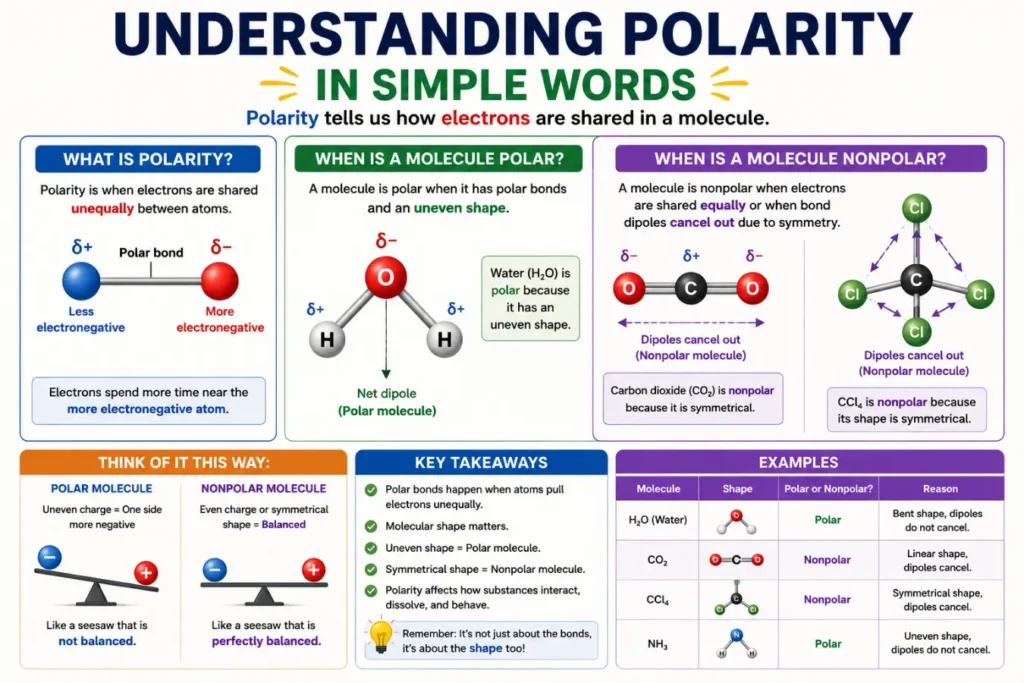
A molecule becomes polar when electrons stay closer to one side.
A molecule becomes nonpolar when electrons stay evenly distributed.
Think of four people pulling a rope.
- If everyone pulls equally, nothing moves.
- If one side pulls harder, the rope moves.
CCl4 is like the first example. Every chlorine atom pulls equally, so the forces balance perfectly.
Lewis Structure and Molecular Shape of CCl4
The Lewis structure shows:
- Carbon in the center
- Four single bonds
- Each chlorine has three lone pairs
- Carbon has no lone pairs
According to VSEPR theory:
- Electron groups = 4
- Molecular shape = Tetrahedral
- Bond angle = 109.5°
This symmetrical shape explains why CCl4 is nonpolar.
CCl4 Polar vs Polar Molecules
| Feature | CCl4 | H2O |
|---|---|---|
| Molecular shape | Tetrahedral | Bent |
| Bond polarity | Polar bonds | Polar bonds |
| Symmetry | Symmetrical | Asymmetrical |
| Dipole cancellation | Yes | No |
| Net dipole moment | Zero | Greater than zero |
| Overall polarity | Nonpolar | Polar |
Water has an uneven shape. Therefore, its dipoles do not cancel.
CCl4 has a balanced shape. Therefore, its dipoles cancel completely.
Real-Life Examples of Nonpolar Molecules
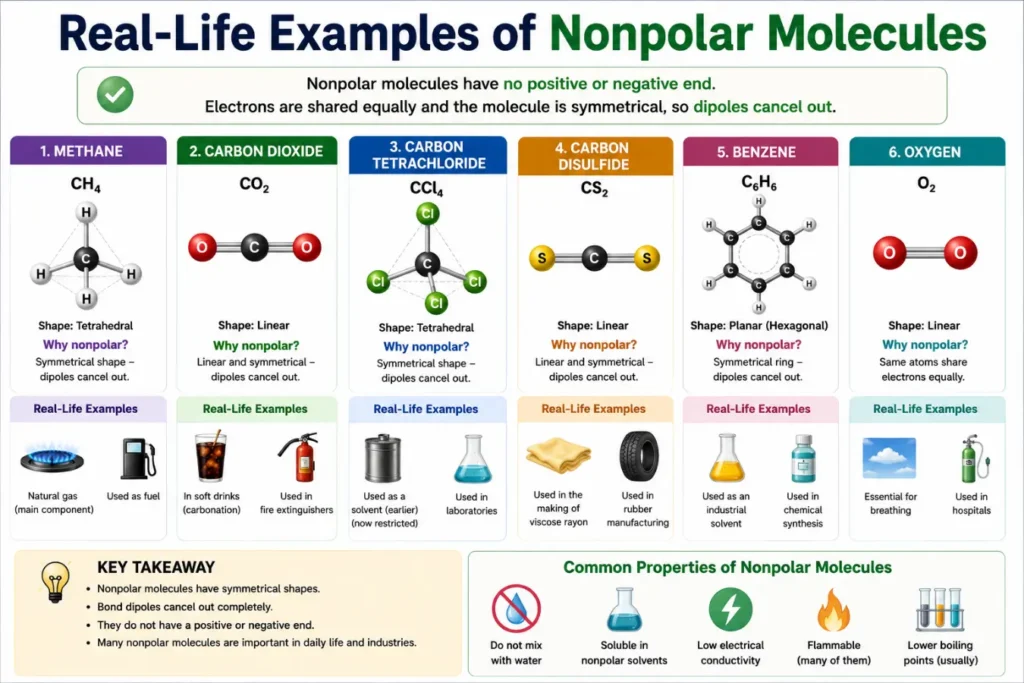
Many nonpolar molecules behave like CCl4.
Examples include:
- Methane (CH4)
- Carbon dioxide (CO2)
- Carbon tetrachloride (CCl4)
- Carbon disulfide (CS2)
- Benzene (C6H6)
These molecules usually dissolve in nonpolar liquids instead of water.
Where Is Carbon Tetrachloride Used?
Carbon tetrachloride was once widely used.
Common uses included:
- Industrial cleaning
- Laboratory solvent
- Chemical manufacturing
- Fire extinguishers
Today, its use is limited because it is toxic and harmful to the environment.
Even so, chemistry students still study it to understand molecular polarity.
Common Mistakes About CCl4 Polarity
Students often make these mistakes:
Thinking polar bonds always create a polar molecule
This is incorrect.
The overall shape also matters.
Ignoring molecular geometry
Symmetry determines whether dipoles cancel.
Looking only at electronegativity
Electronegativity explains bond polarity, not molecular polarity alone.
Forgetting dipole cancellation
Equal dipoles can completely cancel each other.
Easy Tips to Remember
Use these simple tricks.
- Polar bonds do not always mean a polar molecule.
- Always check molecular geometry.
- Symmetrical molecules are often nonpolar.
- Tetrahedral molecules with identical atoms are usually nonpolar.
- Draw the shape before deciding.
These tips help solve many polarity questions quickly.
Why Does Polarity Matter in Daily Life?
Polarity affects many everyday processes.
For example:
- It decides which liquids mix.
- It affects cleaning products.
- It influences medicine development.
- It helps explain chemical reactions.
- It determines many physical properties.
Scientists use polarity when designing new chemicals and materials.
Synonyms
While learning this topic, you may also see these terms:
- Molecular polarity
- Bond polarity
- Polar molecule
- Nonpolar molecule
- Dipole moment
- Electronegativity
- Covalent bond
- Molecular geometry
- Tetrahedral structure
- Symmetrical molecule
- Electron distribution
- VSEPR theory
These related terms help build a deeper understanding.
Expert Insights
Chemists never judge polarity from bonds alone.
Instead, they study:
- Molecular geometry
- Bond dipoles
- Symmetry
- Net dipole moment
This approach gives the correct answer every time.
Remember this simple rule:
Bond polarity plus molecular shape determines molecular polarity.
That is why CCl4 remains one of the best examples of a nonpolar molecule with polar bonds.
Frequently Asked Questions
Is CCl4 polar or nonpolar?
CCl4 is nonpolar because its tetrahedral shape cancels all bond dipoles.
Why are C–Cl bonds polar?
Chlorine is more electronegative than carbon. Therefore, it pulls electrons toward itself.
What is the molecular shape of CCl4?
CCl4 has a tetrahedral molecular geometry with bond angles of about 109.5°.
Does CCl4 have a dipole moment?
No. Its net dipole moment is zero because all bond dipoles cancel.
Why is water polar but CCl4 nonpolar?
Water has a bent shape. CCl4 has a symmetrical tetrahedral shape.
Can CCl4 dissolve in water?
No. It is nonpolar, while water is polar. They do not mix well.
Which theory predicts the shape of CCl4?
VSEPR theory predicts its tetrahedral geometry.
Is carbon tetrachloride still used today?
Its use is now limited because of safety and environmental concerns.
Conclusion
Is CCl4 Polar or Nonpolar? The answer is simple. CCl4 is a nonpolar molecule because its tetrahedral shape creates perfect symmetry. Although each carbon-chlorine bond is polar, the bond dipoles cancel completely. As a result, the molecule has no overall dipole moment. Understanding this concept makes it easier to solve many chemistry questions about molecular polarity. Always examine both bond polarity and molecular geometry before deciding whether a molecule is polar or nonpolar. Once you remember this rule, identifying molecules like CCl4 becomes much easier and more accurate.

Sophia Hayes is a language researcher and content writer at WordsCoppe.com, specializing in word comparisons, spelling differences, grammar explanations, and vocabulary insights. She is passionate about making English easier to understand through clear, accurate, and practical content. By breaking down complex language topics into simple explanations, Sophia helps readers improve their writing and communication skills. Her goal is to make learning English more accessible, engaging, and confidence-building for learners worldwide.