
Believe it or not is a common English expression that introduces something surprising. People use it before sharing an unexpected fact, story, result, or opinion. The phrase creates curiosity and can sound friendly, playful, serious, or sarcastic. You can hear it in conversations, stories, blogs, and captions. However, context can change its effect. In this guide, you will learn its meaning and correct usage. You will also see sentence examples, punctuation rules, alternatives, and common mistakes. These tips will help you use the phrase naturally. By the end, you will understand when it fits and when another expression works better.
Quick Summary
- The expression introduces surprising or unexpected information.
- It means the next statement may seem hard to accept.
- Speakers often use it before an interesting fact or story.
- The phrase creates curiosity before the main point.
- It works well in casual speech and friendly writing.
- Tone can make it sound serious, playful, or sarcastic.
- A comma usually follows it at the start of a sentence.
- Alternatives include “surprisingly” and “strangely enough.”
What Does Believe It or Not Mean?
The expression tells someone that the next statement may surprise them. It suggests that the speaker knows the information sounds unusual.
For example:
Believe it or not, Sarah finished the project in one day.
The speaker expects Sarah’s speed to surprise the listener.
The phrase usually does not ask for an answer. It simply prepares the audience for unexpected information.
In simple English, it means, “This may surprise you, but it is true.”
Why Do People Use This Expression?
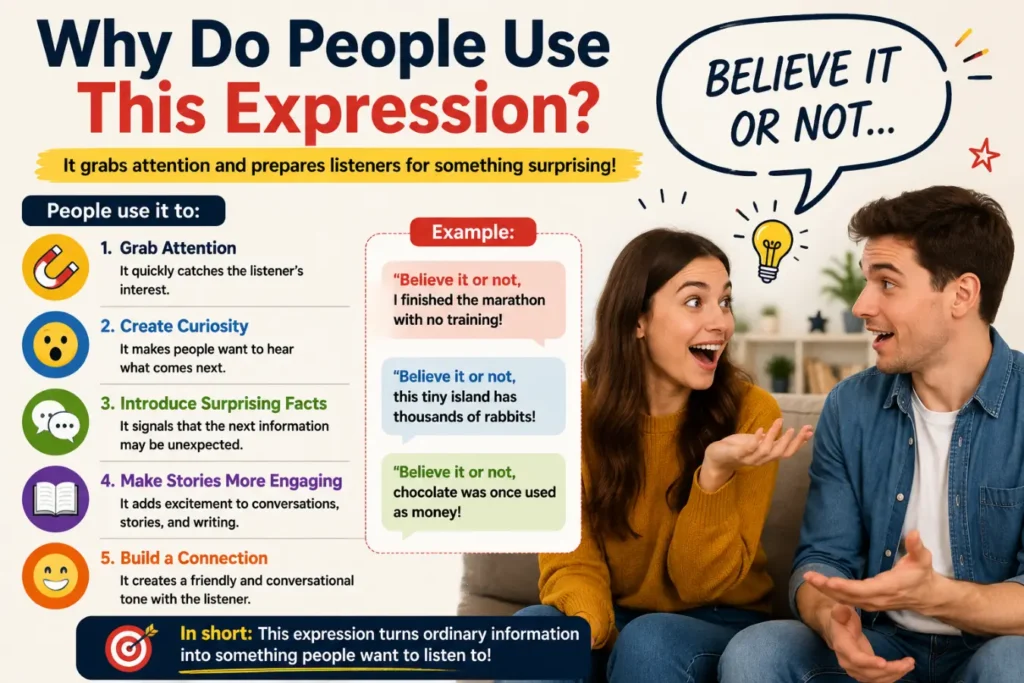
People use the phrase to grab attention. It creates a short pause before an interesting detail.
Compare these sentences:
I saw a snake in my backyard.
Believe it or not, I saw a snake in my backyard.
The second sentence creates more curiosity.
Therefore, it works well in storytelling and casual conversation. Writers can use the same technique to encourage readers to continue.
How Is the Phrase Used in a Sentence?
You can place the expression at the beginning of a sentence.
Believe it or not, Tom hates chocolate.
You can also place it after the main statement.
Tom hates chocolate, believe it or not.
Both sentences express surprise. The first highlights what follows, while the second adds emphasis afterward.
When the phrase starts a sentence, place a comma after “not.”
Real-Life Examples
Everyday situations provide many natural uses for this expression.
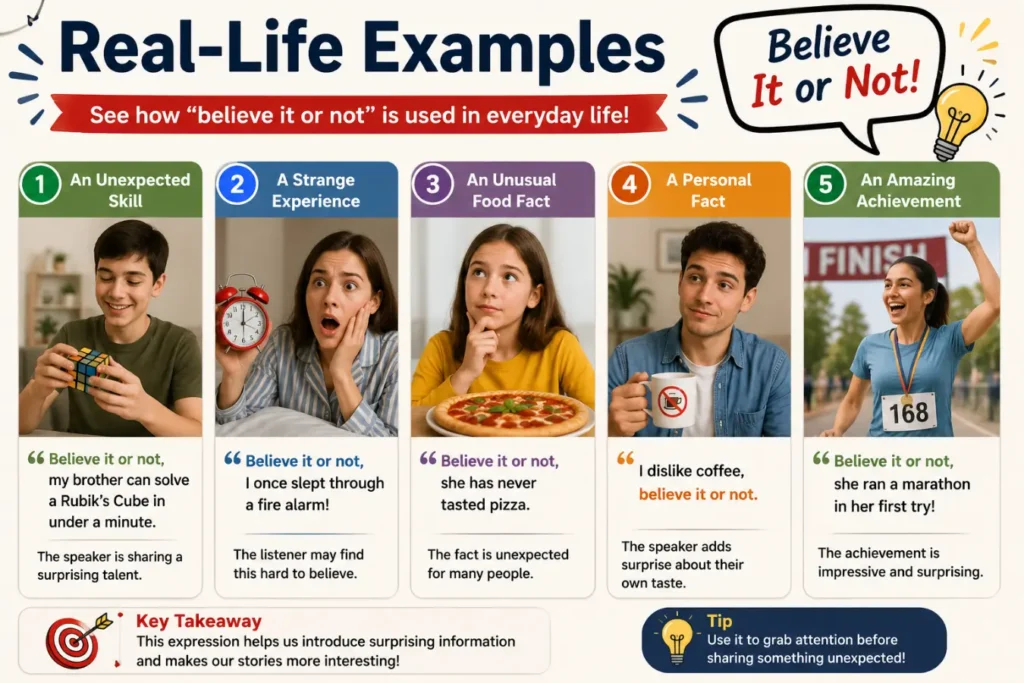
An Unexpected Skill
Believe it or not, my brother can solve a Rubik’s Cube quickly.
The speaker highlights an unusual ability.
A Strange Experience
Believe it or not, I once slept through a fire alarm.
The listener may find the story difficult to imagine.
An Unusual Food Fact
Believe it or not, she has never tasted pizza.
The speaker expects this fact to surprise others.
A Personal Fact
I dislike coffee, believe it or not.
Here, the expression appears at the end.
How Does It Compare With Similar Expressions?
English has several expressions for introducing surprising information. Each one creates a slightly different effect.
| Expression | Main Purpose | Typical Tone |
| Believe it or not | Introduces surprising information | Conversational |
| Surprisingly | Highlights an unexpected result | Neutral |
| Strangely enough | Introduces something unusual | Casual |
| Unexpectedly | Shows an unusual outcome | Neutral |
| Believe me | Asks for trust | Direct |
“Surprisingly” often sounds more neutral.
The main expression feels more conversational and personal.
Therefore, choose the wording that matches your audience and purpose.
Is This Expression Formal or Informal?
The expression works well in everyday communication and has a conversational feel.
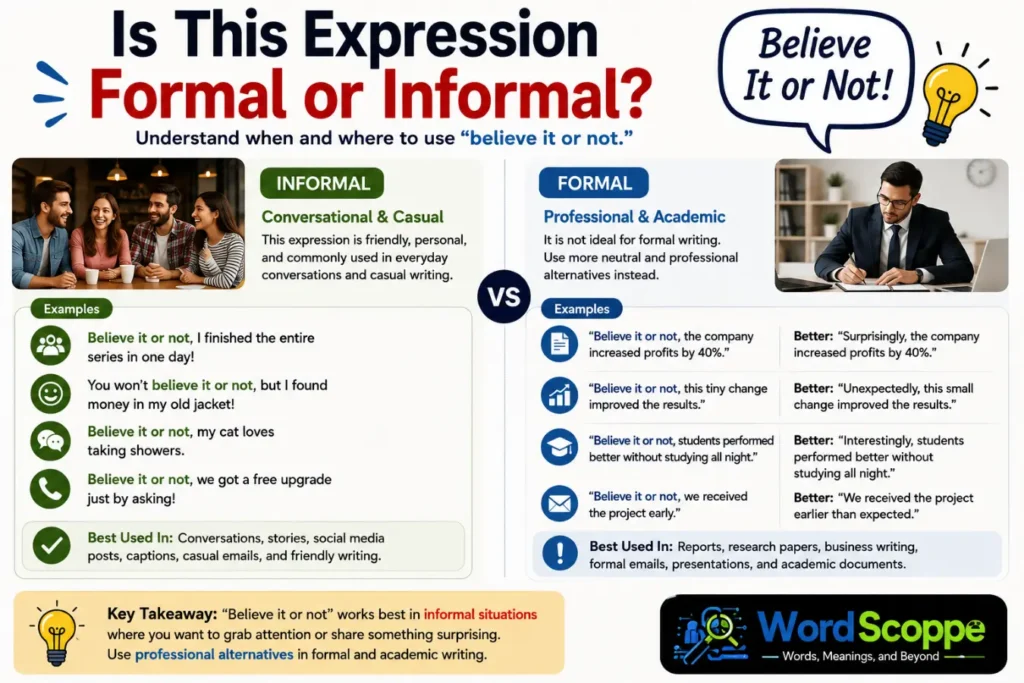
You can use it in:
- Everyday conversations
- Personal stories
- Blog posts
- Social media captions
- Friendly emails
- Magazine-style writing
Academic papers and technical reports usually need more direct language.
For example, “Unexpectedly, the results showed a major change” sounds more objective.
Consider your audience before choosing the expression.
How Does Tone Change Its Meaning?
Tone can change how listeners understand the same words.
A friendly tone can show excitement:
Believe it or not, we won the game!
A serious tone can introduce an important fact:
Believe it or not, the small company became a major brand.
A sarcastic tone can make the speaker sound doubtful:
Believe it or not, he forgot his keys again.
The wording stays the same, but the speaker’s attitude changes. Context therefore matters.
Common Mistakes to Avoid
English learners often make a few small errors.
Mistake 1: Treating It as a Literal Question
The phrase usually does not require an answer.
The speaker simply introduces an unexpected fact.
Mistake 2: Forgetting the Comma
Use a comma when the expression begins a sentence.
Correct: Believe it or not, she remembered my name.
Mistake 3: Using It Too Often
Repeated use can weaken its effect. Save it for details that deserve attention.
Mistake 4: Using It Everywhere
The phrase has a conversational style. Formal reports may need more objective wording.
Tips for Using the Expression Naturally
First, use it when your information creates genuine surprise. Next, consider your audience and keep the sentence simple.
Believe it or not, the shop stayed open all night.
You can vary your wording when another option fits better. Try “surprisingly” or “unexpectedly” in neutral writing.
Finally, match your tone with your message. A playful fact needs different delivery from a serious one.
Where Can You Use It in Daily Life?
This expression fits many everyday situations.
You might use it while telling a friend about an unusual event or family fact.
Storytellers use it to build anticipation. Social media writers may use similar wording to make posts more engaging.
Bloggers can place it before a surprising fact about travel, food, animals, or history.
The key is to provide useful information after the attention-grabbing opening.
Synonyms and Alternative Phrases
Several alternatives can express a similar idea.
Surprisingly works well in neutral writing.
Unexpectedly emphasizes an unusual result.
Strangely enough sounds casual and conversational.
Believe me focuses more on trust than surprise.
You may be surprised to learn works well in informative writing.
These alternatives help you vary your wording and adjust the tone.
Expert Insight: Why Does This Phrase Work?
The expression works because it creates anticipation. Readers receive a signal that something unusual follows.
Good writing can create curiosity before an important detail. However, avoid exaggerating ordinary facts.
If every statement sounds shocking, readers may stop trusting the content.
Instead, reserve the expression for information that genuinely adds interest.
This approach keeps the wording natural and useful.
Frequently Asked Questions
What does this expression mean?
It introduces information that may surprise the listener. The speaker expects the detail to seem unusual.
Is this an idiom?
Yes. English speakers commonly use it as a fixed expression before surprising information.
Do I need a comma after it?
Yes, when the expression starts a sentence, use a comma after “not.”
Can I use it in writing?
Yes. It works well in blogs, stories, captions, friendly messages, and informal articles.
Is it formal English?
It can appear in formal contexts, but it usually sounds conversational.
What can I say instead?
You can use “surprisingly,” “unexpectedly,” or “strangely enough.”
Conclusion
Believe it or not is a useful English expression for introducing surprising information. It tells listeners that the next statement may sound unusual. The phrase works well in conversations, stories, blogs, and friendly writing. You can place it at either end of a sentence. A comma usually follows it at the beginning. Tone also matters because the same words can sound friendly or sarcastic. Similar alternatives include “surprisingly,” “unexpectedly,” and “strangely enough.” Choose according to your audience and purpose. Use the expression when the information deserves extra attention.

Sophia Hayes is a language researcher and content writer at WordsCoppe.com, specializing in word comparisons, spelling differences, grammar explanations, and vocabulary insights. She is passionate about making English easier to understand through clear, accurate, and practical content. By breaking down complex language topics into simple explanations, Sophia helps readers improve their writing and communication skills. Her goal is to make learning English more accessible, engaging, and confidence-building for learners worldwide.