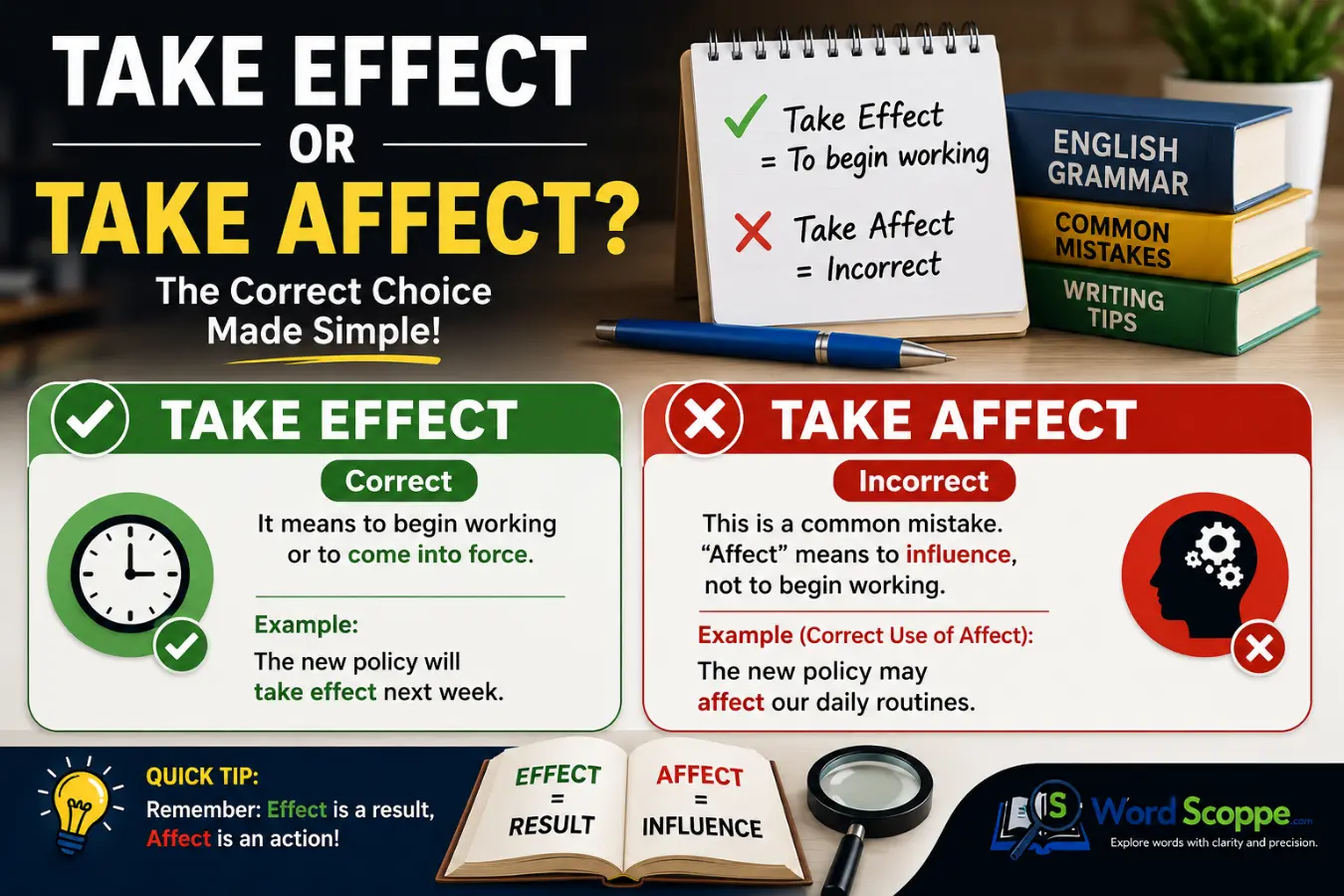
Take effect or take affect can be confusing because both words sound almost identical. However, they have different meanings and grammatical roles. In most sentences, take effect is the correct expression. It means that something begins to work or produce a result. For example, a new rule can take effect next month. The word “affect” usually works as a verb that means to influence something. Therefore, “take affect” does not normally work in standard English. This small difference can cause mistakes in emails, schoolwork, reports, and everyday writing.
Fortunately, you can learn the rule with a few simple examples. This guide explains both words clearly. You will also learn how to remember the difference, avoid common errors, and choose the right expression with confidence.
Quick Summary
- Take effect means to begin working or producing a result.
- Effect usually works as a noun in this expression.
- Affect usually works as a verb meaning “to influence.”
- “Take affect” is usually incorrect in standard English.
- New laws, rules, plans, and medicines can take effect.
- “Affect” describes how one thing influences another.
- Context helps you choose the correct word.
- A simple memory trick can make the difference easier.
What Does “Take Effect” Mean?
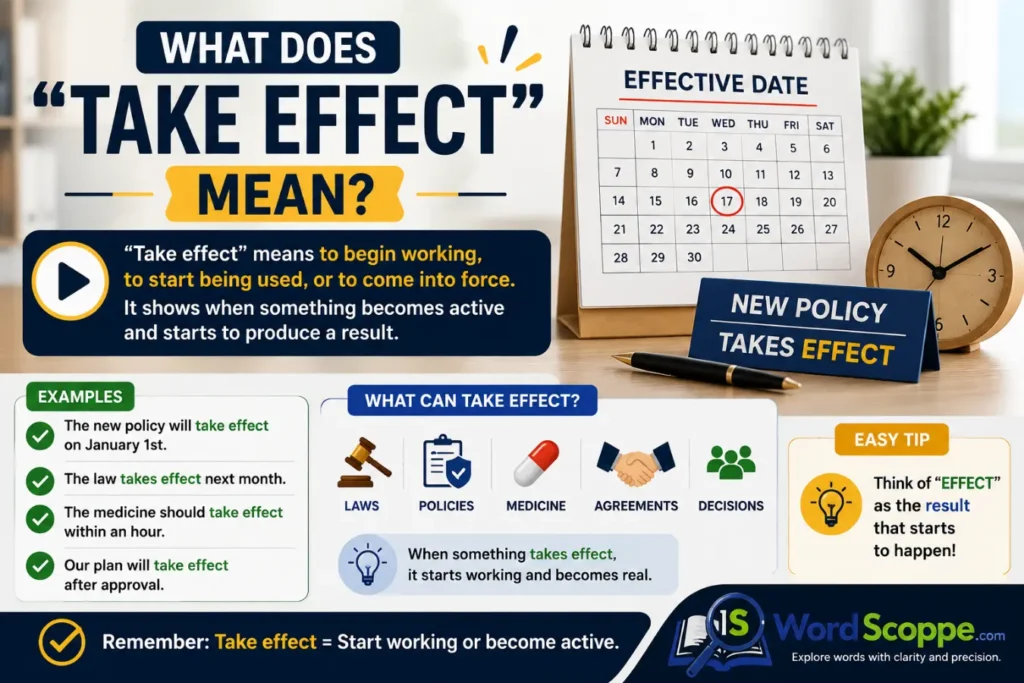
The phrase means that something starts to work or produce a result.
For example:
The new policy will take effect on Monday.
The policy starts working on Monday.
You can use the phrase for rules, laws, decisions, treatments, agreements, and other changes.
Consider this example:
The medicine should take effect within an hour.
Here, the medicine begins producing its intended result.
Therefore, the phrase focuses on a change becoming active or noticeable.
What Does “Affect” Mean?
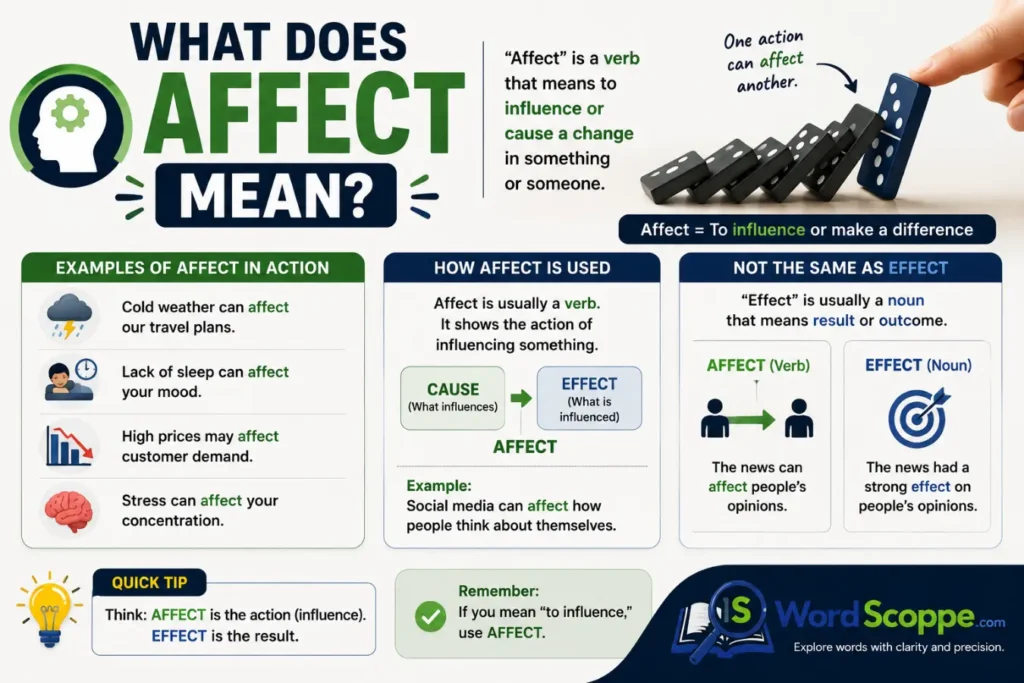
“Affect” usually works as a verb. It means to influence something or someone.
For example:
Lack of sleep can affect your mood.
The lack of sleep influences your mood.
Here are more examples:
- Loud noise can affect your concentration.
- Weather can affect travel plans.
- Stress may affect your performance.
- Price changes can affect customers.
The word describes an influence between two things.
That meaning differs from the idea of something beginning to work.
Why Is “Take Affect” Usually Wrong?
The confusion comes from the similar sounds of “effect” and “affect.”
However, the two words usually perform different jobs.
“Take” needs a noun in this common expression. Effect works as a noun meaning a result or outcome.
Therefore:
The new rule will take effect tomorrow.
“Affect” usually works as a verb. It describes an action that influences something.
Therefore, this sentence works:
The new rule may affect businesses.
The two words can appear in the same topic, but they do not serve the same grammatical role.
Take Effect vs. Affect: The Main Difference
| Word or Phrase | Usual Role | Meaning | Example |
| Take effect | Verb phrase | Begin working | The rule takes effect tomorrow. |
| Effect | Noun | Result or outcome | The change had a positive effect. |
| Affect | Verb | Influence something | The change may affect workers. |
| Take affect | Incorrect in most standard uses | — | Avoid this form. |
This table gives you the basic rule.
When you mean “start working,” use “take effect.”
When you mean “influence,” use “affect.”
You mean “result,” use “effect.”
How Can You Remember the Difference?
A simple memory trick can help.
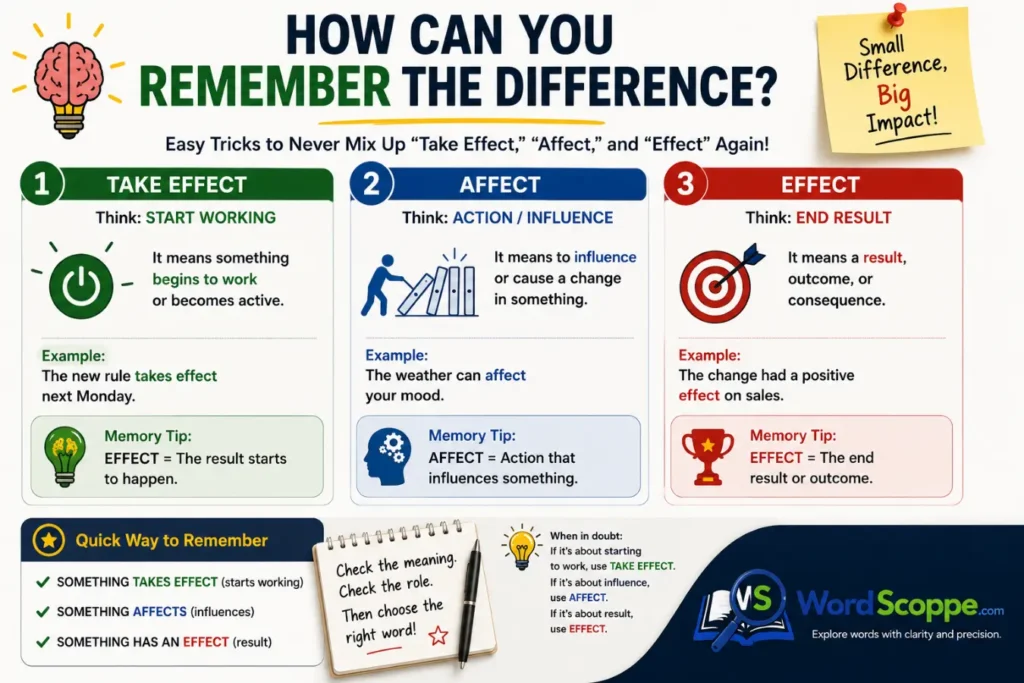
Think of Affect = Action.
Both words begin with the letter “A.” “Affect” usually describes an action that influences something.
For example:
The heat affected the plants.
Now think of Effect = End result.
“Effect” often describes the result of an action.
For example:
The heat had a strong effect on the plants.
This trick does not cover every use of these words. However, it works well for everyday writing.
For the phrase in this article, remember:
Something takes effect when it starts working.
When Should You Use “Take Effect”?
Several situations commonly use this phrase.
Laws and Rules
The new parking law will take effect in June.
The law becomes active at that time.
Policies
The company’s new policy took effect last week.
The policy started operating last week.
Medicine
The pain medicine should take effect soon.
The medicine should begin producing a result.
Agreements
The contract takes effect after both parties sign it.
The agreement becomes active after signing.
Decisions
The decision will take effect immediately.
The decision starts applying at once.
These examples show why the expression appears often in formal and professional writing.
Real-Life Examples of “Affect”
Now consider situations where “affect” works as a verb.
Cold weather can affect road conditions.
The weather influences the roads.
A busy schedule can affect your sleep.
The schedule influences sleep.
High prices may affect customer demand.
The prices influence what customers buy.
Lack of practice can affect your performance.
The lack of practice influences your results.
In each example, “affect” connects one factor with something it influences.
Can “Effect” Work Without “Take”?
Yes. “Effect” often appears as a noun without the phrase.
For example:
The new rule had an immediate effect.
Here, “effect” means a result.
You can also say:
The changes produced positive effects.
Another example is:
The medicine had little effect on the pain.
In each sentence, “effect” names a result or outcome.
So, “effect” has a wider use than the fixed phrase “take effect.”
Common Mistakes to Avoid
English learners often mix these words because their pronunciation sounds similar.
Mistake 1: Writing “Take Affect”
Incorrect: The new rule will take affect tomorrow.
Correct: The new rule will take effect tomorrow.
The correct phrase means the rule will begin working.
Mistake 2: Using “Effect” as a Verb
Incorrect: The weather effected my plans.
When you mean “influenced,” use “affected.”
Correct: The weather affected my plans.
Mistake 3: Using “Affect” for a Result
Incorrect: The change had a positive affect.
Correct: The change had a positive effect.
Here, “effect” means the result produced by the change.
Mistake 4: Choosing by Sound
Pronunciation cannot tell you which spelling works.
Instead, identify the meaning and grammatical role first.
How Do You Choose the Right Word?
Use this quick three-step method.
Step 1: Ask what you mean.
Do you mean “start working”? Use take effect.
Do you mean “influence”? Use affect.
Do you mean “result”? Use effect.
Step 2: Look at the sentence structure.
Check whether the word acts as a noun or verb.
Step 3: Read the sentence again.
Make sure the meaning sounds logical.
For example:
The new rules will take effect next month.
The rules become active.
The new rules will affect small businesses.
The rules influence businesses.
The difference becomes clear when you focus on meaning.
How Are These Words Used in Daily Life?
You can find these terms in many everyday situations.
News reports often discuss laws taking effect. Employers may announce policies that take effect on a specific date.
Doctors and pharmacists may discuss when a treatment takes effect.
Students may write about how stress affects their grades.
Businesses may study how prices affect customers.
Therefore, understanding these words can improve both casual and professional communication.
The distinction also helps when writing emails, reports, articles, and academic assignments.
Synonyms and Related Words
Learning related words can make the distinction easier.
For take effect, useful alternatives include:
- Start working
- Become active
- Begin to apply
- Come into force
- Begin producing results
affect, useful alternatives include:
- Influence
- Change
- Impact
- Alter
- Shape
For effect, related terms include:
- Result
- Outcome
- Consequence
- Impact
- Influence
These alternatives can also help you avoid repetition in your writing.
Expert Insight: Why Does This Difference Matter?
Correct word choice improves clarity.
A reader may understand your meaning even when you choose the wrong word. However, repeated mistakes can make professional writing look less polished.
The best approach involves learning words through context rather than memorizing spelling alone.
Notice how each word behaves in real sentences.
Take effect describes something becoming active.
Affect describes an influence.
Effect often describes a result.
Once you connect each word with its core meaning, the difference becomes much easier to remember.
Frequently Asked Questions
Is “take affect” correct?
Usually, no. The standard expression is “take effect” when something begins to work.
What does “take effect” mean?
It means that something starts working, operating, or producing a result.
Is “affect” a noun or a verb?
“Affect” usually works as a verb meaning “to influence.”
Is “effect” a noun or a verb?
“Effect” usually works as a noun meaning “result.” It can also work as a verb in specific contexts.
What is an easy way to remember affect and effect?
Remember Affect = Action and Effect = End result. This trick works for many everyday examples.
Can medicine take effect?
Yes. Medicine can take effect when it begins producing its intended result.
Can a law take effect?
Yes. A law takes effect when it officially becomes active or applicable.
What is the correct phrase: take effect or take affect?
Use “take effect” when you mean that something begins working or becomes active.
Conclusion
Choosing between these similar words becomes easier when you focus on meaning. Take effect describes something that starts working or becomes active. “Affect” usually works as a verb that means to influence something. “Effect” commonly works as a noun that describes a result. Therefore, the phrase “take affect” usually represents a spelling mistake. Remember the simple rule: use “take effect” for something becoming active. Use “affect” when one thing influences another. Use “effect” when you describe a result. With regular practice, these words will become much easier to use. Always check the meaning before choosing the spelling.

Sophia Hayes is a language researcher and content writer at WordsCoppe.com, specializing in word comparisons, spelling differences, grammar explanations, and vocabulary insights. She is passionate about making English easier to understand through clear, accurate, and practical content. By breaking down complex language topics into simple explanations, Sophia helps readers improve their writing and communication skills. Her goal is to make learning English more accessible, engaging, and confidence-building for learners worldwide.