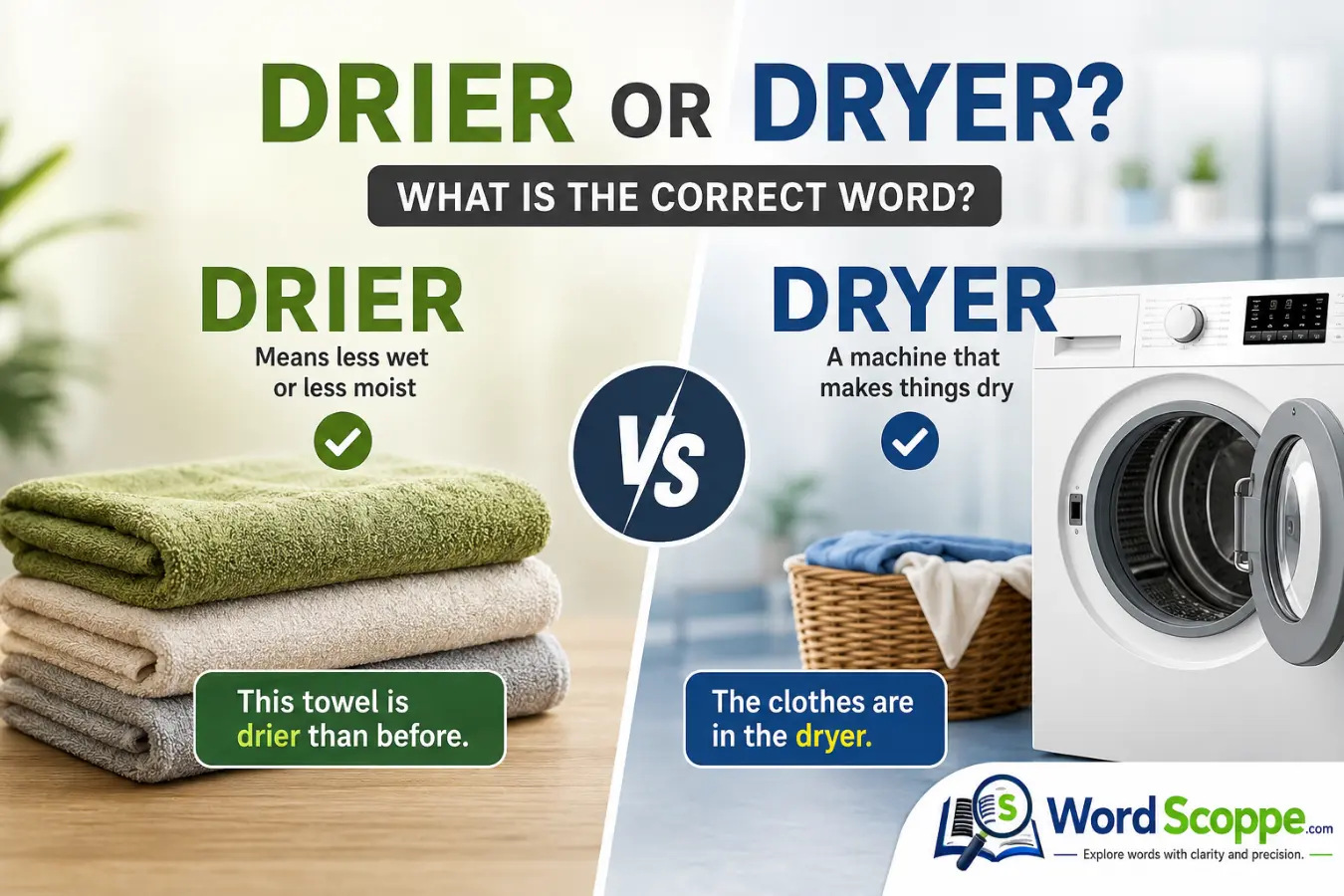
Drier or dryer can be confusing because both spellings relate to the word “dry.” However, they usually serve different purposes in English. Drier commonly describes something with less moisture than before. Dryer often names a machine or device that removes moisture. For example, you might say, “Today is drier than yesterday.” You could also say, “Put the clothes in the dryer.” The difference becomes easier when you look at the word’s role in a sentence. This guide explains both forms with simple definitions, examples, and useful grammar tips. You will also learn when each spelling works, why people confuse them, and how to choose the right word quickly. By the end, you should feel confident using these words in everyday writing and conversation.
Quick Summary
- Drier usually means less wet or less moist.
- Drier is commonly the comparative form of “dry.”
- Dryer commonly refers to a machine that removes moisture.
- A clothes dryer dries clothes.
- “This towel is drier” compares two levels of dryness.
- Both spellings can appear in dictionaries with related meanings.
- Context helps you choose the correct spelling.
- Remember: drier = comparison, dryer = drying machine in common usage.
What Does Drier Mean?
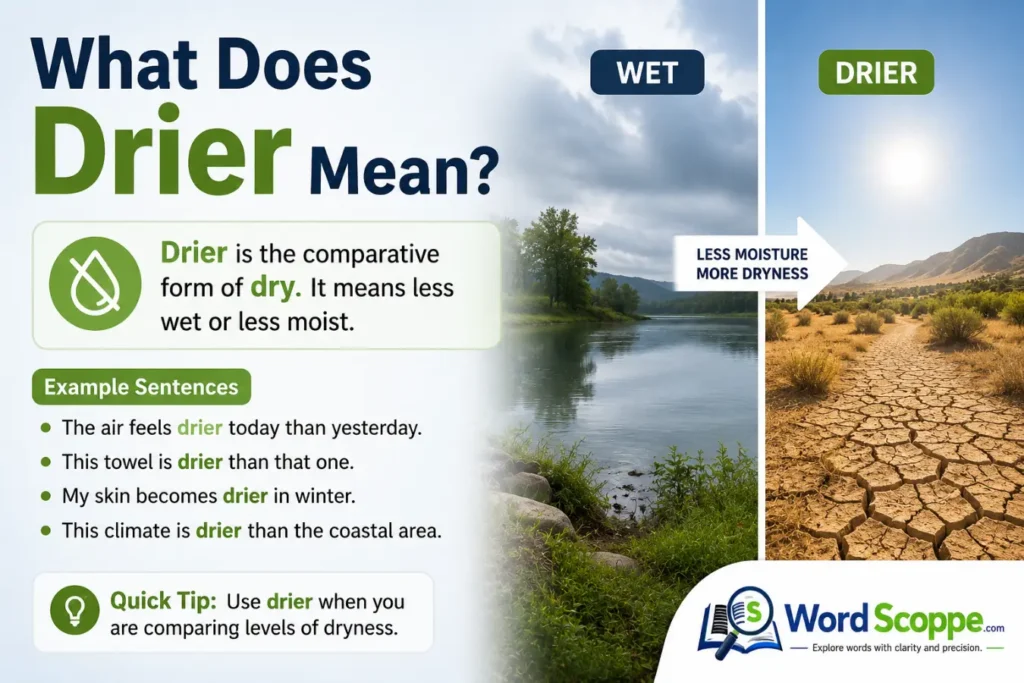
Drier is commonly the comparative form of the adjective dry.
It means something has less moisture than another thing.
For example:
- Today is drier than yesterday.
- This towel feels drier than that one.
- The desert is drier than the coastal region.
- My clothes are drier now.
The word compares two conditions.
One thing has more moisture, while the other has less.
Therefore, drier often answers a comparison.
You can think of it as:
dry → drier → driest
For example:
- The towel is dry.
- The towel is drier now.
- This is the driest towel here.
This pattern helps you remember its basic grammatical role.
What Does Dryer Mean?
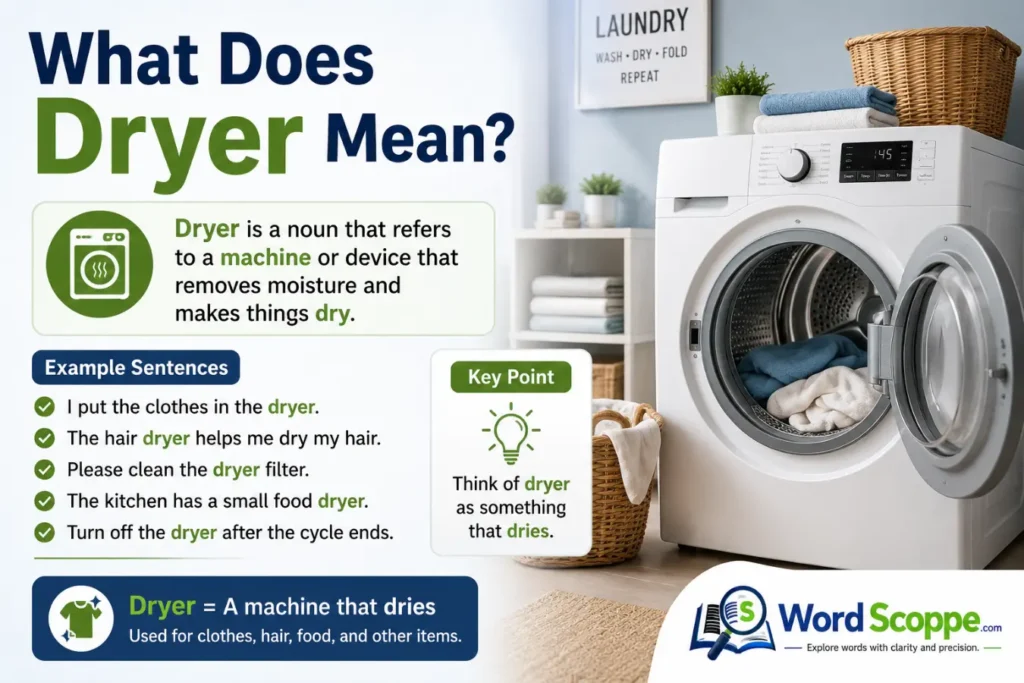
Dryer commonly refers to a device that removes moisture.
The most familiar example is a clothes dryer.
This machine uses heat or moving air to dry clothes.
For example:
- The dryer is running.
- Put the wet clothes in the dryer.
- The dryer stopped after ten minutes.
- I need to clean the dryer filter.
However, the word can describe other drying devices too.
You may hear phrases such as:
- hair dryer
- hand dryer
- food dryer
- industrial dryer
- tumble dryer
In each case, dryer names something designed to remove moisture.
Drier or Dryer: The Main Difference
The easiest way to remember the difference involves the word’s function.
| Word | Common meaning | Typical role | Example |
| Drier | Less wet or moist | Comparative adjective | The air is drier today. |
| Dryer | A device that dries something | Noun | The dryer is full. |
| Dry | Without much moisture | Adjective | The shirt is dry. |
| Driest | Having the least moisture | Superlative adjective | July is the driest month. |
This distinction works in most everyday situations.
If you compare dryness, drier usually fits.
If you name a machine, dryer usually fits.
Still, English has some overlap.
The spelling dryer can also appear as a comparative form of “dry.”
Therefore, context remains important.
Why Are Drier and Dryer Confusing?
The confusion comes from their similar spelling.
Both words connect to the same base word, dry.
The extra e changes the visual form.
English spelling also allows some flexibility with words ending in y.
For example:
- dry → drier
- dry → driest
These forms remove the y before adding the ending.
Meanwhile, dryer has become strongly associated with drying machines.
That common noun gives the spelling a separate identity in everyday English.
As a result, many writers use the word based on context rather than grammar alone.
How to Use Drier in a Sentence
Use drier when comparing levels of moisture or dryness.
Here are some examples:
- This climate is drier than ours.
- My skin feels drier in winter.
- The second towel is drier.
- The ground became drier after the sun appeared.
- The air gets drier at higher temperatures.
Notice the comparison in each sentence.
Sometimes the second part of the comparison remains unstated.
For example:
My clothes are drier now.
The sentence suggests that the clothes were wetter before.
Therefore, drier does not always need the word “than.”
How to Use Dryer in Everyday English
Use dryer when referring to a device that dries something.
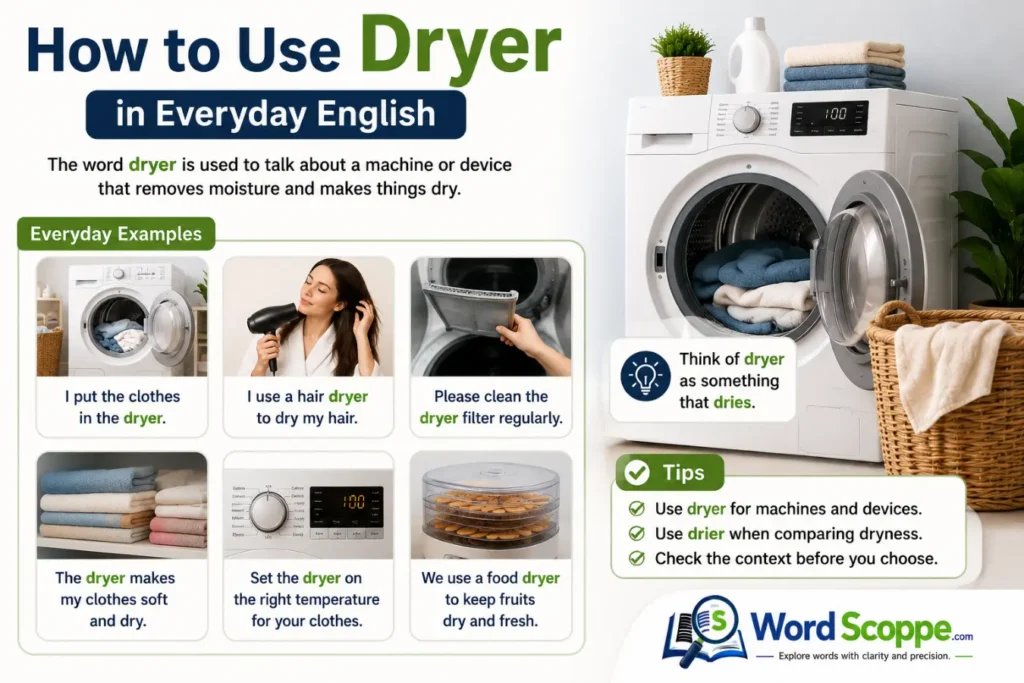
For example:
The clothes are in the dryer.
Here, dryer is a noun.
You can also use it with different objects.
Clothes Dryer
The clothes dryer needs cleaning.
Hair Dryer
I used a hair dryer after my shower.
Hand Dryer
The bathroom has an automatic hand dryer.
Food Dryer
A food dryer can remove moisture from fruits.
These examples show why dryer often appears before or after another noun.
Real-Life Examples of the Two Words
Imagine you washed some clothes.
At first, they are completely wet.
You place them inside a machine.
That machine is the dryer.
After several minutes, the clothes become drier.
So, you could say:
The dryer made my clothes drier.
This sentence uses both forms correctly.
The first word names the machine.
The second word describes the change in moisture.
Another example involves weather.
Suppose Monday has humid air.
Tuesday has much less moisture.
You could say:
Tuesday is drier than Monday.
No machine exists in this example.
The word describes a change in the weather.
Common Mistakes With These Words
Writers often mix these spellings because they sound similar.
Mistake 1: Calling the Machine “Drier”
Incorrect:
Put the clothes in the drier.
Better:
Put the clothes in the dryer.
In everyday English, dryer is the standard spelling for the appliance.
Mistake 2: Using “Dryer” for Every Comparison
For example:
Today is dryer than yesterday.
This can cause confusion.
When comparing dryness, drier is the clearer traditional form.
Better:
Today is drier than yesterday.
Mistake 3: Forgetting the Context
Do not choose the spelling only because it sounds right.
First, decide what the word does.
Does it compare dryness?
Or does it name a drying device?
That quick question can prevent most errors.
Is Dryer Ever Correct as a Comparative?
Yes, this is an important detail.
English dictionaries recognize dryer as a comparative form of “dry” in some usage.
However, drier is widely used and clearly understood as the comparative form.
For careful writing, especially when you want to avoid confusion with the appliance, drier is often the better choice.
For example:
The room is drier today.
This clearly describes the air.
Meanwhile:
The room has a new dryer.
This clearly names a machine.
Therefore, both forms can exist, but their common uses differ.
Drier and Dryer Synonyms
Several related words can replace these terms depending on context.
For drier, you might use:
- less moist
- less wet
- more arid
- less humid
- moisture-free, depending on context
For dryer, related terms include:
- drying machine
- clothes dryer
- hair dryer
- hand dryer
- drying device
However, these words do not always work as exact replacements.
For example, arid usually describes a very dry climate.
Similarly, less humid describes air with lower moisture.
Choose the synonym that matches your sentence.
Easy Tips to Remember the Difference
A simple memory trick can make this distinction easier.
Think “Comparison”
If you compare two things, think:
dry → drier
For example:
This room is drier than the other room.
Think “Machine”
If you are talking about an appliance, think:
dryer = drying machine
For example:
The dryer is beside the washing machine.
Use the Sentence Test
Ask yourself:
Can I replace the word with “less wet”?
If yes, drier probably fits.
Ask another question:
Is the word a machine or device?
If yes, dryer probably fits.
These quick tests work well in everyday writing.
Expert Insight: Why Context Matters
The difference between these words shows why spelling alone cannot explain English grammar.
The base word dry can describe a condition.
It can also create related words with different grammatical functions.
That means context should guide your choice.
When writing professionally, avoid forcing one spelling into every sentence.
Instead, check whether you are describing moisture or naming equipment.
This approach improves clarity and reduces avoidable spelling mistakes.
It also helps readers understand your meaning immediately.
Frequently Asked Questions
Is drier or dryer correct?
Both spellings can be correct. Drier commonly describes something with less moisture, while dryer often names a drying machine.
What is the comparative form of dry?
The traditional comparative form is drier. For example, “The air is drier today.”
Is a clothes drier or dryer?
Clothes dryer is the standard spelling for the machine.
Is it hair drier or hair dryer?
Hair dryer is the standard and most common spelling for the electrical device.
Can dryer mean more dry?
Yes. Dryer can function as a comparative form in some English usage. However, drier is clearer when you mean “more dry.”
What is the difference between dry and drier?
Dry describes a condition. Drier compares that condition with another level of dryness.
How can I remember drier and dryer?
Think drier = comparison and dryer = machine. This simple rule works in most daily situations.
Why do people spell drier as dryer?
The two words sound similar, and dryer is strongly associated with drying machines. That makes the spellings easy to mix up.
Conclusion
The difference between drier or dryer becomes simple once you focus on context. Drier usually describes something that has less moisture than before or compared with something else. Dryer, meanwhile, commonly names a machine or device that removes moisture. For example, clothes become drier inside a clothes dryer. The words look and sound similar, so confusion is normal. However, a quick meaning test can help. If you are making a comparison, think drier. If you are naming a drying machine, think dryer. Also remember that English allows some variation, and “dryer” can sometimes work as a comparative form. Still, using drier for comparisons keeps your writing clear. With this simple distinction, you can use both forms confidently in everyday English.

Sophia Hayes is a language researcher and content writer at WordsCoppe.com, specializing in word comparisons, spelling differences, grammar explanations, and vocabulary insights. She is passionate about making English easier to understand through clear, accurate, and practical content. By breaking down complex language topics into simple explanations, Sophia helps readers improve their writing and communication skills. Her goal is to make learning English more accessible, engaging, and confidence-building for learners worldwide.