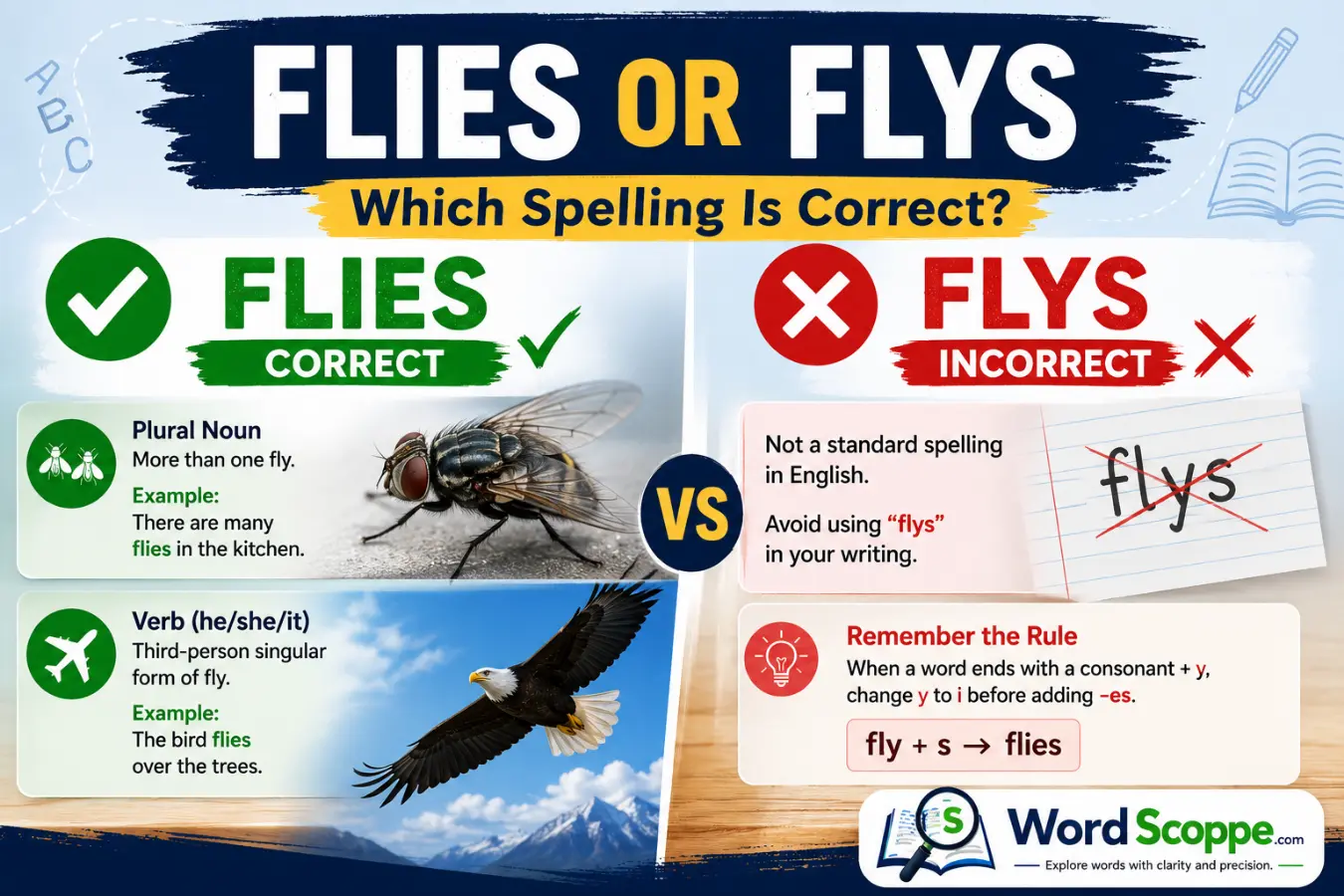
Flies or flys can be confusing when you are writing quickly. The correct spelling depends on what you want to say. In standard English, flies is the correct word. It can mean more than one insect called a fly. It can also mean that someone or something moves through the air. For example, you can say, “The bird flies over the trees.” The spelling flys is usually incorrect in standard English. However, the word “fly” follows a special spelling rule when it changes form. The final y changes to ie before adding s in some cases. That rule explains why we write flies, not “flys.” In this guide, you will learn the difference, see simple examples, and avoid common spelling mistakes.
Quick Summary: Flies or Flys?
- Flies is the standard and correct spelling.
- Flys is generally incorrect in standard English.
- Flies can be the plural of “fly.”
- Flies can also be the verb form of “fly” for he, she, or it.
- The spelling rule changes y to ie before adding s.
- “The flies are annoying” uses flies as a noun.
- “A bird flies south” uses flies as a verb.
- Fly’s is different because it shows possession.
What Does “Flies” Mean?
The word flies has two common grammatical uses.
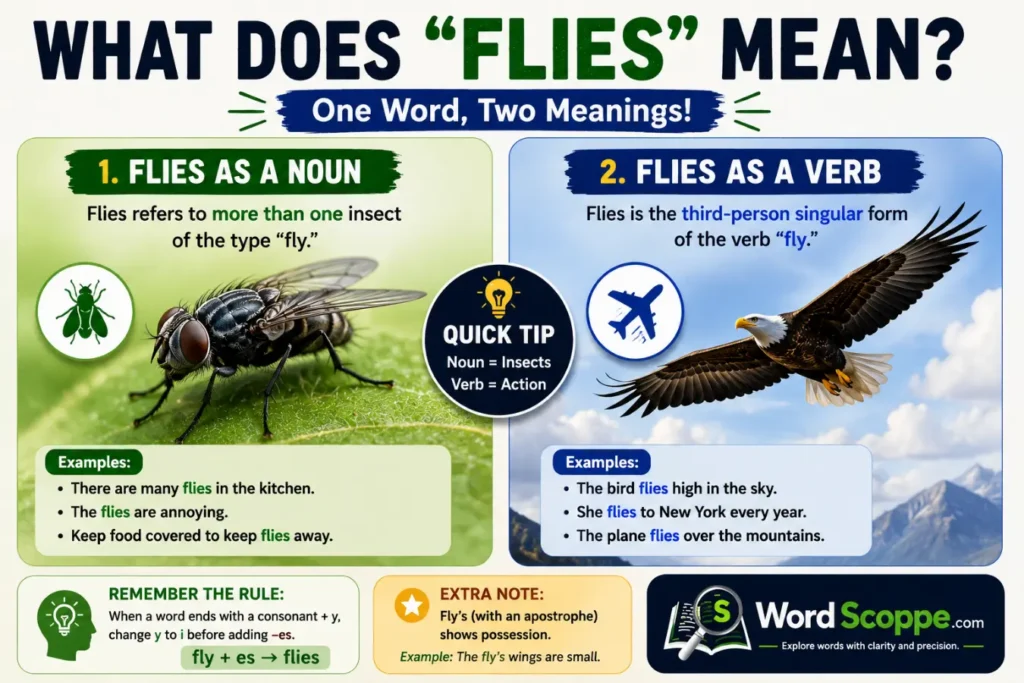
First, it can act as the plural form of the noun fly.
For example:
There are three flies in the kitchen.
Here, “flies” means more than one flying insect.
Second, flies can act as a verb.
It is the third-person singular form of fly.
For example:
The eagle flies above the mountains.
Here, “flies” describes an action.
Therefore, the meaning changes with the sentence.
Why Is “Flys” Usually Wrong?
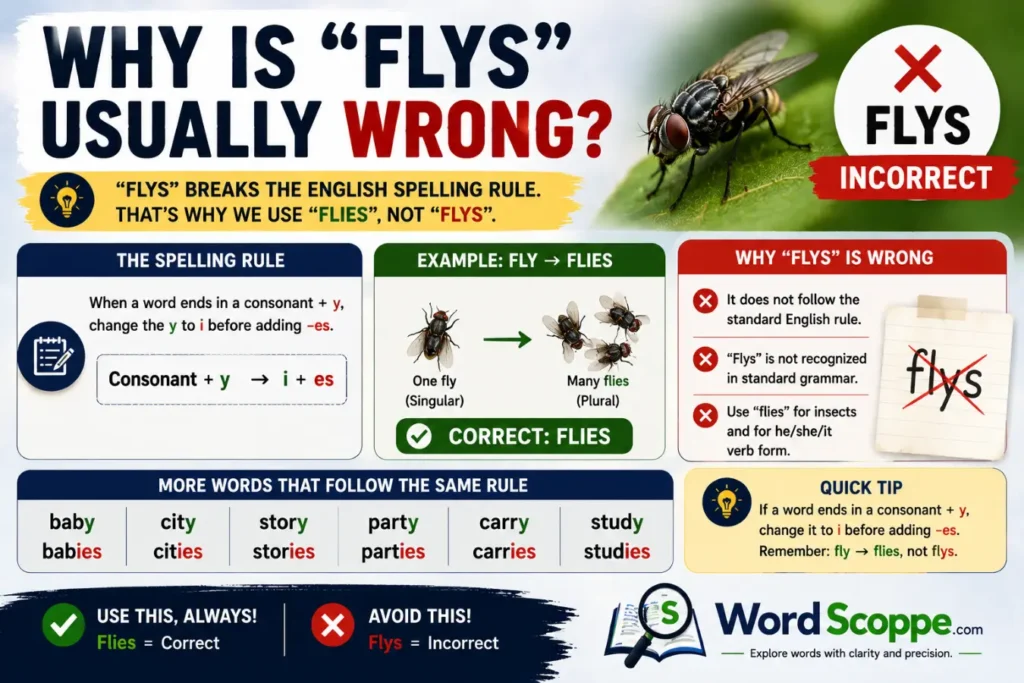
Flys does not follow the standard English spelling rule.
The base word is fly.
When we make it plural or create certain verb forms, the spelling changes.
The letter y often changes to ie when a word ends in a consonant followed by y.
So:
fly + s → flies
Not:
fly + s → flys
This pattern appears in several common English words.
For example:
- baby → babies
- city → cities
- story → stories
- party → parties
- fly → flies
Consequently, “flys” should normally be avoided in standard writing.
Flies as a Plural Noun
One major use of flies describes two or more insects.
The singular form is fly.
The plural form is flies.
Examples include:
- One fly is on the window.
- Two flies are near the door.
- The flies are bothering everyone.
- Several flies landed on the food.
- We need to keep flies away from the kitchen.
This spelling follows the consonant-plus-y plural rule.
The same rule applies to many other nouns.
Thus, “flies” is the correct plural form of “fly.”
Flies as a Verb
The word flies also works as a verb.
The base verb is fly.
When the subject is he, she, or it, we usually add -s.
However, the spelling changes because of the final y.
For example:
- I fly to London.
- You fly to London.
- They fly to London.
- She flies to London.
- He flies every week.
- The plane flies over the city.
Notice the difference.
I fly is correct.
She flies is correct.
She flys is incorrect in standard English.
The Spelling Rule Behind “Flies”
The spelling becomes easier when you know the rule.
When a word ends in a consonant + y, change the y to i before adding -es.
The pattern looks like this:
consonant + y → i + es
Examples:
| Base Word | Correct Form |
| fly | flies |
| baby | babies |
| city | cities |
| carry | carries |
| study | studies |
| try | tries |
| worry | worries |
However, there is an important exception.
If a word ends in a vowel + y, keep the y.
For example:
- play → plays
- enjoy → enjoys
- stay → stays
- boy → boys
- toy → toys
Therefore, the spelling depends on the letter before y.
Flies or Flys: Comparison Table
| Word | Correct? | Meaning | Example |
| flies | Yes | More than one fly | Flies can carry germs. |
| flies | Yes | Third-person form of fly | The bird flies quickly. |
| flys | No | Not standard English | Avoid this spelling. |
| fly | Yes | Singular noun or base verb | A fly landed here. |
| fly’s | Yes | Possessive form | The fly’s wings are small. |
The table shows why context matters.
Still, when choosing between flies or flys, standard English uses flies.
Real-Life Examples of “Flies”
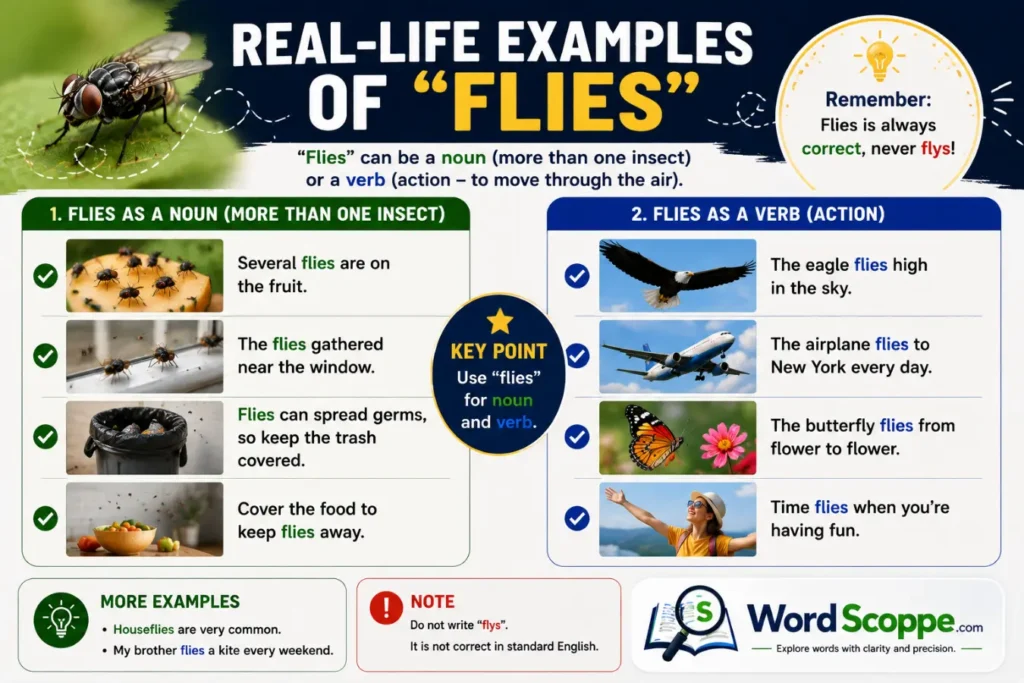
Here are simple examples from everyday English.
As a noun
The flies gathered around the fruit.
I saw several flies near the window.
Please cover the food to keep flies away.
As a verb
The airplane flies across the country.
My brother flies home every summer.
The butterfly flies from flower to flower.
In a question
Why do flies gather around food?
How far does the bird flies?
The last example contains an error.
The correct sentence is:
How far does the bird fly?
After does, use the base form fly.
Common Mistakes With Flies
English learners often make a few predictable mistakes.
Mistake 1: Writing “flys”
Incorrect:
I saw two flys.
Correct:
I saw two flies.
Mistake 2: Using “flys” as a verb
Incorrect:
The bird flys over the house.
Correct:
The bird flies over the house.
Mistake 3: Using “flies” after “does”
Incorrect:
Does she flies often?
Correct:
Does she fly often?
The helping verb does already carries the grammatical ending.
Mistake 4: Confusing “flies” with “fly’s”
These words have different jobs.
Flies can mean multiple insects or a verb.
Fly’s shows possession.
For example:
The fly’s wings are transparent.
Here, the wings belong to the fly.
When Should You Use “Fly”?
Use fly as the singular noun.
For example:
A fly is sitting on the wall.
You also use fly as the base verb.
Examples include:
I fly to Dubai tomorrow.
Birds fly south in winter.
Can you fly a plane?
After words such as can, will, should, must, do, and does, use the base form when grammar requires it.
For example:
Can she fly?
Not:
Can she flies?
Understanding this difference helps prevent many verb errors.
Tips to Remember the Correct Spelling
Try these simple memory tricks.
Think “fly → flies”
Remember the pattern as one pair:
fly → flies
This is similar to:
baby → babies
Check the letter before Y
If a consonant comes before y, the y often changes to i.
For example:
city → cities
fly → flies
Watch for helping verbs
After does, use fly.
Does the bird fly?
But without “does,” use flies with he, she, or it.
The bird flies.
This small check can solve many grammar problems.
Usage of “Flies” in Daily Life
You will see flies in many types of writing.
People use it when discussing insects, travel, aviation, animals, sports, and time.
For example:
Time flies when you are having fun.
Here, “flies” is a verb.
You might also read:
The airline flies to several major cities.
Again, “flies” works as a verb.
Meanwhile:
Houseflies can become a nuisance.
Here, the word refers to insects.
Therefore, recognizing the sentence structure helps you understand the meaning.
Synonyms and Related Words
The best synonym depends on how you use flies.
When “flies” refers to insects, related words include:
- insects
- houseflies
- pests
- flying insects
When “flies” describes movement, related words include:
- soars
- travels through the air
- glides
- moves through the sky
These words are not always exact replacements.
For example, soars suggests smooth movement at a height.
Therefore, choose a synonym based on the sentence.
Flies or Flys in Different Contexts
The spelling flies stays correct across standard English contexts.
Consider these examples:
Plural noun:
The flies are near the trash.
Present-tense verb:
The plane flies every morning.
Figurative expression:
Time flies quickly.
Scientific context:
Some flies have complex life cycles.
In each example, flies has a valid grammatical role.
By contrast, “flys” does not normally have a standard English role.
Expert Insight: Why This Small Rule Matters
Correct spelling makes your writing clearer and more professional.
The y-to-ie rule appears in many everyday words. Learning it can therefore improve more than one spelling choice.
The key point is simple.
When a word ends with a consonant and y, its form may change before -es.
That is why:
fly → flies
But:
play → plays
The difference comes from the letter before the final y.
Learning the pattern is more useful than memorizing one word alone.
FAQs About Flies or Flys
Is “flys” a correct spelling?
No. Flys is generally incorrect in standard English. The correct spelling is flies.
Is “flies” the plural of “fly”?
Yes. One fly becomes two or more flies.
Is “flies” a verb?
Yes. Flies is the third-person singular form of the verb fly.
Why does fly become flies?
The word ends in a consonant followed by y. The y changes to i before -es.
Is “fly’s” correct?
Yes. Fly’s is correct when showing possession.
For example, “The fly’s wings are small.”
What is the difference between fly and flies?
Fly can be a singular noun or base verb. Flies can be a plural noun or third-person singular verb.
Should I write “the bird flys”?
No. Write “the bird flies.”
Should I write “two flies” or “two flys”?
Write “two flies.” It is the correct plural form.
Conclusion
When choosing between flies or flys, remember one simple rule: flies is the standard spelling. Use it when you mean more than one fly. You also use it as the third-person singular form of fly. The spelling changes because fly ends with a consonant followed by y. The y changes to i before -es. Therefore, we write flies, not “flys.” Also, do not confuse flies with fly’s. The apostrophe creates a possessive form. Once you learn these patterns, the choice becomes much easier. So, whenever you wonder whether to write flies or flys, choose flies in standard English.

Sophia Hayes is a language researcher and content writer at WordsCoppe.com, specializing in word comparisons, spelling differences, grammar explanations, and vocabulary insights. She is passionate about making English easier to understand through clear, accurate, and practical content. By breaking down complex language topics into simple explanations, Sophia helps readers improve their writing and communication skills. Her goal is to make learning English more accessible, engaging, and confidence-building for learners worldwide.