Is Hinduism monotheistic or polytheistic? The answer is more complex than simply choosing one label. Hinduism includes many gods, goddesses, traditions, and schools of thought. However, many Hindu philosophies also teach that one ultimate reality stands behind everything. This reality is often called Brahman. Different Hindu traditions understand Brahman in different ways. Some Hindus worship Vishnu, Shiva, Devi, Krishna, or another deity as the Supreme Being. Others see many deities as different forms of one divine reality. Because of this diversity, scholars often use terms such as henotheism, monism, pantheism, and panentheism when discussing Hindu belief. Oxford scholarship also notes that Hindu texts and practices can show both polytheistic and seemingly monotheistic ideas. So, the best answer depends on which Hindu tradition and definition we use.
Quick Summary
- Hinduism does not fit neatly into one religious category.
- It includes worship of many gods and goddesses.
- Many Hindu schools teach one ultimate reality called Brahman.
- Some traditions focus on one Supreme Being.
- Henotheism helps explain devotion to one deity while accepting others.
- Hindu beliefs vary across traditions and philosophical schools.
- Therefore, calling all Hinduism purely monotheistic or purely polytheistic can be misleading.
What Do Monotheistic and Polytheistic Mean?
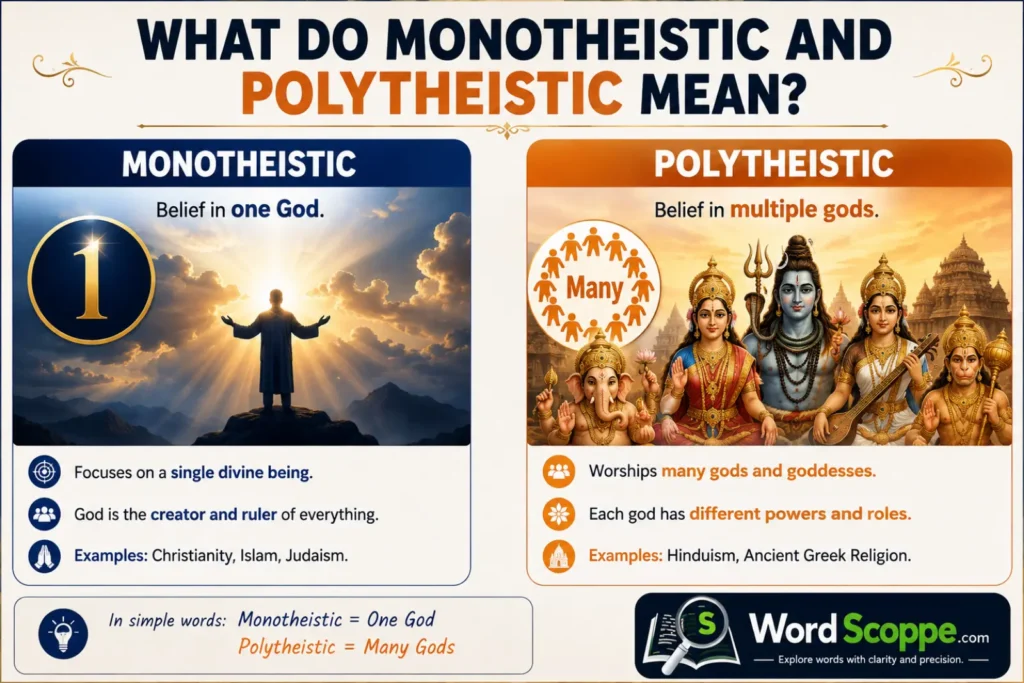
Before answering the question, it helps to understand both terms.
Monotheism means belief in one God. The word focuses on one divine being as the ultimate God.
Polytheism means belief in multiple gods. These gods may have different roles, powers, names, and stories.
For example, ancient Greek religion had Zeus, Athena, Apollo, and other deities.
Hinduism looks different from both simple models. It contains many divine figures. Yet some Hindu philosophies connect those figures with one ultimate reality.
That makes the subject much more interesting.
Is Hinduism Monotheistic or Polytheistic?
The safest answer is that Hinduism can include both monotheistic and polytheistic elements.
However, that statement needs context.
Hinduism is not one single system with one official creed. It contains many traditions and philosophical schools. These traditions can understand God and the divine in different ways.
Some Hindus worship one deity as the Supreme Being. A Vaishnava may see Vishnu or Krishna as supreme. A Shaiva may regard Shiva as supreme. A Shakta may place Devi at the center.
At the same time, many Hindu traditions recognize other deities.
Some philosophies go even further. They describe Brahman as the ultimate reality behind existence.
Therefore, the simple label “polytheistic” does not explain the whole picture.
What Is Brahman in Hinduism?
Brahman is one of the most important concepts in Hindu philosophy.
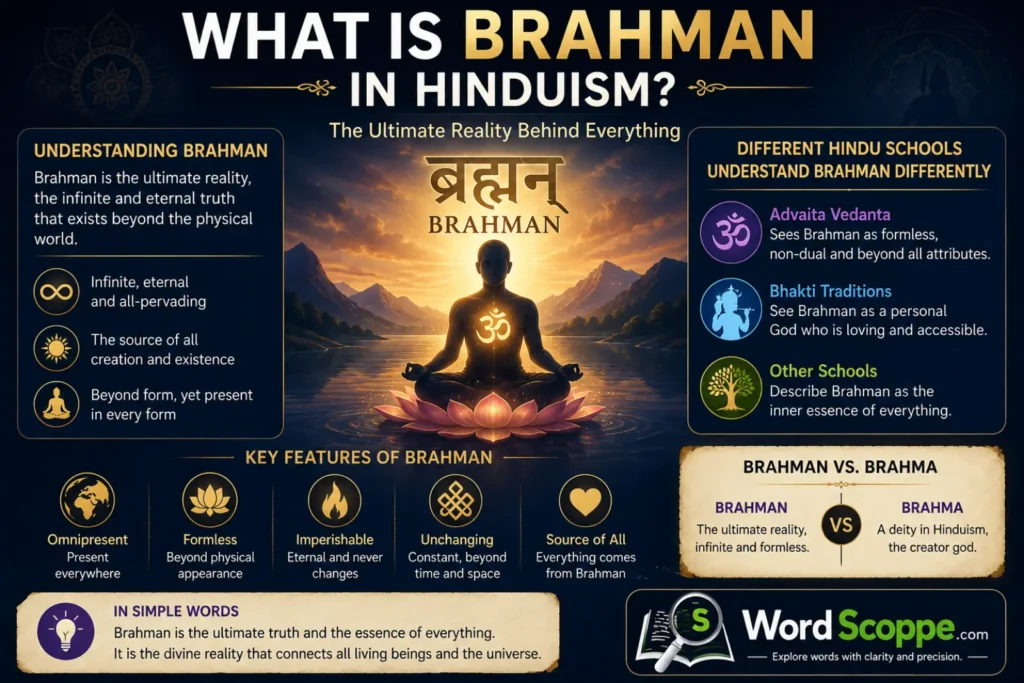
Brahman refers to ultimate reality or the highest spiritual principle. It should not be confused with Brahma, the deity associated with creation in the Hindu tradition.
Different schools understand Brahman differently.
For example, Advaita Vedanta teaches a strong form of non-dualism. It emphasizes the ultimate unity of reality.
Other schools describe Brahman as a personal Supreme Being.
This difference matters because Hinduism has no single view of God.
The idea of Brahman also helps explain why some Hindus see many deities without viewing them as completely separate divine powers.
Why Does Hinduism Have So Many Gods?
Hindu traditions include many well-known deities.
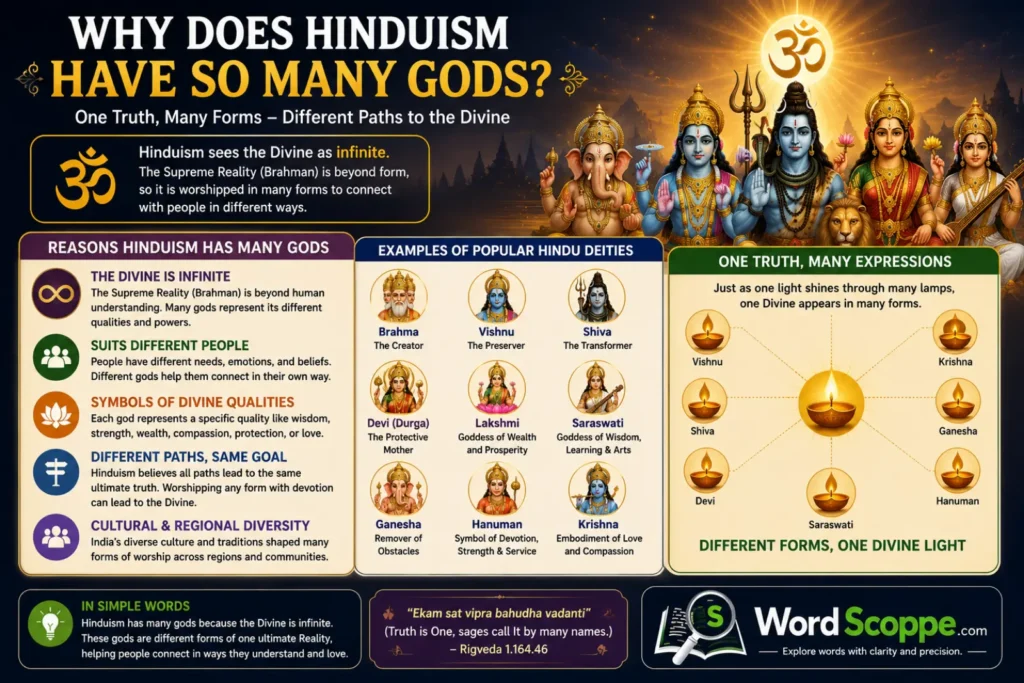
These include:
- Vishnu
- Shiva
- Devi
- Krishna
- Ganesha
- Lakshmi
- Saraswati
- Hanuman
- Durga
Each deity has different stories, symbols, qualities, and traditions.
However, their roles depend on the Hindu tradition being followed.
For some believers, these deities are distinct divine beings. For others, they represent different manifestations or expressions of ultimate divinity.
The relationship between “one” and “many” therefore becomes central to Hindu theology.
Oxford research describes Hinduism as containing both polytheistic ideas and forms that appear monotheistic.
What Is Henotheism?
Henotheism offers another way to understand Hindu worship.
The term describes devotion to one deity as supreme while not necessarily denying other deities.
This idea helps explain why a Hindu may devote their daily worship to Krishna while respecting Shiva or Devi.
The person does not always need to reject every other deity.
The concept has a strong connection with discussions of early Vedic religion. Scholars have used henotheism and kathenotheism to describe patterns found in Vedic texts.
Therefore, henotheism can sometimes describe Hindu religious practice better than a simple monotheism-versus-polytheism choice.
Hinduism Compared With Monotheism and Polytheism
| Feature | Monotheism | Polytheism | Hindu Traditions |
| Number of gods | One | Many | Varies by tradition |
| Supreme reality | One God | Multiple deities | Often linked to Brahman |
| Worship | One God | Several gods | One or several deities |
| Religious structure | Usually more unified | Often diverse | Highly diverse |
| Main concept | One divine being | Multiple divine beings | One, many, or different forms |
| Common label | Monotheistic | Polytheistic | Cannot be reduced to one label |
This table shows why Hinduism can be difficult to classify.
It does not operate like one simple belief system.
Monotheism, Monism, and Hindu Belief
One common mistake involves confusing monotheism with monism.
They are not the same.
Monotheism teaches belief in one God.
Monism focuses on the idea that reality is ultimately one.
Some Hindu philosophies emphasize unity at the deepest level. That does not automatically make them monotheistic in the usual sense.
For example, Advaita Vedanta uses non-dual philosophy to explain ultimate reality.
This distinction helps explain why scholars may use different terms when describing Hindu thought.
Real-Life Examples of Hindu Worship
Imagine a Hindu family visiting a temple dedicated to Shiva.
They may pray to Shiva as their chosen form of the divine.
Another family may worship Vishnu or Krishna.
A Shakta family may center its worship on Devi.
These examples do not necessarily mean that every family believes the same thing about other deities.
In everyday Hindu practice, people may use puja, prayers, devotional songs, offerings, meditation, or festivals.
For example, Ganesha receives special attention during Ganesh Chaturthi. Durga becomes central during Durga Puja. Krishna receives special devotion during Janmashtami.
These practices show the diversity of Hindu religious life.
Common Mistakes About Hindu Gods
Several misunderstandings appear often when people discuss Hinduism.
Mistake 1: “Hinduism has many gods, so it must be purely polytheistic.”
This ignores Hindu ideas about Brahman and divine unity.
Mistake 2: “Hinduism has Brahman, so every Hindu is monotheistic.”
This also oversimplifies Hindu diversity.
Different traditions understand Brahman differently.
Mistake 3: “All Hindus believe the same thing.”
Hinduism includes many traditions and philosophical schools.
Mistake 4: Confusing Brahman with Brahma
Brahman refers to ultimate reality in many Hindu philosophies. Brahma is a deity within Hindu tradition.
Mistake 5: Assuming temple worship tells the whole story
Hindu philosophy includes ideas that go far beyond temple images and rituals.
Tips for Understanding Hindu Beliefs
Use these simple tips when studying Hindu theology:
- Separate Hinduism from one specific Hindu tradition.
- Learn the meaning of Brahman.
- Understand the difference between Brahman and Brahma.
- Study monotheism and monism separately.
- Look at Vaishnavism, Shaivism, and Shaktism individually.
- Remember that Hindu worship can focus on one chosen deity.
- Avoid judging Hinduism only by the number of gods shown in temples.
Most importantly, do not force Hinduism into a Western category without examining its own concepts.
Hinduism in Daily Religious Life
The question also matters because religious labels can shape how people understand Hindu practice.
A Hindu may have a personal relationship with one chosen deity. This deity may serve as the main focus of prayer.
Another Hindu may honor several deities.
Someone else may focus more strongly on meditation and philosophical ideas.
These differences can exist within the wider Hindu tradition.
As a result, Hindu religious life can combine devotion, philosophy, ritual, meditation, festivals, family customs, and spiritual practice.
Synonyms and Related Terms
People searching for this topic may encounter several related terms.
- Monotheism — belief in one God.
- Polytheism — belief in multiple gods.
- Henotheism — devotion to one deity without necessarily rejecting others.
- Monism — belief that reality is ultimately one.
- Pantheism — the view that God and the universe are closely identified.
- Panentheism — the view that the universe exists within God, while God also transcends it.
- Brahman — ultimate reality in many Hindu philosophical traditions.
- Bhakti — devotional practice centered on love and devotion toward the divine.
These terms help explain why Hindu theology cannot always fit into one category.
FAQs About Hinduism and Monotheism
Is Hinduism monotheistic or polytheistic?
Hinduism contains both ideas. Some traditions focus on one Supreme Being, while others include many deities.
Do Hindus believe in one God?
Some Hindus do. Others understand the divine through multiple deities or different philosophical concepts.
Is Brahman one God?
Brahman represents ultimate reality in many Hindu philosophies. Its meaning differs between Hindu schools.
Why do Hindus worship many gods?
Different deities can represent different forms, qualities, or understandings of the divine. Beliefs vary among traditions.
What is henotheism in Hinduism?
Henotheism describes devotion to one deity as supreme while accepting the existence of other deities.
Is Brahma the same as Brahman?
No. Brahma is a deity. Brahman is a philosophical concept referring to ultimate reality in many Hindu traditions.
Is Hinduism a religion with many gods?
Hinduism includes many gods and goddesses. However, Hindu philosophies differ on how these deities relate to ultimate reality.
Why is Hinduism hard to classify?
Hinduism contains many traditions, scriptures, practices, and philosophical schools. Therefore, one label cannot capture every Hindu belief.
Expert Insight: Why the Answer Needs Context
A strong way to approach this question is to avoid a simple yes-or-no answer.
Oxford scholar Wendy Doniger notes that Hindu texts and practices can show both polytheistic and seemingly monotheistic elements.
The Stanford Encyclopedia of Philosophy also discusses how Hindu traditions can elevate one deity or principle to supreme status. It uses Shri Vaishnavism as an example of a tradition with a strong monotheistic interpretation.
Therefore, the most accurate approach is to ask which Hindu tradition, text, or philosophy we are studying.
That approach gives a clearer and more respectful understanding of Hinduism.
Conclusion
So, is Hinduism monotheistic or polytheistic? Neither label fully describes Hinduism as a whole. Hinduism includes traditions that worship one Supreme Being. It also includes many gods and goddesses in religious practice. Some philosophies focus on Brahman as ultimate reality. Others emphasize a personal deity such as Vishnu, Shiva, or Devi. Henotheism can also explain devotion to one chosen deity while recognizing others. Most importantly, Hinduism is highly diverse. Its beliefs differ across traditions, scriptures, and philosophical schools. Therefore, calling Hinduism simply monotheistic or polytheistic can miss important details. The clearest answer is that Hinduism contains monotheistic, polytheistic, henotheistic, monistic, and other theological approaches. Understanding that diversity gives a much more accurate picture.

Sophia Hayes is a language researcher and content writer at WordsCoppe.com, specializing in word comparisons, spelling differences, grammar explanations, and vocabulary insights. She is passionate about making English easier to understand through clear, accurate, and practical content. By breaking down complex language topics into simple explanations, Sophia helps readers improve their writing and communication skills. Her goal is to make learning English more accessible, engaging, and confidence-building for learners worldwide.