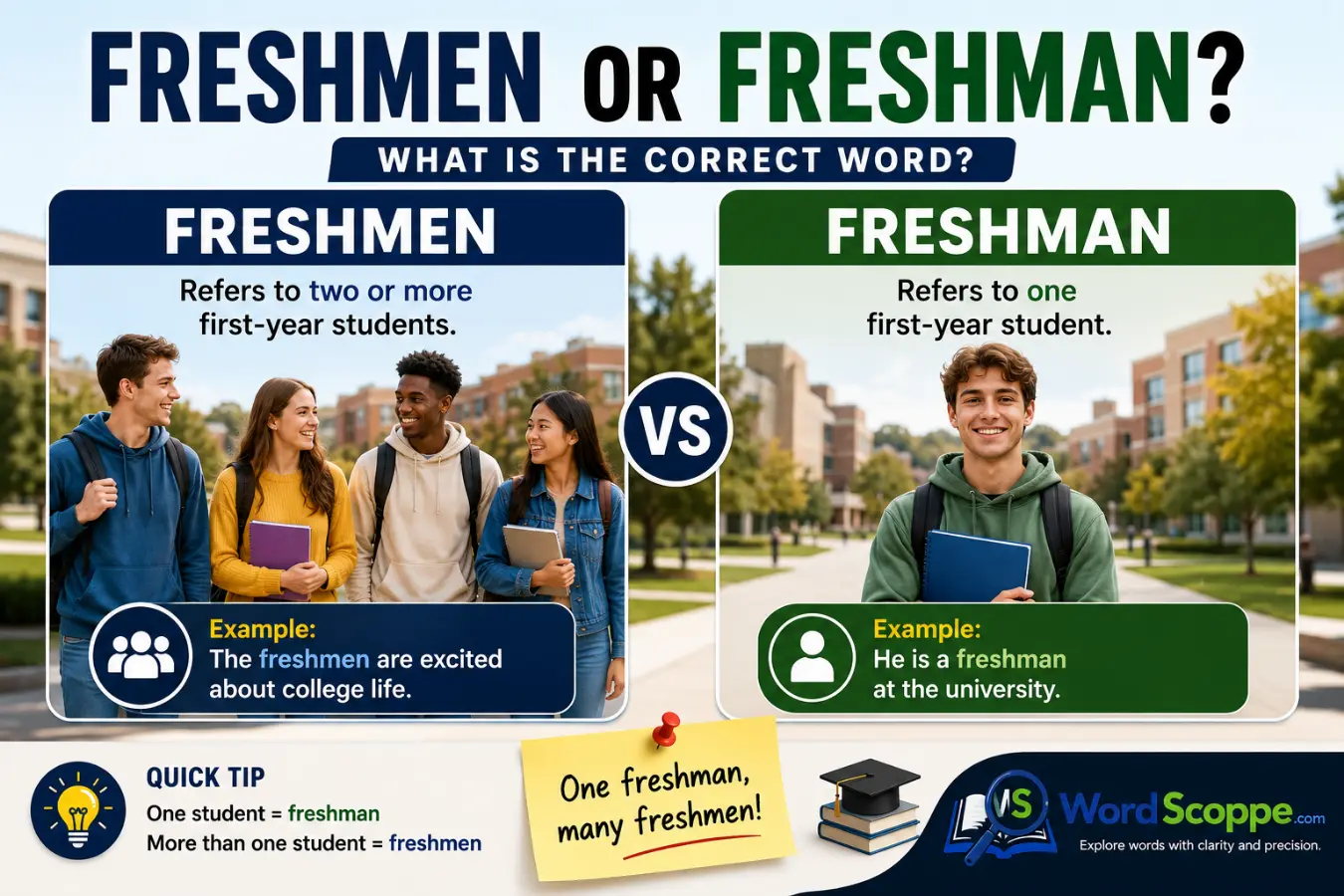
Freshmen or freshman can confuse students because both words describe students in their first year. The key difference is simple: one word refers to one person, while the other refers to more than one. Freshman is singular, so you use it for one first-year student. Freshmen is plural, so you use it for two or more first-year students. This difference follows a common English pattern. However, many learners still mix these forms in school writing, emails, and everyday conversation. You may also see the word freshperson in some settings. This newer term avoids gendered language and can describe one first-year student.
In this guide, you will learn the correct forms, useful examples, common mistakes, and easy memory tricks. By the end, choosing the right word should feel much easier.
Quick Summary
- Freshman refers to one first-year student.
- Freshmen refers to two or more first-year students.
- Use “a freshman” for one person.
- Use “freshmen” for a group.
- “Freshman” can also work as an adjective.
- The plural form changes -man to -men.
- “Freshmen” does not need an “s” at the end.
- Some schools use gender-neutral terms like “first-year student.”
- Context tells you which form you need.
What Does “Freshman” Mean?
The word freshman usually describes a student in the first year of high school or college.
For example:

My brother is a freshman at college.
Only one student appears in this sentence.
The word can also describe something connected with first-year students.
For instance:
She joined the freshman class this year.
Here, “freshman” describes the class rather than one specific student.
Therefore, the word can work as both a noun and an adjective.
What Does “Freshmen” Mean?
Freshmen is the plural form of “freshman.”
It refers to a group of first-year students.
Consider this example:
The freshmen attended an orientation session.
The sentence describes several students.
Another example is:
Many freshmen live on campus during their first year.
The word refers to more than one student.
So, the simplest rule is clear:
One student = freshman.
Two or more students = freshmen.
Freshman vs. Freshmen: What Is the Difference?
The main difference involves number.
| Word | Number | Meaning | Example |
| Freshman | Singular | One first-year student | He is a freshman. |
| Freshmen | Plural | Two or more first-year students | They are freshmen. |
English has several similar plural patterns.
For example:
- Man → men
- Woman → women
- Policeman → policemen
- Freshman → freshmen
Notice that the vowel changes in the plural form.
This pattern explains why freshmans is not the standard plural.
How Do You Use “Freshman” in a Sentence?
Use the singular form when you talk about one student.
Here are some examples:
Alex is a freshman this year.
I met a freshman at the library.
That freshman joined the debate club.
You can also use it before another noun.
She attended a freshman orientation event.
The freshman dorm is near the dining hall.
In these examples, the word describes something connected with first-year students.
How Do You Use “Freshmen” Correctly?
Choose the plural form when you mean several first-year students.
For example:
The freshmen received their class schedules.
Several freshmen joined the sports club.
The school welcomed hundreds of freshmen.
You can also use the word in group-related phrases.
Freshmen orientation begins next Monday.
The freshmen class held a meeting.
However, style can vary between schools and regions. Some institutions prefer first-year students in official communication.
Why Do People Confuse These Two Words?
The confusion often comes from the unusual plural spelling.
Many English nouns simply add -s or -es.
For example:
- Student → students
- Teacher → teachers
- Book → books
“Freshman” follows a different pattern.
The plural changes the ending:
freshman → freshmen
As a result, learners may incorrectly write freshmans.
Another problem comes from pronunciation. The two forms can sound similar in quick speech.
Writing requires more attention because the spelling clearly shows the difference.
Can “Freshman” Describe a Group?

Yes, but context matters.
You may see phrases such as:
The first year of college is often called freshman year.
A freshman class includes students in their first academic year.
New students often attend freshman orientation before classes begin.
In these examples, “freshman” acts as a modifier.
It describes something related to the first year.
For example:
The freshman class starts classes tomorrow.
Here, the phrase refers to a group of first-year students.
English often uses a singular noun before another noun in this way.
Therefore, freshman class does not need “freshmen class.”
Real-Life Examples
Imagine that you are talking about one student.
My cousin is a freshman at the university.
That sentence needs the singular form.
Now imagine several new students.
The freshmen are learning how the campus works.
The plural form fits because the sentence describes a group.
Consider another situation:
The freshman dorm is close to the library.
The word describes the dorm’s purpose.
However:
The freshmen are moving into the dorms.
Here, the word refers directly to multiple students.
These examples show how context determines the correct form.
Common Mistakes to Avoid
Mistake 1: Writing “Freshmans”
Incorrect: The freshmans attended orientation.
Correct: The freshmen attended orientation.
The plural form is freshmen, not “freshmans.”
Mistake 2: Using “Freshmen” for One Person
Incorrect: My sister is a freshmen.
Correct: My sister is a freshman.
One person requires the singular form.
Mistake 3: Writing “Freshmen Year”
Incorrect: I enjoyed my freshmen year.
Correct: I enjoyed my freshman year.
Here, “freshman” modifies “year.”
Mistake 4: Confusing Students With Their Class
Incorrect: The freshmen class meets today.
Correct: The freshman class meets today.
When “freshman” describes the class, the singular form works as a modifier.
What Is an Easy Way to Remember the Difference?
Use the number test.
First, ask yourself:
Am I talking about one student?
If yes, choose freshman.
Next, ask:
Am I talking about several students?
If yes, choose freshmen.
You can also remember this pattern:
One man → many men
One freshman → many freshmen
The vowel change becomes easier after a little practice.
Another useful trick involves the article a.
You can say:
a freshman
You cannot normally say:
a freshmen
Therefore, seeing “a” before the word can help you choose the singular form.
What Are the Gender-Neutral Alternatives?
Some schools and organizations prefer gender-neutral language.
Common alternatives include:
- First-year student
- First-year students
- New student
- First-year class
- New college student
For example:
She is a first-year student at the university.
This wording works well in formal communication.
It also avoids gendered terms when that style suits the audience.
Still, freshman and freshmen remain common in American English.
Always follow the terminology used by your school or institution when possible.
How Is the Word Used in Daily Life?
You may encounter these terms in many school-related situations.
Students often talk about their freshman year, freshman classes, and freshman orientation.
Colleges may publish information for incoming freshmen. Schools may also organize events specifically for new students.
The words appear in emails, schedules, websites, announcements, and student guides.
Understanding the difference helps you write clearer messages.
It also prevents small grammar errors in academic work.
Synonyms and Related Terms
Several phrases can replace these words depending on the context.
First-year student is a clear and gender-neutral alternative.
New student describes someone who recently joined a school.
First-year class refers to students during their first academic year.
Underclassman can describe students in the earlier years of high school or college.
However, these terms do not always mean exactly the same thing.
Therefore, choose a replacement based on the specific meaning you want.
Expert Insight: Which Form Should You Choose?
The most reliable method involves checking number and function.
If you mean one student, choose the singular form.
When you mean several students, choose the plural form.
If the word describes another noun, check the phrase carefully.
For example:
The first year of college is often called freshman year.
A freshman class includes students in their first academic year.
New students often attend freshman orientation before classes begin.
These expressions use “freshman” as a modifier.
Meanwhile:
The freshmen arrived early.
Here, the word acts as a plural noun.
This simple distinction can prevent most errors.
Frequently Asked Questions
Is “freshman” singular or plural?
“Freshman” is singular. It usually refers to one student in the first year.
Is “freshmen” singular or plural?
“Freshmen” is plural. It refers to two or more first-year students.
Is “freshmans” correct?
No. The standard plural form is freshmen.
Should I say “freshman year” or “freshmen year”?
Use freshman year. Here, “freshman” modifies the noun “year.”
Can “freshman” describe a female student?
Yes. “Freshman” traditionally applies to students of any gender.
What is a gender-neutral alternative?
“First-year student” is a common gender-neutral alternative.
Is freshman only used for college students?
No. It can also describe first-year students in high school and some other educational settings.
What is the easiest way to remember the difference?
Think of one freshman and many freshmen. The plural changes “man” to “men.”
Conclusion
The choice between freshman and freshmen depends mainly on number. Use freshman when you mean one first-year student. Choose freshmen when you mean two or more students. The singular form can also modify nouns in phrases like “freshman year” and “freshman class.” Avoid the common mistake of writing “freshmans.” For formal or inclusive writing, “first-year student” offers a useful alternative. Once you focus on whether you mean one person or a group, the difference becomes simple. Remember the basic rule: one freshman, many freshmen. That quick pattern can help you choose the correct form in school writing, conversations, emails, and everyday English.

Sophia Hayes is a language researcher and content writer at WordsCoppe.com, specializing in word comparisons, spelling differences, grammar explanations, and vocabulary insights. She is passionate about making English easier to understand through clear, accurate, and practical content. By breaking down complex language topics into simple explanations, Sophia helps readers improve their writing and communication skills. Her goal is to make learning English more accessible, engaging, and confidence-building for learners worldwide.