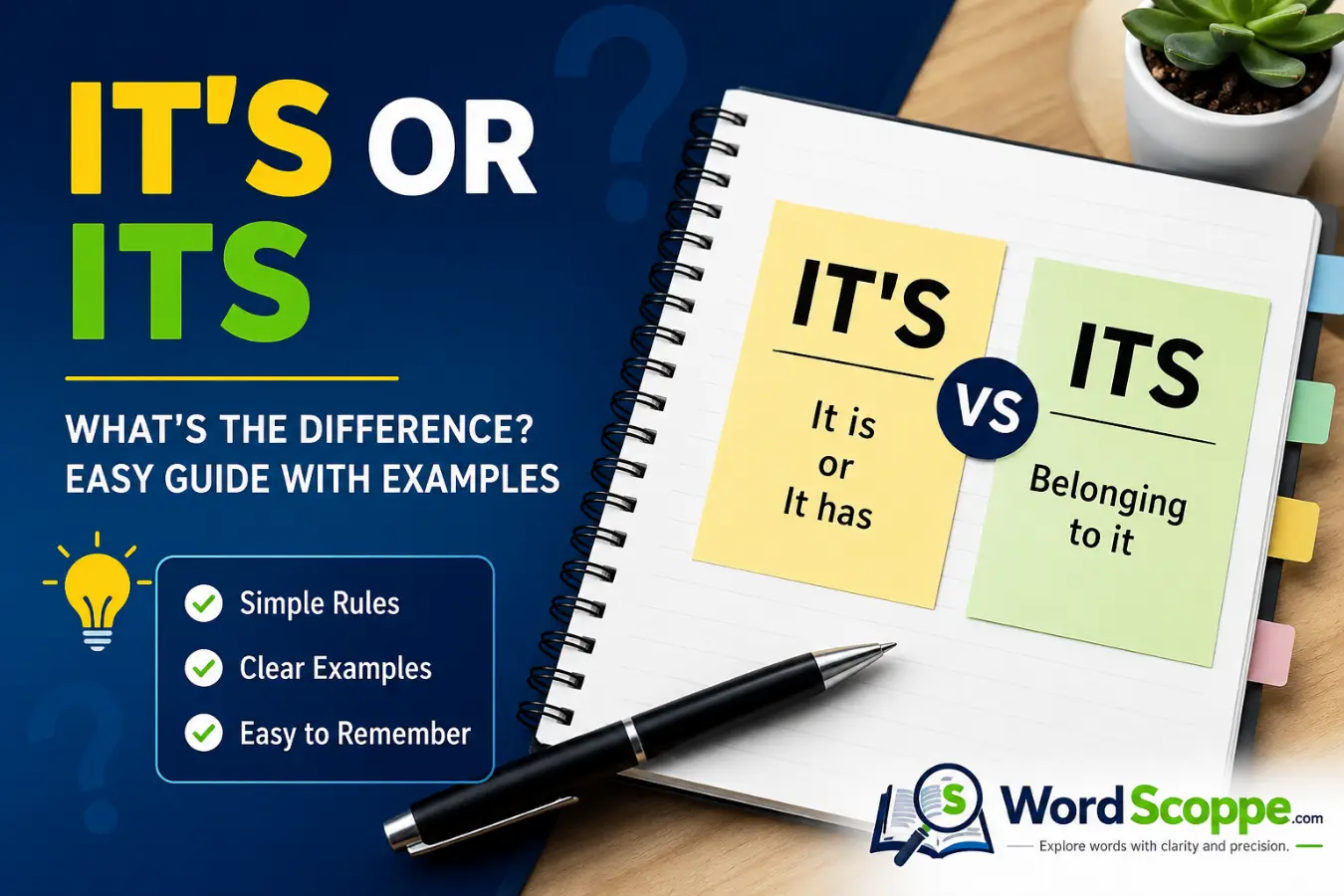
It’s or its is one of the most common grammar questions in English. Many people mix them up because they look almost the same. However, they have different meanings and uses. Once you learn one simple rule, you can use each word correctly every time.
This guide explains the difference in clear and simple language. You will see easy examples, a comparison table, common mistakes, and helpful memory tricks. Whether you are writing an email, school assignment, blog post, or social media caption, this article will help you choose the correct word with confidence. By the end, you will never wonder whether to write it’s or its again.
Quick Summary
- It’s means it is or it has.
- Its shows ownership or possession.
- It’s always includes an apostrophe.
- Its never uses an apostrophe.
- Replace it’s with it is. If the sentence still makes sense, it’s is correct.
- If you are talking about something belonging to an object or animal, use its.
What Does “It’s” Mean?
It’s is a contraction. A contraction combines two words into one shorter form.
The word it’s can mean:
- It is
- It has
Examples
- It’s raining outside.
- It’s a beautiful morning.
- It’s been a busy week.
- It’s time for dinner.
- I think it’s ready now.
If you expand it’s into it is or it has and the sentence still sounds correct, then you have chosen the right word.
Quick Test
It’s cold today.
Expand it:
It is cold today. ✅
The sentence still makes sense, so it’s is correct.
What Does “Its” Mean?
Its is a possessive adjective. It shows that something belongs to an animal, object, company, country, or idea.
Think of its as meaning belonging to it.
Examples
- The dog wagged its tail.
- The company changed its logo.
- The phone lost its signal.
- Every tree drops its leaves.
- The school opened its new library.
Notice that its never has an apostrophe.
It’s vs Its: Key Differences
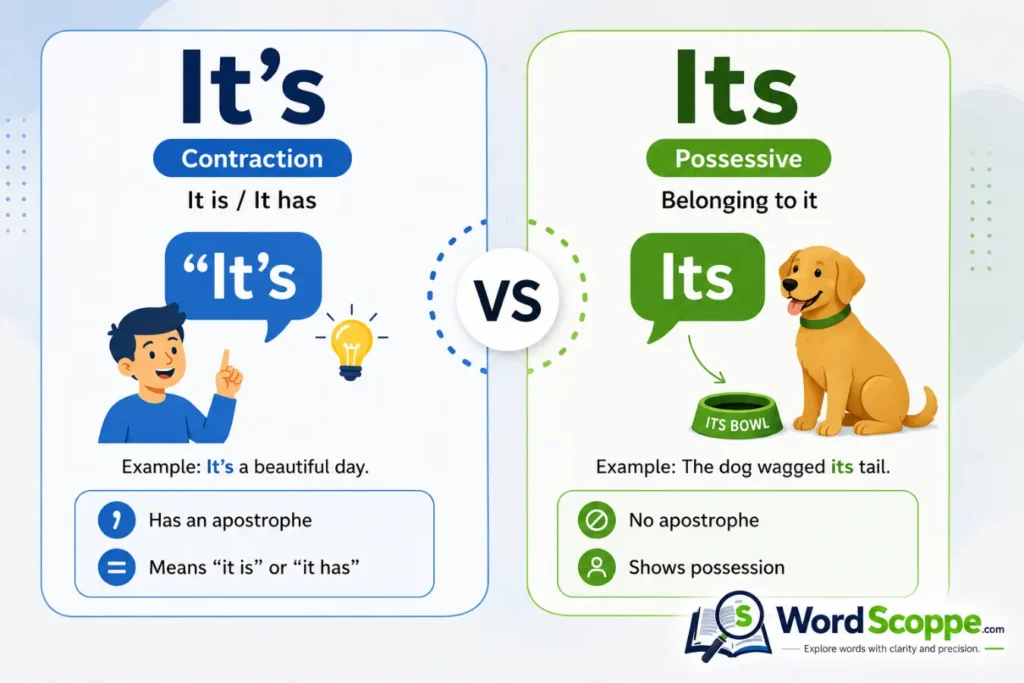
The easiest way to remember it’s or its is to understand their different jobs.
| Feature | It’s | Its |
| Meaning | It is or it has | Belonging to it |
| Part of Speech | Contraction | Possessive adjective |
| Apostrophe | Yes | No |
| Shows Ownership | No | Yes |
| Example | It’s sunny today. | The cat cleaned its paws. |
This simple comparison makes choosing the correct word much easier.
Why Do People Confuse It’s and Its?
Many English words use an apostrophe to show possession.
For example:
- Sarah’s book
- John’s car
- Teacher’s desk
Because of this pattern, many writers think it’s should show possession too.
However, English grammar works differently here.
The possessive form of it is simply its.
Meanwhile, it’s is only a contraction for it is or it has.
This unusual grammar rule causes confusion, even for experienced writers.
Real-Life Examples of It’s and Its
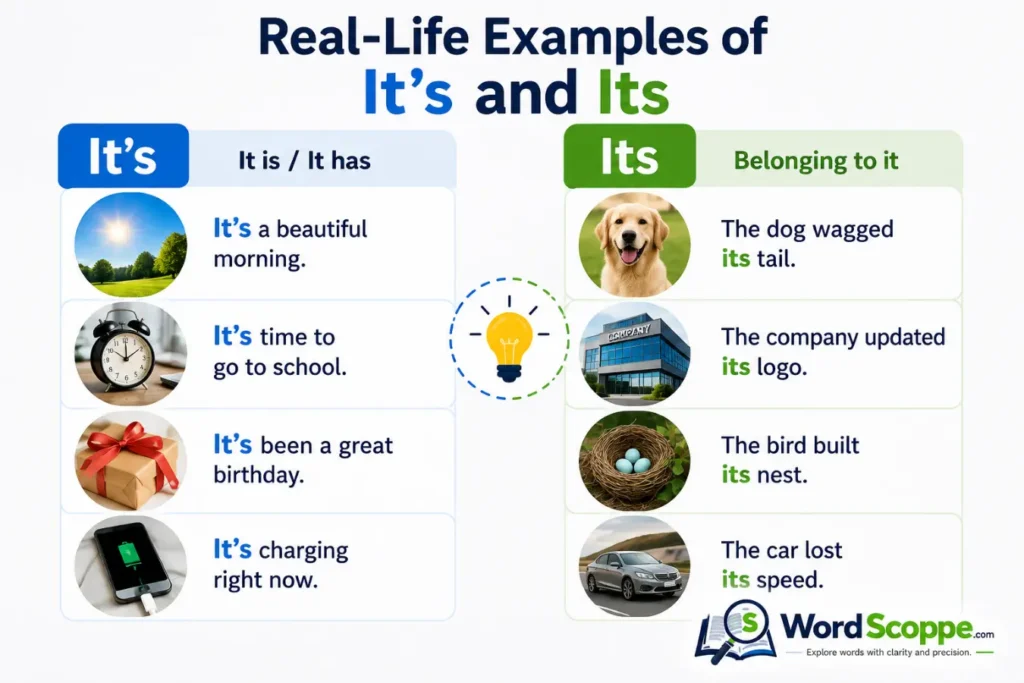
Understanding grammar becomes easier when you see real situations.
At Home
- It’s time to clean the kitchen.
- The refrigerator keeps its food fresh.
School
- It’s our science lesson today.
- Every student brought its project. ❌
- Every student brought their project. ✅
Work
- It’s an important meeting.
- The company updated its website.
About Animals
- It’s sleeping on the sofa.
- The bird spread its wings.
About Technology
- It’s charging now.
- The laptop needs its charger.
These examples show how each word fits naturally into everyday writing.
Common Mistakes People Make
Many writers make the same grammar mistakes. Fortunately, they are easy to fix.
Mistake 1: Using “it’s” for ownership
❌ The cat licked it’s paws.
✅ The cat licked its paws.
The paws belong to the cat, so its is correct.
Mistake 2: Forgetting the contraction
❌ Its raining today.
✅ It’s raining today.
The sentence means It is raining today, so you need it’s.
Mistake 3: Guessing Instead of Testing
Some people choose randomly.
Instead, replace it’s with it is.
If the sentence still works, use it’s.
Otherwise, choose its.
Mistake 4: Assuming Apostrophes Always Show Possession
This is one of the biggest grammar myths.
Remember:
- John’s car ✅
- Sarah’s phone ✅
- Its engine ✅
- It’s working ✅
The pronoun its is the exception to the usual apostrophe rule.
Simple Trick to Remember the Difference
You do not need to memorize complicated grammar rules.
Instead, remember this easy method.
Use the Expansion Test
Ask yourself:
Can I replace the word with “it is” or “it has”?
If yes, write it’s.
If not, write its.
Examples
It’s easy to understand.
→ It is easy to understand. ✅
The dog wagged its tail.
→ The dog wagged it is tail. ❌
Since the sentence no longer makes sense, its is the correct choice.
Using It’s and Its in Daily Life
You will see it’s and its almost everywhere. They appear in books, emails, websites, advertisements, and text messages. Knowing the difference helps you write clearly and professionally.
Here are some everyday examples.
In Emails
- It’s great to hear from you.
- The company announced its new policy.
In School Assignments
- It’s important to check your grammar.
- Every country has its own culture.
On Social Media
- It’s finally the weekend!
- The puppy found its favorite toy.
In Business Writing
- It’s time to review the report.
- The brand updated its product packaging.
Using the correct word makes your writing look polished and trustworthy.
Synonyms and Related Grammar Concepts
Although it’s and its have different meanings, learning similar grammar ideas can strengthen your writing.
Words Related to “It’s”
Because it’s means it is or it has, similar expressions include:
- It is
- It has
- This is
- That is
- Here is
Words Related to “Its”
Since its shows possession, it belongs with other possessive adjectives, such as:
- My
- Your
- His
- Her
- Our
- Their
These words all tell us who owns or has something.
Easy Practice Sentences
Try choosing the correct word before checking the answer.
- ___ a beautiful day outside.
It’s a beautiful day outside.
- The horse shook ___ head.
The horse shook its head.
- ___ been a long journey.
It’s been a long journey.
- Every phone has ___ own serial number.
Every phone has its own serial number.
- ___ easy once you know the rule.
It’s easy once you know the rule.
Practicing with simple sentences helps you remember the rule faster.
Expert Insights
Grammar experts recommend focusing on meaning instead of punctuation alone.
Apostrophes usually show possession. However, its is an important exception. The apostrophe in it’s does not show ownership. Instead, it replaces the missing letters in it is or it has.
Professional editors often use the expansion test while proofreading. They mentally replace it’s with it is. If the sentence still works, the contraction is correct. If it does not, its is the right choice.
This simple habit can prevent one of the most common grammar mistakes in English writing.
Frequently Asked Questions
Is it “it’s” or “its”?
Use it’s when you mean it is or it has. Use its to show ownership.
Why doesn’t “its” have an apostrophe?
Its is a possessive pronoun. Like his, hers, and theirs, it does not need an apostrophe.
Can “it’s” show possession?
No. It’s never shows possession. It only means it is or it has.
How can I remember the difference?
Replace it’s with it is. If the sentence still makes sense, it’s is correct. Otherwise, use its.
Is “The dog wagged it’s tail” correct?
No. The correct sentence is:
The dog wagged its tail.
The tail belongs to the dog.
Is “It’s been a long day” correct?
Yes. It means:
It has been a long day.
Why do people confuse “it’s” and “its”?
Both words look similar, and apostrophes often show possession in English. However, its is an exception, making it easy to confuse the two.
Final Thoughts
Choosing between it’s or its becomes simple once you understand their different roles. It’s is always a contraction for it is or it has, while its shows ownership. Remember the expansion test whenever you feel unsure. If you can replace the word with it is or it has, use it’s. If you are talking about something belonging to a person, animal, object, or organization, choose its instead. With a little practice, this rule will become second nature. Using the correct form improves your grammar, makes your writing clearer, and helps readers understand your message without confusion. Whether you write for school, work, or everyday communication, mastering this small grammar rule will make a big difference.

Sophia Hayes is a language researcher and content writer at WordsCoppe.com, specializing in word comparisons, spelling differences, grammar explanations, and vocabulary insights. She is passionate about making English easier to understand through clear, accurate, and practical content. By breaking down complex language topics into simple explanations, Sophia helps readers improve their writing and communication skills. Her goal is to make learning English more accessible, engaging, and confidence-building for learners worldwide.