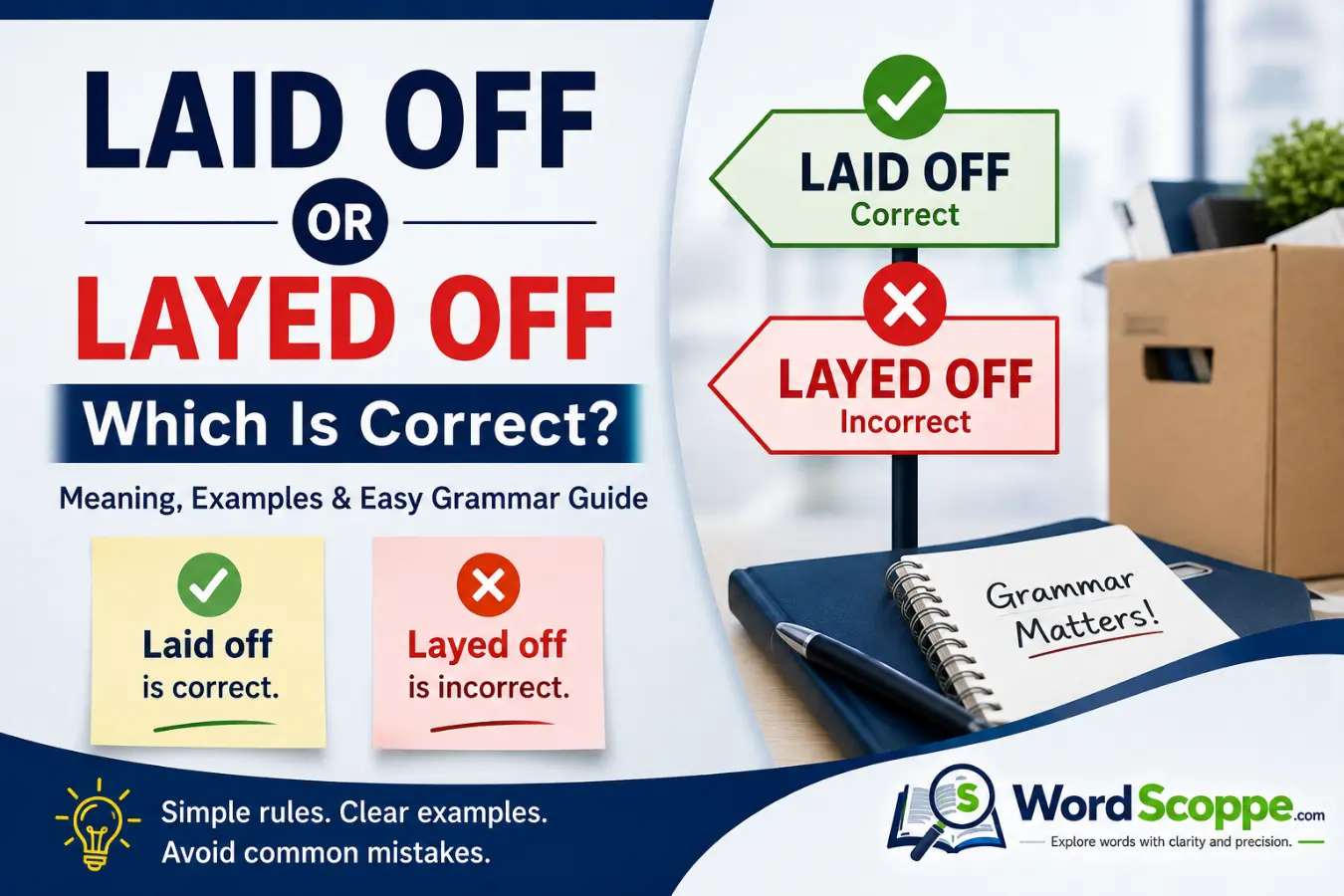
Laid off or layed off is a question many English learners and native speakers ask. The two phrases look similar, but only one is correct in standard English. Choosing the right spelling helps you write clearly and professionally.
In this guide, you will learn the correct form, why people confuse these words, and how to remember the rule. You will also find simple examples, a comparison table, common mistakes, and practical tips. Whether you are updating your resume, writing an email, or reading company news, this article will help you use the correct phrase with confidence.
Quick Summary
- Laid off is the correct phrase.
- Layed off is incorrect in standard English.
- Laid is the past tense and past participle of lay.
- Companies lay off employees when reducing their workforce.
- Use laid off in resumes, emails, and professional writing.
- Never use layed off in formal or informal English.
What Does “Laid Off” Mean?
Laid off means someone has lost a job because a company reduced its workforce. The employee usually did nothing wrong.
A layoff often happens because of:
- Business losses
- Budget cuts
- Company restructuring
- Economic downturns
- Factory closures
- Mergers or acquisitions
Being laid off is different from being fired. A fired employee loses a job because of performance or behavior. A laid-off employee loses a job because of business reasons.
Simple Examples
- Maria was laid off last month.
- Hundreds of workers were laid off after the merger.
- The company laid off several employees to reduce costs.
- He is looking for a new job after being laid off.
Is “Layed Off” Ever Correct?
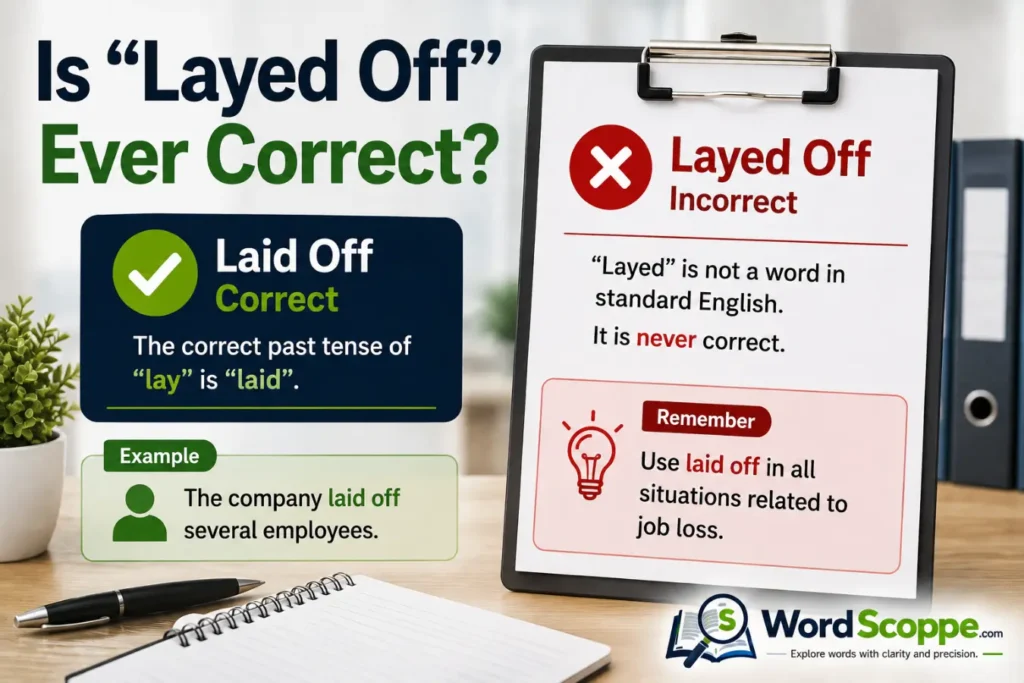
No.
Layed off is not a correct English phrase.
Many people think layed is the past tense of lay, but English grammar uses laid instead.
Correct verb forms are:
- Present: lay
- Past: laid
- Past participle: laid
There is no standard English verb called layed.
Laid Off vs Layed Off: Key Differences
| Feature | Laid Off | Layed Off |
| Correct spelling | ✅ Yes | ❌ No |
| Standard English | ✅ Accepted | ❌ Incorrect |
| Used in business writing | ✅ Yes | ❌ Never |
| Used in resumes | ✅ Yes | ❌ No |
| Dictionary approved | ✅ Yes | ❌ No |
Whenever you write about losing a job because of company decisions, always choose laid off.
Why Do People Write “Layed Off”?
This mistake happens because English verbs can be confusing.
Many regular verbs add -ed to form the past tense.
For example:
- Play → Played
- Stay → Stayed
- Clean → Cleaned
People assume the same rule applies to lay.
However, lay is an irregular verb.
Its past tense is laid, not layed.
This grammar rule surprises many writers because it does not follow the usual pattern.
Real-Life Examples of Using “Laid Off”
Seeing real situations makes the rule easier to remember.
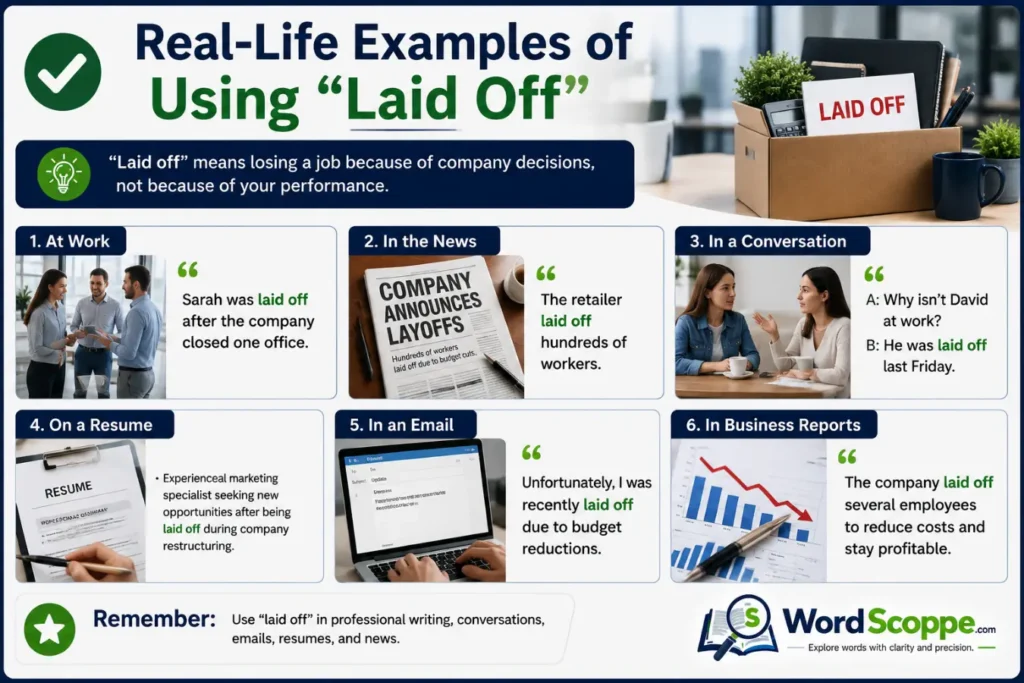
At Work
- Our company laid off twenty employees this year.
- She was laid off after the department closed.
In the News
- Thousands of workers were laid off because of lower sales.
- The airline announced more layoffs this week.
During a Conversation
Person A: Why isn’t David at work?
Person B: He was laid off last Friday.
On a Resume
- Experienced marketing specialist seeking new opportunities after being laid off during company restructuring.
In an Email
- Unfortunately, I was recently laid off due to budget reductions.
These examples all use the correct phrase naturally.
Common Mistakes People Make
Many writers repeat the same errors. Here are the most common ones.
Mistake 1: Writing “Layed Off”
❌ I was layed off yesterday.
✅ I was laid off yesterday.
Always use laid as the past tense of lay.
Mistake 2: Confusing “Laid Off” With “Fired”
These phrases are not the same.
Laid off means the company eliminated the position.
Fired means the employee lost the job because of performance or conduct.
Knowing the difference makes your writing more accurate.
Mistake 3: Mixing Up “Lay” and “Lie”
These verbs confuse many people.
- Lay = Put something down.
- Lie = Rest or recline.
Examples:
- Please lay the book on the table.
- I need to lie down for a while.
The phrase laid off comes from the verb lay, not lie.
Mistake 4: Using the Wrong Verb Form
Incorrect verb forms create grammar mistakes.
❌ The company has layed off workers.
✅ The company has laid off workers.
Remember:
- Lay
- Laid
- Laid
There is never a need to write layed.
Easy Trick to Remember the Correct Phrase
You only need one simple memory trick.
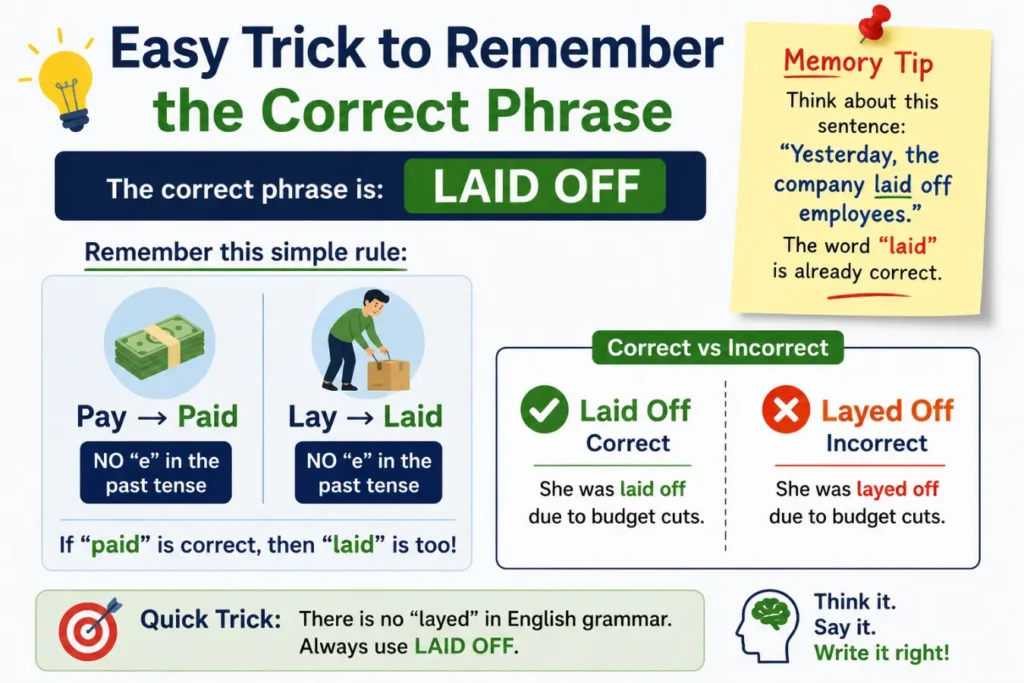
Think about this sentence:
Yesterday, the company laid off employees.
The word laid is already the correct past tense of lay.
There is no “e” in the past tense.
Memory Tip
Remember this pattern:
- Pay → Paid
- Lay → Laid
Notice that neither word becomes payed or layed in standard English.
If you remember paid, remembering laid becomes much easier.
Using “Laid Off” in Everyday English
You will hear laid off in workplaces, news reports, business meetings, and daily conversations. It is a common phrase that describes job loss because of business decisions rather than employee performance.
Here are some everyday examples.
At Work
- The company laid Sarah off after it closed one office.
- Our manager said the company would not lay off anyone else this year.
Job Interviews
- The company laid me off after reducing its workforce.
- My position ended during a company restructuring.
Business News
- The retailer laid off hundreds of workers.
- Many technology companies announced layoffs this year.
In Daily Conversations
- His company laid my neighbor off last month.
- After the company laid him off, he found a new job within weeks.
Using the correct phrase helps you communicate clearly and professionally.
Synonyms and Related Terms
The phrase laid off has several related words. However, each has a slightly different meaning.
Similar Terms
- Job loss
- Workforce reduction
- Staff reduction
- Downsizing
- Redundancy (British English)
- Position eliminated
- Employment termination (general business term)
Related Business Words
- Layoff
- Restructuring
- Budget cuts
- Company downsizing
- Cost reduction
- Workforce planning
- Business reorganization
Although these words are related, laid off specifically means losing a job because of company needs, not personal performance.
Expert Insights
Career experts recommend using the phrase laid off correctly because employers understand its meaning immediately. It clearly explains that the job ended due to business circumstances rather than employee misconduct.
Grammar experts also emphasize that laid is the only correct past tense of lay in this expression. Writing layed off can make resumes, cover letters, emails, and professional documents appear less polished.
When discussing employment history, choosing the correct wording builds credibility and shows strong communication skills.
Frequently Asked Questions
Is it “laid off” or “layed off”?
Laid off is correct. Layed off is incorrect in standard English.
Why is “layed off” wrong?
The verb lay is irregular. English uses laid as the past tense of lay, not layed.
What does “laid off” mean?
It means someone lost a job because of business reasons, such as budget cuts, restructuring, or reduced demand.
Is being laid off the same as being fired?
No. A layoff happens because of company decisions. Being fired usually relates to performance or behavior.
Can I write “I was layed off” on my resume?
No. Always write:
I was laid off due to company restructuring.
Is “laid off” used in American and British English?
Yes. Both varieties of English use laid off, although British English also commonly uses made redundant or redundancy.
How can I remember the correct spelling?
Remember the pair:
- Pay → Paid
- Lay → Laid
If paid is correct, then laid is too.
Final Thoughts
Understanding the difference between laid off or layed off is easier than it seems. Laid off is the only correct phrase in standard English, while layed off is a spelling mistake. Whether you are writing a resume, updating your LinkedIn profile, sending a professional email, or talking about employment, using laid off shows good grammar and clear communication. Remember that laid is the past tense of lay, just as paid is the past tense of pay. This simple rule can help you avoid one of the most common English mistakes. With regular practice and the examples in this guide, you can use the correct phrase confidently in both personal and professional writing.

Sophia Hayes is a language researcher and content writer at WordsCoppe.com, specializing in word comparisons, spelling differences, grammar explanations, and vocabulary insights. She is passionate about making English easier to understand through clear, accurate, and practical content. By breaking down complex language topics into simple explanations, Sophia helps readers improve their writing and communication skills. Her goal is to make learning English more accessible, engaging, and confidence-building for learners worldwide.