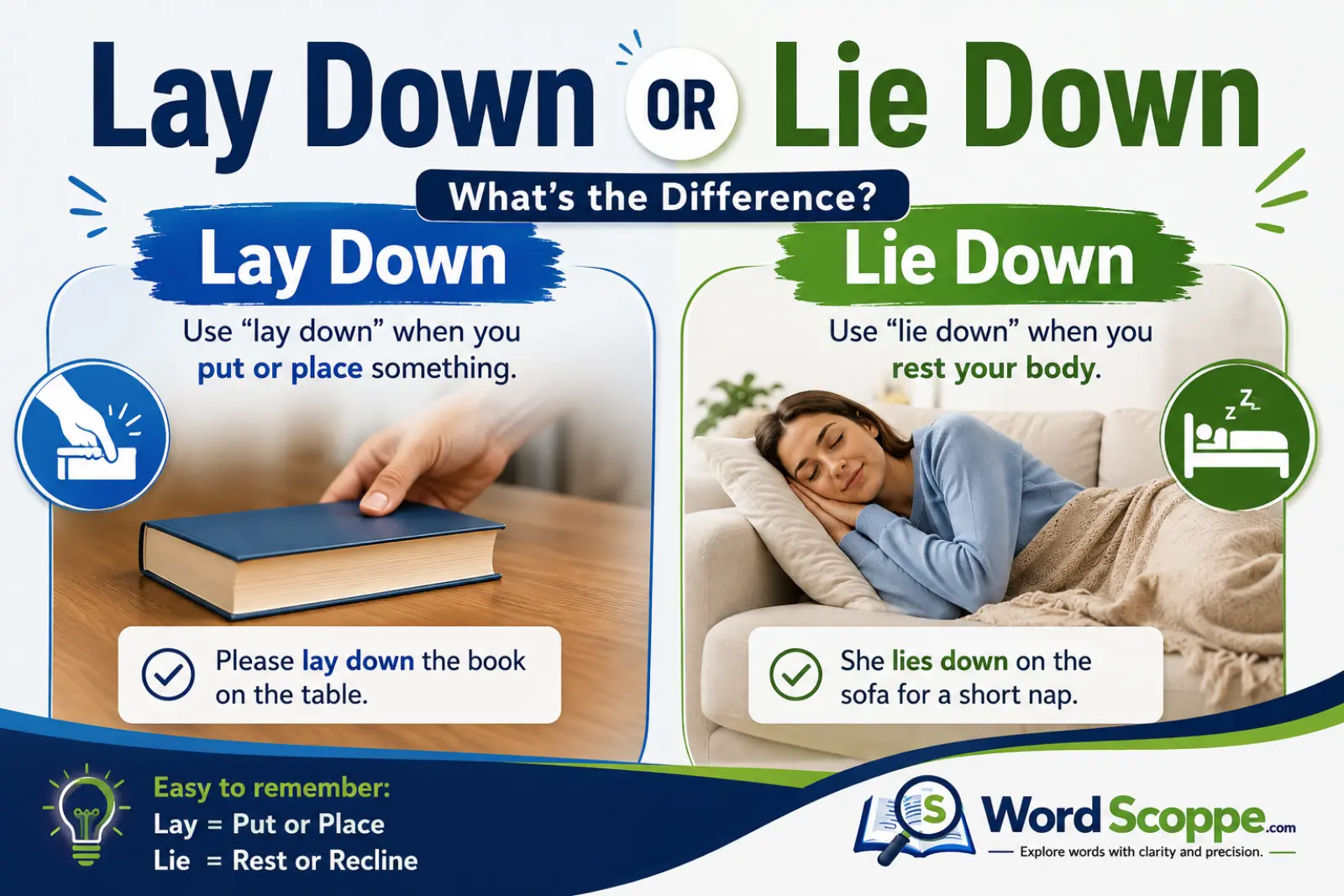
“Lay down or lie down” often confuses English learners and native speakers. Both phrases describe putting your body in a resting position. However, they do not work in the same way.
The main difference comes from the verb that follows each phrase. Lie does not need a direct object. Lay usually needs something to receive the action.
For example, you can say, “I need to lie down.” However, you would say, “Please lay the book down.” The first sentence describes your own action. The second sentence describes an action done to something else.
This small grammar difference causes many common mistakes. Fortunately, the rule becomes easier with a few simple examples. This guide explains when to use each verb, how their past forms work, and how to remember the difference.
Quick Summary
- Use lie down when a person rests their own body.
- Use lay down when someone puts something somewhere.
- Lie usually does not take a direct object.
- Lay normally needs a direct object.
- “I need to lie down” is correct.
- “Lay the bag down” is correct.
- The past tense of lie is lay.
- The past tense of lay is laid.
- Context helps you choose the correct verb.
What Does “Lie Down” Mean?
Lie down means to move your body into a flat or resting position.

The person performs the action themselves. Therefore, the verb lie does not need a direct object.
For example:
- I want to lie down.
- She needs to lie down.
- We decided to lie down for a while.
- Please lie down on the sofa.
Here, nobody places another object somewhere. The person simply changes their body position.
You can use lie down when talking about rest, sleep, relaxation, or physical comfort.
What Does “Lay Down” Mean?
Lay down means to put something or someone in a particular position.
The verb lay normally requires a direct object. That object receives the action.

For example:
- Lay the book down.
- He laid the keys down.
- Please lay the baby down carefully.
- She laid her phone down on the table.
Notice the difference. You lay something down, but you lie down yourself.
This distinction gives you a useful starting point when choosing between the two phrases.
Lay Down vs Lie Down: The Main Difference
The easiest rule is simple.
Use lie when the subject rests or reclines. Use lay when the subject places something somewhere.
| Phrase | Basic meaning | Needs an object? | Example |
| Lie down | Rest your body | No | I want to lie down. |
| Lay down | Put something somewhere | Yes | Lay the book down. |
| Lie | Rest or recline | No | I lie on the bed. |
| Lay | Put or place | Yes | I lay the keys on the desk. |
Therefore, ask yourself one question:
Am I resting myself, or am I putting something somewhere?
If you are resting, choose lie. If you are placing something, choose lay.
Why Do People Confuse These Verbs?
The confusion comes from their similar meanings and unusual verb forms.
The present tense of lie is “lie.” However, its past tense is “lay.”
The present tense of lay is “lay.” Its past tense is “laid.”
That creates this pattern:
| Verb | Present | Past | Past Participle |
| Lie | lie | lay | lain |
| Lay | lay | laid | laid |
This table explains many common errors.
For instance, “Yesterday, I lay down” is correct. It describes a past action involving your own body.
However, “Yesterday, I laid down” is usually incorrect when no object follows.
When Should You Use “Lie Down”?
Use lie down when the subject rests their own body.
Consider these everyday examples:
Correct: I feel tired, so I will lie down.
Correct: She went upstairs to lie down.
Correct: The dog likes to lie down near the door.
Correct: You should lie down and relax.
In each example, the subject performs the action without placing an object.
You can also use this phrase when giving someone an instruction.
For example:
Please lie down and take a deep breath.
Here, the person changes their own position.
When Should You Use “Lay Down”?
Use lay down when you place something somewhere.
For example:
Correct: Lay your jacket down on the chair.
Correct: He laid his wallet down beside the phone.
Correct: Please lay the papers down carefully.
Correct: She laid the baby down in the crib.
Each sentence has an object. The jacket, wallet, papers, and baby receive the action.
That object makes lay the correct choice.
Real-Life Examples of the Difference
Imagine you are exhausted after work.
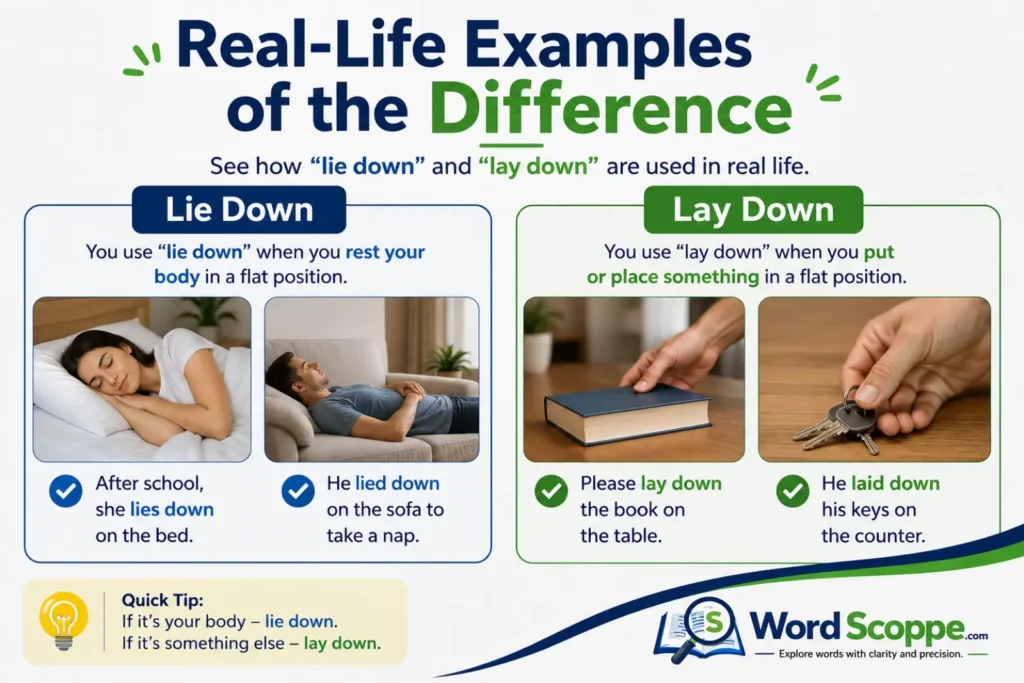
You might say:
I am tired. I need to lie down.
You are describing your own movement.
Now imagine you are cleaning your desk.
You might say:
I need to lay these books down first.
The books receive the action.
Here is another example involving a child.
You could say:
The baby is sleepy. Please lay the baby down.
The baby receives the action.
However, you could say:
The baby is sleepy and wants to lie down.
Now the baby performs the action.
The meaning changes because the verb changes.
The Tricky Past Tense: “Lay” vs “Laid”
This is where many speakers make mistakes.
The past tense of lie is lay.
For example:
- Today, I lie down after lunch.
- Yesterday, I lay down after lunch.
The past tense of lay is laid.
For example:
- Today, I lay the book down.
- Yesterday, I laid the book down.
The word lay can therefore represent two different verbs.
Its meaning depends on the sentence and its tense.
Common Mistakes to Avoid
One common mistake is saying:
I am going to lay down.
This sentence usually needs an object. If you mean resting yourself, say:
I am going to lie down.
Another mistake is saying:
I laid down yesterday.
If you mean that you rested yesterday, use:
I lay down yesterday.
A third mistake involves forgetting the object after lay.
Instead of saying:
Lay down the book.
You can also say:
Lay the book down.
Both versions work when the object is clear.
Therefore, always check what receives the action.
How to Remember Lie and Lay
A simple memory trick can make this rule easier.
Think:
Lie = yourself.
Lay = something else.
If you are resting, choose lie.
If you are placing an object, choose lay.
You can also use the “object test.”
Ask:
What am I laying?
If you can answer the question, lay may be correct.
For example:
What am I laying? The book.
So:
Lay the book down.
If there is no object, lie may be the better choice.
Lay Down or Lie Down in Daily English
These verbs appear often in normal conversations.
People use lie down when discussing rest, sleep, sickness, or relaxation.
For example:
I have a headache, so I need to lie down.
People use lay down when discussing objects.
For example:
Lay your phone down before dinner.
You may also hear these verbs in instructions, stories, songs, books, and casual conversations.
Learning this difference can make everyday English sound more natural.
Are “Lie Down” and “Lay Down” Synonyms?
They are related, but they are not true synonyms.
Both can involve moving into a lower or resting position. However, their grammar differs.
Lie down describes the subject resting.
Lay down describes the subject placing something.
Related expressions include:
- recline
- rest
- stretch out
- lie flat
- put down
- place down
- set down
However, these alternatives do not always work in the same sentence.
For example, put down can replace lay down in many situations. It cannot replace lie down when you mean resting your body.
Expert Insight: The Object Test Works Best
The most useful grammar test is to look for a direct object.
If the verb acts on something, lay often fits.
For example:
Lay the blanket down.
“Blanket” receives the action.
If the subject simply changes position, use lie.
For example:
Lie down on the blanket.
Here, the blanket does not receive the action.
This approach works better than memorizing isolated sentences. It helps you understand why each verb belongs in a particular sentence.
Frequently Asked Questions
Is “lay down” or “lie down” correct?
Both are correct, but they have different uses. Use lie down for resting yourself. Use lay down for placing something.
Should I say “I need to lay down”?
Usually, no. If you mean that you need to rest, say, “I need to lie down.”
Is “I lay down yesterday” correct?
Yes. Lay is the past tense of lie. Therefore, “I lay down yesterday” is grammatically correct.
Is “I laid down yesterday” correct?
Not when you mean that you rested. The correct sentence is, “I lay down yesterday.”
What is the past tense of lie?
The past tense of lie is lay.
What is the past tense of lay?
The past tense of lay is laid.
Does “lay” need an object?
Yes, when lay means “put” or “place,” it normally needs a direct object.
How can I remember the difference?
Remember this simple rule: lie means rest, while lay means place something.
Conclusion
The difference between lay down or lie down becomes easier when you focus on the object. Use lie down when someone rests their own body. Use lay down when someone places something somewhere.
Remember that the past tense creates another challenge. The past tense of lie is lay, while the past tense of lay is laid.
When you are unsure, use the object test. Ask whether something receives the action. If it does, lay is usually the right choice. If you are simply resting, choose lie.
With a little practice, these verbs will become much easier to use. The key is simple: lie for resting, lay for placing.

Sophia Hayes is a language researcher and content writer at WordsCoppe.com, specializing in word comparisons, spelling differences, grammar explanations, and vocabulary insights. She is passionate about making English easier to understand through clear, accurate, and practical content. By breaking down complex language topics into simple explanations, Sophia helps readers improve their writing and communication skills. Her goal is to make learning English more accessible, engaging, and confidence-building for learners worldwide.