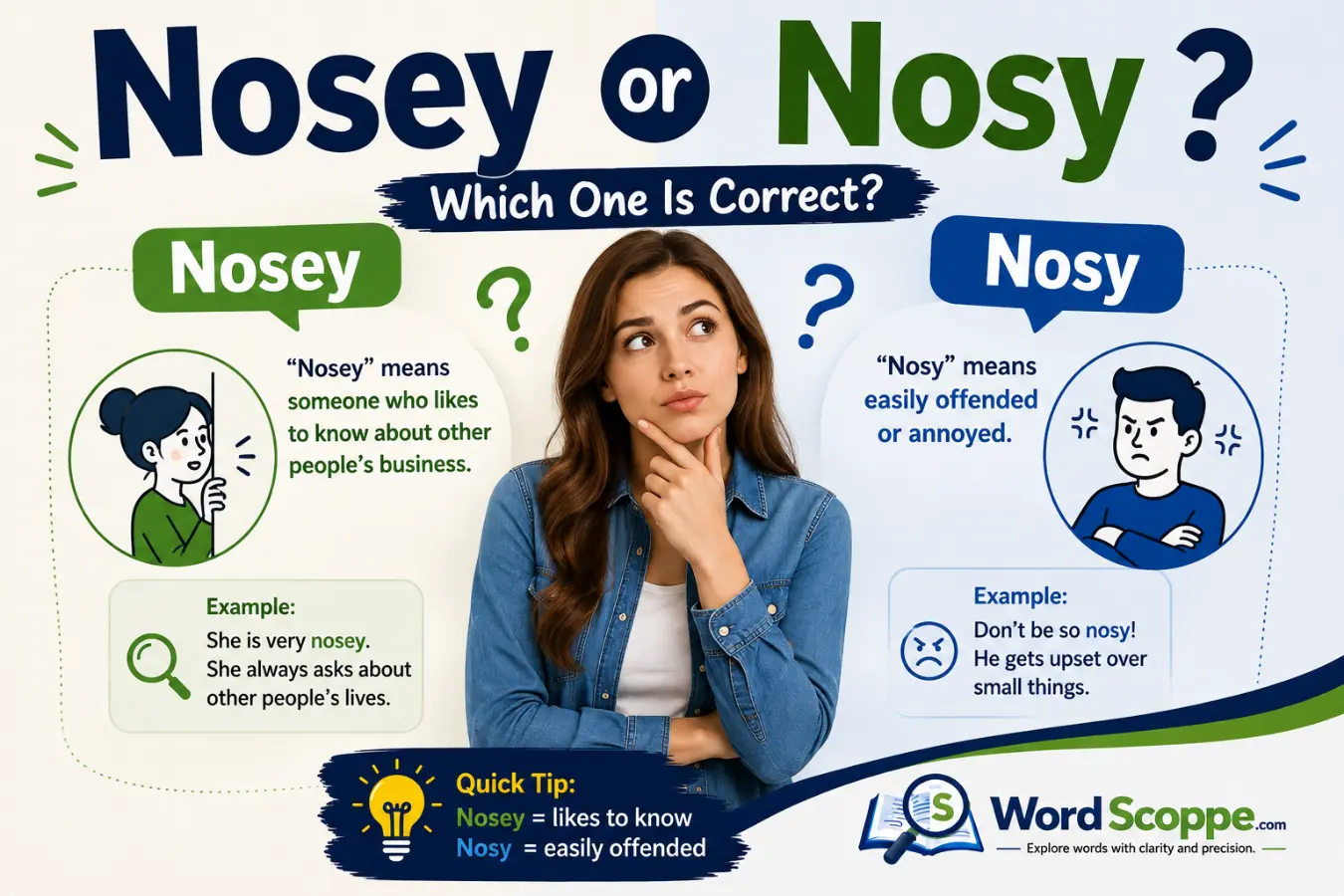
Nosey or nosy can both look correct when you describe someone who asks too many personal questions. However, one spelling is more common in modern English. Nosy is the standard spelling in most dictionaries and style guides. Nosey is also accepted, especially in British English and informal writing.
Both words have the same meaning. They describe someone who shows too much interest in other people’s private matters. For example, a nosy neighbor may ask about your visitors or family plans.
The spelling difference does not change the meaning or pronunciation. Still, choosing the right form can make your writing look more polished. This guide explains both spellings, their meanings, examples, origins, and common mistakes. You will also learn when each version works best.
Quick Summary
- Nosy and nosey have the same meaning.
- Nosy is the more common spelling.
- Nosey is also a correct variant.
- Both words describe unwanted curiosity.
- The word often describes people who ask personal questions.
- Nosy appears more often in American English.
- Nosey is common in British and informal usage.
- Neither spelling changes the pronunciation.
- Use nosy when you want the most widely recognized form.
What Does “Nosy” Mean?
Nosy describes someone who takes too much interest in other people’s private lives.
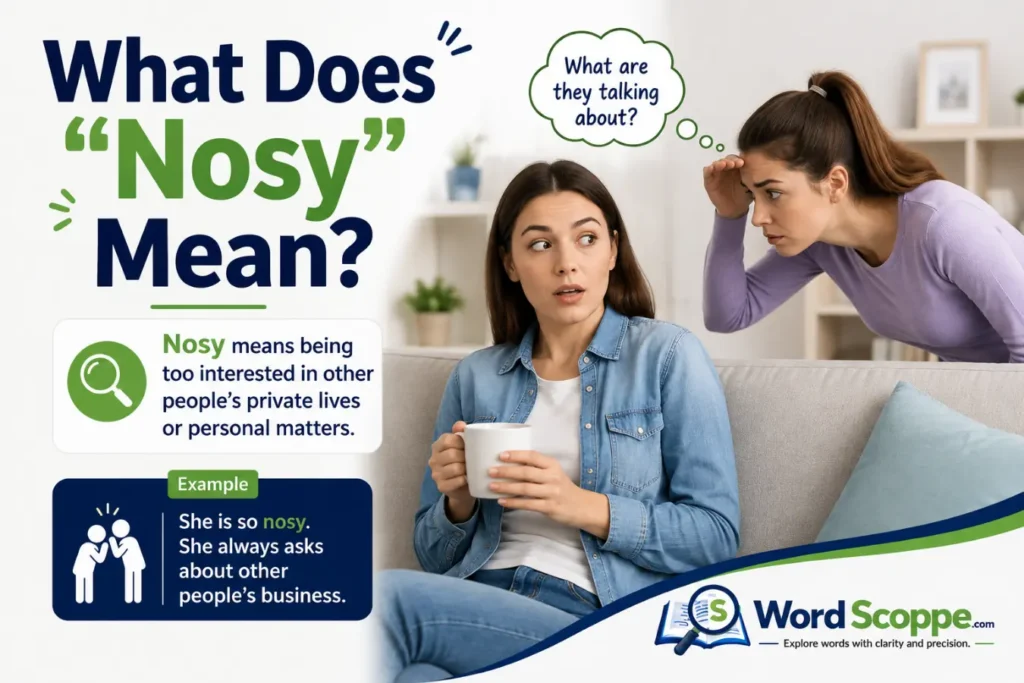
A nosy person may ask questions that do not concern them. They may also try to discover private information.
For example:
- My neighbor is very nosy.
- Stop being nosy about my plans.
- She asked a few nosy questions.
- His nosy behavior annoyed everyone.
The word usually has a negative meaning. However, people sometimes use it in a playful or friendly way.
For instance, a friend might say, “I am just being nosy!” after asking about someone’s weekend.
Therefore, the tone depends on the situation and relationship between the speakers.
What Does “Nosey” Mean?
Nosey has the same meaning as nosy.
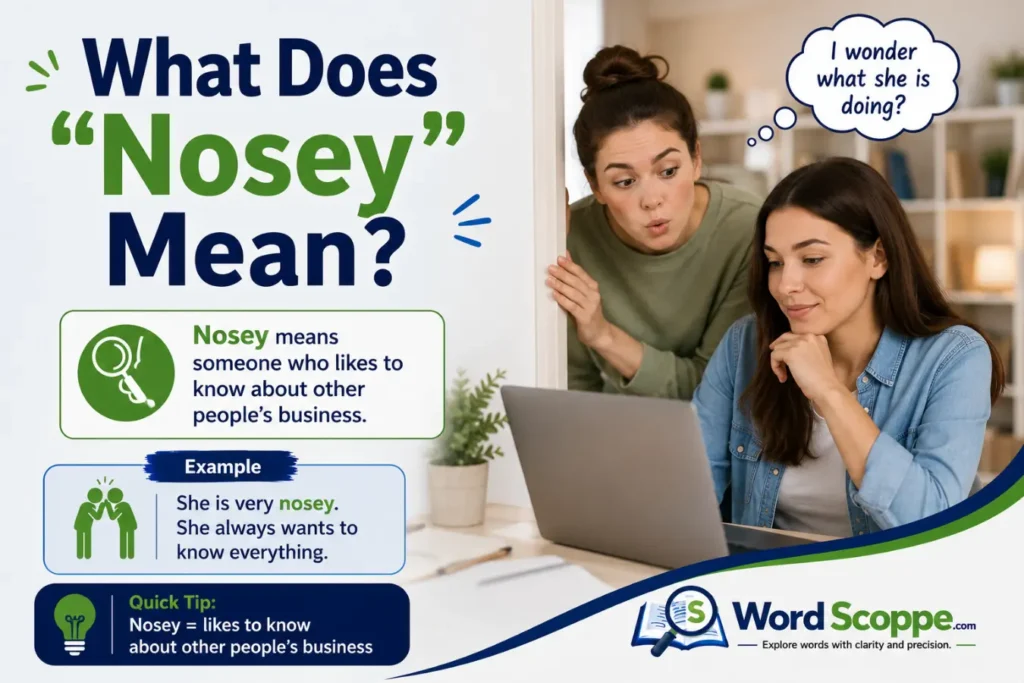
It describes someone who shows excessive curiosity about other people’s affairs. The spelling simply includes an extra e.
For example:
- That was a nosey question.
- My cousin can be quite nosey.
- The nosey neighbor wanted to know everything.
- Don’t get nosey about their relationship.
You can use nosey in the same situations as nosy.
However, nosy generally appears more often in modern written English. That makes it the safer choice for most general writing.
Nosey or Nosy: What Is the Difference?
The main difference is spelling, not meaning.
| Feature | Nosy | Nosey |
| Meaning | Overly curious | Overly curious |
| Pronunciation | Same | Same |
| Word type | Adjective | Adjective |
| Common usage | More common | Less common |
| American English | Very common | Less common |
| British English | Common | Also common |
| Formal writing | Preferred choice | Acceptable variant |
| Example | He is nosy. | He is nosey. |
Both forms are grammatically correct.
However, nosy is usually the better choice when you want the most common spelling. Nosey can still appear in British English and casual writing.
Why Are There Two Spellings?
The word comes from the noun nose.
The original idea connects to someone putting their “nose” into other people’s business. English speakers later formed the adjective nosy from that idea.
The spelling developed in more than one way. Some writers kept the connection with nose more clearly and used nosey.
Others shortened the spelling to nosy.
Both forms survived in English. Over time, nosy became the more common spelling in many sources.
This kind of variation appears in other English words too. English often keeps multiple accepted spellings for the same word.
How Do You Use “Nosy” in a Sentence?
You can use nosy before a noun or after a linking verb.
For example:
Before a noun:
She asked a nosy question.
After a linking verb:
My brother is nosy.
You can also use it with common expressions.
Examples include:
- nosy neighbor
- nosy coworker
- nosy friend
- nosy questions
- nosy behavior
- nosy person
- nosy child
The word usually describes curiosity that crosses a social boundary.
For example, asking someone about their favorite movie is usually harmless. Asking about their salary may feel much more personal.
Nosey vs Nosy in Real-Life Examples
Imagine a coworker asks about your weekend.
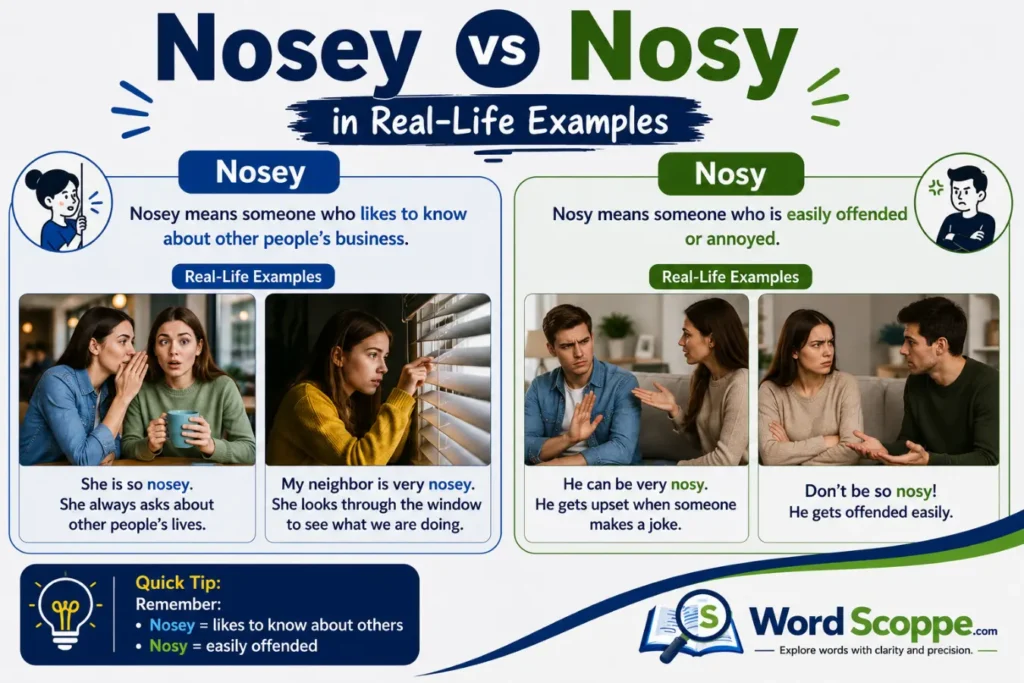
If they ask casually, their question may not seem intrusive.
However, they keep asking about your relationship, finances, and private plans. You might describe them as nosy.
Another example involves neighbors.
A friendly neighbor may ask whether you enjoyed your vacation. A nosy neighbor might ask how much the trip cost.
The difference often depends on personal boundaries.
Similarly, parents may jokingly call a curious child “nosy.” In that situation, the word may sound playful rather than rude.
Therefore, context matters when using this adjective.
Is “Nosy” a Negative Word?
Usually, yes.
Nosy often suggests that someone’s curiosity has gone too far. It can sound critical, rude, or annoyed.
For example:
Why are you asking such nosy questions?
This sentence shows clear irritation.
However, the word does not always sound harsh. Friends and family members may use it jokingly.
For example:
You are so nosy! Tell me what happened.
Here, the speaker may simply show playful curiosity.
The relationship between the speakers helps determine the tone.
Common Mistakes With These Spellings
One common mistake is thinking that the two forms have different meanings. They do not.
Another mistake involves assuming that nosey is always incorrect. It is an accepted spelling variant.
Some writers also use the word when they simply mean curious. These words are related, but they are not always interchangeable.
Curious usually has a neutral or positive meaning.
Nosy often suggests unwanted curiosity.
For example:
She was curious about the new project.
This sounds neutral.
She was nosy about everyone’s private business.
This sounds negative.
Therefore, choose the word based on the tone you want.
When Should You Use “Nosy” Instead of “Nosey”?
Choose nosy when you want the most widely recognized spelling.
This is especially useful for:
- Blog writing
- General websites
- School assignments
- American English
- SEO content
- Professional communication
- Educational content
You can still use nosey when following a source’s spelling or writing for an audience familiar with British English.
If you are unsure, nosy is the simplest choice.
It is short, common, and immediately recognizable to most English readers.
Tips to Remember the Correct Spelling
A simple memory trick can help.
Think of nosy as the shorter form.
You can connect it with the phrase:
“Nosy means no privacy.”
The shorter spelling makes the word easier to remember.
Another helpful tip involves the noun nose. The spelling nosey makes the connection with “nose” obvious.
However, the common modern spelling is nosy.
If you write articles for a broad audience, choosing the shorter form can reduce confusion.
Most importantly, remember that both versions describe the same behavior.
Synonyms for Nosy and Nosey
Several words can describe similar behavior.
Common synonyms include:
- Curious
- Inquisitive
- Intrusive
- Meddlesome
- Prying
- Interfering
- Snooping
- Interfering
- Overcurious
- Questioning
However, these words have slightly different tones.
Curious sounds neutral.
Inquisitive can sound positive and intelligent.
Prying suggests unwanted interest in private matters.
Intrusive suggests that someone crosses personal boundaries.
Therefore, nosy is best when you want a casual word for unwanted curiosity.
Expert Insight: Which Spelling Should You Choose?
From a practical writing perspective, nosy is the strongest default choice.
It is widely recognized and commonly used in modern English. It also works naturally in everyday conversation and online content.
Still, nosey should not be treated as a spelling error. It remains an accepted variant.
The important point is consistency.
If your article uses nosy, keep that spelling throughout the main text. Avoid switching between both forms without a reason.
For SEO content, you can mention both spellings naturally. This helps address readers who search for either version.
Frequently Asked Questions
Is “nosey” or “nosy” correct?
Both spellings are correct. Nosy is more common, while nosey is an accepted variant.
Is “nosy” American or British English?
Nosy appears in both varieties. It is especially common in American English.
Is “nosey” wrong?
No. Nosey is an accepted spelling of the same adjective.
What does nosy mean?
Nosy means showing too much interest in other people’s private lives or personal matters.
Are nosy and curious the same?
Not exactly. Curious often sounds neutral, while nosy usually suggests unwanted curiosity.
What is a nosy person?
A nosy person asks questions or seeks information that may be private or none of their business.
What is the plural of nosy?
Nosy is an adjective, so it does not have a normal plural form. You can say nosy people or nosy persons.
How do you pronounce nosy?
Nosy and nosey have the same pronunciation. They sound like “NOH-zee.”
Conclusion
When choosing between nosey or nosy, remember that both spellings carry the same meaning. They describe someone who shows too much interest in other people’s private matters.
The main difference involves usage and spelling preference. Nosy is the more common form and works well for most modern writing. Nosey remains an accepted variant, especially in British and informal usage.
The word can describe a nosy neighbor, a nosy friend, or someone asking intrusive questions. However, its tone depends on the situation. Sometimes people use it seriously, while friends may use it playfully.
For general writing, nosy is the safest choice. If you see nosey, do not assume it is wrong. Both forms are valid, but nosy is usually the preferred spelling.

Sophia Hayes is a language researcher and content writer at WordsCoppe.com, specializing in word comparisons, spelling differences, grammar explanations, and vocabulary insights. She is passionate about making English easier to understand through clear, accurate, and practical content. By breaking down complex language topics into simple explanations, Sophia helps readers improve their writing and communication skills. Her goal is to make learning English more accessible, engaging, and confidence-building for learners worldwide.