
Women or woman can confuse English learners because both words refer to an adult female. However, they do not have the same meaning. The main difference is simple: one refers to one person, while the other refers to more than one. Understanding this small grammar rule can improve your writing and speaking. It also helps you avoid common mistakes in emails, articles, schoolwork, and daily conversations.
In this guide, you will learn the difference between these two words with clear examples. We will also compare their forms, explain their pronunciation, and cover common usage errors. By the end, choosing the correct word should feel much easier.
Quick Summary
- Woman refers to one adult female.
- Women refers to two or more adult females.
- Woman is singular.
- Women is plural.
- The word woman usually sounds like “wuh-muhn.”
- The word women usually sounds like “wim-in.”
- Use woman with singular verbs and determiners.
- Use women with plural verbs.
- “One woman” is correct.
- “Many women” is correct.
What Does Woman Mean?
Woman is the singular noun for an adult female.
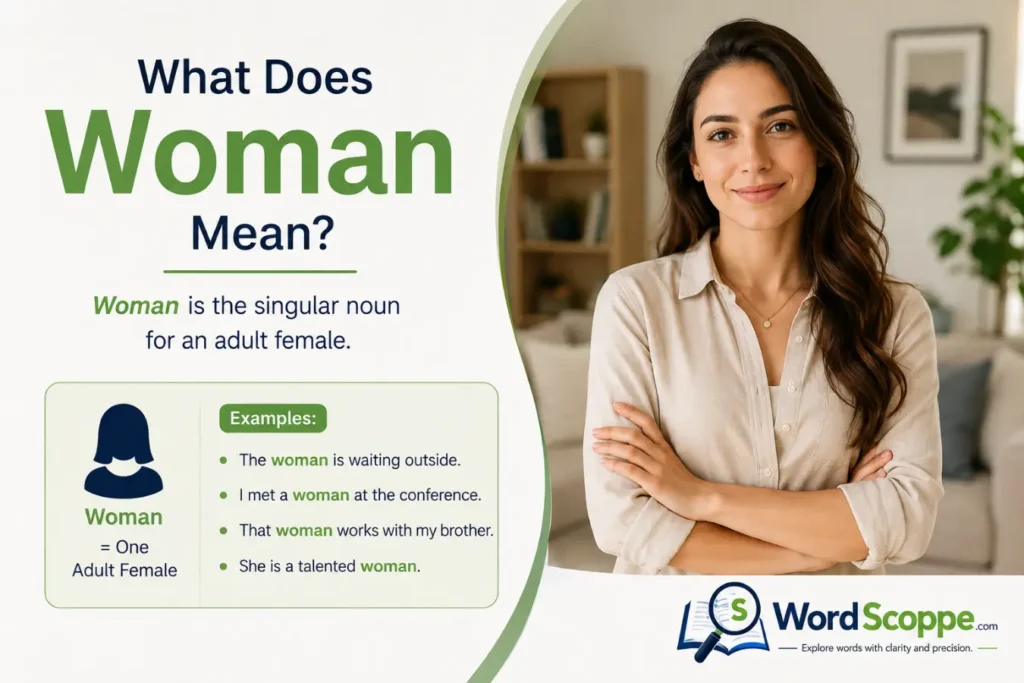
You use it when you talk about one person.
For example:
- The woman is waiting outside.
- I met a woman at the conference.
- That woman works with my brother.
- She is a talented woman.
The word can describe an adult female of any age.
However, context can affect the exact meaning. In most modern English, woman means an adult human female.
You can also use it in phrases such as:
- businesswoman
- woman doctor
- working woman
- young woman
- older woman
Therefore, remember one simple rule: one person = woman.
What Does Women Mean?
Women is the plural form of woman.
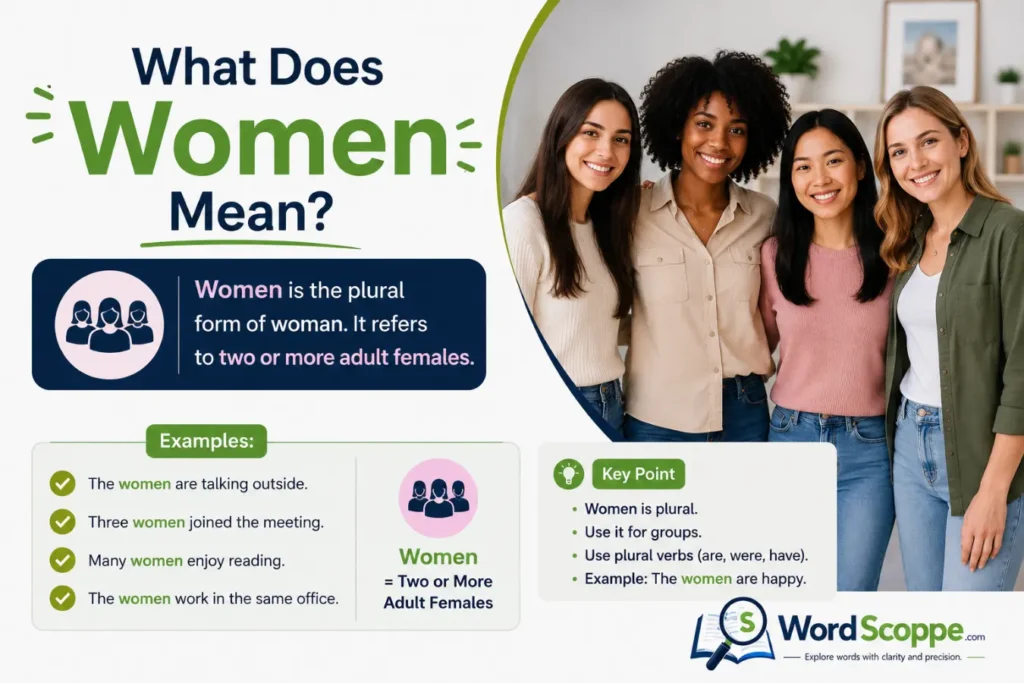
It refers to two or more adult females.
For example:
- The women are talking outside.
- Three women joined the meeting.
- Many women enjoy reading.
- The women work in the same office.
Notice the verb in these examples.
We say “The woman is” because the subject is singular.
We say “The women are” because the subject is plural.
This difference also applies to other parts of a sentence.
For instance:
- One woman has a ticket.
- Two women have tickets.
The spelling changes, and the verb changes too.
Women or Woman: What Is the Main Difference?
The easiest way to understand the difference is to focus on number.
| Word | Number | Meaning | Example |
| Woman | Singular | One adult female | The woman is smiling. |
| Women | Plural | Two or more adult females | The women are smiling. |
So, woman describes one person.
Meanwhile, women describes a group.
This rule works in most everyday situations.
For example, imagine that you see one person at a bus stop. You can say, “A woman is waiting.”
Now imagine five people at the same bus stop. You can say, “Five women are waiting.”
The meaning becomes clear through the number.
How Do You Pronounce Woman and Women?
Pronunciation makes this pair more confusing.
The singular word woman usually sounds like “wuh-muhn.”
The plural word women usually sounds like “wim-in.”
Their pronunciation differs even though their spelling looks similar.
Here is a simple guide:
- Woman: wuh-muhn
- Women: wim-in
The first vowel sound changes between the two words.
This difference is important when speaking English.
For example, saying “two woman” sounds incorrect because the plural form is women.
Similarly, “one women” is grammatically wrong.
Listening to native English speakers can help you notice the difference.
Woman and Women in Real-Life Examples
Real situations make this grammar rule easier to remember.
At Work
- One woman leads the project.
- Several women work on the project.
At School
- A woman teaches English.
- The women teachers attended the meeting.
Store
- I saw a woman near the entrance.
- Two women were looking at shoes.
In News Reports
- A woman won the competition.
- Several women received awards.
In Daily Conversation
- That woman lives next door.
- Those women live next door.
As you can see, the number of people determines the correct form.
Common Mistakes With Woman and Women
English learners often make a few predictable mistakes.
Mistake 1: Using Woman for Multiple People
Incorrect:
The woman are waiting.
Correct:
The women are waiting.
The subject refers to several people, so use women.
Mistake 2: Using Women for One Person
Incorrect:
A women called me.
Correct:
A woman called me.
The article a always points to one person.
Mistake 3: Using the Wrong Verb
Incorrect:
The women is ready.
Correct:
The women are ready.
A plural subject needs a plural verb.
Mistake 4: Confusing Spelling
Some learners write “womans” as the plural form.
That spelling is incorrect.
The correct plural is women.
How to Choose the Correct Word
You can use a quick number test.
First, ask yourself: Am I talking about one person or several people?
If you mean one adult female, choose woman.
If you mean two or more adult females, choose women.
For example:
One:
One woman entered the room.
More than one:
Four women entered the room.
You can also look at words before the noun.
Words such as a, one, and each usually point to one person.
Words such as many, several, two, and these usually point to more than one.
This simple test works well for beginners.
Singular and Plural Forms in Daily English
The difference appears in many common phrases.
Here are some useful examples:
- a woman
- one woman
- this woman
- that woman
- each woman
- many women
- several women
- two women
- these women
- those women
The surrounding words can help you select the correct noun.
For example:
This woman is my manager.
But:
These women are my colleagues.
Therefore, learning the word alone is not enough.
Try learning it with common sentence patterns.
Synonyms and Related Words
The best synonym depends on the sentence and context.
Some related terms include:
- female
- lady
- girl, when referring to a female child
- adult female
- mother, when referring specifically to a female parent
- wife, when referring specifically to a married female partner
However, these words are not always interchangeable.
For example, female can work as a noun or adjective in certain contexts.
Lady can sound more polite or formal in some situations.
Meanwhile, girl usually refers to a child or young female.
Therefore, choose a related word based on the exact meaning you want.
Expert Insight: Why This Difference Matters
This grammar difference looks small, but it affects sentence accuracy.
Using the wrong form can make otherwise good writing look careless.
It can also create confusion when you discuss groups or individuals.
A useful learning strategy involves connecting each form with a number.
Think:
Woman = one
Women = more than one
Then check the verb.
Use is, was, has, or does with singular subjects.
Use are, were, have, or do with plural subjects.
For example:
The woman has a question.
But:
The women have questions.
This method helps you check both the noun and the verb together.
Frequently Asked Questions
Is “woman” singular or plural?
Woman is singular. It refers to one adult female.
Is “women” singular or plural?
Women is plural. It refers to two or more adult females.
What is the plural of woman?
The plural form of woman is women.
Can I say “one women”?
No. The correct phrase is “one woman.”
Can I say “two woman”?
No. The correct phrase is “two women.”
Why are woman and women pronounced differently?
English pronunciation changes the vowel sounds between the singular and plural forms.
Which is correct: “women is” or “women are”?
“Women are” is correct because women is plural.
Is “womans” a correct word?
No. Womans is not the standard plural form. Use women instead.
Conclusion
Understanding women or woman becomes easy when you focus on number. Woman refers to one adult female. Women refers to two or more adult females. Their spelling and pronunciation also differ, so both forms deserve attention. When writing, check the number of people first. Then choose the matching noun and verb. For one person, use woman with a singular verb. For several people, use women with a plural verb. A simple number test can prevent most mistakes. With regular practice, this difference will become natural in both speaking and writing. The key takeaway is simple: one woman, two or more women.

Sophia Hayes is a language researcher and content writer at WordsCoppe.com, specializing in word comparisons, spelling differences, grammar explanations, and vocabulary insights. She is passionate about making English easier to understand through clear, accurate, and practical content. By breaking down complex language topics into simple explanations, Sophia helps readers improve their writing and communication skills. Her goal is to make learning English more accessible, engaging, and confidence-building for learners worldwide.