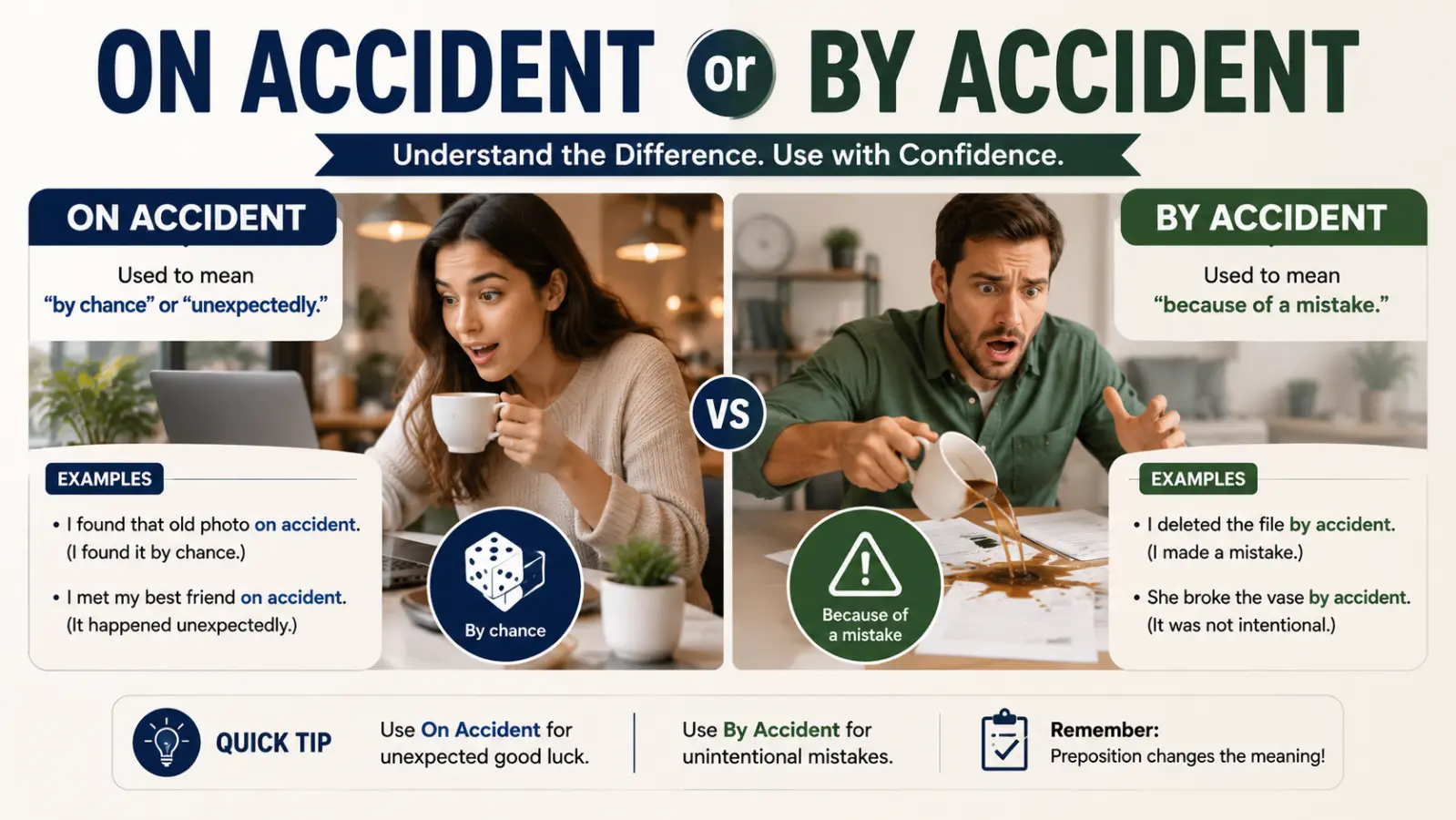
On accident or by accident is a question many English learners ask. Both phrases appear in conversations, but they are not equally accepted. If you want your English to sound natural, you should know when each phrase fits. In standard English, by accident is the traditional and widely accepted expression.
However, on accident has become common in everyday American speech, especially among younger speakers. This difference often confuses students, writers, and even native speakers. The good news is that the rule is easy to understand. Once you know why people use each phrase, you can choose the best one with confidence. This guide explains the meaning, grammar, examples, and usage in simple English so you never have to guess again.
Quick Summary
- By accident standard aur preferred phrase hai.
- On accident informal hai aur zyadatar spoken American English mein bola jata hai.
- Dono phrases kisi unintended ya bina planning ke hone wale kaam ke liye use hote hain.
- Formal, academic, ya business writing mein hamesha by accident prefer karein.
Featured Snippet: Which Phrase Should You Use?
By accident standard English ka sahi phrase hai, jiska matlab hai koi kaam unintentionally ya bina kisi planning ke hona. Iske muqable mein on accident ek informal expression hai jo zyadatar American English conversation mein sunne ko milta hai. Halanke bolne mein log ise istemal kar lete hain, lekin professional aur formal writing mein hamesha by accident hi likhna chahiye.
What Does “By Accident” Mean?
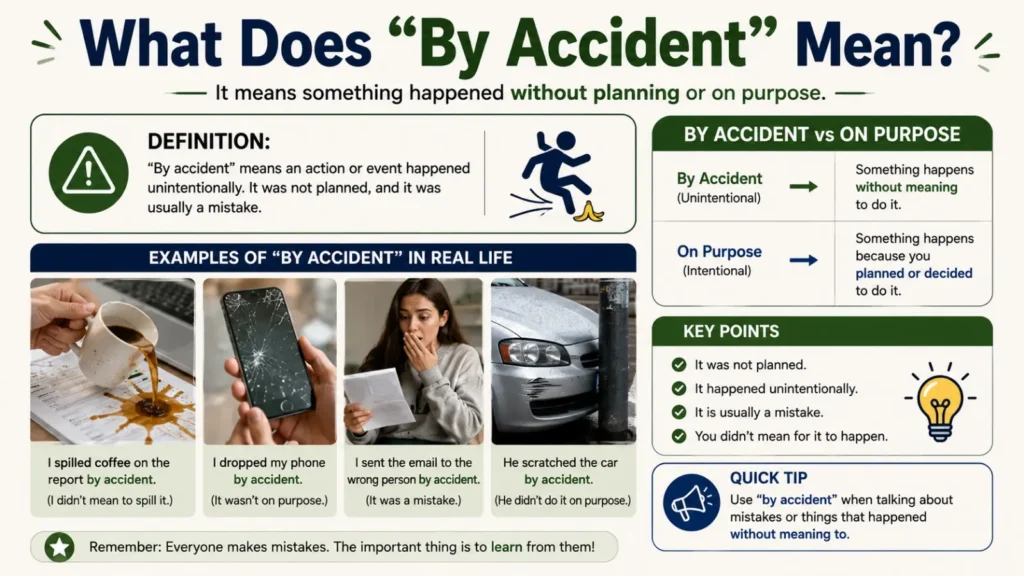
The phrase by accident means that something happened without intention. In other words, nobody planned or expected it.
You can use this expression in many situations.
For example:
- I deleted the file by accident.
- She dropped her phone by accident.
- We met by accident at the airport.
The phrase simply tells the reader or listener that the event was not planned.
What Does “On Accident” Mean?
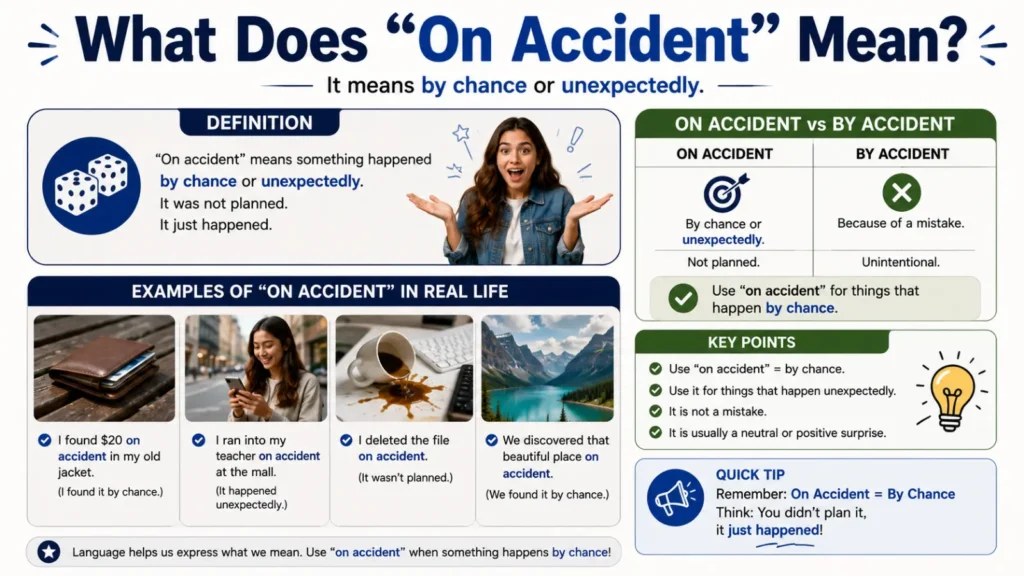
On accident has the same meaning as by accident. The difference is its style.
Many people, especially younger Americans, use on accident during casual conversations.
For example:
- I broke the glass on accident.
- He called me on accident.
Although native speakers understand this phrase, many teachers and editors still consider it informal.
If you write an essay, email, or report, by accident remains the safer choice.
Which One Should You Use?
Your choice depends on the situation.
If you are writing for school, work, or a website, choose by accident.
If you are chatting with friends, you may hear or use on accident, especially in American English.
Think about your audience before deciding.
Best Practice
- Formal writing → By accident
- Business emails → By accident
- Academic papers → By accident
- Everyday conversation → Either phrase may appear, but by accident is still more widely accepted.
Why Do People Say “On Accident”?
Many language experts believe on accident became popular because people compare it with another common phrase:
- On purpose
Since English speakers often say on purpose, some naturally began saying on accident as the opposite.
Although this pattern makes sense, English did not originally develop that way.
Traditional grammar has long preferred by accident.
Language changes over time, so on accident is now common in informal American speech.
On Accident vs. By Accident: Comparison Table
| Feature | On Accident | By Accident |
| Meaning | Unintentionally | Unintentionally |
| Grammar status | Informal | Standard English |
| Formal writing | Not recommended | Recommended |
| Academic writing | Avoid | Preferred |
| Business communication | Avoid | Best choice |
| Casual conversation | Common in some regions | Very common |
| Best overall option | ❌ | ✅ |
Grammar Rule Behind the Two Phrases
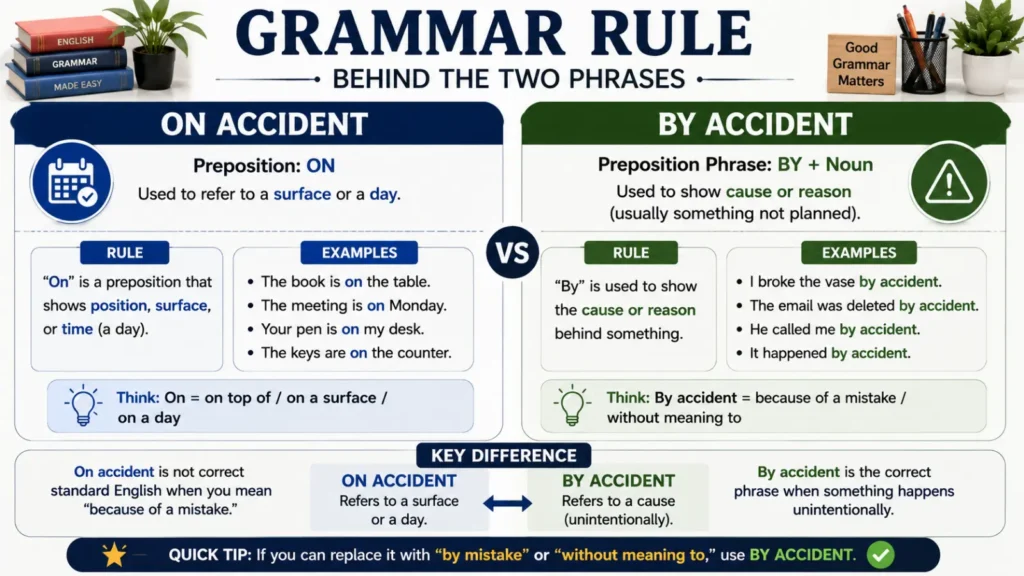
The difference comes from English prepositions.
The phrase by accident follows a long-established grammar pattern.
Examples include:
- By chance
- By mistake
- By coincidence
These expressions describe how something happened.
Meanwhile, on usually appears in phrases like:
- On time
- On purpose
- On schedule
Because of this, grammar books continue to recommend by accident instead of on accident.
Real-Life Examples
Example 1: At School
Emma submitted the wrong homework by accident.
This sentence sounds natural in both speech and writing.
Example 2: Text Message
“I called you on accident.”
Friends often use this version in casual conversation.
Example 3: At Work
The assistant deleted an important document by accident.
This is the preferred choice in professional settings.
Example 4: Cooking
Dad added too much salt by accident, so the soup tasted very salty.
Example 5: Shopping
I picked up the wrong bag by accident before leaving the store.
When Is “By Accident” the Better Choice?
Use by accident whenever clarity and correctness matter.
It is the better option for:
- School assignments
- College essays
- Business emails
- Job applications
- Professional reports
- Blog articles
- News writing
- Formal presentations
Choosing the standard phrase helps your writing sound polished and trustworthy.
Common Mistakes with Prepositions in Daily English
Even advanced English learners make mistakes with these phrases. Fortunately, you can avoid them by following a few simple rules.
Using “On Accident” in Formal Writing
❌ The manager sent the wrong report on accident.
✅ The manager sent the wrong report by accident.
Business documents and academic writing should use the standard expression.
Thinking “On Accident” Is Grammatically Wrong
Some people believe on accident is always incorrect.
That is not true.
Many native English speakers use it in casual conversations. However, it is still considered informal by most style guides.
Mixing Similar Expressions
Some learners replace by accident with by purpose.
That is incorrect.
The correct pair is:
- By accident
- On purpose
Remembering this pair makes the rule much easier.
Ignoring Your Audience
Language depends on context.
A phrase that sounds natural in a text message may not fit a school essay or a business email.
Always think about where your writing will appear.
Easy Tips to Remember the Difference
You do not need to memorize complex grammar rules.
Instead, try these simple tricks.
- Think of the common phrase by mistake. It follows the same pattern as by accident.
- If you are writing something important, always choose by accident.
- Use on accident only when speaking casually with people who commonly use it.
- If you are unsure, the safer option is always by accident.
These tips work well for exams, workplace writing, and everyday communication.
How These Phrases Appear in Daily Life
You will hear these expressions in many everyday situations.
At Home
“I spilled the juice by accident.”
At School
“The student answered the wrong question by accident.”
At Work
“I attached the wrong file by accident.”
With Friends
“I texted your brother on accident.”
Online
Social media users often write on accident, while news websites almost always use by accident.
This difference shows how the audience influences word choice.
Similar Expressions and Related Terms
If you want to expand your vocabulary, these words and phrases have similar meanings.
- By mistake
- Unintentionally
- Accidentally
- Without meaning to
- By chance
- Inadvertently
- Carelessly (depending on context)
- Unplanned
- Without intending
These alternatives help you avoid repeating the same phrase while keeping your writing natural.
Expert Insight
Language experts agree that by accident remains the standard expression in modern English. It appears in dictionaries, grammar books, newspapers, and professional writing. At the same time, linguists recognize that on accident has become common in spoken American English. This change reflects how languages naturally evolve. For the clearest communication, match your wording to your audience and purpose.
Frequently Asked Questions
Is it correct to say “on accident”?
Yes, many people say on accident in informal American English. However, it is not the preferred choice for formal writing.
Which is grammatically correct: on accident or by accident?
By accident is the standard and grammatically accepted expression in formal English.
Why do Americans say “on accident”?
Many linguists believe it became popular because people matched it with the phrase on purpose.
Can I use “on accident” in an essay?
No. Most teachers and editors recommend by accident in academic writing.
Is “by accident” old-fashioned?
No. It remains the standard expression in both British and American English.
What is another way to say “by accident”?
You can say accidentally, by mistake, unintentionally, or without meaning to, depending on the sentence.
Which phrase should English learners use?
English learners should use by accident because it is accepted almost everywhere.
Conclusion
The choice between these two phrases depends on the situation,but one option is clearly more reliable. By accident is the standard expression used in formal writing, education, business communication, and professional publishing. In contrast, using “on accident” appears mainly in informal American speech and casual conversations. While native speakers may use both forms, sticking with the standard phrase helps your writing sound more natural and widely accepted. Whenever you are unsure, follow the traditional rule—it will serve you well in exams, emails, articles, and everyday English. Once you understand this simple difference, you can communicate with greater confidence and accuracy.

Sophia Hayes is a language researcher and content writer at WordsCoppe.com, specializing in word comparisons, spelling differences, grammar explanations, and vocabulary insights. She is passionate about making English easier to understand through clear, accurate, and practical content. By breaking down complex language topics into simple explanations, Sophia helps readers improve their writing and communication skills. Her goal is to make learning English more accessible, engaging, and confidence-building for learners worldwide.