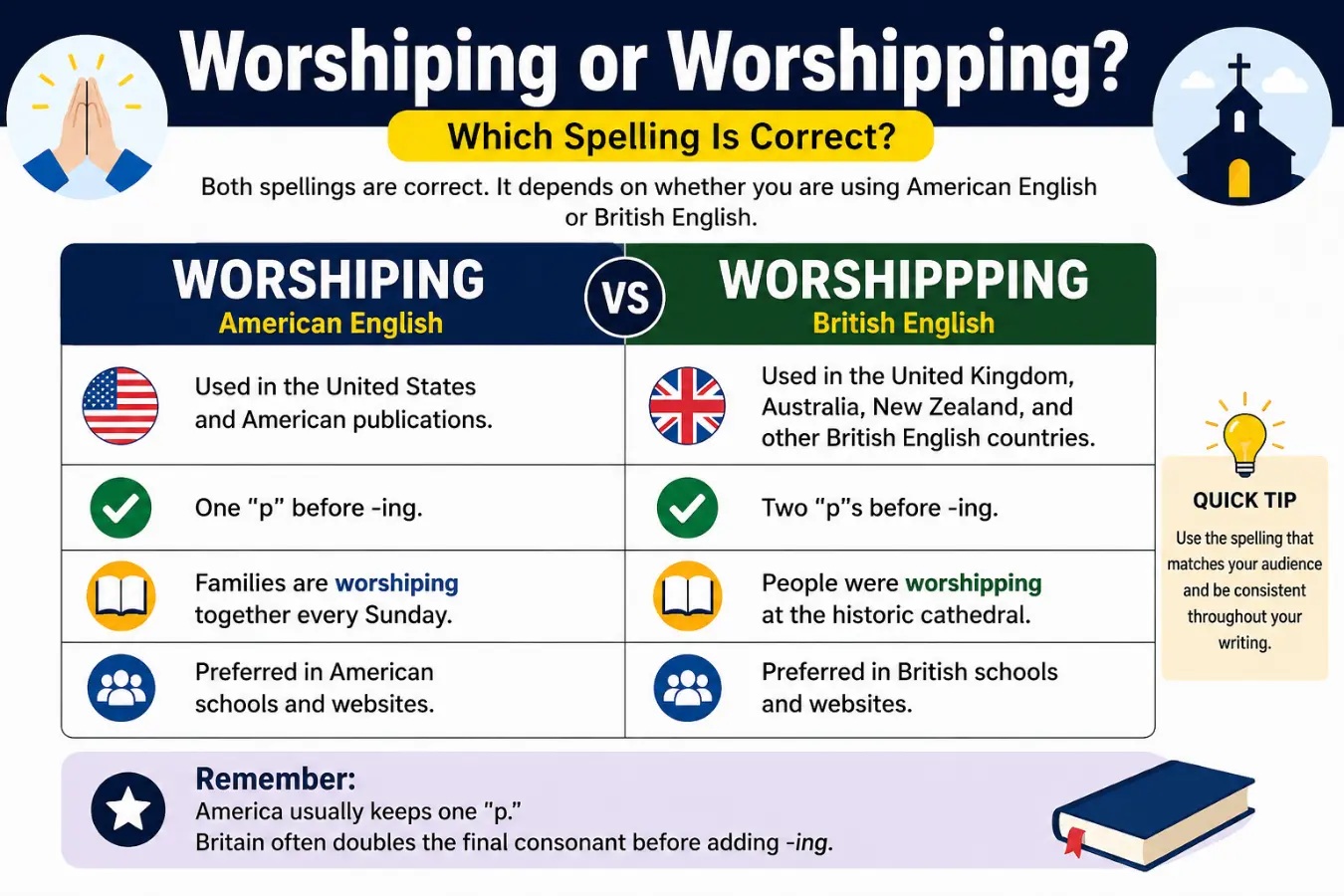
Worshiping or worshipping is a common spelling question for English learners and writers. Both words look similar, but many people wonder which one is correct. The answer depends on the type of English you use. American English and British English follow different spelling rules. Therefore, you may see both forms in books, websites, and newspapers.
Understanding the difference helps you write clearly and avoid spelling mistakes. It also makes your writing more professional and consistent. In this guide, you will learn the meaning of each spelling, the grammar rule behind them, real-life examples, and simple tips to remember the correct form. By the end, you will know exactly when to use worshiping and when to use worshipping.
Quick Summary
Featured Snippet Answer
- Both “worshiping” and “worshipping” are correct.
- Worshiping is the preferred spelling in American English.
- Worshipping is the preferred spelling in British English.
- Both words have the same meaning.
- Choose one spelling and stay consistent throughout your writing.
- Follow your audience’s English style.
Worshiping vs Worshipping: Comparison Table
| Feature | Worshiping | Worshipping |
| English Style | American English | British English |
| Correct Spelling | Yes | Yes |
| Meaning | Showing love, respect, or devotion | Showing love, respect, or devotion |
| Common Usage | United States | United Kingdom, Australia, New Zealand |
| Pronunciation | Same | Same |
| Grammar | Present participle of worship | Present participle of worship |
What Does “Worship” Mean?
The word worship means showing deep love, honor, respect, or devotion. People often use it in religious settings, but it can also describe strong admiration for someone or something.
For example:
- People worship God in many religions.
- They worship at the local church every Sunday.
- Some fans almost worship their favorite celebrities.
In grammar, worshiping and worshipping are both present participle forms of the verb worship.
Worshiping or Worshipping: Which Is Correct?
The simple answer is:
Both spellings are correct.
The difference is not the meaning. Instead, it depends on whether you are writing in American English or British English.
- Use worshiping if you follow American English.
- Use worshipping if you follow British English.
Neither spelling is more correct than the other. They simply follow different spelling conventions.
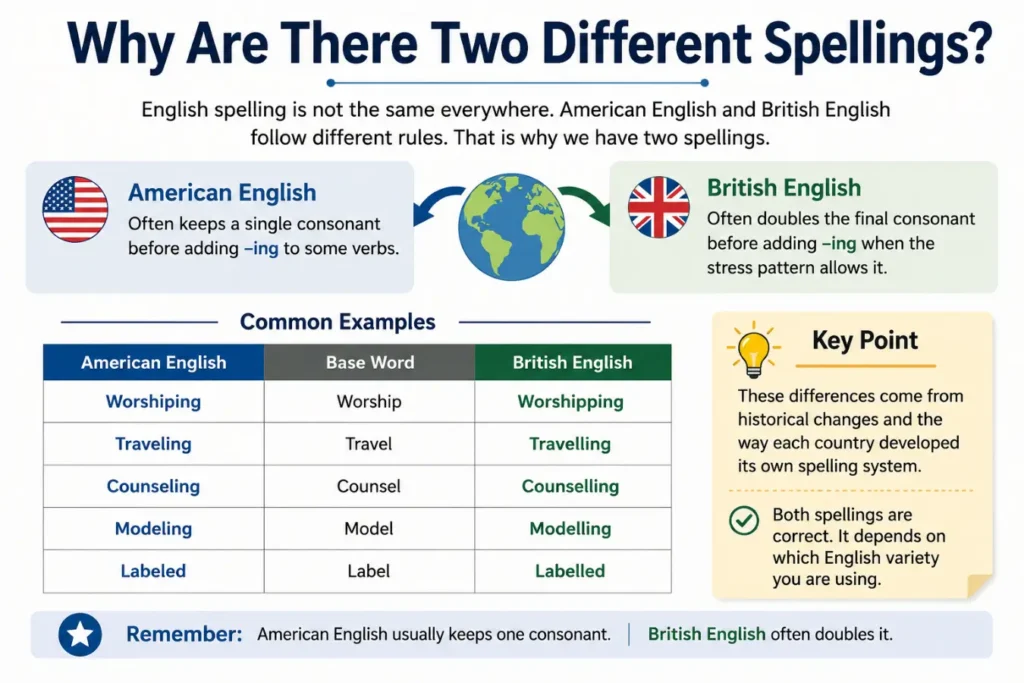
Why Are There Two Different Spellings?
English spelling rules are not always the same around the world.
American English often keeps a single consonant before adding -ing to some verbs.
British English often doubles the final consonant before adding -ing when the stress pattern allows it.
That is why these spelling differences exist:
| American English | British English |
| Worshiping | Worshipping |
| Traveling | Travelling |
| Counseling | Counselling |
| Modeling | Modelling |
| Labeled | Labelled |
This spelling pattern appears in many other English words.
When Should You Use “Worshiping”?
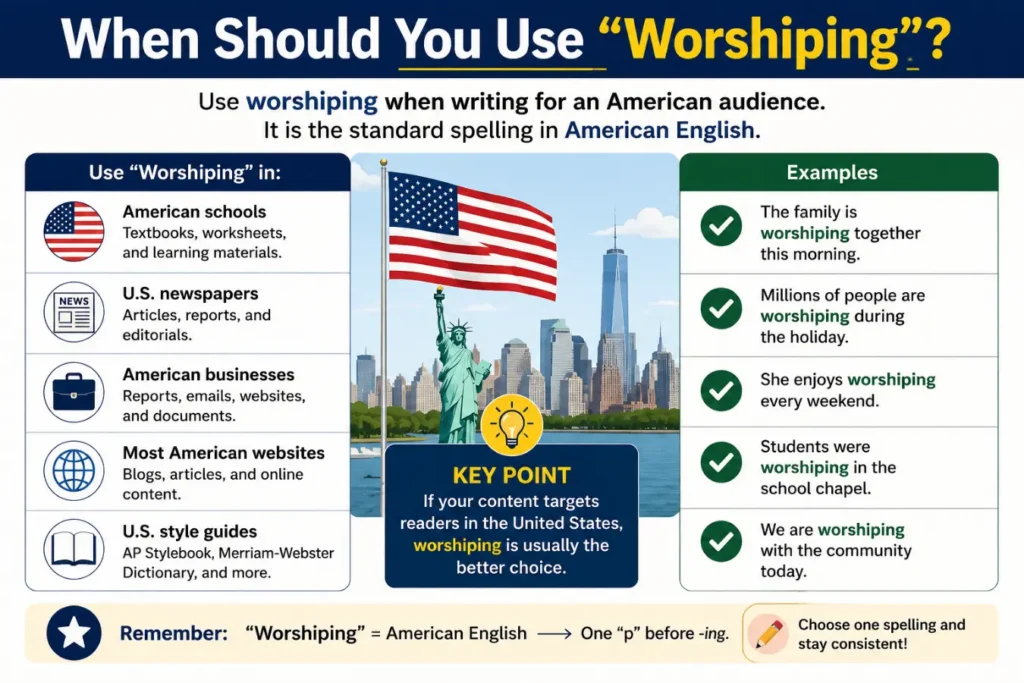
Use worshiping when writing for an American audience.
It is the standard spelling in:
- American schools
- U.S. newspapers
- American businesses
- Most American websites
- U.S. style guides
Examples
- The family is worshiping together this morning.
- Millions of people are worshiping during the holiday.
- She enjoys worshiping every weekend.
- Students were worshiping in the school chapel.
If your content targets readers in the United States, worshiping is usually the better choice.
When Should You Use “Worshipping”?
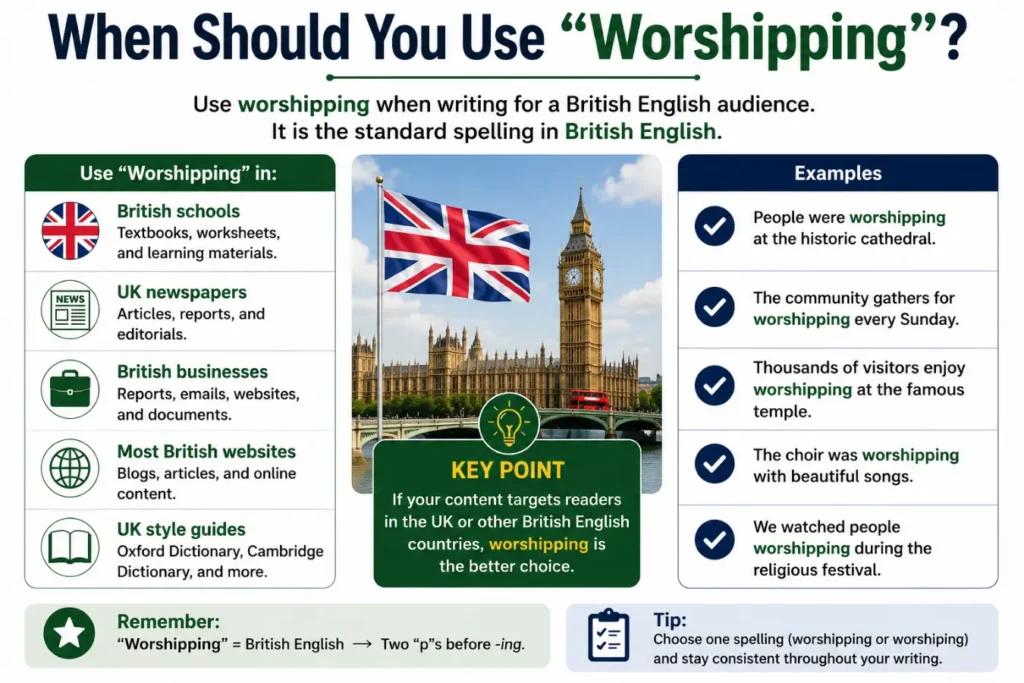
Use worshipping when writing for readers in countries that follow British English.
This spelling is common in:
- The United Kingdom
- Australia
- New Zealand
- South Africa
- Many Commonwealth countries
Examples
- People were worshipping at the historic cathedral.
- The community gathers for worshipping every Sunday.
- They spent the morning worshipping together.
- Many visitors enjoy worshipping at the famous temple.
If your audience uses British English, worshipping is the preferred spelling.
Does the Meaning Change?
No. The meaning stays exactly the same.
Both spellings describe the act of showing devotion, honor, praise, or deep respect.
Whether you write worshiping or worshipping, readers understand the same action.
The only difference is the spelling style based on the version of English you choose.
Why Consistency Matters
Choosing the correct regional spelling is important, but consistency is even more important.
For example, if you are writing an article for American readers, use worshiping throughout the entire article.
Likewise, if you are writing for British readers, use worshipping everywhere.
Mixing both spellings in the same document can confuse readers and make your writing look less professional.
Professional writers, editors, and publishers always follow one language style from beginning to end.
Real-Life Examples of Worshiping and Worshipping
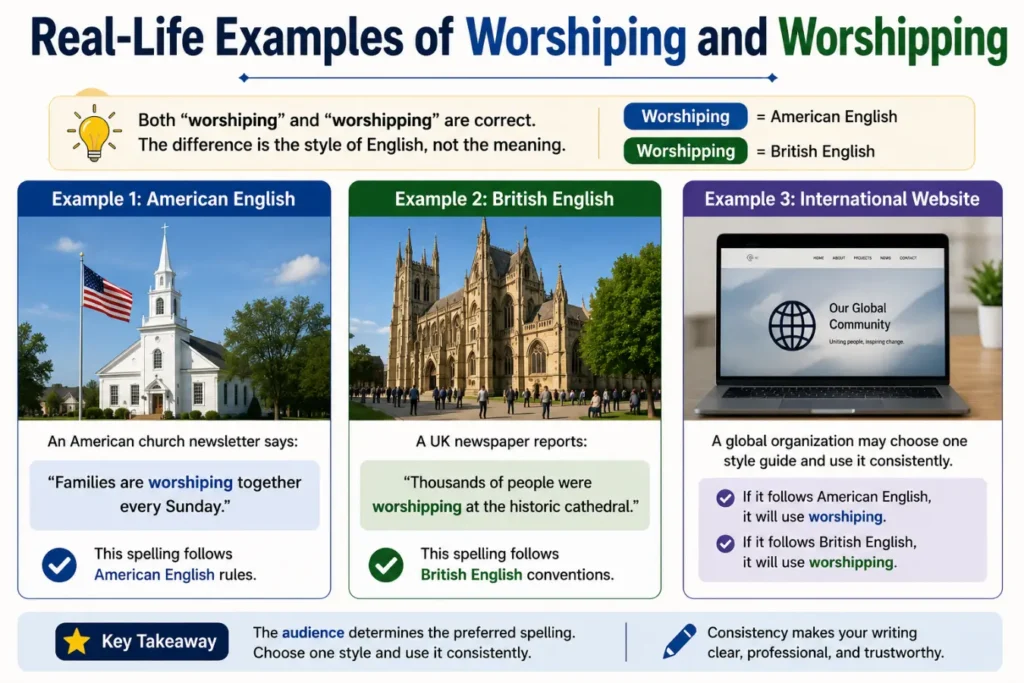
Understanding the difference becomes easier when you see both spellings in everyday writing.
Example 1: American English
An American church newsletter says:
“Families are worshiping together every Sunday.”
This spelling follows American English rules.
Example 2: British English
A UK newspaper reports:
“Thousands of people were worshipping at the historic cathedral.”
This spelling follows British English conventions.
Example 3: International Website
A global organization may choose one style guide and use it consistently.
If it follows American English, every page will use worshiping. If it follows British English, every page will use worshipping.
These examples show that the audience determines the preferred spelling.
Common Mistakes When Using Worshiping or Worshipping
Many writers make simple spelling mistakes. Avoid these common errors.
1. Mixing Both Spellings
Do not use worshiping in one paragraph and worshipping in the next.
Choose one style and keep it throughout your writing.
2. Thinking One Is Incorrect
Both spellings are correct.
The difference depends on the English variety.
3. Ignoring Your Audience
Always consider where your readers live.
American readers expect worshiping, while British readers usually expect worshipping.
4. Forgetting Other Regional Spellings
Many English words follow similar spelling patterns.
Learning these patterns helps improve your writing.
Tips to Remember the Difference
These simple tricks make the spelling easier to remember.
- American English = Worshiping (one “p”)
- British English = Worshipping (two “p”s)
- Follow the same style throughout your article.
- Check your website’s language settings before publishing.
- Use your spell checker with the correct English dictionary.
A simple memory tip is:
America usually keeps one “p.” Britain often doubles it.
How People Use These Words in Daily Life
The words worshiping and worshipping appear in many situations.
Religious Services
People worship in churches, mosques, temples, and synagogues.
Books and Articles
Authors use the spelling that matches their audience.
Schools
Students learn the correct regional spelling in English classes.
Online Content
Blogs, websites, and news articles follow either American or British English.
Social Media
Users often choose the spelling based on where they live.
Synonyms
Depending on the context, these words have similar meanings.
Synonyms
- Praising
- Honoring
- Adoring
- Revering
- Glorifying
- Exalting
- Devoting
- Respecting
Related Grammar Terms
- American English spelling
- British English spelling
- Present participle
- Spelling differences
- English grammar
- Regional spelling
- Double consonant rule
- Verb forms
These related terms help readers better understand English spelling patterns.
Expert Insights
Language experts agree that both spellings are correct.
The key is using the spelling that matches your audience.
Professional editors follow a style guide before publishing. For example, American publications use worshiping, while British publications prefer worshipping.
Consistency improves readability and makes your writing look more professional. It also helps maintain a clear writing style across articles, books, and websites.
When writing for an international audience, choose one English variety and use it consistently from beginning to end.
Frequently Asked Questions (FAQs)
Is worshiping or worshipping correct?
Both are correct. Worshiping is American English, while worshipping is British English.
Which spelling is used in the United States?
American English uses worshiping with one p.
Which spelling is common in the United Kingdom?
British English prefers worshipping with two ps.
Do both words have the same meaning?
Yes. They both mean showing devotion, praise, honor, or deep respect.
Why does British English use two “p”s?
British English often doubles the final consonant before adding -ing to certain words.
Can I use either spelling?
Yes. Use the version that matches your audience and stay consistent.
Is worshipping a spelling mistake?
No. It is the standard British English spelling.
Should I mix both spellings in one article?
No. Choose either American or British English and use it throughout the entire article.
Conclusion
Choosing between worshiping or worshipping is easier once you understand the difference between American and British English. Both spellings are correct, and both carry the same meaning. The only real difference is the regional spelling style.
If you write for readers in the United States, use worshiping. If your audience is in the United Kingdom or other countries that follow British English, use worshipping. Most importantly, remain consistent throughout your writing.
Understanding these spelling variations will improve your grammar, make your content more professional, and help you communicate clearly with readers around the world. By following the correct regional style, you can write with confidence and avoid common spelling mistakes.

Sophia Hayes is a language researcher and content writer at WordsCoppe.com, specializing in word comparisons, spelling differences, grammar explanations, and vocabulary insights. She is passionate about making English easier to understand through clear, accurate, and practical content. By breaking down complex language topics into simple explanations, Sophia helps readers improve their writing and communication skills. Her goal is to make learning English more accessible, engaging, and confidence-building for learners worldwide.