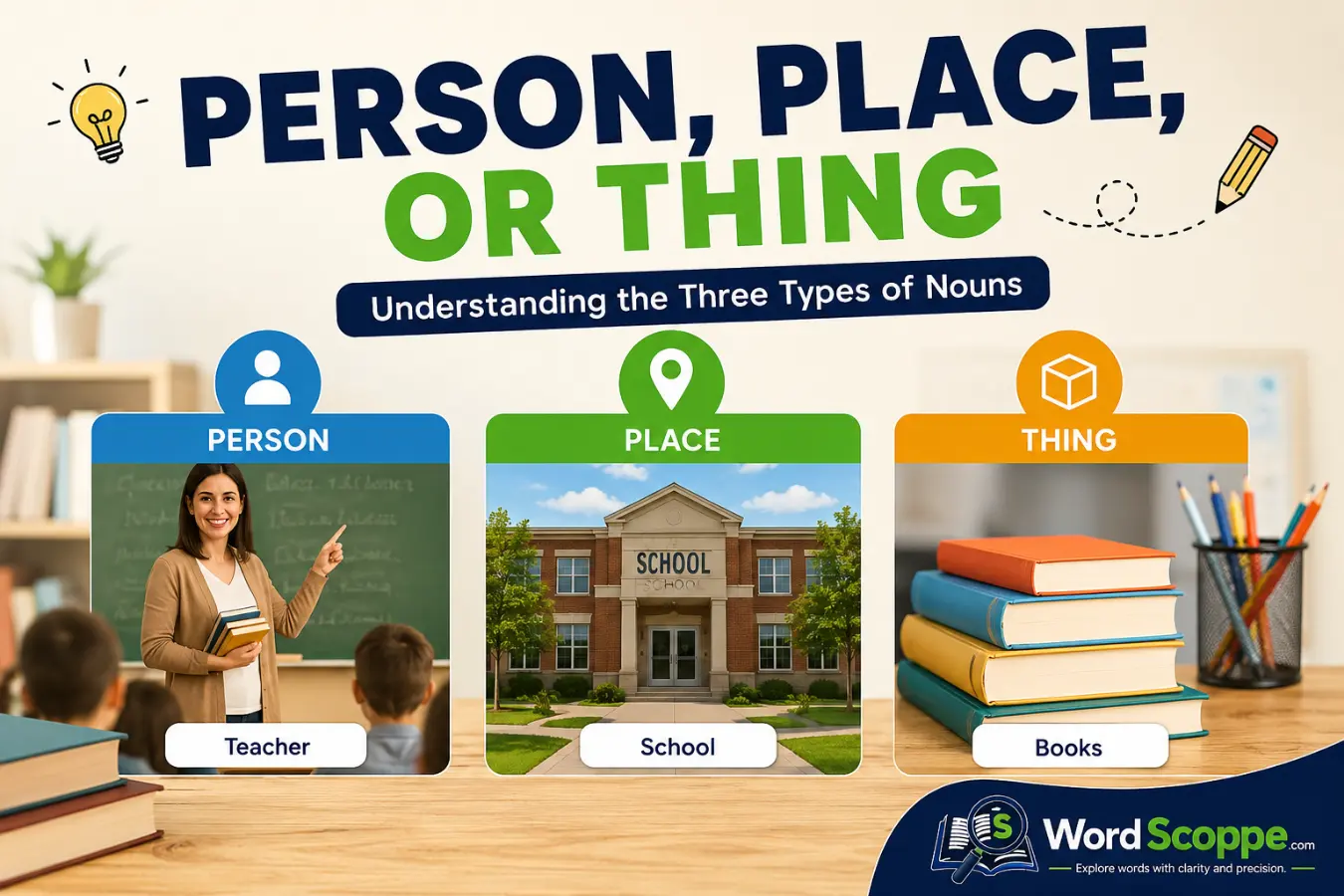
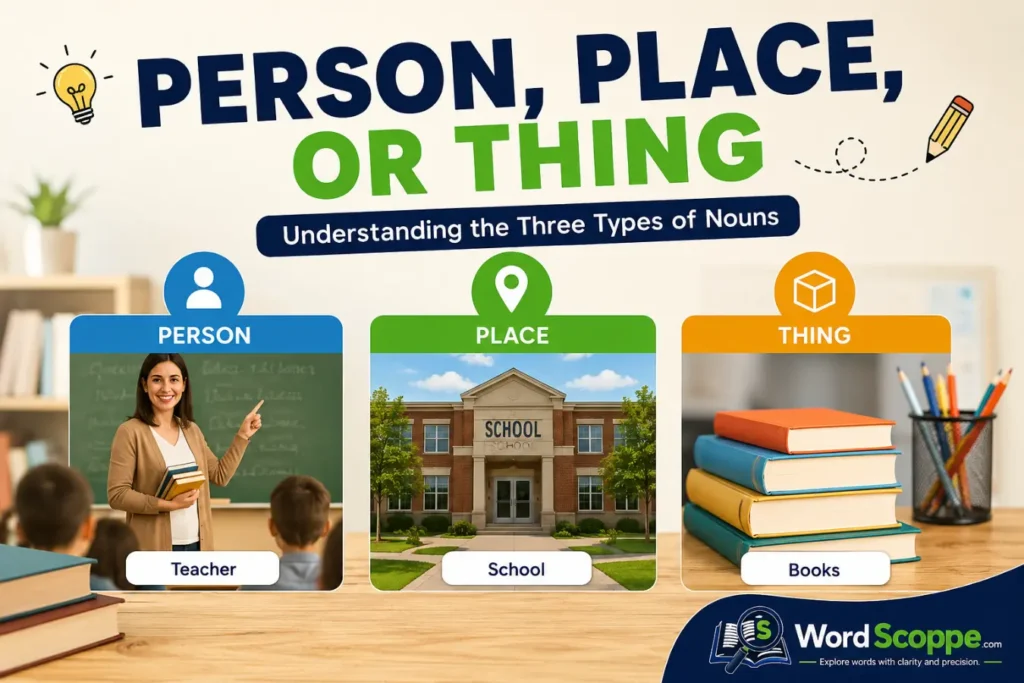
Person, place, or thing describes the three basic categories that nouns can name. These words appear in almost every sentence we read or write. A person can be a teacher, doctor, friend, or child. A place can be a school, park, city, or country. A thing can be a book, phone, table, or idea. Learning these categories makes grammar easier for students and English learners. It also helps you identify nouns when reading or writing sentences. Although the idea seems simple, some words can confuse learners. For example, words like “happiness” and “freedom” name things that we cannot touch. Still, they work as nouns. In this guide, you will learn how these categories work. You will also see clear examples, common mistakes, and simple grammar tips.
Quick Summary
- A noun names a person, place, thing, or idea.
- A person can be a student, mother, driver, or artist.
- A place can be a school, village, country, or beach.
- A thing can be a chair, computer, animal, or book.
- Some nouns name ideas, feelings, or qualities.
- Nouns can appear as subjects or objects in sentences.
- Identifying nouns can improve reading and writing skills.
What Is a Noun?
A noun is a word that names something. It can name a person, location, object, animal, or idea.
For example, consider this sentence:
Sarah opened the window.
“Sarah” names a person. “Window” names an object. Both words work as nouns.
Nouns help us talk about the world around us. They also let us discuss thoughts and feelings.
Consider another example:
Honesty builds trust.
“Honesty” does not describe a physical object. Instead, it names an idea or quality.
Therefore, nouns cover more than objects that we can see or touch.
What Does Person Mean in Grammar?
A person noun names a human being. It can describe one person or a group of people.

Here are some common examples:
- teacher
- doctor
- student
- mother
- brother
- driver
- farmer
- singer
- engineer
- friend
A person’s name also works as a noun.
For example:
David plays football.
“David” names a specific person.
Likewise, words such as “girl,” “man,” and “parent” identify people without using names.
Person nouns appear often in everyday conversations. They help us explain who performs an action.
What Does Place Mean in English?
A place noun identifies a location. It can describe a small area or a large region.
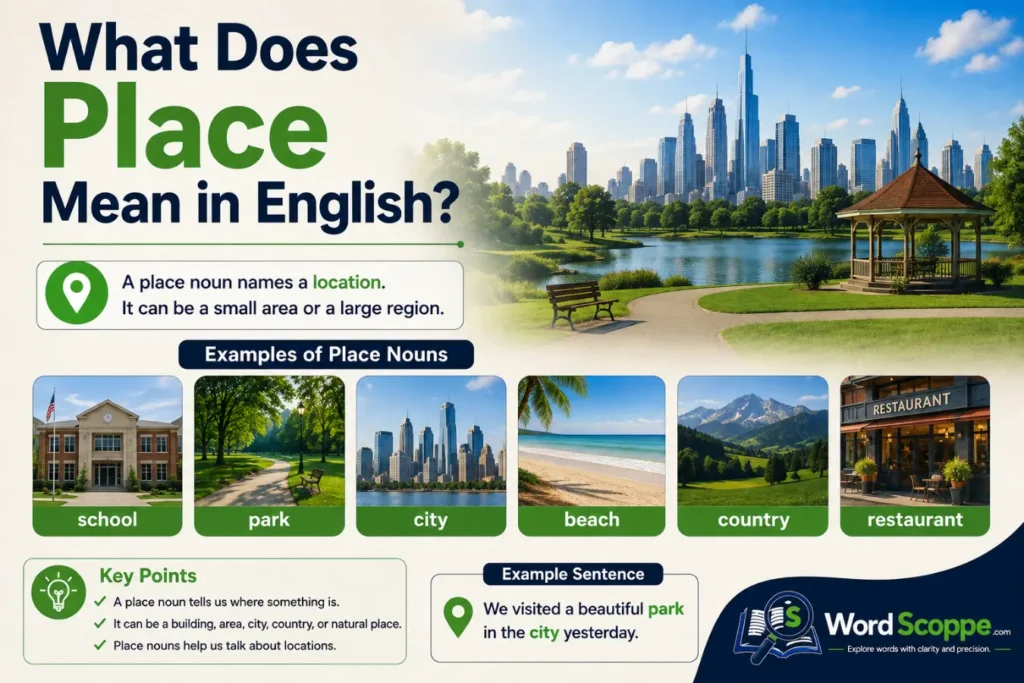
Common examples include:
- school
- hospital
- house
- park
- city
- village
- country
- beach
- office
- restaurant
Proper names can also identify places.
For instance:
London is a busy city.
“London” names a particular location.
However, “city” gives the general type of place.
This difference helps explain the idea of common and proper nouns.
What Does Thing Mean in Grammar?
A thing noun names an object, animal, substance, or other item. It does not need to be something humans can hold.
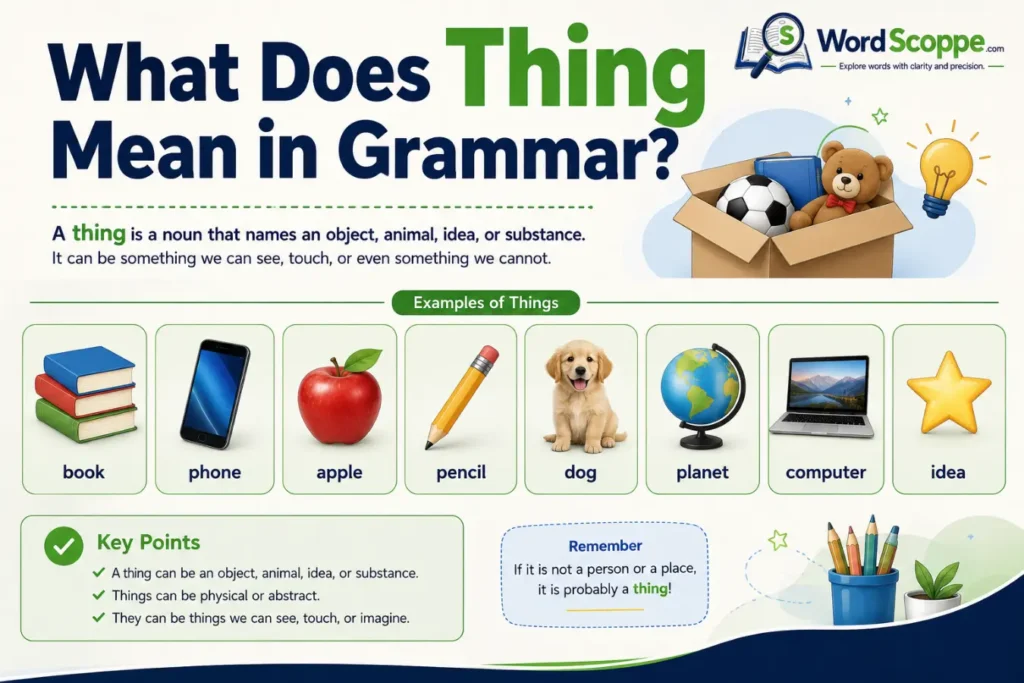
Examples include:
- phone
- chair
- pencil
- car
- computer
- dog
- apple
- water
- music
- idea
For example:
The dog chased the ball.
“Dog” and “ball” both work as nouns.
Some thing nouns can represent concepts instead of physical objects. Words such as “knowledge,” “love,” and “anger” fall into this group.
These words still act as nouns within sentences.
What Is the Difference Between a Person, Place, and Thing?
The main difference comes from what the noun identifies.
| Category | What It Names | Examples |
| Person | A human being | teacher, child, doctor |
| Place | A location | school, city, park |
| Thing | An object, animal, idea, or substance | book, cat, water |
This simple test can help:
Ask what the word names.
If it names someone, it belongs to the person category.
If it identifies a location, it belongs to the place category.
It names an object, animal, substance, or idea, it fits the thing category.
How Do You Identify a Noun?
Finding nouns becomes easier when you look at their role.
First, read the sentence carefully. Then ask what each important word names.
Consider:
The teacher entered the classroom.
“Teacher” names a person. “Classroom” names a place.
Now look at this sentence:
Emma bought a new notebook.
“Emma” names a person. “Notebook” names a thing.
You can also look for words that follow articles such as “a,” “an,” or “the.”
For example:
the house
a teacher
an apple
However, this trick does not work every time. So, focus on the meaning and function of the word.
Real-Life Examples of Nouns
Nouns surround us throughout the day.
When you wake up, you might look at your phone. You may then walk into the kitchen and speak with your brother.
Later, you could travel to school or work. During the day, you may use a computer and read a message.
Each sentence can contain several types of nouns.
For example:
The driver parked the car outside the hospital.
“Driver” names a person.
“Car” names a thing.
“Hospital” names a place.
This example shows how different noun categories can appear together.
Common Mistakes Students Make
Many English learners understand nouns but still make a few common mistakes.
Mistake 1: Thinking Every Thing Must Be Physical
Some learners believe nouns must describe objects they can touch.
That idea is incorrect.
Words such as “love,” “peace,” “fear,” and “success” can also function as nouns.
Mistake 2: Confusing Adjectives With Nouns
An adjective describes a noun.
For example:
The clever student answered quickly.
“Clever” describes the student. Therefore, “clever” works as an adjective.
“Student” names a person, so it works as a noun.
Mistake 3: Ignoring Proper Nouns
Names such as “Maria,” “Canada,” and “Monday” are also nouns.
They identify specific people, places, or things.
Proper nouns usually begin with capital letters.
Person, Place, or Thing in Daily English
Understanding nouns can make everyday English easier.
You use nouns when introducing people, describing locations, and discussing objects.
For example:
My sister works at a hospital.
The word “sister” identifies a person. “Hospital” identifies a place.
You can also use nouns to describe experiences:
The movie was exciting.
Here, “movie” names a thing.
As a result, noun recognition helps you understand sentences faster.
Synonyms and Related Grammar Terms
The word “noun” has several related grammar terms. These terms describe different noun types.
Common noun: A general name, such as “city” or “teacher.”
Proper noun: A specific name, such as “Paris” or “James.”
Concrete noun: Something you can experience through your senses, such as “table.”
Abstract noun: An idea, feeling, or quality, such as “kindness.”
Collective noun: A word that names a group, such as “team.”
These categories can overlap.
For example, “London” is both a proper noun and a place name.
Expert Tips for Learning Nouns
Start with simple sentences when learning noun categories. Then gradually study more complex examples.
One useful method involves asking three questions:
Who? Look for a person.
Where? Look for a place.
What? Look for a thing or idea.
You can also underline nouns while reading short texts. This practice builds recognition skills over time.
Another helpful strategy involves creating groups. Put words for people, locations, and objects into separate lists.
Finally, write your own sentences. Using new words helps you remember their meanings and grammar roles.
Frequently Asked Questions
Is a person a noun?
Yes. Words that name people can work as nouns. Examples include “teacher,” “mother,” and “John.”
Is a place a noun?
Yes. Location names and general location words can work as nouns. Examples include “school,” “city,” and “Pakistan.”
Is an animal a person or a thing?
In basic grammar lessons, animals usually fit under the “thing” category. Words such as “dog” and “horse” are nouns.
Can an idea be a noun?
Yes. Abstract ideas can work as nouns. Examples include “freedom,” “happiness,” and “knowledge.”
What is the easiest way to find a noun?
Ask what the word names. If it identifies someone, somewhere, or something, it may be a noun.
Can one sentence have several nouns?
Yes. A sentence can contain many nouns.
For example:
The teacher gave Ali a book.
“Teacher,” “Ali,” and “book” are all nouns.
Are names of countries nouns?
Yes. Country names are proper nouns. They identify specific places and usually begin with capital letters.
Conclusion
Learning the basic noun categories makes English grammar much easier. A noun can identify a person, location, object, animal, or idea. These words appear in simple conversations and advanced writing alike. You can often identify them by asking what a word names. However, remember that some nouns describe ideas rather than physical objects. Words such as “hope,” “love,” and “knowledge” still function as nouns. Practice with everyday sentences to build confidence. Also, learn common, proper, concrete, and abstract nouns as you progress. Once you understand these patterns, sentence structure becomes easier to recognize. The key is simple: look at what the word names and how it works within the sentence.

Sophia Hayes is a language researcher and content writer at WordsCoppe.com, specializing in word comparisons, spelling differences, grammar explanations, and vocabulary insights. She is passionate about making English easier to understand through clear, accurate, and practical content. By breaking down complex language topics into simple explanations, Sophia helps readers improve their writing and communication skills. Her goal is to make learning English more accessible, engaging, and confidence-building for learners worldwide.