
Accused guilty or innocent describes three ideas that often confuse people. An accused person faces an allegation of breaking the law. That allegation does not prove guilt. A court must examine the facts and apply the law. Until then, the accused remains legally presumed innocent in systems that follow this principle. If a court later finds enough proof, it may declare the person guilty. If the proof does not meet the required standard, the court may acquit the person. Therefore, being accused does not mean being guilty. This difference matters in court, news reports, everyday speech, and legal writing. In this guide, you will discover each term in simple English. You will also see examples, common mistakes, and useful ways to use these words correctly.
Quick Summary
- An accused person faces an allegation of wrongdoing.
- An accusation does not automatically prove guilt.
- Guilty means a court has found that a person committed the offense.
- Innocent can describe someone who did not commit the offense.
- The legal system generally starts with a presumption of innocence.
- Prosecutors usually need to prove guilt under the required legal standard.
- A person can face accusations without ever receiving a guilty verdict.
What Does “Accused” Mean?

The word accused refers to a person who someone claims committed an offense.
For example, police may accuse someone of stealing a phone. The person then becomes the subject of an allegation.
However, an accusation remains an allegation until the legal process establishes what happened.
The word can appear in different settings.
You may hear:
- The accused appeared in court.
- Police arrested the accused person.
- The accused denied the charge.
- The accused hired a lawyer.
The term does not tell you whether the person actually committed the offense.
What Does “Guilty” Mean?

Guilty means that a court has determined that a person committed the charged offense.
A guilty finding normally follows a legal process. That process may include evidence, witness testimony, arguments, and legal rules.
For example:
The court found the defendant guilty of theft.
Here, guilty describes the court’s decision.
The word therefore carries a much stronger meaning than accused.
An accused person may become guilty after a court reaches the required finding. However, an accusation alone cannot establish guilt.
What Does “Innocent” Mean?
In everyday language, innocent means someone did not commit the wrongdoing.
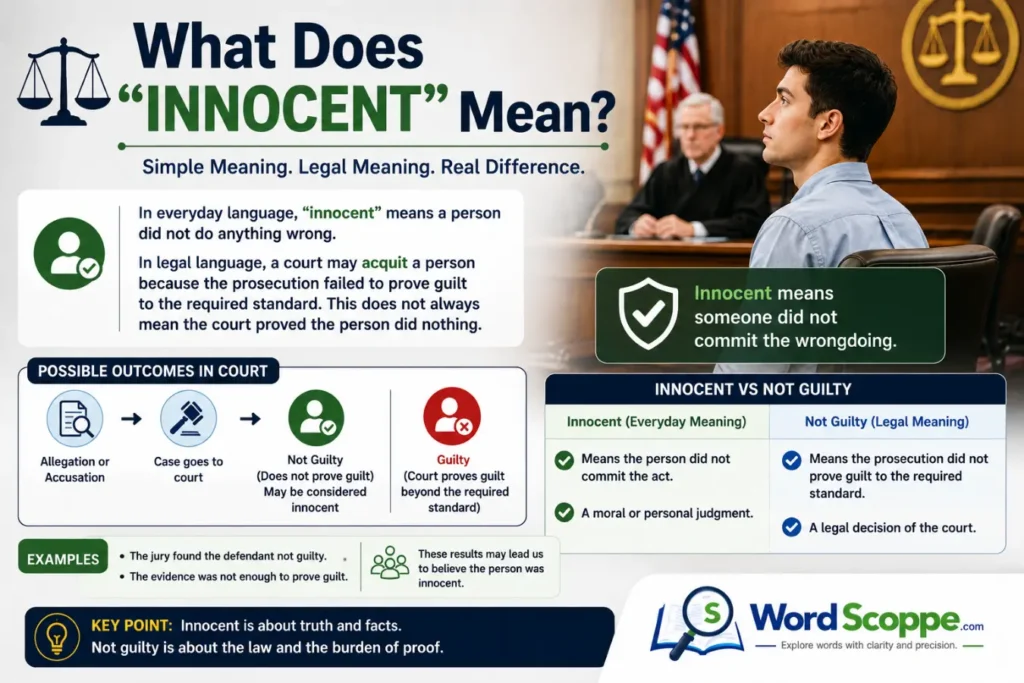
Legal language can require more care.
A court may acquit a defendant because the prosecution failed to prove guilt to the required standard. That outcome does not always mean the court proved that nothing happened.
For this reason, legal writers often use not guilty instead of simply saying innocent.
For example:
The jury found the defendant not guilty.
This statement accurately describes the legal result.
The exact effect of an acquittal can also depend on the country’s laws and legal system.
Accused, Guilty, and Innocent Compared
| Term | Simple meaning | Does it prove wrongdoing? | Typical legal context |
| Accused | A person faces an allegation | No | Investigation or court case |
| Guilty | A court finds the person committed the offense | Yes, after the required legal finding | Verdict or judgment |
| Innocent | A person did not commit the wrongdoing | Not necessarily a formal court finding | Everyday language |
| Not guilty | The prosecution did not establish guilt under the required standard | No | Court verdict |
This table shows why these terms should not be treated as interchangeable.
What Happens After Someone Gets Accused?
The process differs across countries and legal systems.
Usually, an allegation leads to some form of investigation or legal action. Authorities may collect evidence and question witnesses.
If prosecutors bring charges, the accused may appear before a court.
The court then considers the case under applicable rules.
Several outcomes may follow. The case could end before trial. Charges could be withdrawn or dismissed. A trial could result in a guilty or not-guilty verdict.
Therefore, an accusation represents a stage in the process. It does not represent the final result.
Real-Life Examples of These Terms
Imagine a person called Alex.
A store owner reports that Alex stole a laptop. Police investigate the claim. At this stage, Alex is accused of theft.
Later, prosecutors bring the case to court.
If the court finds that the evidence meets the required legal standard, Alex may be found guilty.
If the prosecution does not establish guilt to the required standard, the court may find Alex not guilty.
These three stages show why careful wording matters.
Example 1: News Report
Poor wording:
Alex is a thief who stole the laptop.
Better wording:
Alex was accused of stealing the laptop.
The second sentence avoids treating an allegation as an established fact.
Example 2: Court Result
After a guilty verdict, a report may say:
The court found Alex guilty of theft.
After an acquittal, it may say:
The court found Alex not guilty.
These statements clearly separate allegations from court outcomes.
Why Presumption of Innocence Matters
The presumption of innocence protects a person’s legal position during a criminal case.
In systems that follow this principle, the accused does not need to prove innocence simply because someone made an allegation.
Instead, the prosecution generally carries the burden of proving the case.
The exact burden and standard can vary by jurisdiction. Criminal cases often require proof beyond a particular high standard.
This principle also affects responsible reporting.
Writers should avoid presenting an unproven allegation as a fact. Careful language protects accuracy and helps readers understand the legal status of a case.
Common Mistakes to Avoid
Calling an Accused Person Guilty
An accusation does not equal a conviction.
Use accused when the person faces an allegation. Use guilty after an appropriate legal finding.
Treating “Not Guilty” as Exactly the Same as “Innocent”
These phrases can differ in legal meaning.
A not-guilty verdict generally means the prosecution did not prove the charge to the required standard.
Using Emotional Labels
Words such as “criminal” or “thief” can imply guilt before a court decides the case.
Use neutral language during an ongoing case.
Ignoring the Legal System
Legal terms do not work identically everywhere.
Always consider the country and legal system involved.
How to Use These Words Correctly
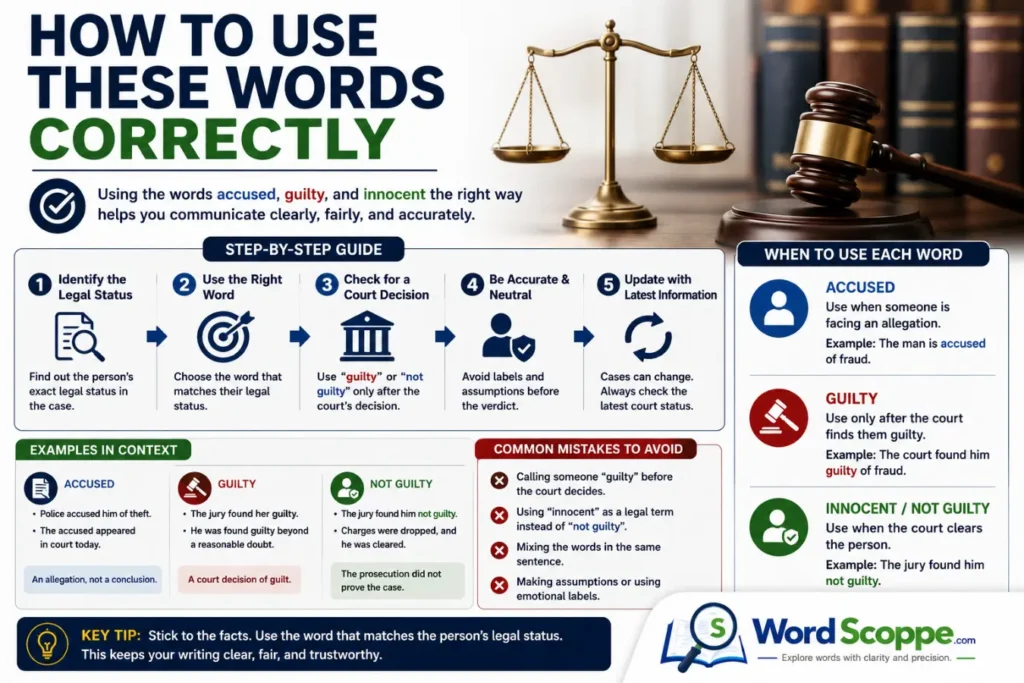
First, identify the person’s legal status.
If someone faces an allegation, use accused or another accurate neutral term.
Next, check whether a court has reached a decision.
If the court has found the person guilty, guilty may be appropriate.
If the court has returned a not-guilty verdict, say not guilty when discussing the legal result.
Also, avoid adding facts that the evidence does not establish.
For journalists, bloggers, students, and content writers, this habit improves both accuracy and credibility.
Synonyms and Related Legal Terms
Several related words appear in legal writing.
Accused: alleged offender, suspect, person charged, defendant.
Guilty: convicted, found guilty, responsible for the offense.
Not guilty: acquitted, cleared of the charge, found not guilty.
However, these terms are not always perfect substitutes.
For example, suspect and defendant can describe different stages of a legal case. A suspect may face investigation without formal charges. A defendant usually refers to someone involved in a formal court case.
Therefore, choose the term that matches the person’s exact legal status.
Expert Insights for Clear Legal Writing
Legal writing should separate claims, evidence, and decisions.
A useful rule is simple: describe what is known, then identify what remains alleged.
For example, instead of writing:
The accused committed fraud.
Write:
Prosecutors accused the person of fraud.
That wording clearly identifies the source of the claim.
Also, check the latest court status before publishing legal content. Cases can change quickly through hearings, appeals, dismissals, or new decisions.
Finally, remember that laws differ between countries. When legal accuracy matters, consult an appropriate legal source or qualified professional.
Frequently Asked Questions
Does being accused mean you are guilty?
No. An accusation does not automatically establish guilt. A court must decide the case under applicable law.
What is the difference between accused and guilty?
An accused person faces an allegation. A guilty person has received a guilty finding through the relevant legal process.
Is accused the same as suspect?
Not always. Legal systems may use these terms differently. A suspect may be under investigation, while an accused person may face a formal allegation or charge.
Does not guilty mean innocent?
Not necessarily in a strict legal sense. A not-guilty verdict generally means the prosecution failed to prove guilt under the required standard.
Who has to prove guilt?
In many criminal justice systems, the prosecution carries the burden of proving the charge. The exact rules depend on the jurisdiction.
Can an accused person be found not guilty?
Yes. A court may find the person not guilty when the prosecution does not meet the required standard.
What word should journalists use before a verdict?
Journalists should normally use neutral terms such as accused, suspect, or defendant, depending on the person’s legal status.
Why should writers avoid calling someone guilty too early?
Early claims may remain unproven. Neutral wording helps prevent readers from confusing an allegation with an established legal finding.
Conclusion
The difference between accused guilty or innocent becomes clear when you separate allegations from legal decisions. An accused person faces a claim of wrongdoing, but that claim does not automatically prove guilt. A guilty finding comes after the legal process reaches the required conclusion. A not-guilty verdict means the prosecution did not establish guilt under the applicable standard. The word innocent can have a broader everyday meaning, so legal writers often prefer not guilty when describing a court result. Therefore, choose your words carefully. This approach keeps articles, reports, and conversations accurate. Most importantly, never treat an accusation as proof. When discussing legal cases, always focus on the person’s actual legal status and the latest court decision.
Discover More Posts:
Traveled or Travelled: Which Spelling Is Correct?
Is Hinduism Monotheistic or Polytheistic? Explained
Eggs Float or Sink? Powerful Freshness Test Explained Simply

Sophia Hayes is a language researcher and content writer at WordsCoppe.com, specializing in word comparisons, spelling differences, grammar explanations, and vocabulary insights. She is passionate about making English easier to understand through clear, accurate, and practical content. By breaking down complex language topics into simple explanations, Sophia helps readers improve their writing and communication skills. Her goal is to make learning English more accessible, engaging, and confidence-building for learners worldwide.