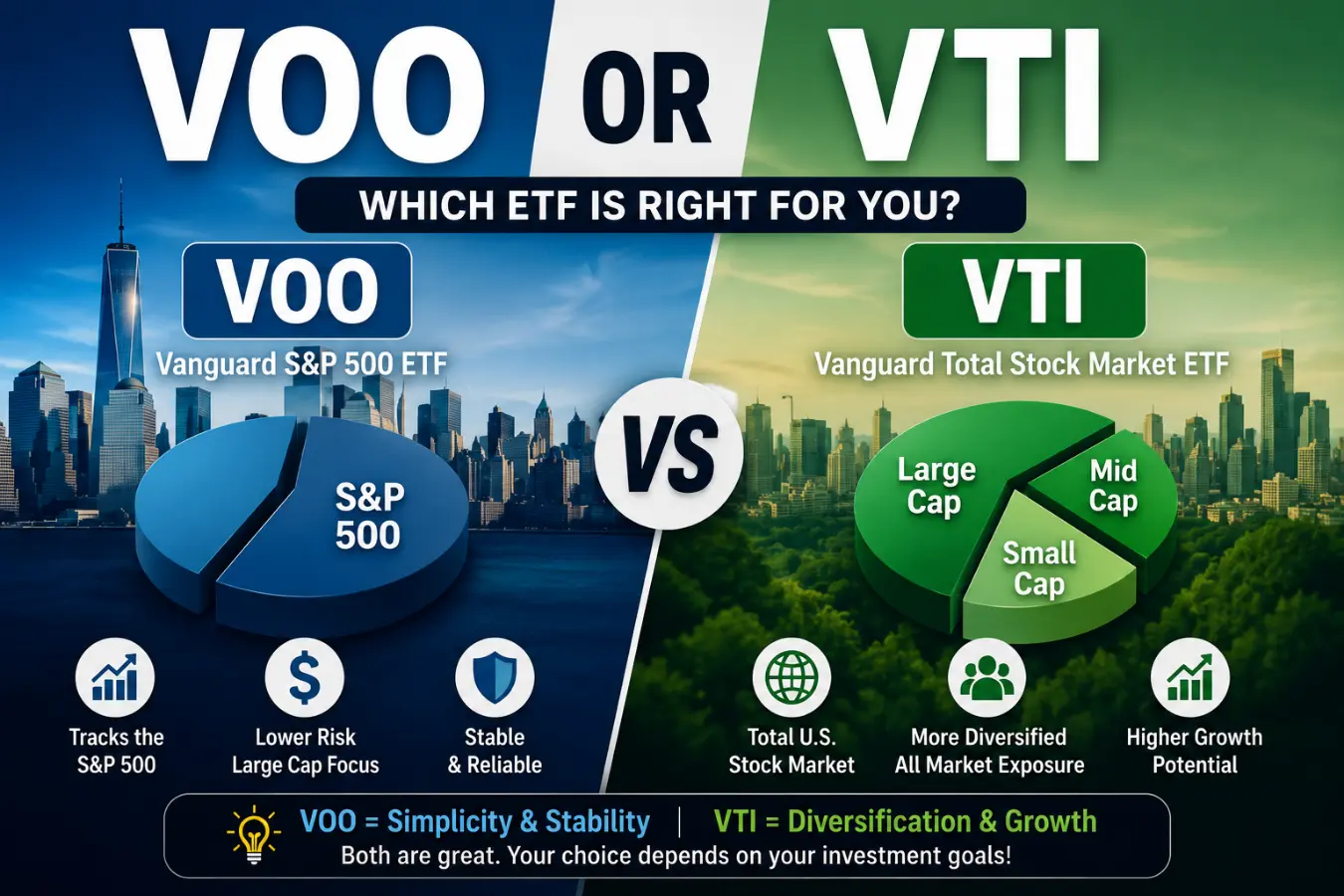
VOO or VTI is one of the most common questions new investors ask. Both exchange-traded funds (ETFs) come from Vanguard and offer low-cost investing. At first glance, they look very similar. However, they track different stock indexes and provide different levels of market exposure. Choosing the right ETF depends on your investment goals, risk tolerance, and long-term strategy. The good news is that both funds have strong performance records and are popular among experienced investors. In this guide, you will learn the key differences between VOO or VTI, how each ETF works, their advantages and disadvantages, real-life examples, and which option may fit your investment plan.
Quick Summary Box
- VOO tracks the S&P 500 Index.
- VTI tracks the entire U.S. stock market.
- Both are low-cost Vanguard ETFs.
- VTI includes large-, mid-, small-, and micro-cap stocks.
- VOO invests only in about 500 large U.S. companies.
- Both are suitable for long-term investing.
- Your choice depends on your diversification goals.
Featured Snippet: VOO or VTI
VOO and VTI are both excellent Vanguard ETFs. VOO tracks the S&P 500 and focuses on large U.S. companies. VTI tracks the entire U.S. stock market, including large-, mid-, small-, and micro-cap stocks. Investors seeking broader diversification often choose VTI, while those who prefer leading blue-chip companies may prefer VOO.
What Are VOO and VTI?
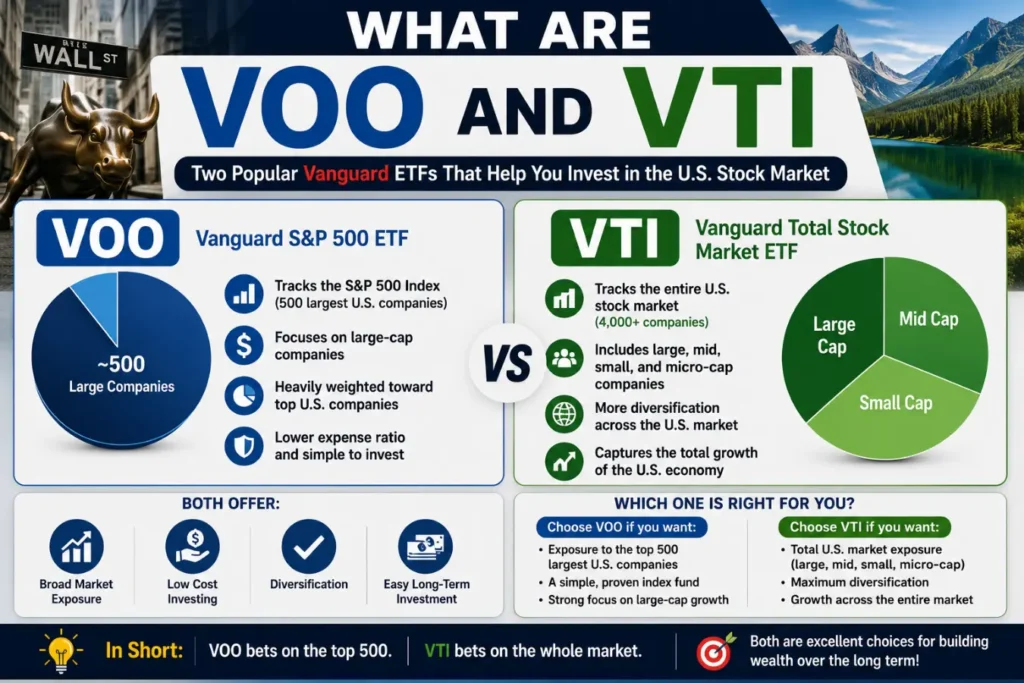
VOO and VTI are exchange-traded funds (ETFs) offered by Vanguard.
An ETF is a basket of investments that trades like a stock.
Instead of buying individual companies, you buy one fund that holds many stocks.
This approach reduces risk through diversification.
Both ETFs are designed for long-term investors.
However, they follow different market indexes.
What Does VOO Invest In?
VOO tracks the S&P 500 Index.
It owns shares in approximately 500 of the largest publicly traded U.S. companies.
These companies include well-known businesses from many industries.
Examples include:
- Apple
- Microsoft
- NVIDIA
- Amazon
- Alphabet
Since these companies represent a large part of the U.S. market, VOO offers broad exposure to large-cap stocks.
What Does VTI Invest In?
VTI tracks the CRSP US Total Market Index.
It owns thousands of U.S. companies.
The fund includes:
- Large-cap stocks
- Mid-cap stocks
- Small-cap stocks
- Micro-cap stocks
Because of this wider coverage, VTI represents nearly the entire U.S. stock market.
VOO vs VTI Comparison Table
| Feature | VOO | VTI |
| Tracks | S&P 500 Index | Total U.S. Stock Market |
| Number of holdings | About 500 | More than 3,000 |
| Large-cap exposure | High | High |
| Mid-cap exposure | No | Yes |
| Small-cap exposure | No | Yes |
| Diversification | Excellent | Even broader |
| Expense ratio | Very low | Very low |
| Best for | Large-company investors | Total market investors |
Key Differences Between VOO and VTI
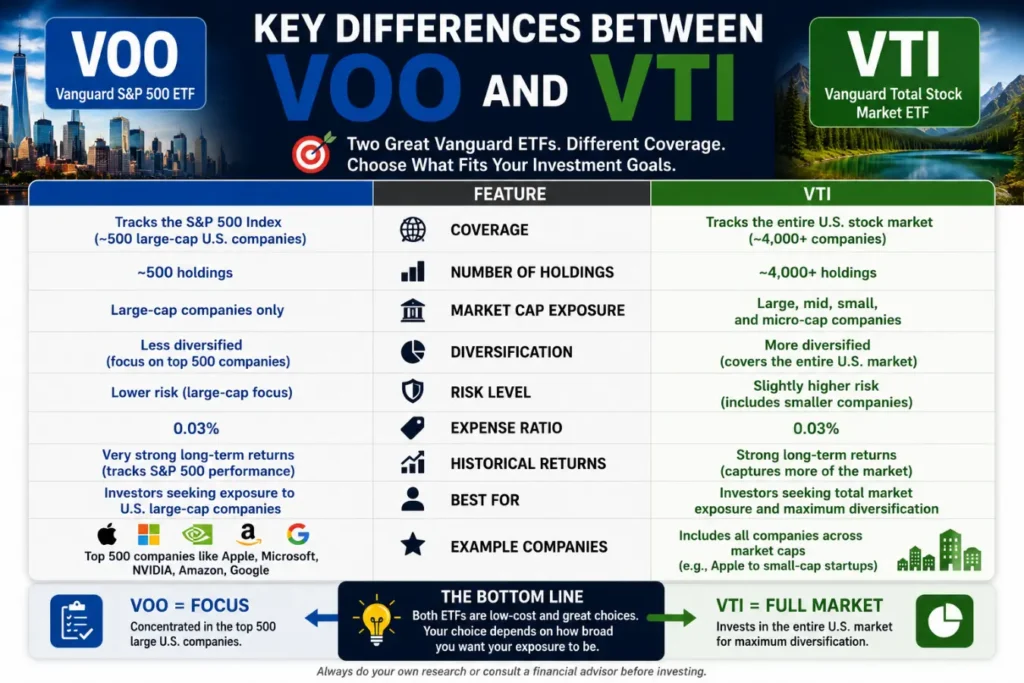
Although both ETFs share many of the same largest companies, they differ in market coverage.
VOO Focuses on Large Companies
VOO invests only in major U.S. corporations.
These companies often have long histories and stable earnings.
VTI Covers the Entire Market
VTI includes both large businesses and smaller growing companies.
This wider exposure increases diversification.
Performance Is Often Similar
Because large companies make up most of the U.S. market, both ETFs usually deliver similar long-term returns.
However, VTI may benefit more when smaller companies outperform.
Real-Life Examples
Here are simple examples.
Example 1
Emma wants to invest in America’s biggest companies.
She chooses VOO.
Example 2
David wants exposure to nearly every U.S. public company.
He buys VTI.
Example 3
Sarah plans to invest for retirement over 30 years.
She chooses VTI because she prefers broader diversification.
Which ETF Is Better for Beginners?
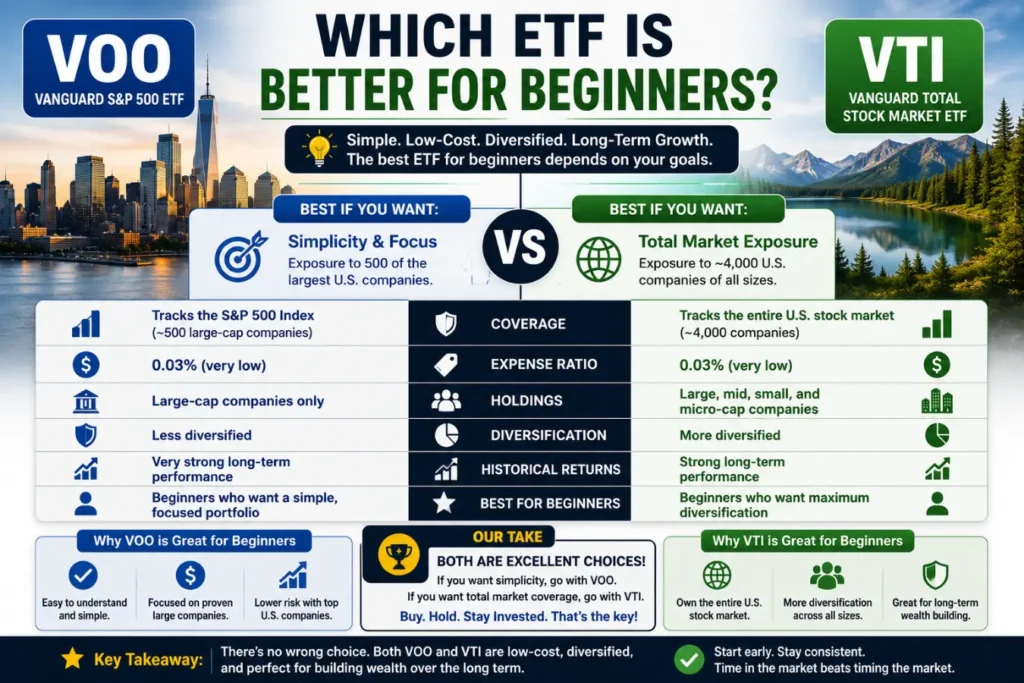
Both funds work well for beginners.
Choose VOO if you:
- Prefer large, established companies.
- Like following the S&P 500.
- Want a simple investment strategy.
Choose VTI if you:
- Want maximum diversification.
- Prefer exposure to the whole U.S. market.
- Plan to invest for many years.
Neither choice is wrong.
Both ETFs have helped many investors build wealth over time.
Common Mistakes When Choosing VOO or VTI
Avoid these common errors.
Thinking One Is Always Better
Both funds have strengths.
Your goals matter more.
Ignoring Diversification
Some investors forget that VTI includes thousands more companies.
Chasing Short-Term Performance
Long-term investing usually matters more than recent returns.
Buying Without a Plan
Always understand your investment strategy before purchasing any ETF.
Tips for Choosing Between VOO and VTI
Use these simple tips.
- Define your investment goals first.
- Invest consistently over time.
- Focus on long-term growth.
- Avoid emotional decisions.
- Review your portfolio regularly.
- Understand the index each ETF tracks.
These habits help investors stay disciplined.
Synonyms
Learning these terms makes ETF investing easier.
- Exchange-Traded Fund (ETF)
- Index fund
- Diversification
- S&P 500
- Total stock market
- Large-cap stocks
- Small-cap stocks
- Passive investing
- Portfolio allocation
- Long-term investing
These concepts often appear alongside VOO and VTI.
Why Investors Compare VOO and VTI
Many investors compare these ETFs because both offer low fees, strong diversification, and simple investing.
Each fund follows a passive investment strategy.
They also hold many of the same largest companies.
The main difference is that VTI adds thousands of smaller businesses.
For many investors, the decision comes down to whether they want large-cap exposure or total market exposure.
Expert Insights
Financial professionals often recommend broad, low-cost index ETFs for long-term investing. Both VOO and VTI fit that approach. VOO provides concentrated exposure to America’s largest companies, while VTI offers nearly complete U.S. stock market coverage. Historically, their long-term performance has been very similar because large-cap companies represent most of the market’s value. Investors should choose the ETF that best matches their diversification preferences and financial goals rather than trying to predict short-term market movements.
Frequently Asked Questions
Is VOO better than VTI?
Neither is universally better. VOO focuses on large companies, while VTI covers the entire U.S. stock market.
What is the biggest difference between VOO and VTI?
VOO tracks the S&P 500, while VTI tracks nearly the entire U.S. stock market.
Which ETF has more diversification?
VTI offers broader diversification because it holds thousands more companies.
Do VOO and VTI have similar returns?
Yes. Their long-term performance has often been very close.
Is VTI good for retirement investing?
Many long-term investors use VTI because of its broad market exposure.
Can I own both VOO and VTI?
Yes. However, they overlap significantly because many of VOO’s companies are also included in VTI.
Which ETF is better for beginners?
Both are beginner-friendly. The best choice depends on your investment objectives.
Conclusion
Choosing between VOO or VTI depends on your investing style rather than finding a single “best” ETF. VOO gives you exposure to the largest and most established U.S. companies through the S&P 500. VTI expands that coverage by including thousands of additional small- and mid-sized companies. Both funds offer low costs, broad diversification, and strong long-term investing potential. For many investors, either ETF can serve as a solid foundation for a portfolio. Before investing, consider your financial goals, risk tolerance, and desired level of diversification. A consistent, long-term strategy often matters more than choosing between these two outstanding Vanguard ETFs.

Sophia Hayes is a language researcher and content writer at WordsCoppe.com, specializing in word comparisons, spelling differences, grammar explanations, and vocabulary insights. She is passionate about making English easier to understand through clear, accurate, and practical content. By breaking down complex language topics into simple explanations, Sophia helps readers improve their writing and communication skills. Her goal is to make learning English more accessible, engaging, and confidence-building for learners worldwide.